Turkey Is Rewriting History. The Students Are Paying for It.
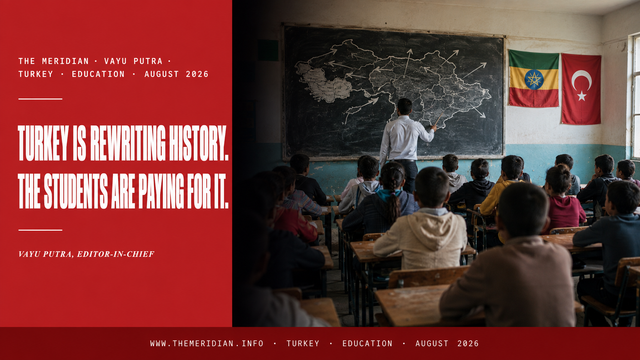
Turkey operates the world's most ambitious state-funded educational soft power architecture: 53,000 students across 53 countries, a Common Turkic History textbook incorporated into four Central Asian national curricula, Central Asia renamed "Turkestan" in Turkey's own school syllabus, and Maarif Foundation schools in Senegal, Mali, Niger, and across the ECOWAS region. At the 9th Meeting of OTS Education Ministers held in Turkistan, Kazakhstan, on 7-8 June 2026, the financial architecture sustaining this project produced significant internal disagreement. Turkey pressed its partners to share costs more equitably. Those governments lacked the fiscal capacity to commit. The burden fell on students' parents. The minister executing the model domestically has sued 168 intellectuals for defending secularism, called a teacher candidate a terrorist at a public event, and stated that the Universal Declaration of Human Rights should be revised. This analysis examines what Turkey is building, who is paying for it, and what it costs the countries on the receiving end.
In November 2025, Turkey's Education Minister Yusuf Tekin announced that the term "Central Asia" would be replaced with "Turkistan" across Turkey's national geography and history curricula. The change, embedded in the Türkiye Yüzyılı Maarif Modeli, Turkey's Century Education Model, launched in the 2024-2025 academic year, was presented as a correction of historical injustice. The term "Central Asia," Tekin argued, had been deliberately introduced into academic literature to divide the Turkic world. The curriculum was restoring what colonialism had obscured. By June 2026, Tekin repeated the same formulation at the OTS Education Ministers meeting in Turkistan, Kazakhstan, a city whose own recent renaming provides the clearest available symbol of the broader linguistic politics underway. The classroom, in Ankara's strategic framework, is not an educational instrument alone. It is a geopolitical one. And Turkey is deploying it on two simultaneous tracks: in Central Asia, through a shared civilisational narrative built on ethnic and linguistic Turkic identity; and in West Africa, through quality schools, Turkish language instruction, Diyanet mosques, and Ottoman television drama, filling the vacuums left by departing Western institutions. Both tracks are documented, deliberate, and consequential. Both are running into structural limits that the June 2026 ministerial meeting made visible in a way the official communiqué chose not to report.
The Türkiye Yüzyılı Maarif Modeli introduced the most extensive curriculum revision in Turkey's recent history. The renaming of Central Asia as Turkistan is the most discussed change, but the revision extends across multiple subjects. The Age of Discovery is now labelled "colonialism policies." The Crusades are renamed "Crusader attacks." The maritime doctrine of Mavi Vatan (Blue Homeland), asserting Turkish sovereignty claims across the Aegean and Eastern Mediterranean, replaces the technical phrase "our water resources" in the geography syllabus. Byzantium becomes "the Eastern Roman Empire." These revisions constitute a coherent geopolitical reading of history embedded in compulsory school instruction for every Turkish student: the Turkic world is a civilisational unity, its fragmentation was externally imposed, and its reconstitution under Ankara's intellectual leadership is a historical necessity.
The business association TÜSIAD publicly criticised the new curriculum as failing to prepare Turkey for the future. The criticism is significant: TÜSIAD represents Turkey's internationally oriented private sector, whose interest in technically educated graduates diverges sharply from a curriculum increasingly organised around religious instruction, Ottoman historical narrative, and pan-Turkic civilisational identity. Tekin also expanded religion courses and protocols with the Religious Affairs Directorate, assigning imams and preachers to schools from preschool to high school level.
Within the Organisation of Turkic States framework, Turkey's educational ambitions take their most institutionally concrete form in two flagship projects: the Common Turkic Alphabet and the Common Turkic History textbook.
The Common Turkic Alphabet, a Latin-based 34-letter framework, was adopted at the Baku Commission meeting of 9-11 September 2024. A fourth commission meeting in Astana in June 2025 approved implementation guidelines and recommended Kazakh and Kyrgyz alphabets based on the common framework. The symbolic ambition is the unification of Turkic-speaking nations under a shared script, breaking from the Cyrillic alphabet that the Soviet period imposed and that Russia's regional influence partly depends on. The financial and political reality of implementation is considerably more constrained.
Turkey and Azerbaijan, which already use Latin-based scripts, bear no conversion cost. The burden falls entirely on Kazakhstan, Kyrgyzstan, and Uzbekistan, the states with the least fiscal capacity. Kazakhstan's experience is the most instructive. The Latin script transition was ordered by President Nazarbayev in October 2017, with a completion deadline of 2025. The deadline was revised to 2031, a six-year postponement, because the costs of reprinting textbooks, retraining teachers, replacing public signage, and digitising archives proved too large for the government's budgetary capacity. President Tokayev stated that the transition should not be rushed. Kyrgyzstan has made no commitment to switch at all, remaining on Cyrillic and leaving the Common Turkic Alphabet without coverage of a key member state. The OTS and Turkic Academy rely on member contributions. There is no published, ring-fenced budget for alphabet transition or textbook rollout. Implementation decisions, in official OTS documentation, remain within the competence of the authorised authorities of each state. Each country's treasury bears the cost.
The Common Turkic History textbook has achieved wider adoption. Developed between 2015 and 2017 by experts from Azerbaijan, Turkey, Kyrgyzstan, and Kazakhstan under the Astana-based Turkic Academy, it has been incorporated into middle school curricula in four OTS member states. Its limitation is equally concrete: it covers history to the 15th century, leaving the Ottoman, Russian, Soviet, and post-independence periods to national curricula that each member state narrates within its own political constraints.
The 9th Meeting of the Ministers of Education of the OTS, held in Turkistan, Kazakhstan, on 7-8 June 2026, was chaired by Kazakhstan's Minister of Science and Higher Education, Sayasat Nurbek. The official communiqué described discussions on academic mobility, the Turkic Universities Union's 170-institution network, the Orhun Exchange Programme, and the Turkic World Vision 2040 framework. The public record presented seamless progress toward deeper integration.
The picture inside the meeting room was more complicated. Reporting from a journalist present at the proceedings indicates that the financing of the Common Turkic educational integration agenda produced significant disagreement among the delegations. Turkey pressed its partners to assume a larger share of programme costs. The other member states, whose fiscal positions are materially more constrained than Ankara's, were unable to commit to expanded contributions. The consequence was that the burden of sustaining the educational integration agenda fell on the parents of the students the programme is designed to reach, through fees and direct costs rather than government funding.
The states with the least fiscal capacity bear the most conversion burden. Turkey and Azerbaijan, which already use Latin script, bear none. The common alphabet is common in name and fractured in practice. The common history is adopted in four curricula and unfunded in all of them. The civilisational ambition is real. The financial architecture is broken.
This funding gap is structurally significant. It reveals the central contradiction of Turkey's pan-Turkist educational project: Ankara has the civilisational ambition and the institutional infrastructure, but not the financial capacity to fund the project unilaterally at the scale its rhetoric implies, and its partners lack both the fiscal space and, in some cases, the political will to close the gap. The product Turkey exports is not the product Turkey funds.
Yusuf Tekin is Turkey's Minister of National Education and the chief executor of the Century of Türkiye Education Model. He attends OTS meetings as Turkey's representative and presented the Turkestan curriculum renaming to his counterparts in Turkistan in June 2026. His domestic record is documented in public sources and warrants examination alongside his international role.
In February 2026, Tekin filed a lawsuit against 168 writers, academics, artists, and journalists who signed the "We Defend Secularism Together" manifesto. The lawsuit arose from a dispute over his circular instructing schools nationwide, from preschool to high school, to organise religious activities during Ramadan. In May 2026, at a public event, Tekin referred to a teacher candidate protesting the opaque interview-based hiring system as "arrogant" and claimed intelligence linked him to terrorist organisations. Opposition members of parliament condemned the remark. In 2025, Education International's General Secretary wrote formally to Tekin raising concerns over the cancellation of gender equality education projects and pressure on the Eğitim-Sen teachers union. Tekin responded by framing the concerns as opposition to what he described as LGBT imposition. In 2023, Tekin stated publicly that the Universal Declaration of Human Rights should be revised because it protects LGBT rights.
Reporters Without Borders documents that media owners in Turkey's ministerial environment must pledge allegiance to the government, journalists attend mandatory patriotism programmes, and prison sentences for contempt of the president remain in the penal code. Rwanda ranks 144th out of 180 countries on the World Press Freedom Index. Turkey ranks 158th.
The minister who is presenting Turkey's educational model to OTS partners and to African governments as a framework for the next generation is simultaneously suing intellectuals for defending secularism, labelling protesting teachers as terrorists, cancelling gender equality education, and expressing the view that international human rights law requires revision.
The product Turkey exports is not the product Turkey practises. A state promoting a civilisational educational framework abroad while systematically narrowing the intellectual and civic freedoms of the educators who would sustain it domestically is exporting a vision it does not apply at home. This is the central incoherence of the project, and it is the most significant finding available to any government considering Turkey's educational model as a framework worth adopting.
Turkey's global educational project operates on two distinct but coordinated tracks whose mechanisms differ materially while serving the same overarching strategic purpose.
In Central Asia, the mechanism is ethnic and linguistic: Turkey exports a pan-Turkist historical narrative to populations that share a Turkic ethnic and linguistic identity, framing that shared identity as the basis for a civilisational community centred on Istanbul rather than Moscow. The Common Turkic History textbook, the alphabet framework, the Orhun Exchange Programme's student mobility, and the Turkic Universities Union's 170-institution network are all instruments of this strategy. Their limitation is the fiscal one identified above: the member states that are asked to adopt the narrative are simultaneously asked to pay for its delivery, in conditions of budgetary constraint that make meaningful adoption a burden.
In West Africa and Senegal specifically, the mechanism is entirely different. There is no Turkic ethnic or linguistic connection to build on. Senegal is a predominantly Wolof, French-speaking, Sufi Muslim country with no historical relationship to the Ottoman Empire's Central Asian or Anatolian geography. Turkey builds its influence through five coordinated instruments: the Maarif Foundation schools across the ECOWAS region including Senegal, teaching Turkish from kindergarten to Grade 13 with a B2 proficiency target; the Yunus Emre Institute's Turkish language and culture centre in Dakar; the Diyanet's mosque construction programme across West Africa, framing Turkey as the natural leader of global Sunni Islam; TİKA's development aid projects in over 30 African countries; and the global circulation of Turkish historical television dramas, including Dirilis Ertugrul and Payitaht Abdulhamid, which build cultural familiarity with Ottoman history before the schools arrive.
The Africa Report's analysis concludes that Turkey's African educational investment creates a soft dependency more enduring than loans or troops. Where France's presence has thinned, Turkey's has normalised: its language, standards and scholarships quietly redefine the default orientation of elites. A generation of West African students graduating with B2 Turkish proficiency, exposure to Ottoman historical television dramas, and institutional connections to Turkish universities is a generation for whom Turkey is a natural civilisational reference point. That is not an attack on Senegalese culture in the conventional sense. It is a reorientation of the cultural formation of the next generation of West African elites toward a Turkish framework, quietly, through quality schools, in a vacuum left by departing Western educational institutions.
Turkey's pan-Turkist educational project is real, institutionally sophisticated, geographically extensive, and strategically coherent. The Turkic Universities Union, the Common Turkic History textbook, the alphabet framework, the Maarif schools in 53 countries, the Diyanet's global mosque network, and the Yunus Emre cultural centres represent a sustained investment in educational soft power that no comparable regional actor is matching at equivalent scale.
The project's structural limits are equally real. The June 2026 ministerial meeting in Turkistan revealed the central one: Turkey cannot fund the civilisational project unilaterally, its partners cannot fund it bilaterally, and the consequence is that the cost falls on the parents of the students the project is designed to reach. The Common Turkic Alphabet is common in name and fractured in practice. Kazakhstan has postponed its transition by six years. Kyrgyzstan has made no commitment. There is no OTS funding mechanism to close the gap between ambition and delivery.
The minister executing the model domestically has sued intellectuals for defending secularism, labelled a protesting teacher candidate a terrorist, cancelled gender equality programmes, and expressed the view that international human rights law requires revision. The gap between what Turkey exports as an educational vision and what its own minister practises at home is not a minor inconsistency. It is the structural limit of the project: a state promoting a civilisational educational framework abroad while systematically narrowing the intellectual and civic freedoms of the educators who would sustain it domestically. The classroom is a powerful geopolitical instrument. Turkey understands this better than most. But the instrument is only as credible as the education system behind it.
Add comment
Comments