Choke Points and Corridors: Redesigning Global Logistics for the Post-Tariff Era
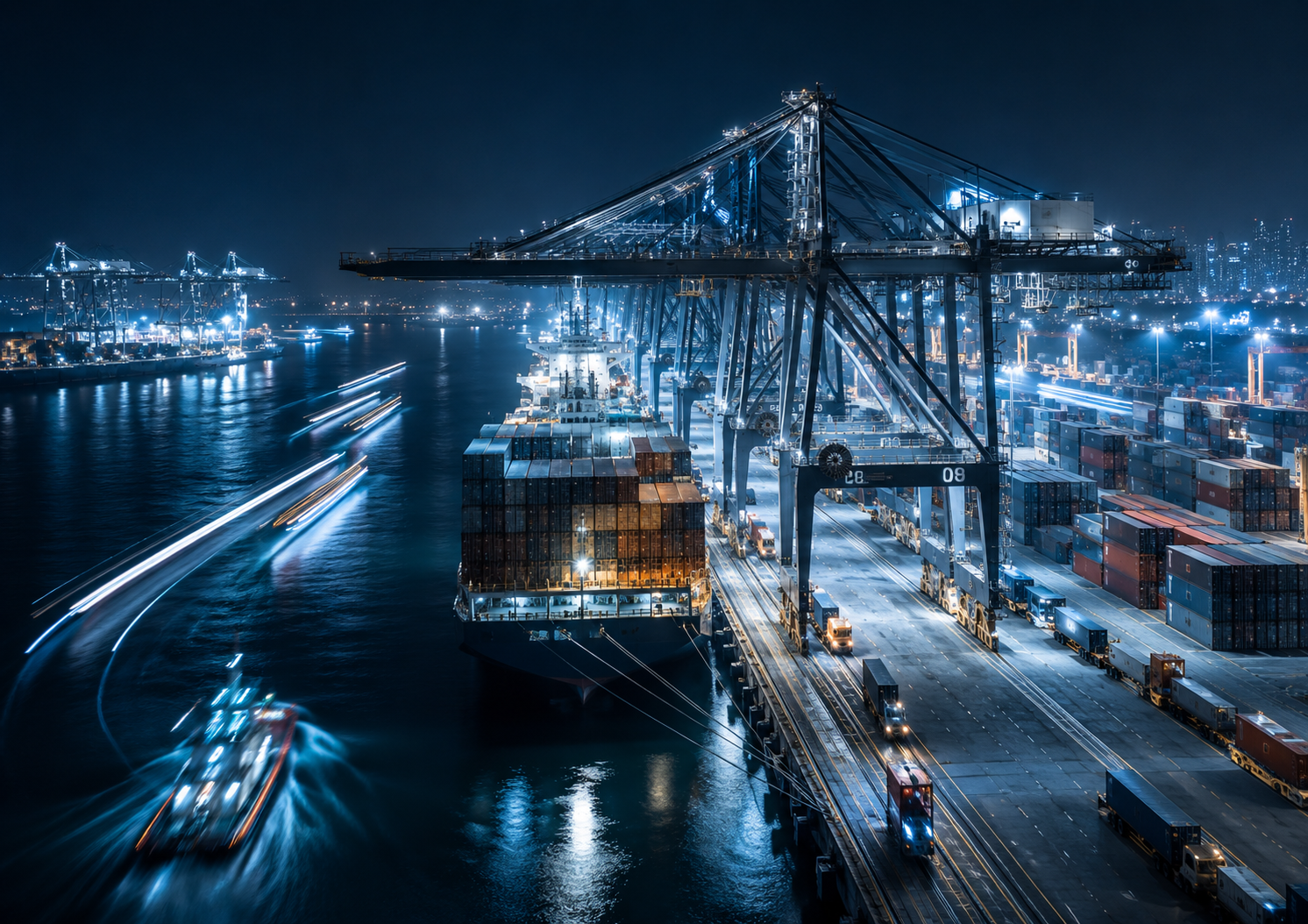
In the first quarter of 2026, for the first time in modern history, both of the Middle East's major maritime corridors became simultaneously blocked: the Strait of Hormuz effectively closed following military escalation on 28 February, and the Red Sea route to Europe, already operating at 49 per cent of pre-crisis capacity following Houthi attacks in 2024 and 2025, was closed again. The structural vulnerability of the just-in-time global logistics model, long discussed in theory, is now a live operational crisis. This briefing examines the verified scale of the disruption, the longer-term tariff-driven supply chain restructuring underway independently of the maritime closures, and the investment implications for corridor infrastructure across the Global South.
Global logistics has operated for three decades on an architecture built around two assumptions: that key maritime chokepoints would remain navigable, and that tariff barriers between major trading blocs would remain low enough to permit deep geographic specialisation in production. Both assumptions have been invalidated simultaneously in 2026. The result is not a temporary disruption but a structural repricing of logistics risk that will take years to work through the capital allocation decisions of industrial firms and institutional investors.
The Strait of Hormuz carries approximately 25 per cent of the world's maritime oil trade and 20 per cent of global liquefied natural gas, according to UNCTAD. Ship transits through the Strait dropped from approximately 130 per day in February 2026 to just 6 in March, a collapse of approximately 95 per cent, following military escalation in the region. Maersk, Mediterranean Shipping Company, CMA CGM, and Hapag-Lloyd all suspended transits. Brent crude peaked at $126 per barrel. Some nations in Asia and Africa saw diesel prices surge by as much as 84 per cent. The airfreight price index declined in January 2026 as ocean freight capacity was disrupted, but is projected to rise by approximately 15 per cent by mid-2026 as demand shifts to air.
The concurrent closure of the Red Sea route compounds the impact. The Red Sea corridor was already operating at 49 per cent of its pre-crisis capacity following the resumption of Houthi attacks in late 2025, which reversed the fragile gains made since the October 2025 ceasefire. Unlike the Red Sea, where vessels can reroute via the Cape of Good Hope at significantly extended transit times and higher fuel costs, the Strait of Hormuz offers no viable maritime alternative. Any cargo destined for Gulf economies must transit the Strait. There is no bypass route.
UNCTAD's April 2026 rapid assessment projects global merchandise trade growth to decelerate sharply from approximately 4.7 per cent in 2025 to between 1.5 and 2.5 per cent in 2026, as global demand weakens and uncertainty rises. Global economic growth is projected to slow from 2.9 per cent in 2025 to 2.6 per cent in 2026, with the Kiel Institute for the World Economy modelling significant welfare losses concentrated in energy-dependent import economies across Africa and Asia. The disruptions represent a simultaneous supply shock and demand constraint: energy costs rise while economic activity slows, a combination that compresses margins across every sector of the industrial economy that relies on maritime logistics.
The maritime crisis sits on top of a separate but concurrent structural shift in global trade that has been building since 2018 and accelerated sharply through 2025. The escalation of US tariffs under the Trump administration's second term produced a significant reconfiguration of sourcing patterns, with global goods trade in 2025 growing faster than in any year since 2017, according to the DHL Global Connectedness Report 2026, as firms front-loaded shipments ahead of tariff implementation and redirected supply chains away from high-tariff origins.
However, the DHL analysis also found that trade flows shifted more toward neutral countries than to close allies, implying more de-risking than genuine friendshoring. In 2025, only 12 per cent of global goods trade, 5 per cent of greenfield FDI, and 3 per cent of cross-border mergers and acquisitions took place between US-aligned and China-aligned blocs of close allies. The dominant pattern is not bloc consolidation but jurisdictional diversification: firms are actively seeking production and sourcing locations that sit outside the principal axis of US-China trade restriction.
The tariff cost impact is concrete and measurable at the firm level. Ford Motor Company's steel and aluminium tariff exposure has added between $500 and $1,000 to the cost of each vehicle produced in the United States. Apple has invested over $1 billion in Indian manufacturing facilities since 2023 and is shifting 15 to 20 per cent of its production to India and Vietnam to reduce exposure to US-China tariff risk. Nearshoring activity measured by Infios shows shipment values up 78 per cent year on year in 2026, even as entry counts fell 7 per cent, indicating consolidated and more deliberate sourcing rather than a retreat from cross-border trade.
The structural shift underway is a transition from just-in-time inventory management, which prioritises minimal stockholding and maximum supply chain velocity, toward what logistics practitioners have termed just-in-case inventory management, which prioritises buffer stock, supply chain redundancy, and jurisdictional diversification over pure unit-cost efficiency. This transition has capital implications that extend beyond the logistics sector itself.
The era of the single-hub, minimum-inventory supply chain is closing. What replaces it is not a simpler system. It is a more expensive, more resilient, and more geographically distributed one. The question for allocators is where the infrastructure of that new system needs to be built.
Just-in-case inventory management requires more warehousing, more distributed port infrastructure, more rail connectivity between inland production zones and coastal export facilities, and more sophisticated logistics data systems to manage the increased complexity of multi-origin, multi-route supply chains. Each of these requirements represents a capital investment opportunity. The regions that can offer the combination of geographic positioning, regulatory stability, and infrastructure development capacity will attract a disproportionate share of that investment.
The structural logic of supply chain decentralisation points toward the Global South for a specific and verifiable reason. The production cost advantage of established Asian manufacturing hubs is partially offset, in the new tariff environment, by the additional compliance cost, transit risk, and political friction associated with those origins. Jurisdictions that sit outside the principal axis of US-China trade restriction, that have stable regulatory environments, and that offer geographic access to both the African and Asian consumer markets without requiring transit through the Hormuz or Red Sea corridors are strategically positioned to attract a share of the production and logistics investment that is currently being redirected.
Mauritius presents a specific case that illustrates this logic. As noted previously in this briefing series, the South-South maritime trade corridor that passes through Mauritius's maritime zone carries an estimated $3.75 trillion in annual trade. Port Louis sits on the Indian Ocean shipping lane between Asia, the Middle East, East Africa, and Southern Africa. It does not depend on Hormuz or Red Sea transit for its core connectivity. Its bunkering infrastructure is operational and expanding. The EDB Mauritius data confirms 30,000 vessel transits annually through the country's maritime zone. As the Cape of Good Hope rerouting of Red Sea-bound vessels increases Indian Ocean traffic, Mauritius's position as a bunkering and transshipment node becomes incrementally more valuable.
The restructuring of global logistics toward just-in-case resilience and jurisdictional diversification creates demand for a specific category of infrastructure investment: deepwater port capacity outside traditional congested hubs, inland rail and road connectivity linking production zones to export facilities, bonded warehouse and free zone capacity allowing multi-origin inventory consolidation, and logistics data infrastructure supporting real-time multi-route supply chain visibility.
These are not speculative infrastructure plays. They are the physical requirements of a supply chain architecture that is already being built by the largest industrial firms in the world in response to verified and ongoing disruption. The capital question is whether institutional allocators will position in the infrastructure before the demand is fully priced, or after.
The honest assessment of nearshoring as a strategic response to tariff and logistics disruption is more nuanced than the headline investment narrative suggests. QIMA's Q4 2025 Barometer found that friendshoring was proving tougher in practice than in theory: after peaking at 22 per cent year-on-year growth in inspection and audit activity in July 2025, activity fell sharply in August and September as transshipment tariffs and trade tensions with India introduced fresh headwinds to the South and Southeast Asia diversification strategy. Limited local capacity in nearshoring destinations leaves firms with few scalable alternatives at short notice.
The practical implication is that supply chain restructuring is a multi-year capital programme, not a quarterly adjustment. Firms that began the process in 2023 and 2024 are better positioned to absorb the 2026 disruptions than those that have not yet initiated structural sourcing changes. For infrastructure investors, this means the demand for logistics facilities in strategic corridors outside established hubs will build over a 3 to 7 year horizon, not instantaneously, and the investment case requires a capital horizon that matches that timeline.
The simultaneous closure of the Strait of Hormuz and the Red Sea corridor is not a temporary shock. The Kiel Institute and UNCTAD both assess that the structural consequences for global supply chains will persist well beyond any short-term military resolution, because the commercial relationships, vessel routing decisions, insurance pricing, and infrastructure investment decisions made in response to a major chokepoint closure do not reverse immediately when the closure ends.
The longer-term tariff-driven restructuring adds a second layer of permanent change. The 12 per cent share of global goods trade between directly opposed geopolitical blocs reflects a new baseline of trade fragmentation that will not revert regardless of the outcome of individual diplomatic negotiations. Supply chains are being rebuilt around jurisdictional neutrality, regulatory predictability, and logistics corridor security, not around unit cost minimisation alone.
The Meridian Intelligence Desk provides confidential logistics corridor assessments and infrastructure investment analysis for institutional allocators, development finance institutions, and industrial firms navigating the restructuring of global supply chains in the Global South.
Enquiries: editor@themeridian.info
Add comment
Comments