The Base-Load Imperative: Why Renewable Energy Alone Cannot Power Heavy Industry
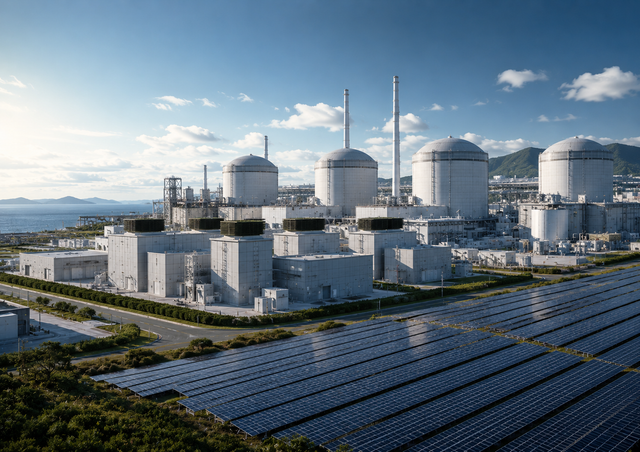
The energy transition is frequently presented as a straightforward substitution: fossil fuels out, renewables in. For the residential and commercial electricity sectors, that framing is broadly adequate. For heavy manufacturing, it is not. Semiconductor fabrication, steel processing, aluminium smelting, and chemical production operate on power requirements that intermittent renewable sources cannot satisfy without a firm base-load foundation. This briefing examines the verified energy parameters of heavy industry, the structural case for hybrid power infrastructure, and the investment landscape for the base-load technologies that the industrial transition actually requires.
A large semiconductor fabrication facility consumes as much as 100 megawatt-hours of electricity every single hour of every single day, according to McKinsey and Schneider Electric analysis. That is more than many oil refineries and automotive plants combined. TSMC's first phase at its Arizona campus requires approximately 200 megawatts of dedicated power, necessitating the construction of new substations and substantial transmission infrastructure by Arizona Public Service. Intel's Ohio campus, at full buildout, is projected to require between 4 and 8 terawatt-hours of electricity annually, a grid planning challenge of the same order of magnitude as a mid-sized city. These are not edge cases. They are the baseline power requirements of the manufacturing facilities that will define economic competitiveness in the next two decades.
The fundamental incompatibility between intermittent renewable generation and heavy industrial power requirements is not a political or ideological position. It is an engineering constraint. Semiconductor fabrication involves up to 300 separate manufacturing operations across a production cycle that typically runs for 85 days from raw material to finished chip. Each of those operations requires high-quality, stable electrical supply. A power outage lasting more than a few seconds can destroy an entire batch of wafers in production. A voltage sag, even at millisecond scale, can damage precision tools and generate losses running from several million to tens of millions of dollars per incident.
Samsung's semiconductor plant in Austin, Texas provides a documented reference point. When winter storms caused a power outage in February 2021, Samsung lost approximately $270 million in production value from a single disruption event. The plant was shut down for weeks. The chips that were in production at the moment of the outage were irretrievably scrapped. No insurance policy and no renewable energy certificate addresses the operational reality that a manufacturing process requiring continuous, stable, high-voltage power cannot tolerate the intermittency that is inherent in wind and solar generation without substantial storage and backup infrastructure.
Electricity accounts for up to 30 per cent of a semiconductor fab's total operating costs, according to McKinsey analysis. The latest extreme ultraviolet lithography technology, which is required for the most advanced chip nodes, consumes up to ten times more energy than the previous generation of lithography equipment. The direction of travel is toward higher, not lower, power intensity per unit of production. Meanwhile, US grid interconnection queues for industrial loads of 200 to 600 megawatts now require between 3 and 5 years from application to energisation under current conditions, as renewable energy projects, data centres, and new fab construction compete simultaneously for the same transmission capacity.
The power reliability challenge is substantially more acute in the Global South than in the established manufacturing jurisdictions of North America, Europe, and East Asia. Grid stability in much of Africa and South Asia is characterised by load shedding, voltage fluctuations, and planned outages that are managed as a routine operational tool by national utilities under peak demand pressure. South Africa's well-documented load-shedding programme, which ran at Stage 6 levels for extended periods through 2023 and 2024, represents the clearest regional example of the structural gap between national grid reliability and the requirements of advanced manufacturing. But the South African grid is not an outlier in its region; it is the most developed grid in sub-Saharan Africa.
The implication for industrial investors considering Global South deployment is direct. A manufacturing facility that depends on the national grid for its primary power supply is a facility whose operational continuity is subject to decisions made by a national utility operating under competing political and social pressures. Governments facing residential power shortfalls will ration industrial supply first. That is not a theoretical risk. It is the documented operational experience of industrial facilities across the developing world.
The question for industrial infrastructure investors in the Global South is not whether to include base-load power provision in the project capital budget. It is whether the project is viable without it. In most cases, the honest answer is that it is not.
The investment case for hybrid power infrastructure in industrial contexts is straightforward and supported by the operational data. A hybrid system combines a firm base-load source, capable of delivering continuous, stable power at the required voltage and frequency regardless of weather conditions, with utility-scale renewable generation for operational load during favourable conditions, and grid-scale storage systems to manage the transition between sources and provide the millisecond-level voltage stability that precision manufacturing requires. The hybrid model does not reject renewables. It places them correctly in the power architecture as a variable load supplement to a firm base-load foundation, rather than as a primary supply source that requires backup.
The capital structure of hybrid industrial power projects is correspondingly different from standard renewable energy finance. Base-load infrastructure, whether gas, nuclear, or advanced storage, requires long-dated, stable debt financing that reflects the 20 to 40-year operational lifespan of the underlying assets. Renewable components can be financed on shorter timelines with standard project finance instruments. The integration of the two within a single behind-the-meter power system, meaning one that generates power on-site and bypasses the volatility of the national grid, is the architecture that advanced industrial operators are increasingly requiring as a condition of site selection.
Small Modular Reactors have emerged as the base-load technology most directly suited to industrial cluster power requirements. SMRs are defined as nuclear reactors with nameplate capacities typically between 50 and 300 megawatts, designed for modular manufacturing and simplified construction. That capacity range maps directly onto the power requirements of a large semiconductor fab, an aluminium smelter, or a steel mini-mill. Unlike large conventional nuclear plants, which require financing commitments of $10 billion or more and construction timelines of a decade or longer, SMRs can be financed in smaller tranches, constructed modularly, and co-located with industrial facilities on brownfield or greenfield sites.
The SMR market was valued at $159.4 million in 2024 and is projected to reach $5.17 billion by 2035, a compound annual growth rate of 42.31 per cent, according to GlobeNewswire analysis published in August 2025. The United States Department of Energy reissued a $900 million Generation III+ SMR solicitation in March 2025, with Tennessee Valley Authority receiving $400 million for deployment of a GE Vernova Hitachi BWRX-300 and Holtec receiving $400 million for two SMR-300 reactors at the Palisades site in Michigan. In India, the government's Bharat SMR programme was reported in 2026 to be approximately six months from inviting bids for its first units, with a cost estimate of approximately Rs 30 crore per megawatt of installed capacity.
The practical consequences of the Strait of Hormuz closure in early 2026 for industrial energy costs in the Global South are direct and quantifiable. Brent crude peaked at $126 per barrel following the closure. Diesel prices in the hardest-hit nations in Asia and Africa surged by as much as 84 per cent. For industrial facilities in the Global South that rely on diesel or heavy fuel oil for backup generation -- which represents a significant proportion of industrial sites across the region -- the Hormuz closure translated directly into a sharp increase in the operating cost of the power backup systems they depend on to compensate for grid unreliability.
This is the compounding risk that the hybrid infrastructure model addresses. A facility with on-site base-load generation that does not depend on imported liquid fuel for its backup systems is structurally insulated from the energy cost transmission mechanism that the Hormuz closure demonstrated. That insulation has a calculable value in the context of the 2026 energy environment.
Industrial power infrastructure investment operates on a capital horizon that differs fundamentally from standard equity or even project finance timelines. A base-load power facility co-located with an industrial complex is not a 5 to 7 year private equity investment. It is a 20 to 40 year infrastructure asset that generates stable, contracted revenue from the industrial operator it serves. The appropriate capital for this category of investment is patient institutional capital: pension funds, sovereign wealth funds, development finance institutions, and infrastructure funds with long duration mandates.
The return profile is correspondingly different from higher-volatility industrial equity. The power purchase agreement between the industrial operator and the on-site generator is typically structured as a long-term, fixed or inflation-linked contract. The revenue is contracted, the counterparty is a large industrial operator with a strong operational incentive to maintain the power supply relationship, and the asset is physically integrated into the industrial campus in a way that creates switching costs that protect the revenue stream over the contract lifetime. For institutional investors seeking stable, long-duration returns in the Global South, industrial power infrastructure is among the most structurally defensible asset classes available.
The energy numbers for heavy manufacturing are not negotiable. A semiconductor fab consuming 100 megawatt-hours per hour requires a power supply that behaves with absolute stability across every one of those hours. The Samsung Austin event demonstrated what happens when that stability is interrupted: $270 million in losses from a single outage. The Hormuz closure demonstrated what happens to the cost of diesel backup generation when the global energy system is disrupted. Both events point to the same structural conclusion.
Renewables are a necessary component of the industrial energy mix. They are not a sufficient one. The base-load foundation, whether provided by gas with carbon capture, advanced nuclear, or the SMR technologies now entering commercial deployment in the United States and India, is the non-negotiable precondition for heavy industrial operations in any jurisdiction, including and especially the Global South, where national grid reliability cannot be assumed.
The Meridian Intelligence Desk provides confidential energy infrastructure assessments and hybrid power deployment analysis for industrial investors, development finance institutions, and sovereign capital allocators considering heavy manufacturing projects in the Global South.
Enquiries: editor@themeridian.info
Add comment
Comments