Climate-Insulated Agribusiness: Hedging Large-Scale Food Production Against Water Crises
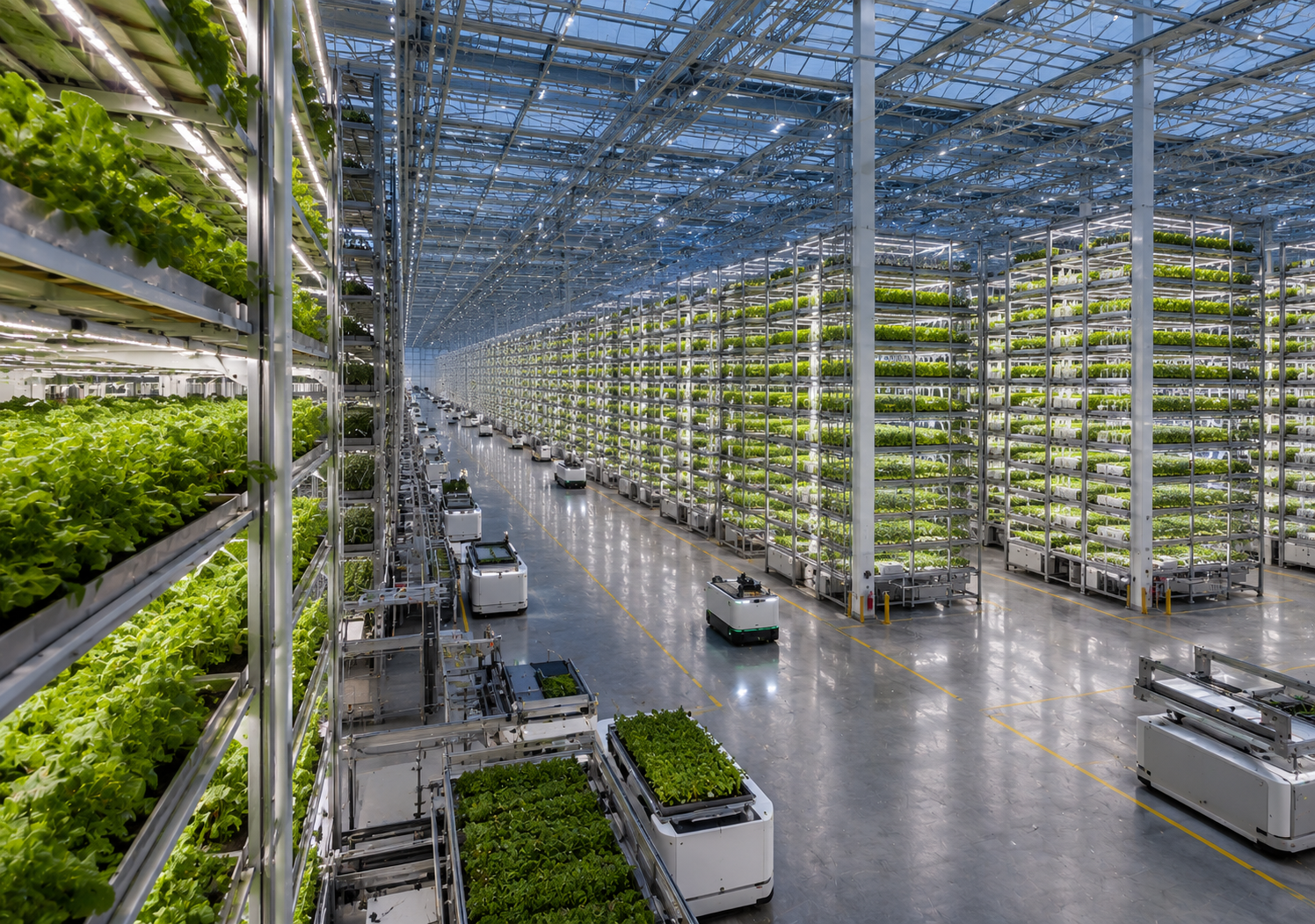
The global vertical farming sector lost over $1.37 billion in historical funding across fourteen bankruptcies in 2025 alone. AeroFarms, AppHarvest, Bowery Farming, Plenty Unlimited, and Freight Farms all failed or restructured between 2023 and 2025. Yet the global controlled-environment agriculture market stands at between $7.5 and $8 billion in 2026, projecting growth to between $18 and $40 billion by the early 2030s. The apparent contradiction is not a contradiction at all. It is the difference between the first generation of climate-insulated agribusiness, which was financed as venture capital speculation, and the second generation, which is being built as infrastructure. Understanding that distinction is the entire investment thesis.
Agriculture accounts for 72 per cent of all global freshwater withdrawals, according to UN-Water data. It is simultaneously the sector most dependent on water and the sector most exposed to the water scarcity that its own practices help to accelerate. The United Nations Food and Agriculture Organisation estimates that agricultural production must grow by 50 per cent to meet the demands of a global population approaching 10 billion by 2050, a trajectory that would require global water withdrawals approximately 30 per cent higher than today's already stressed levels. The UNU Institute for Water, Environment and Health, in its 2026 assessment, concluded that the terms "water stress" and "water crisis" are no longer adequate to describe the current global water availability situation. The UN has adopted the term "water bankruptcy" to signal both the irreversibility and the structural insolvency of the current freshwater system. These are not advocacy projections. They are the baseline within which every large-scale food production investment must be assessed.
The verified dimensions of the water risk to agricultural production are as follows. An estimated 2.4 billion people currently live in water-stressed countries, according to the FAO. Approximately 40 per cent of global croplands already experience water scarcity, according to CSIS analysis published in May 2025. Four billion people, representing nearly two thirds of the global population, experience severe water scarcity for at least one month per year, according to the Mekonnen and Hoekstra study cited by UN-Water. Freshwater resources per person have dropped by 20 per cent over the past two decades, according to the FAO. Water demand has been increasing at approximately 1 per cent per year since the 1980s, driven by population growth, dietary shifts, and industrial expansion.
The Global South is disproportionately exposed to this dynamic. Sub-Saharan Africa, South Asia, and the Middle East and North Africa region contain the greatest concentration of water-stressed agricultural land, the highest proportion of populations dependent on rain-fed subsistence farming, and the least developed irrigation and water management infrastructure. They are also the regions where agricultural demand will grow fastest over the next two decades, as population growth, urbanisation, and rising incomes drive increased food demand. The collision between rising demand and declining water availability is not a future scenario. It is an ongoing process with accelerating momentum.
Any serious institutional analysis of climate-insulated agribusiness must begin with an honest account of what happened to the first generation of controlled-environment agriculture businesses. AeroFarms, once widely cited as a pioneer, filed for Chapter 11 in June 2023 with $135 million in liabilities and closed its Danville, Virginia facility, laying off approximately 172 employees. AppHarvest collapsed in July 2023 under $341 million in debt. Bowery Farming, which had raised $700 million and reached a peak valuation of $2.3 billion, halted operations in late 2024. Plenty Unlimited filed for Chapter 11 in March 2025 after raising nearly $1 billion. Freight Farms filed for bankruptcy, with its assets acquired by Canada's Growcer in October 2025. According to AGEYE industry analysis, fourteen indoor farming and controlled-environment agriculture companies filed for bankruptcy in 2025 alone, with combined historical funding across the failed companies exceeding $1.37 billion.
These failures were not primarily failures of the underlying technology. Hydroponic growing systems work. Controlled-environment agriculture produces consistent, high-quality yields. The failures were failures of the business model. The first generation of vertical farming companies were financed as venture capital growth businesses, optimised for rapid scale at any cost rather than for unit economics and operational sustainability. Electricity accounted for between 50 and 70 per cent of operational costs in leading facilities, according to Coherent Market Insights analysis, with no viable pathway to profitability at the product prices achievable in the consumer market segments they were targeting. The business model was structurally insolvent before the first plant was harvested.
The first generation of vertical farming businesses were built on the venture capital assumption that scale would drive unit cost reduction fast enough to reach profitability before the funding ran out. For most of them, it did not. The second generation is being built on a fundamentally different economic logic: long-duration infrastructure financing, contracted offtake agreements with institutional buyers, co-location with low-cost or waste energy sources to address the electricity cost problem, and focus on high-value crop categories where the price premium over field-grown equivalents justifies the operational cost structure.
The institutional investor who looks at the 2023 to 2025 bankruptcy wave and concludes that controlled-environment agriculture is uninvestable has drawn precisely the wrong lesson. The correct lesson is that vertical farming financed as venture capital speculation is uninvestable. Vertical farming structured as long-duration infrastructure with contracted revenue is a different category of investment entirely.
Despite the bankruptcy wave, the global controlled-environment agriculture market stands at between $7.5 and $8 billion in 2026, according to multiple market research firms including Mordor Intelligence, Maximize Market Research, and Fortune Business Insights. The methodological spread across those estimates reflects differences in what each firm includes under the vertical farming definition, but the convergence around the $7.5 to $8 billion baseline is sufficient to establish the market's current scale. Projections for the early 2030s range from $18 billion to $40 billion, with the variance reflecting different assumptions about technology cost trajectories and adoption rates rather than disagreement about the underlying demand driver.
The structural consolidation that followed the bankruptcy wave is producing a more operationally credible industry. In August 2025, 80 Acres Farms merged with Soli Organic to achieve greater scale, in a consolidation pattern that has seen distressed assets acquired at discounted prices by operators with more patient capital structures. BrightFarms, backed by Cox Enterprises, is leveraging patient capital and extensive real estate networks for competitive site selection. The industry has entered what AGEYE's February 2026 analysis described as "a new phase defined by operational credibility rather than speculative hype," with renewed growth driven by institutional confidence rather than venture capital chasing scale at any cost.
The fundamental technical case for controlled-environment agriculture as a water risk hedge rests on the verified efficiency differential between hydroponic production and conventional field agriculture. Hydroponic systems recirculate water through closed loops, delivering nutrients directly to plant root systems and recovering the water that plants do not absorb. The result is a water consumption reduction of up to 90 to 95 per cent compared to equivalent field production, depending on the crop and the specific system design. That figure is not a marketing claim; it is the result of the physical architecture of a closed-loop hydroponic system, which eliminates evaporation losses, run-off, and soil absorption that account for the majority of water losses in conventional irrigation.
For the investor, the water efficiency differential has two distinct implications. The first is direct: a facility producing food with 90 to 95 per cent less water than a conventional field operation is structurally insulated from the water scarcity risk that will progressively impair conventional agricultural production in water-stressed regions. The second is regulatory: as water pricing, water rights frameworks, and agricultural water allocation systems tighten in response to scarcity, the facility with the lowest water intensity per unit of production is most protected from the regulatory and cost consequences of that tightening. Water-intensive conventional agriculture is acquiring a regulatory liability that controlled-environment agriculture structurally avoids.
The water efficiency of a closed-loop hydroponic system is not an environmental benefit that happens to be commercially useful. It is a structural cost and regulatory advantage that becomes more valuable as water scarcity intensifies and water pricing tightens. The environmental and commercial cases are the same case.
The energy cost problem that destroyed the first generation of vertical farming businesses has not been solved at the technology level. LED lighting, climate control, and automated nutrient delivery systems remain energy-intensive. What has changed is the approach to sourcing that energy. The second generation of climate-insulated agribusiness operations is being structured with energy as a co-location decision rather than an operating cost variable. Facilities co-located with industrial energy sources, whether waste heat from data centres, off-take from renewable energy installations at below-grid rates, or in the Global South context, dedicated biomass or biogas generation from agricultural waste streams, can reduce electricity costs to a level at which the unit economics of controlled-environment production become commercially viable.
This connects the climate-insulated agribusiness investment thesis directly to the base-load energy infrastructure argument examined earlier in this briefing series. A vertical farming facility that depends on the national grid for its electricity supply in a jurisdiction characterised by load-shedding and price volatility faces the same operational continuity risk as a semiconductor fab in the same environment. The solution, as with industrial manufacturing more broadly, is behind-the-meter power generation: on-site or directly contracted energy supply that operates independently of the national grid's reliability and pricing. In the Global South, where agricultural waste streams from existing commodity production provide feedstock for biogas generation, this integration is structurally achievable at a cost basis that is not available in Western markets.
The argument for deploying climate-insulated agribusiness infrastructure in the Global South is not primarily about replicating the Western vertical farming model in a new geography. It is about applying the core technological principle, the decoupling of food production from rainfall and ambient temperature, to the specific food security challenge of water-stressed, high-population-growth regions where conventional rain-fed agriculture is most vulnerable to climate disruption.
The relevant crop categories in the Global South context are not the leafy greens and microgreens that dominate the Western vertical farming market, where the premium price commanded by locally grown, pesticide-free produce is the primary commercial driver. In the Global South, the relevant categories are staple crops, protein sources, and high-value perishables for which supply consistency, reduced post-harvest loss, and proximity to urban consumption centres are the primary value drivers. Tomatoes, peppers, cucumbers, and other warm-weather vegetables grown in controlled environments within urban food distribution corridors eliminate the post-harvest spoilage losses that can represent 30 to 50 per cent of yield value in conventional supply chains across sub-Saharan Africa.
The investment structure for Global South climate-insulated agribusiness differs correspondingly from the Western venture capital model. Long-duration project finance against contracted offtake agreements with urban food retailers, institutional catering operations, or government food security programmes provides the revenue predictability that the infrastructure investment requires. Development finance institution co-investment, which is increasingly available for food security infrastructure projects that meet climate adaptation criteria, provides patient capital at concessionary rates that Western commercial investors alone cannot match. The combination of commercial infrastructure finance and development finance co-investment is the capital structure that makes the unit economics of climate-insulated agribusiness viable in markets where consumer price levels do not support purely commercial returns.
Beyond the production facility itself, the most strategically significant infrastructure investment in the water-scarcity context is the control of water rights. As freshwater scarcity intensifies, the legal right to extract water from a specific aquifer, river system, or desalination facility acquires asset-like characteristics that are fundamentally different from a conventional agricultural commodity input. In jurisdictions where water rights are transferable, they are already trading as financial instruments. In jurisdictions where water rights frameworks are developing, early-mover positioning in water access agreements, infrastructure concessions, and aquifer management partnerships represents a defensible first-mover advantage that becomes progressively more valuable as scarcity conditions intensify.
The investment in water infrastructure, whether deep-aquifer irrigation systems, rainwater harvesting and storage networks, or advanced water recycling infrastructure at the facility level, is the foundational capital requirement of the climate-insulated agribusiness model. The production facility, whether a hydroponic greenhouse, a controlled-environment vertical farm, or a precision drip-irrigated field system, derives its primary competitive advantage from the security and efficiency of its water supply. The capital hierarchy runs in that order: water security first, energy supply second, production technology third.
The global water scarcity data is not contested. Two-thirds of the world's population live under water stress for at least part of the year. Forty per cent of global croplands already face water scarcity. The FAO requires a 30 per cent increase in global water withdrawals by 2050 to meet projected food demand, against a backdrop of declining per-capita freshwater availability. The UNU Institute has declared the global water system in effective "bankruptcy." These are the conditions within which every large-scale agricultural investment must be underwritten from this point forward.
The 2023 to 2025 vertical farming collapse demonstrated that climate-insulated food production financed on venture capital terms with no contracted revenue, no energy cost resolution, and no viable unit economics at consumer prices is not investable. It also demonstrated, through the consolidation and restructuring that followed, that the underlying technology works and the demand for consistent, water-efficient food production is real and growing.
The second generation of climate-insulated agribusiness investment is being built on infrastructure economics: long-duration project finance, contracted offtake, co-located energy, and in the Global South context, development finance institution co-investment against food security mandates. That is a fundamentally different and structurally more defensible investment than anything that AeroFarms or AppHarvest represented. The two generations should not be confused. The failures of the first do not invalidate the thesis of the second. They define the structural conditions under which the second generation can succeed where the first did not.
The Meridian Intelligence Desk provides confidential food security infrastructure assessments, water risk analysis, and agribusiness investment structure reviews for institutional allocators, development finance institutions, and sovereign capital considering climate-resilient food production in the Global South.
Enquiries: editor@themeridian.info
Add comment
Comments