The Unfinished Declaration: An Editor’s Letter on Human Rights, Two Laws, and One Planet
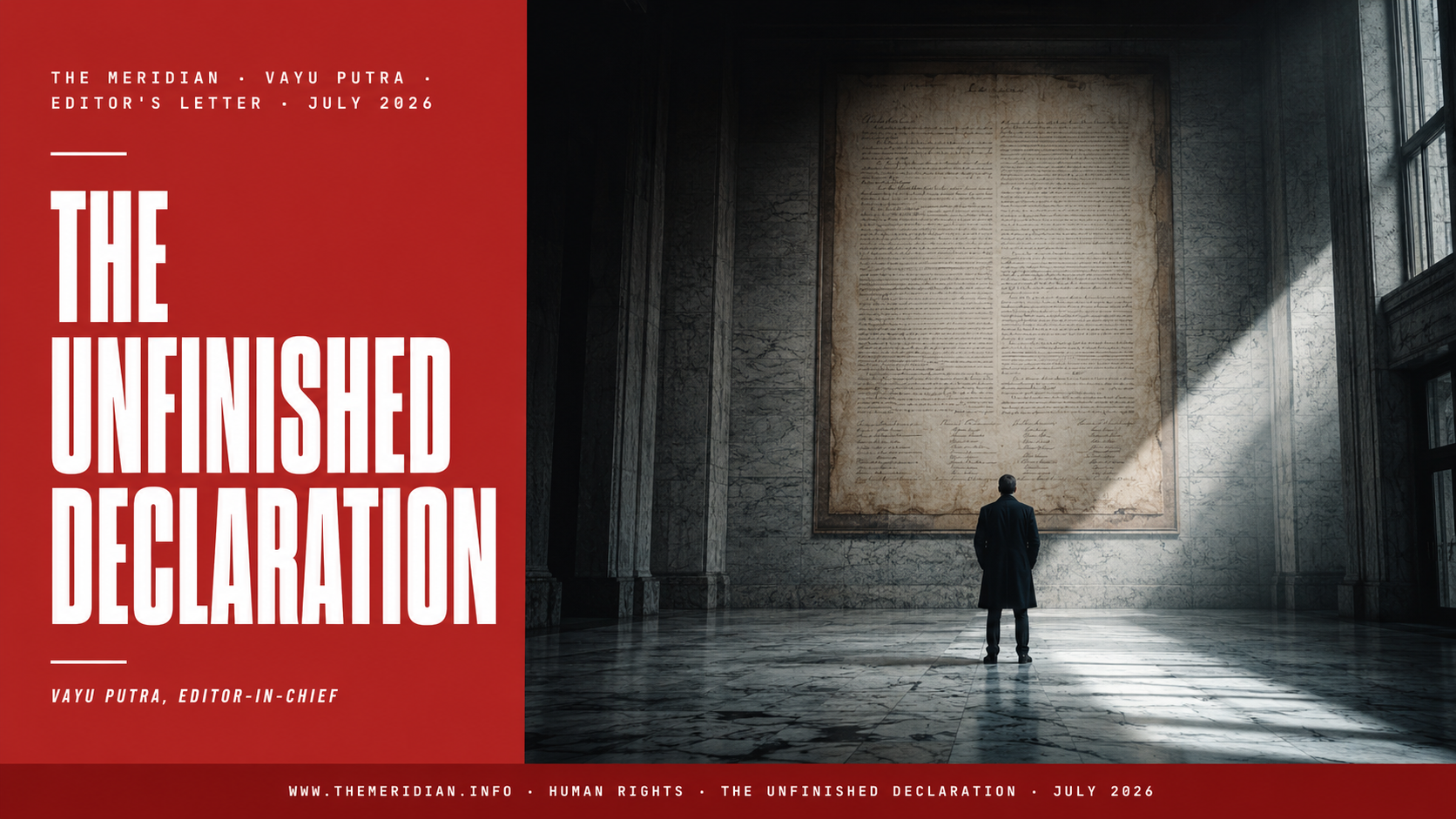
Every nation on earth signed the Universal Declaration of Human Rights in 1948. Every nation on earth violates it daily. The question is not whether human rights exist. The question is who they exist for -- and who has always benefited from the gap between the text and the enforcement.
On 10 December 1948, in the Palais de Chaillot in Paris, the United Nations General Assembly adopted the Universal Declaration of Human Rights. There were no dissenting votes. Eight nations abstained -- the Soviet Union, its Eastern European allies, Saudi Arabia, and South Africa -- but not one nation voted against. The Declaration passed because its language was understood by every government in the room to be aspirational. It was a statement of what the world intended to become, not a binding legal instrument with enforcement teeth.
Seventy-eight years later, 193 nations are signatories. The UDHR has been translated into more than 500 languages. It is cited in more legal proceedings, political speeches, academic papers, and NGO reports than any other document in the history of international relations. It is also, by any honest accounting, the most systematically violated document in the history of international relations. Those two facts are not in tension. They are the same fact, stated twice.
The UDHR is 78 years old. It has never been more cited. It has never been more violated. This edition asks why -- and names who benefits from the gap between the text and the reality.
This is the question The Meridian’s July 2026 Human Rights Edition sets out to answer. Not whether human rights are real. Not whether the UDHR was a worthy document. Both are settled. The question is structural: why does a framework signed by every government on earth produce a world in which 3.5 million people are held in pre-trial detention without conviction, 320 human rights defenders were killed in 2025, 12 million people are displaced in Sudan with zero accountability, and a Bangladeshi worker processing tuna in Mauritius under a UK trade agreement has fewer enforceable rights than the agreement’s labour provisions guarantee on paper?
The answer, as this edition will demonstrate across seventeen original articles and six analytical chapters, is not that the UDHR failed. It is that the UDHR was never designed to succeed in the way its signatories publicly claimed. It was designed to perform commitment without requiring it.
The UDHR is the founding text of the modern human rights system. It established thirty articles covering civil, political, economic, social, and cultural rights. It declared that these rights were universal -- not dependent on nationality, race, gender, religion, or political opinion. It stated, in Article 1, that all human beings are born free and equal in dignity and rights.
What it did not establish was any mechanism to enforce those rights against governments that violated them. The International Covenant on Civil and Political Rights, adopted in 1966 and entering into force in 1976, created a Human Rights Committee with the power to receive complaints. Its decisions are not legally binding. The International Covenant on Economic, Social and Cultural Rights created a committee with similar advisory powers. Neither covenant has an enforcement mechanism with real legal effect against a state that chooses to ignore its findings.
The result is a system that produces the language of accountability without its substance. States appear before UN treaty bodies, submit periodic reports, receive recommendations, and return home to continue the practices those recommendations addressed. The cycle is not a malfunction. It is the design.
The central thesis of this edition is simple. There are two legal systems operating simultaneously on one planet. They share a founding document. They do not share an outcome.
In the first system, Article 5 of the UDHR -- which prohibits torture and cruel, inhuman or degrading treatment -- is enforced through domestic constitutional courts, independent judiciaries, and international treaty bodies. Citizens can seek redress. Governments can be held accountable. The law, imperfectly but meaningfully, operates.
In the second system, the same Article 5 exists on paper and nowhere else. The provisional charge functions as punishment without conviction. The pre-trial cell functions as imprisonment without sentence. The deportation centre functions as detention without crime. The pushback at sea functions as refoulement without record. The factory floor functions as exploitation without remedy. None of these outcomes require a government to formally violate the UDHR. They only require a government to do nothing while the violation occurs.
The provisional charge is not unique to Mauritius. It is a structural feature of legal systems across Africa, Asia, and the Global South: a mechanism of administrative control that operates independently of the presumption of innocence guaranteed under Article 11 of the UDHR. You do not need a conviction to destroy a life. You need only an allegation, a file, and a system that treats the file as evidence of guilt before any verdict is reached.
Nigeria’s DSS maintained Prof Okey Ndibe’s name on a security watchlist from 2013 to the present day. Five administrations. Zero formal charge. Zero conviction. The watchlist is not a legal instrument under any framework that would survive constitutional scrutiny. It exists because the state has the power to maintain it and the citizen lacks the power to remove it.
One of the most revealing expressions of the two-law system is the vocabulary we use to describe human movement. A British finance professional relocating to Dubai is an expat. A Bangladeshi garment worker relocating to Mauritius is a migrant. Both are exercising the right of movement recognised under Article 13 of the UDHR. The law does not distinguish between them. The language does. And the language, as this edition’s Chapter Four will demonstrate, encodes a legal reality that the UDHR was explicitly written to prevent.
The Bangladeshi worker processing tuna at a factory in Mauritius earns Rs 16,500 a month. The tuna she processes is exported to the United Kingdom and the European Union under preferential trade agreements that contain explicit labour rights provisions. Those provisions require Mauritius to uphold International Labour Organisation standards as a condition of market access. The worker cannot change her employer. She has no effective remedy against underpayment. The labour provisions in the trade agreement are not enforced. The tuna reaches the UK market.
Same human movement. Same Article 13 of the UDHR. One word for the British professional in Dubai. Another word for the Bangladeshi worker in Mauritius. The language encodes the law before the law is applied.
This is not an isolated case. It is the structure. Fast fashion supply chains from Bangladesh to Cambodia operate under the same architecture: binding trade access, voluntary labour standards, zero enforcement. Pharmaceutical patent regimes grant monopoly pricing rights to corporations in wealthy nations while making the same medicines criminal or unaffordable in the Global South. Seed monopoly laws criminalise the saving and replanting of seeds that subsistence farmers in Africa and South Asia have practised for ten thousand years. In each case, the same legal framework that claims to protect human rights is the instrument through which those rights are systematically denied.
No region of the world was promised more by the post-1945 international order and delivered less than Africa. The Universal Declaration of Human Rights was adopted three years after the end of a war fought in the name of human dignity. Most of Africa was still under colonial administration when the Declaration passed. The nations that drafted and adopted it were, many of them, simultaneously administering colonial territories in which the Declaration’s provisions were systematically denied to the colonised population.
This is not ancient history. It is the architecture of the present. The debt structures that trap African governments in perpetual fiscal crisis were designed by the same institutions that claim to promote human rights. The trade agreements that deny African producers market access were negotiated by the same governments that fund human rights organisations. The aid conditionality that requires African states to implement austerity programmes cutting health and education budgets -- the programmes most directly connected to Articles 25 and 26 of the UDHR -- is administered by an institution whose governance gives African nations a combined voting share of approximately seven per cent despite representing seventeen per cent of the world’s population.
The Sahel is the sharpest current expression of this contradiction. Three military governments have displaced elected governments that were themselves delivering neither democracy nor rights. The international community’s response has been to condemn the coups while ignoring the question of what those elected governments were actually delivering to the citizens who now, in significant numbers, support the juntas that replaced them. Ibrahim Traore’s statement that democracy is not for Africa is wrong as political philosophy. It is not wrong as an observation about what democracy has delivered to the Sahel. Chapter Two of this edition holds both truths simultaneously, which is the only honest way to hold them.
The oldest distinction in jurisprudence is between malum in se and malum prohibitum. An act that is malum in se is wrong in itself -- murder, torture, the deliberate destruction of a civilian population. An act that is malum prohibitum is wrong only because a legal authority has declared it so -- drug possession, visa overstay, the crossing of an administrative line on a map.
The UDHR was written to protect human beings from acts that are malum in se: arbitrary detention, torture, discrimination, denial of the right to a fair trial. What the UDHR’s enforcement architecture has produced, in practice, is a system in which acts that are malum in se are tolerated when committed by states with sufficient power or strategic value, while acts that are malum prohibitum are used to deny the UDHR’s protections to the human beings who most need them.
The asylum seeker pushed back into the Aegean Sea has committed no act that is malum in se. The act of crossing a maritime boundary without authorisation is malum prohibitum -- wrong because a legal authority says so, not because it is wrong in itself. Yet it is used to deny that individual the protections of Article 14, which guarantees the right to seek asylum. Frontex has documented 40,000 illegal pushbacks since 2020. The European Union continues to fund Frontex.
Every structural gap between the text of the UDHR and its enforcement benefits someone. The gap between the labour rights provisions in UK trade agreements and their non-enforcement benefits corporations that source from Mauritius’s tuna supply chain at a cost that would be higher if those provisions were applied. The gap between Article 14 and Frontex’s pushback operations benefits European governments facing domestic political pressure on immigration. The gap between the ICJ’s advisory opinion and its non-enforcement benefits the government whose occupation the opinion addressed.
The gap is not an accident. It is not a failure of political will that better leadership might resolve. It is a design feature of a system that was constructed to provide the language of rights without the substance of enforcement. The language costs nothing. The enforcement would cost everything.
The language of human rights costs nothing. The enforcement would cost everything. That is why the language exists and the enforcement does not.
This is The Meridian’s position, stated plainly: the Universal Declaration of Human Rights is one of the most important documents in human history. The system built to give it effect was designed, from the beginning, to ensure that it would not. The question for 2026 is not whether we can improve the system at the margins. The question is whether the architecture itself can be reformed, or whether what is required is something more fundamental: an enforcement mechanism with real teeth, a Security Council that cannot veto its own accountability, and trade agreements whose labour provisions are binding rather than aspirational.
The Meridian’s July 2026 Human Rights Edition is organised across six chapters and seventeen original articles. Chapter One examines the architecture of the law itself -- the UDHR, the two international covenants, the malum in se and malum prohibitum distinction, and the provisional charge as a structural instrument of rights denial. Chapter Two covers Africa: the Sahel paradox, Sudan’s forgotten war, and Nigeria’s watchlist state. Chapter Three examines Asia and the Global South: garment workers in Bangladesh and Cambodia, Sri Lanka’s economic collapse as a human rights violation, and Palestine and the limits of the ICJ. Chapter Four examines the migrant and the law: the expat and migrant vocabulary split, the Mauritius labour rights trap, and Fortress Europe’s assault on Article 14. Chapter Five examines corporate power: the UN Guiding Principles on Business and Human Rights and why fifteen years of voluntarism have produced zero binding accountability. Chapter Six examines reform, resistance, and the road forward: the courts that said no, the defenders who were killed for saying it, and what full UDHR compliance would actually require.
Seventeen articles. Six chapters. One founding document that 193 nations have signed and none has fully honoured. The Meridian does not publish this edition in the belief that naming the gap closes it. We publish it in the belief that naming it precisely, with evidence, with specificity, and without diplomatic hedging, is the beginning of the only serious conversation that matters.
The UDHR’s drafters knew what they were writing. They knew the enforcement architecture they left out. The question that has always faced the human rights movement is not whether the Declaration was sincere. It is whether sincerity, without enforcement, is worth anything at all to the fisherman whose asylum claim is vetoed at sea, the worker whose labour rights are voluntary, or the professor whose name remains on a watchlist thirteen years after it was placed there.
We believe that question deserves a direct answer. This edition provides one.
Add comment
Comments