Same Rights, Different Planets: The UDHR at 78 and the Enforcement Gap Nobody Wants to Close
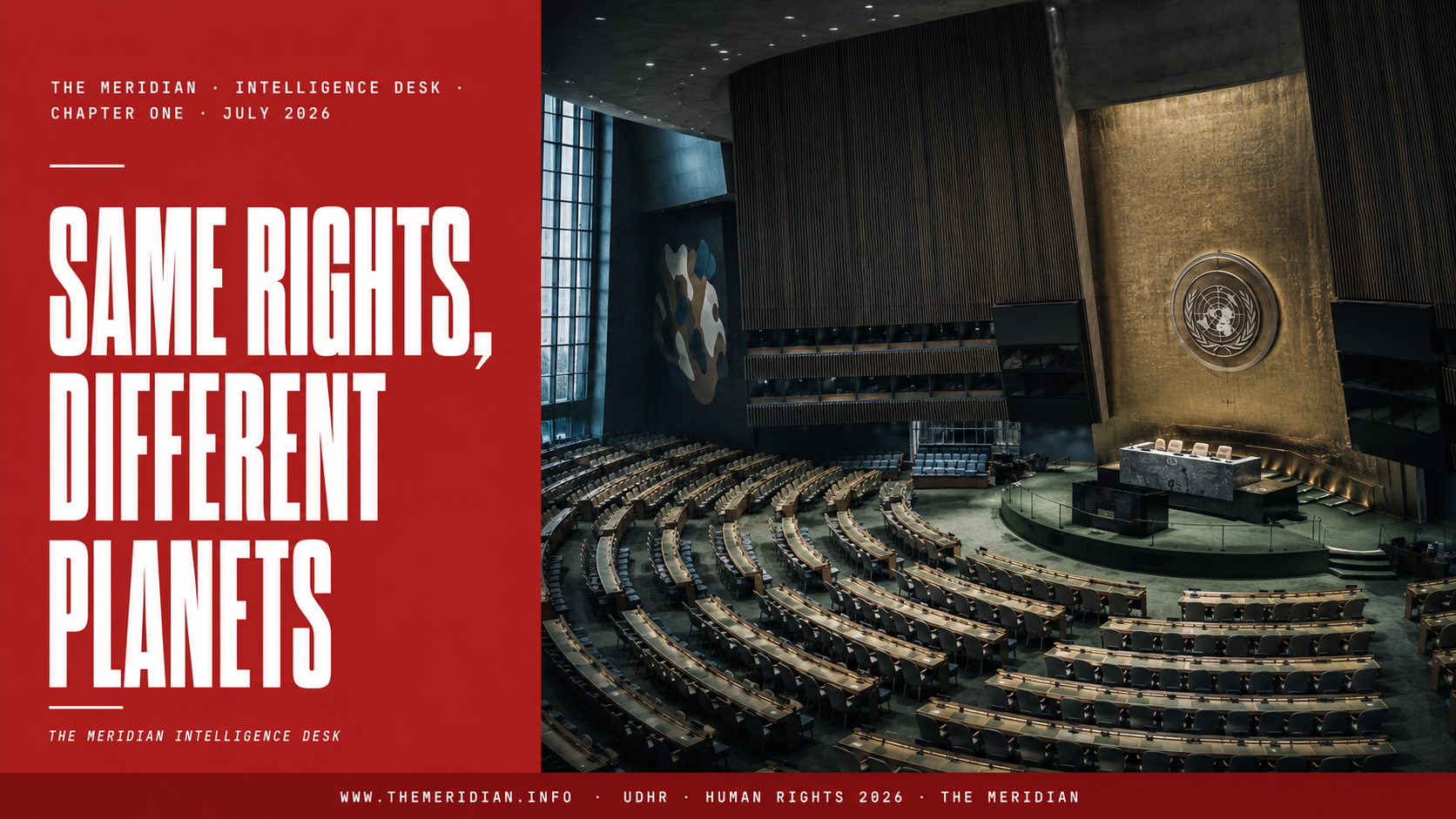
The Universal Declaration of Human Rights is the most countersigned document in the history of international relations. It is also the most selectively enforced. On its 78th anniversary, The Meridian examines what the gap between those two facts actually costs -- and who it costs it to.
In December 1948, the nations of the world made a promise. They called it universal. They wrote it in thirty articles. They said it applied to every human being on earth regardless of nationality, race, religion, gender, or political opinion. They signed it. Every one of them signed it. And then, with varying degrees of enthusiasm and varying degrees of delay, every one of them began to violate it.
This is not a cynical observation. It is the foundational fact of the modern human rights system, and no honest analysis of that system can proceed without stating it plainly. The Universal Declaration of Human Rights is 78 years old in 2026. It has 193 signatories. It has no enforcement mechanism with real legal effect against a state that chooses to ignore it. The gap between those three facts is not a failure of the system. It is the system.
The Meridian’s Human Rights Edition opens with this question not to dismiss the UDHR but to take it seriously -- seriously enough to ask why the most ambitious statement of human dignity ever produced by the international community has, after nearly eight decades, left 3.5 million people in pre-trial detention without conviction, 320 human rights defenders killed in a single year, and 12 million people displaced in Sudan with zero binding accountability triggered against anyone responsible.
The UDHR was drafted between 1947 and 1948 by a committee chaired by Eleanor Roosevelt, with significant contributions from René Cassin of France, Charles Malik of Lebanon, Peng Chun Chang of China, and Hansa Mehta of India, among others. Its thirty articles cover the full spectrum of human rights: the right to life (Article 3), prohibition of torture (Article 5), the right to a fair trial (Article 10), the presumption of innocence (Article 11), the right to seek asylum (Article 14), the right to an adequate standard of living (Article 25), and the right to education (Article 26).
What the drafters did not include -- and this was a deliberate political decision, not an oversight -- was any mechanism by which a state could be compelled to honour these commitments. The Declaration was explicitly framed as a common standard of achievement, not a binding treaty. Its moral authority was intended to substitute for legal enforcement. The assumption was that states, having publicly committed to these principles, would feel sufficient reputational pressure to honour them.
The moral authority of the UDHR was intended to substitute for legal enforcement. Seventy-eight years of evidence suggests that assumption was wrong in every case that mattered most.
Seventy-eight years of evidence suggests that assumption was wrong in every case that mattered most -- precisely because the cases in which states were most likely to violate the UDHR were the cases in which they were least susceptible to reputational pressure, either because they were powerful enough to ignore it or because the victims of their violations were not powerful enough to generate it.
After the UDHR, the international community spent two decades negotiating binding instruments that would give its principles legal force. The result was two international covenants, both adopted in 1966 and entering into force in 1976: the International Covenant on Civil and Political Rights (ICCPR) and the International Covenant on Economic, Social and Cultural Rights (ICESCR). Together with the UDHR, these form what is known as the International Bill of Human Rights.
The ICCPR created a Human Rights Committee with the power to receive complaints from individuals against states that had ratified its Optional Protocol. The Committee can find a violation. It can recommend a remedy. Its findings are not legally binding. The ICESCR created a Committee on Economic, Social and Cultural Rights with similar advisory powers. Its findings are also not legally binding.
The pattern repeats across the entire architecture of international human rights law. The Convention Against Torture, adopted in 1984, created a Committee Against Torture that can investigate and report. Its findings are advisory. The Convention on the Rights of the Child, the most widely ratified human rights treaty in history with 196 states parties, created a Committee on the Rights of the Child that receives reports, makes recommendations, and is systematically ignored by governments that find its recommendations inconvenient.
The one institution in the international system with real enforcement power is the United Nations Security Council, which can authorise sanctions, arms embargoes, and military action under Chapter VII of the UN Charter. The Security Council can, in theory, act to enforce human rights. In practice, its five permanent members each hold a veto that exempts them and their allies from accountability. The architecture that was supposed to enforce human rights was designed, from the beginning, with a clause that guaranteed its most powerful members could never be held to account under it.
The result is a human rights enforcement architecture with a geography. Rights are enforced where the powerful have an interest in enforcing them. They are not enforced where the powerful have an interest in looking away, or where the state committing the violation is itself powerful enough to make looking away the rational choice for everyone else.
This geography is not random. It follows the contours of geopolitical interest, economic relationship, and strategic alliance with a consistency that any honest mapping of human rights enforcement over the past seventy-eight years will confirm. It is not that the powerful do not care about human rights. It is that they care about them instrumentally -- as a vocabulary to deploy against adversaries and a standard to exempt themselves from.
In July 2024, the International Court of Justice issued an advisory opinion concluding that Israel’s continued presence in the occupied Palestinian territory was unlawful under international law, and that all states had an obligation not to recognise or assist that presence.
In September 2024, the United Nations General Assembly passed a resolution demanding compliance with the opinion by 124 votes to 14, with 43 abstentions.
The United States vetoed enforcement at the Security Council. The opinion exists. The occupation continues. This is not a malfunction of the international human rights system. This is the system functioning exactly as its architecture permits.
Seventy-eight years after the UDHR, the human rights situation in the Global South can be summarised with a set of numbers that the international community generates, publishes, discusses at length in well-funded conferences, and does not substantially change.
3.5 million people are held in pre-trial detention globally without conviction -- the majority in the Global South -- in direct violation of Article 11 of the UDHR, which guarantees the presumption of innocence. 320 human rights defenders were killed in 2025, according to Front Line Defenders, with Colombia accounting for the largest share and the Philippines second. Most were land defenders. Most were indigenous. Most had reported receiving threats before they were killed. The reporting mechanism worked perfectly. The protection mechanism did not exist.
Sudan has produced the largest displacement crisis on earth, with 12 million people forcibly uprooted since the outbreak of conflict between the Sudanese Armed Forces and the Rapid Support Forces in April 2023. More people have been displaced in Sudan than in Ukraine. The Security Council has been unable to agree a binding resolution because Russia and China have used their veto to block enforcement measures. The displacement continues. The international community publishes reports about it.
The most accurate way to describe the UDHR’s operation in 2026 is not that it has failed. It is that it operates differently depending on which planet you live on.
On Planet One, the UDHR is a living document. Constitutional courts cite it. Domestic legislation implements it. Independent judiciaries enforce it. Citizens can seek redress when it is violated. Governments face real political and legal consequences when they breach its provisions systematically. This planet exists. It is mostly in the Global North, with significant variations and exceptions.
On Planet Two, the UDHR is a piece of paper that governments sign, reference in speeches, and systematically violate without consequence. The provisional charge operates as punishment before verdict. The pre-trial cell operates as imprisonment before conviction. The deportation centre operates as detention without crime. The factory floor operates as exploitation without remedy. The pushback at sea operates as refoulement without record. Planet Two exists. It is mostly in the Global South, with significant variations and exceptions.
The UDHR does not fail on Planet Two. It simply does not arrive. The enforcement mechanisms that would carry it there were never built.
The critical point is that the existence of Planet One does not prove that the UDHR works. It proves that human rights can be enforced when a society has the institutional infrastructure to enforce them. The UDHR’s contribution to building that infrastructure in the Global South has been limited by the same enforcement gap that limits its contribution to addressing the violations that infrastructure was supposed to prevent.
The enforcement gap in international human rights law is not a mystery. Its causes are well understood. Its solutions are well documented. They have not been implemented because implementing them would require the states that benefit from the current architecture to surrender the privileges that architecture provides them.
Closing the gap would require, at minimum, four structural changes. First, the creation of a binding international human rights court with compulsory jurisdiction over all UN member states -- not the current system of optional protocols and advisory opinions, but a court whose judgments states are legally obligated to comply with, backed by automatic sanctions for non-compliance. Second, the reform of the UN Security Council veto to prevent permanent members from blocking enforcement action in cases where they or their allies are the accused party. Third, the conversion of the labour rights provisions in bilateral and multilateral trade agreements from voluntary standards to binding conditions, enforceable through trade sanctions. Fourth, the establishment of a mandatory corporate human rights due diligence regime with extraterritorial application -- so that a corporation headquartered in London or Paris cannot benefit from supply chain practices in Bangladesh or Mauritius that would be illegal at home.
None of these proposals is new. All of them have been advocated by human rights organisations, legal scholars, and Global South governments for decades. None of them has been implemented. The reason is not that they are technically impossible. The reason is that the states with the power to implement them are the states with the most to lose from a world in which human rights are actually enforced.
The Universal Declaration of Human Rights is not a failed document. Its thirty articles represent the clearest statement of human dignity that international politics has ever produced. The failure is not in the text. The failure is in the architecture that was built -- or rather, deliberately not built -- to give the text effect.
Seventy-eight years of evidence shows that the gap between the UDHR’s promise and its performance is not closing. It is, in important respects, widening -- as authoritarian governments grow more sophisticated in the use of legal instruments to suppress rights, as corporate supply chains grow longer and more opaque, and as the Security Council grows less functional as a mechanism for collective action.
The question for 2026 is not whether to celebrate the UDHR’s anniversary. It is whether the international community is prepared to do what it has refused to do for 78 years: build the enforcement architecture that would make the Declaration something other than a statement of aspiration addressed to the people least able to enforce it for themselves.
Add comment
Comments