The Storm Zone Abdication: Why the NCD Crisis is a Policy Failure, Not a Force of Nature
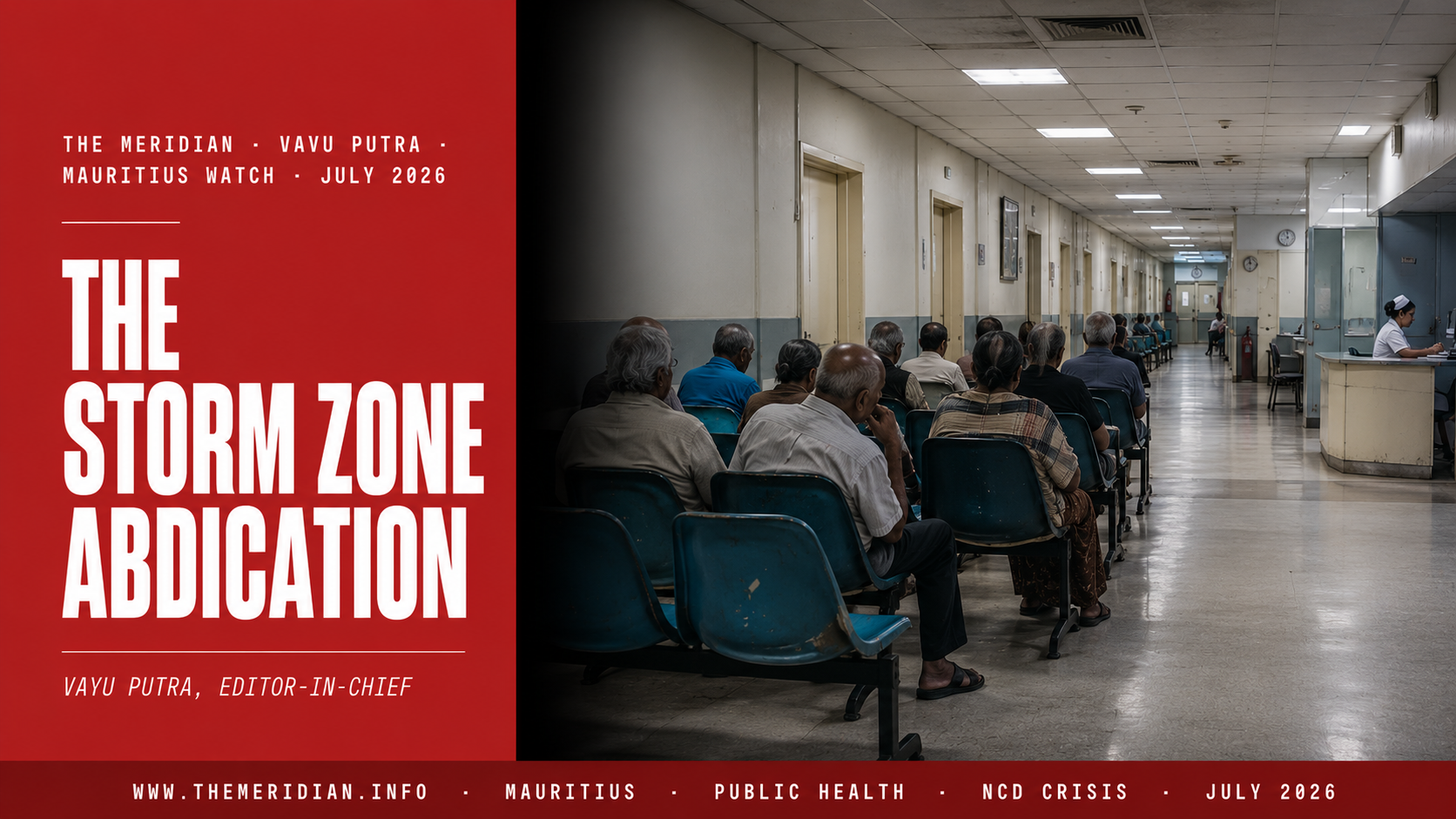
When a state official addresses a national public health crisis, the public expects clarity, accountability, and a roadmap for structural reform. Instead, recent comments from the Ministry of Social Security regarding life expectancy in Mauritius offered a defensive mathematics lesson and, inadvertently, a stunning admission of systemic policy failure.
Defending the statistical reality that life expectancy for a 60-year-old in Mauritius sits around 80 years, the junior minister attempted to reconcile this data with the lived reality of Mauritians who watch their loved ones succumb to early deaths. To explain this, he described the sixties as a “storm zone” of non-communicable diseases like diabetes and cardiovascular illness, essentially splitting the country into two “parallel realities”: those who survive the storm to enjoy modern longevity, and those who do not. The math is not the issue. The World Bank data is indeed accurate. The issue is the framing, which represents a profound abdication of governmental responsibility.
Describing the rampant rates of diabetes, cardiovascular disease, and metabolic illness as a “storm zone” implies that these premature deaths are an unavoidable natural disaster. They are not. They are the direct consequence of long-term, systemic failures in preventative healthcare, food policy, and public health infrastructure. A government cannot throw its hands up and treat the preventable deaths of its citizens as an act of God. Treating early-stage NCDs is a matter of proactive governance. Resigning the population to a survival-of-the-fittest “storm zone” in their sixties is an admission of institutional surrender.
The question is not whether the average is accurate. The question is who in Mauritius is actually expected to reach that average, and whether the pension reform falls hardest on those least likely to do so.
By explicitly stating that Mauritius exists in “two parallel realities,” the minister has inadvertently said the quiet part out loud. The state has failed to provide equitable health outcomes. One reality is inhabited by those with the resources, access, and capital to bypass public sector bottlenecks and manage their health proactively. The other reality is a death sentence for those who rely entirely on an overburdened public system designed for late-stage disease management rather than early prevention. A Social Security mandate exists precisely to close the gap between these realities, not to merely observe it.
Beyond the human tragedy, accepting this high mortality rate is mathematically equivalent to accepting a permanent drain on the Mauritian economy. When a citizen is lost to a preventable NCD in their late fifties or early sixties, the economy is stripped of its most experienced cohort. This is a rapid depreciation of human capital, wiping out decades of institutional knowledge and managerial experience just as those individuals should be mentoring the next generation. Furthermore, capital-intensive, late-stage disease management, such as mass dialysis and acute cardiac care, consumes the lion’s share of national healthcare expenditure. Every rupee spent managing preventable systemic failure is a rupee diverted from productive investments, infrastructure, and economic stabilisation. As Mauritius navigates an ageing population and a constrained labour pool, losing active contributors to the NCD “storm zone” accelerates the dependency ratio in the worst possible way.
The IMF’s Article IV consultation report is real and The Meridian does not dispute it. Pension spending has tripled as a share of GDP over the past decade, from roughly 3 per cent in the early 2010s to nearly 9 per cent in the 2024-2025 financial year. The fiscal pressure is documented. The IMF explicitly supports raising the pension eligibility age from 60 to 65 by 2034 and estimates savings of between 0.3 and 1.6 per cent of GDP. Without further reform, public debt, already at approximately 88 per cent of GDP, could approach 96 per cent by 2040. The Meridian does not dispute any of these numbers.
What The Meridian disputes is not the numbers but the application of them. The IMF report is a surveillance document, not a conditionality agreement. Mauritius is not under an IMF loan programme. It has not drawn on IMF credit facilities. Its SDR allocation remains intact. It borrows bilaterally, from India, from China, and from international bond markets, and none of those bilateral arrangements carry the published structural adjustment conditions that an IMF programme imposes. The reform is a political choice made by a government with fiscal room to make different choices about who bears the cost of adjustment. Citing the IMF report while omitting that distinction is a selective use of institutional authority to shield a political decision from scrutiny.
A national average life expectancy of 80 years at age 60 conceals a distribution. The construction worker in Roche Bois, the textile factory worker in Curepipe, the cane cutter in the south, the woman who spent forty years in a processing facility: these are not the same population as the Port Louis actuary who will benefit from the same statistic.
Life expectancy disaggregated by occupation, income decile, and region in Mauritius produces a different picture from the national average. The IMF does not disaggregate it. The minister did not disaggregate it. The reform, however, is applied to individuals, not to averages. A pension reform that raises the eligibility age using a national average hides the fact that the citizens most likely to die before 65 are precisely those who need the pension most and who spent the most physically demanding decades building the economy the average is meant to represent.
The discourse surrounding national mortality deserves the utmost gravity. It does not require sarcastic dismissals from public officials insisting they are not “magicians,” nor does it warrant petty postscripts complaining about social media detractors. The people of Mauritius do not need magicians. They need policymakers who understand that public health and economic stability are inextricably linked, and who are willing to make the distributional consequences of their choices explicit rather than hiding them behind a population-level average.
It is time to shift the national strategy from expensive, late-stage reaction to aggressive, early-stage prevention. A state that invests in preventive healthcare, food policy reform, accessible screening and early intervention not only reduces the human cost of the NCD crisis. It reduces the fiscal cost that the IMF report correctly identifies as unsustainable. The two goals are not in tension. They are the same goal approached from opposite ends of the disease timeline. Until that shift is made, the “parallel realities” will persist, the economy will continue to pay the price, and the storm zone will continue to be described as weather rather than named as the governance failure it is.
The junior minister cited a real number. The World Bank data is accurate. The IMF fiscal warning is legitimate. The Meridian acknowledges all of it. What The Meridian does not accept is using a national average life expectancy to justify a reform whose distributional burden falls hardest on the citizens least likely to reach that average, and calling that argument a statistical defence rather than a political choice.
Mauritius is not under IMF conditionalities. Every decision about who bears the cost of fiscal adjustment is being made voluntarily, by a government with the political agency to make different choices. The minister did not say that. The reform announcement did not say that. The use of the IMF report as a shield, without acknowledging that Mauritius has not surrendered its sovereignty to it, is precisely the kind of narrative borrowing that this publication exists to name.
Publish the life expectancy data disaggregated by occupation, income decile, and region. Show the Mauritian public which citizens are expected to reach 65 and which are not. Then make the policy argument. Until that data is on the table, the storm zone framing remains what it is: an abdication of institutional responsibility dressed as a mathematics lesson.
Add comment
Comments