The Democratic Accountability Test: What Happens When a Government Loses the People
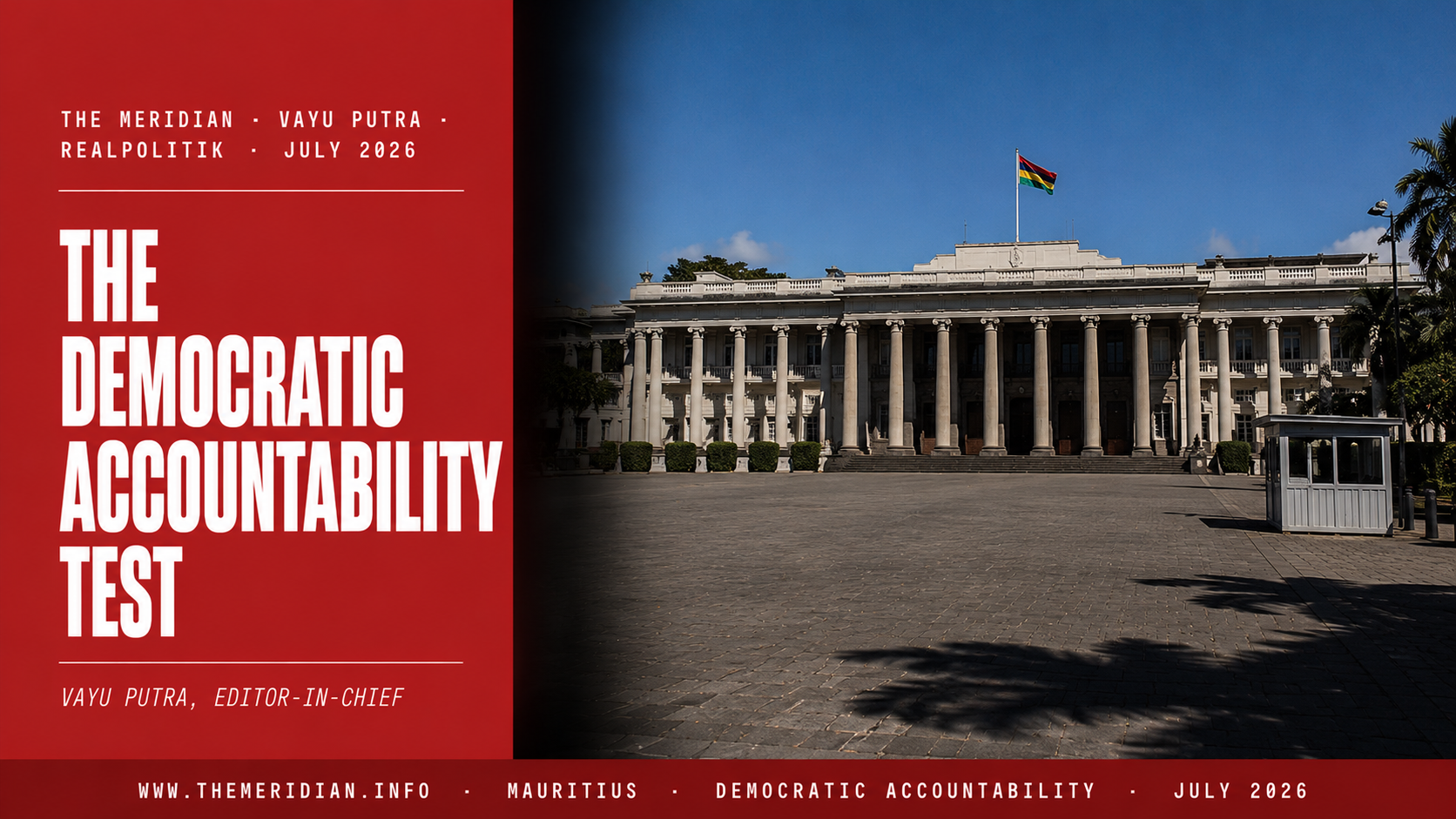
The Meridian does not call for elections. It does not advocate for or against any political party. What it does, in this analysis, is explain precisely what the Mauritian constitution, the labour laws, and the democratic tradition of this republic say happens when a government acts in sustained contradiction of the mandate it was given to govern. The mechanisms exist. The public deserves to know what they are.
Democratic accountability is not a sentiment. It is an architecture. In any functioning constitutional republic, the relationship between a government and the people it governs is not simply a matter of electoral preference expressed once every five years and then suspended until the next polling day. It is an ongoing contractual relationship, defined by the manifesto on which the government sought its mandate, governed by the constitution that sets the boundaries of its authority, and subject at every point to the legitimate mechanisms through which the people may express disagreement, withdraw confidence, or compel a change of course. Mauritius has all of these mechanisms. They have been used before. Understanding them is not a radical act. It is the minimum expectation of an informed citizenry.
The Alliance led by Navin Ramgoolam won the November 2024 general election with a mandate that was specific in its social commitments. The pension was not presented as a fiscal sustainability problem requiring structural reform. The cost of living was identified as the primary concern of the electorate and the primary obligation of the incoming government. The rhetoric of the campaign was one of protection: protection of the elderly, protection of household purchasing power, protection of the most economically vulnerable Mauritians from the consequences of an administration the Alliance characterised as having governed in the interests of the few.
By July 2026, that campaign is not ancient history. It is twenty months old. The Finance Bill through which the pension reform will be legislated into law is the first major legislative test of whether the mandate the Alliance received was genuine or rhetorical. The Platform Komun Syndikal’s march on 11 July, which The Meridian reported in full in this edition, was the population making that test explicit. The constitutional and legal mechanisms this article examines are the framework within which that test will be assessed, by institutions that are older and more durable than any single government.
The Constitution of Mauritius establishes a Westminster-model parliamentary republic. The Prime Minister holds office by virtue of commanding the confidence of the National Assembly. That confidence is not assumed indefinitely by virtue of the electoral result. It is a living constitutional condition, subject to formal challenge through the mechanism of a motion of no confidence. Section 45 of the Constitution provides that the Prime Minister shall cease to hold office if the National Assembly passes a resolution of no confidence in the government and the Prime Minister does not resign within three days of that resolution or advise the President to dissolve the National Assembly within the same period.
This is not a theoretical provision. It is the constitutional architecture that determines the boundary between a government with a mandate and a government that has lost it. The threshold for a vote of no confidence is a majority of the total membership of the National Assembly. The current Alliance holds a substantial parliamentary majority. A vote of no confidence, in the present configuration of the Assembly, is not arithmetically imminent. But the constitutional mechanism exists, it is operative, and its existence is the reason why every Alliance backbencher who campaigns in their constituency and hears their voters speak about the pension is a political variable in the government’s calculation, not simply an instrument of the executive.
The right to strike in Mauritius is protected by Section 13 of the Constitution, which guarantees freedom of association, and given specific legal form by the Employment Relations Act 2008 and its subsequent amendments. A trade union or federation of trade unions wishing to call industrial action, including a general strike, must comply with the applicable notice and procedural requirements. The Platform Komun Syndikal’s announcement on 11 July of an indicative vote in favour of a general strike is the precursor to that process, not the act itself. It is the constitutionally and legally recognised way of placing the government on notice that the procedural machinery of industrial action has been set in motion and that the Finance Bill is the variable that determines whether it proceeds.
A general strike in a small island economy with Mauritius’s specific structural dependencies is not simply a labour dispute. It is an economic event with consequences that extend across the services sector, the tourism industry, the port, the airport, the financial sector, and the public administration. The government that faces a general strike in July 2026, at a moment when investor confidence, FATF compliance, and bilateral debt servicing are all live concerns, faces a compound risk that is considerably larger than the fiscal cost of maintaining the pension at 60. The Platform Komun Syndikal understands this arithmetic. The Finance Bill is the government’s opportunity to demonstrate that it understands it too.
A government does not lose a democratic mandate all at once. It loses it incrementally, through each decision that contradicts the commitment that earned the mandate, until the accumulation reaches a point that the constitutional mechanisms were designed to address.
There is a legal and constitutional debate in democratic theory about whether an election manifesto constitutes a binding contract or a statement of intent. In the strict legal sense, it is the latter. No court in Mauritius or elsewhere would compel a government to implement every manifesto commitment regardless of changed circumstances, fiscal constraints, or new information. That is the correct position. Governments that came to power on the basis of a fiscal picture they subsequently discovered to be materially different from what was represented to them have a legitimate argument for revising their commitments, provided they make that argument transparently and subject it to democratic scrutiny.
What the democratic accountability test asks, however, is not whether the government is entitled to revise its commitments. It is whether the revision is being made transparently, with the distributional consequences named and owned, or whether it is being dressed in the language of technical necessity to avoid the political accountability that a voluntary political choice requires. The Meridian has argued in this edition, across the Storm Zone Abdication article and the analysis of the IMF Article IV report, that the pension reform as currently framed is a political choice being presented as a fiscal inevitability. The democratic accountability test is the mechanism through which the population can respond to that framing. The constitution provides the instruments. The Platform Komun Syndikal has begun to use them.
First: The Finance Bill. The most immediate mechanism. If the Finance Bill materially modifies the pension reform in response to the march, the government demonstrates that public pressure has been heard within the normal legislative process. This is the outcome the Platform Komun Syndikal has specified as its condition for not proceeding to a general strike.
Second: The General Strike. A constitutionally protected form of industrial and civic pressure. It is procedurally complex to organise, economically costly to all parties, and historically effective in Mauritius when the cause is sufficiently clear and the organisation sufficiently broad. The Platform Komun Syndikal’s indicative vote of 11 July is the first step in the legal process that leads to this outcome if the Finance Bill does not satisfy the march’s demand.
Third: The Vote of No Confidence. A constitutional mechanism requiring a majority of the total National Assembly membership. Not arithmetically imminent in the present configuration. But constitutionally operative, and the reason why parliamentary discipline within the Alliance is not simply a matter of loyalty but of political survival for any backbencher whose constituency has spoken clearly on the pension.
Fourth: The 2029 General Election. The ultimate democratic accountability mechanism. Five years is a long time. But the pension reform, the cost of living, and the gap between the November 2024 manifesto and the July 2026 Finance Bill will be on the record when the electorate makes its next assessment. Democratic memory is longer than political cycles in Mauritius.
This article does not call for the resignation of the government. It does not argue that the Alliance has forfeited its mandate. It does not advocate for any political party, any opposition formation, or any specific electoral outcome. The Meridian publishes constitutional analysis, not political campaigns. The mechanisms described in this article are available to every Mauritian government and every Mauritian population, regardless of which party holds office and which holds opposition. They are the architecture of democratic accountability, not the property of any political tendency.
What this article does argue is that informed citizens in a constitutional republic are entitled to know what mechanisms are available to them when they believe their government has acted in contradiction of its mandate. The Platform Komun Syndikal’s march on 11 July was an exercise of constitutional rights that are decades old and belong to no party. The Finance Bill is a legislative instrument that will be read, interpreted, and held to account by institutions, citizens, and ultimately voters who have longer memories than a single news cycle. The democratic accountability test does not end with a march or a Finance Bill or a general strike. It ends when the electorate has the full record in front of it and makes its next choice accordingly.
The Mauritian constitution is not a document that demands a change of government. It is a document that defines the conditions under which a change of government becomes the consequence of a government’s own choices. A motion of no confidence requires a parliamentary majority that does not currently exist. A general strike requires procedural steps that have been initiated but not completed. A general election is three years away. None of these mechanisms is imminent. All of them are operative.
The Finance Bill is the pressure point. It is the moment at which the Alliance government converts its political announcements into binding law, and in doing so, makes its choices visible, permanent, and subject to the full range of constitutional responses that a democratic republic provides to citizens who believe those choices contradict the mandate under which the government was elected.
The people of Mauritius who marched on 11 July did not ask for an election. They asked for a specific legislative response in a specific document. That is the most precise form of democratic accountability available in a functioning constitutional republic: a named demand, a named instrument, and a named consequence if the instrument does not answer the demand. The government has been given all three. What it does with the Finance Bill is its answer.
Add comment
Comments