The Minimum Wage Revolution: The Law That Changed the Architecture of Slavery in the Global South
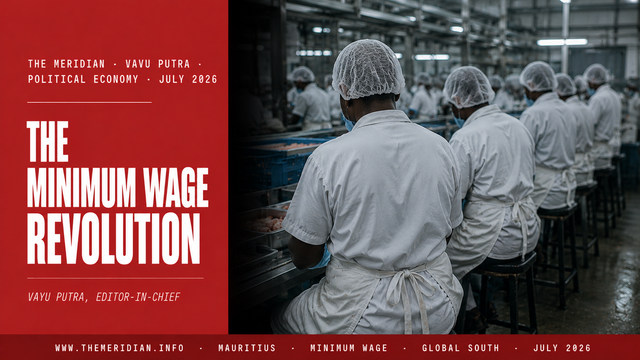
In 2008, I called for a National Minimum Wage in Mauritius. I proposed Rs 8,500 per month, with a structured annual increase mechanism to reach a living wage over time. The government of the day did not act. Ten years later, the MSM government of Pravind Jugnauth introduced the National Minimum Wage at Rs 9,000 per month, effective 1 January 2018. It was the most important labour law passed in Mauritius since independence. Most of the Global South does not understand why.
Before the National Minimum Wage, Mauritius had legal slavery by another name. Not in the historical sense of chattel slavery, which this republic formally abolished long before independence. But in the economic sense that matters in the twenty-first century: a system in which the purchase of human labour at any price was legally permissible, in which an employer could pay a person Rs 1,500 per month for a full working week and the state had chosen, structurally, to permit it. Permitted it because the Remuneration Orders that governed sector-by-sector wages covered only registered formal sector employers and left vast categories of workers, domestic workers, casual agricultural labourers, security guards in the informal economy, small construction site workers, entirely outside any legal floor. The state did not set a price below which human labour could not be sold. It left that price to the employer. In a captured economy with state monopolies on energy, water, fuel and telecommunications, the people with the least bargaining power were paying administered prices for necessities while their own labour was priced by whoever had the power to set the terms.
I made the case for a National Minimum Wage in Mauritius in 2008, as an economist who had been observing the low-wage trap that Mauritian economic policy had constructed, reinforced, and defended for the better part of two decades. The number I proposed was Rs 8,500 per month, with an annual escalation mechanism tied to the cost of living. The argument was straightforward. In the absence of a legal floor, the labour market in Mauritius was not a market in any meaningful sense. It was a monopsony: a structure in which employers in labour-intensive sectors, textiles, tourism, agriculture, domestic services, had sufficient collective market power to set wages well below what a genuinely competitive labour market would produce, and in which workers with no legal protection, no credible outside option, and no union coverage had no effective mechanism to resist.
The government of the day did not introduce a minimum wage. The response, in various forms across the 2005-2014 period, was that a minimum wage would damage competitiveness, burden small employers, threaten jobs in the export processing zone and the textile sector, and distort the natural operation of the labour market. These arguments were not entirely without basis. They were also, in the view of an economist who had studied what Mauritius was actually doing to its labour force, a rationalisation for a political choice to keep a segment of the population economically dependent and therefore politically compliant. The Dynastic Capture framework published elsewhere in this edition describes the patronage economy that the low-wage trap serves. A population that is economically independent does not need the dynasty. A population earning Rs 1,500 a month does.
In 2008, I proposed Rs 8,500. The National Wage Consultative Council, after years of formal study, recommended Rs 8,000 rising to Rs 8,500 in 2019. The government set it at Rs 9,000. The official advisory body arrived, a decade later, at the same number I had proposed in 2008. The ten-year delay had a cost. It was paid by the people earning Rs 1,500 a month.
To understand why the minimum wage argument was resisted for so long, it is necessary to understand the strategic choice Mauritius made, or failed to make, at the end of the twentieth century. Between 1995 and 2000, Mauritius stood at a fork in the road that every successful late-industrialising economy faces at a certain stage of development. The textile and export processing zone model that had driven Mauritius's post-independence growth was approaching its natural ceiling. The Multi-Fibre Arrangement that had protected Mauritian garment exports from full global competition was being phased out under WTO negotiations. The writing was visible to any economist paying attention: the low-cost, low-skill, labour-intensive manufacturing model that had served Mauritius through the 1980s could not survive the arrival of Bangladesh, Cambodia, Vietnam, and Sri Lanka as competitors offering wages that Mauritius could not match and would not want to match if it had chosen to move up the value chain.
Taiwan made the choice. Singapore made the choice. South Korea made the choice. They accepted rising wages as a signal of development rather than a competitive threat, invested aggressively in skills, technology and manufacturing sophistication, and moved their economies progressively up the value chain until their workers were producing goods that could not be competed away by a competitor offering lower wages, because the goods required capabilities the competitor did not have. Mauritius had the institutional foundations, the literacy rate, the legal system, the financial sector and the geographic position to make the same choice. Instead, between 1995 and 2000, it doubled down. It deepened its dependence on imported foreign labour to keep textile wages suppressed. It continued relying on heavy oil and coal for cheap industrial energy. It treated competitiveness as a function of keeping wages low rather than skills high. That was not an economic miscalculation. It was Machiavellian governance: a deliberate political choice to maintain a low-wage, low-skill, labour-dependent economic structure that kept a large section of the population economically dependent and therefore politically manageable.
A national minimum wage is not a wage subsidy. It is not a social transfer. It is not a government payment to workers funded by the taxpayer. It is a legal constraint on the price at which human labour can be purchased. It says, with the full force of law: below this number, the transaction is not permitted. The state has decided that human labour has a minimum value, and that no private agreement between an employer and an employee, however apparently voluntary, can legally set the price of that labour below the floor.
This is why the minimum wage is, in the history of labour economics, one of the most politically contested interventions the state can make in a market economy. It directly overrides what employers and workers agree to in the absence of the law. In doing so, it makes explicit something that free market economics prefers to leave implicit: that a transaction between a worker who has no credible outside option and an employer who controls the only available job is not a market transaction in any meaningful sense. It is a coerced exchange dressed in market language. The minimum wage does not eliminate that coercion. But it sets a floor below which the coercion cannot legally operate.
The National Minimum Wage in Mauritius was introduced by the MSM government of Prime Minister Pravind Jugnauth, effective 1 January 2018. This is a historical fact and it deserves to be recorded as such, without partisan qualification. The government set the rate at Rs 9,000 per month, above the Rs 8,000 to Rs 8,500 range that the National Wage Consultative Council had recommended, and despite significant opposition from employer organisations who argued, as employer organisations always argue when minimum wage legislation is proposed, that it would damage competitiveness, burden small enterprises, and threaten employment in labour-intensive sectors.
The employer organisations were wrong, as the employment data for the post-2018 period demonstrates. Mauritius did not experience the mass job losses that the opponents of the minimum wage predicted. What it experienced was a redistribution of income toward the bottom of the wage distribution, a reduction in the most egregious forms of wage exploitation in the domestic service and informal sectors, and a gradual upward pressure on wages in sectors that had previously competed primarily on the basis of paying as little as legally possible. The government that introduced this law understood the economic mechanism it was operating. The MSM under Pravind Jugnauth deserves credit, in the historical record, for having acted where the previous administration had not, and for having set the rate above the advisory body's recommendation rather than below it.
What Mauritius ended in January 2018, most of the Global South has not yet ended. Across sub-Saharan Africa, large portions of the labour force work without any legal floor on their wages. In Bangladesh, the garment sector minimum wage covers only the formal sector and is set at levels that the ILO and multiple independent assessments have found to be below the actual cost of living. In the Gulf states, the kafala system structurally prevents workers from leaving employers who underpay them, making the concept of a minimum wage functionally meaningless in the absence of freedom of movement.
In country after country across Asia, Africa, and the Pacific, the pattern is identical to what Mauritius had before 2018: sector-specific wage orders covering only registered formal employers, leaving the majority of the actual workforce in the informal economy with no legal protection whatsoever. The ILO estimates that more than 60 per cent of the global workforce is employed in the informal economy. For those workers, the absence of a national minimum wage is not a market outcome. It is a political choice by their governments to permit their exploitation.
Naming this masked slavery is not hyperbole. When the state has the legal capacity to set a floor on the price of human labour and chooses not to exercise it, the state has chosen to make the purchase of human labour at any price legally permissible. That is a political decision. It should be described as one.
The Tin Tuna Index, The Meridian's proprietary measure of the purchasing power of the minimum wage in terms of the most basic nutritional unit available in a given economy, puts the Mauritius NMW in its proper context. At Rs 17,110 per month in 2026, a full-time Mauritian worker earning the minimum wage can purchase approximately 100 tins of standard canned tuna per month of earnings. That is not prosperity. It is a floor, and a low one relative to the actual cost of living in an economy where energy, water, fuel and telecommunications are all state-administered rather than competitively priced. The captured economy that Vayu Putra describes in the companion essay in this edition extracts administered prices for necessities from the same workers who receive the minimum wage. The floor is real. But the ceiling imposed by the captured economy is also real, and it compresses the living standards that the floor was designed to protect.
This does not diminish the minimum wage's importance. It contextualises it. The NMW ended the most extreme forms of wage exploitation in Mauritius. It did not end the structural conditions that make the minimum wage necessary in the first place. Ending those conditions requires the liberalisation agenda described in the Captured Economy essay: genuine competition in energy, water, fuel and telecommunications so that the workers protected by the wage floor are not simultaneously subjected to administered prices for the inputs to their daily lives. The minimum wage and economic liberalisation are not alternative policies. They are complementary ones. The floor on the price of labour and the ceiling on the price of necessities are the two policy levers that together determine whether a working household can actually build a life.
The National Minimum Wage is not a perfect policy. It is an insufficient one in an economy where the captured architecture of state monopolies extracts administered prices from the same workers the wage floor is meant to protect. It covers formal sector workers better than informal ones. It sets a floor that is real but low relative to actual living costs. It does not, by itself, break the low-wage low-skill trap that Mauritius has spent thirty years constructing. None of this diminishes what it did.
What it did was simple and profound in equal measure. It said: in this republic, there is a price below which we will not permit human labour to be purchased. That sentence had never been written into Mauritian law before January 2018. It has been written now. The government that wrote it understood what it was doing and had the political will to do it over the objections of the employer organisations that benefited from its absence. The Meridian records that fact without partisan purpose and without qualification.
The Global South needs to understand this mechanism. Not as an ideological preference for state intervention in markets. As the recognition that in the absence of a legal floor on the price of human labour, the market sets that price at whatever the most exploitative employer is willing to offer. In a world where 60 per cent of workers have no minimum wage protection, the architecture of masked slavery is not history. It is the present operating condition of the majority of the world's workforce. The Mauritius case proves that a small island economy with limited resources and significant competitive pressures can set that floor and not collapse. It proves that the choice not to set it, everywhere it has not been set, is a political choice. And it should be named as one.
Add comment
Comments