The Captured Economy: Why Mauritius Is Not a Free Market and Who Benefits From It Staying That Way
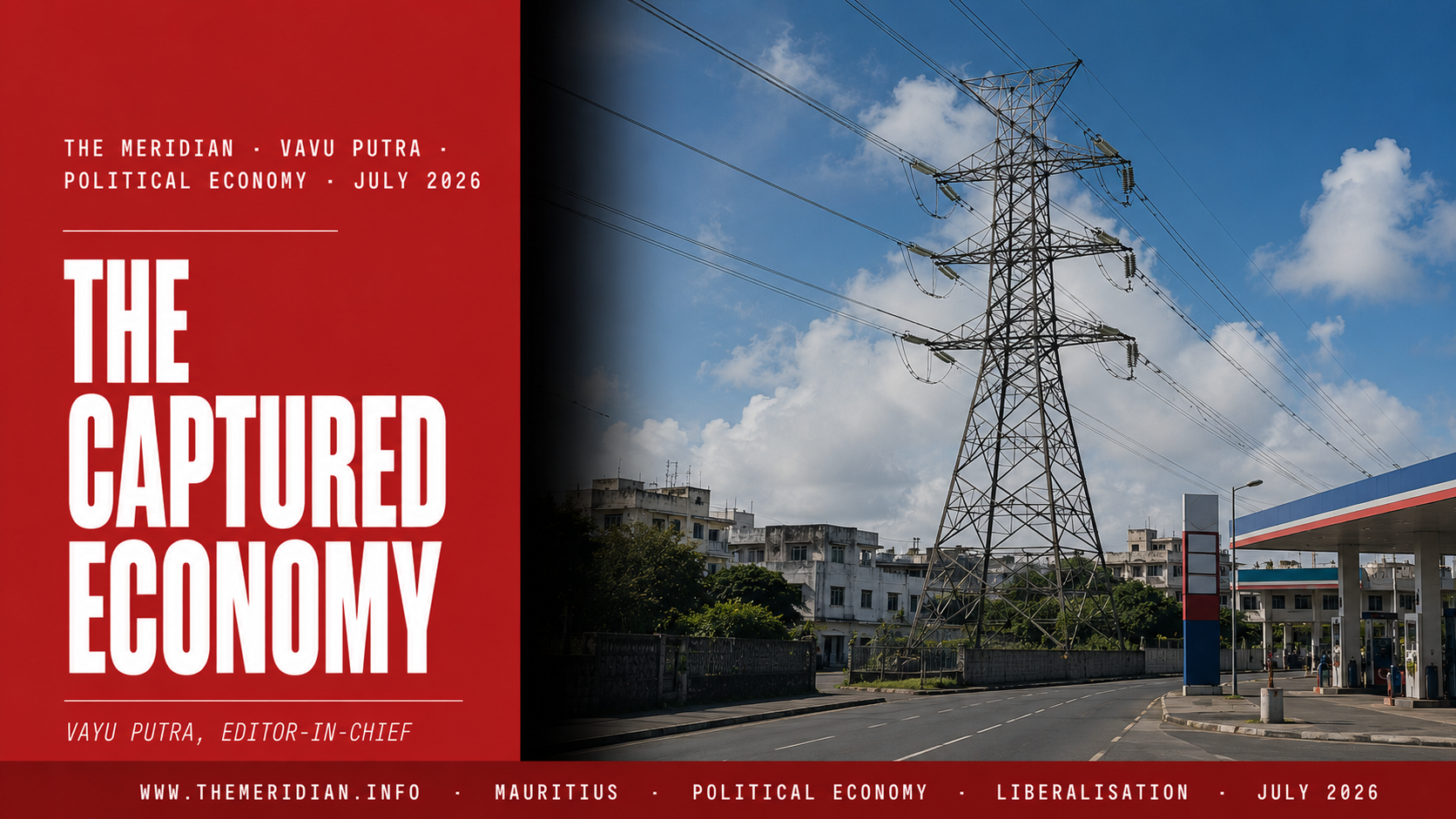
Mauritius markets itself to the world as a business-friendly, open economy with low taxes and a liberalised financial sector. That description is accurate for the offshore financial centre, the IRS villa market, and the export processing zone. It is not accurate for the economy in which 1.3 million Mauritians actually live. That economy is captured: administered at every point where a citizen spends money, controlled by state monopolies, distorted by subsidy loops, and structurally organised to suppress domestic wage competition while protecting the industries that benefit from it.
The definition of a free market is straightforward: a system in which prices are determined by the interaction of supply and demand, in which multiple competing providers give consumers genuine choice, and in which the cost of goods and services reflects actual production costs rather than administered decisions made by a state entity or a politically connected monopoly. By this definition, Mauritius is not a free market. It is a company town in which the state controls the inputs to daily life with the thoroughness of a colonial-era plantation management structure and then presents the result to international investors as evidence of openness. The contradiction is not accidental. It is the architecture of a political economy designed to serve specific beneficiaries while keeping the domestic population economically dependent.
The capture architecture of the Mauritian economy rests on four institutional pillars, each of which operates in a different domain of daily economic life and each of which, individually, might be defensible on narrow grounds. Together, they constitute a comprehensive system of administered prices that eliminates real economic choice for the Mauritian household and the Mauritian SME while preserving competitive pricing for the sectors that the state has chosen to privilege.
The State Trading Corporation controls fuel pricing. No market mechanism determines what a Mauritian family pays at the petrol pump, what a fisherman pays for diesel, what a bakery pays to run its ovens, or what a transport operator pays to run the vehicles that connect the island's communities. The STC purchases petroleum products on international markets and sets domestic retail prices through an administrative process that is formally subject to regulatory oversight but is in practice a political decision about who bears the cost of international price fluctuations. When oil prices rise globally, the STC can absorb the cost through its price stabilisation mechanism, delaying the pass-through to consumers. When oil prices fall, the STC can retain the margin. The household has no choice of supplier, no ability to seek a better price, and no mechanism to signal its preferences to the market other than using less fuel, an option that is structurally constrained by the absence of viable public transport alternatives across most of the island.
The Central Electricity Board controls electricity generation and distribution. The SME that wants to power its manufacturing process, the household that wants to run its air conditioning through a Mauritian summer, and the hotel that wants to keep its pool lit at night all buy electricity from a single supplier at a price that supplier sets through a regulatory process the supplier substantially controls. The partial liberalisation of renewable energy generation through the feed-in tariff programme has introduced some limited competition at the generation level, but distribution remains a CEB monopoly. The household cannot switch providers. The SME cannot negotiate a competitive rate. The price is administered.
The Central Water Authority controls water supply. Water in Mauritius is not priced by a competitive market. It is allocated and priced by a state authority whose infrastructure investment decisions, pricing policy, and service quality are determined by political rather than market processes. The chronic unreliability of water supply across large parts of the island, documented extensively in this edition's coverage of civic infrastructure failures, is not a market failure in any meaningful sense. It is a governance failure: the consequence of a state monopoly that faces no competitive pressure to improve service quality because its customers have no alternative provider.
Mauritius Telecom, despite partial liberalisation of the telecommunications sector, continues to exercise market power in fixed-line infrastructure that shapes the competitive environment across the entire sector. The mobile and internet markets have more competition than energy or water, but the infrastructure foundation on which that competition rests remains largely under MT's structural influence.
The sugar industry is the clearest illustration of what captured economy logic produces when applied to a commodity that the domestic state cannot price on the world market. Mauritius is a price-taker in global sugar markets, not a price-setter. Unlike OPEC, which controls sufficient share of global oil production to influence international prices, Mauritius produces a volume of sugar that is entirely irrelevant to world market pricing. The global sugar price is determined by Brazil, India, Thailand and the European Union. Mauritius accepts whatever that price happens to be.
The consequence is a structural viability problem. When world sugar prices fall, as they periodically do and as they have done for extended periods over the past two decades, Mauritian sugar production is not commercially viable at its actual cost of production. The state's response to this problem has not been to allow the market to determine whether the industry should contract, diversify, or exit. The response has been a tax-and-subsidy loop: a levy on sugar that funds subsidies on fertiliser, equipment and other production inputs, recycling money from the sugar industry back into the sugar industry to keep production viable at a world price that would otherwise make it uneconomic. The taxpayer funds the survival of an industry whose product is priced by someone else entirely, with no competitive discipline operating to force the industry to adapt its cost structure, diversify its product range, or invest in the productivity improvements that would make it genuinely competitive without state support.
The sugar industry is not a market participant. It is a ward of the state, kept alive by an administrative support system that insulates it from the competitive pressures that would force it to change, at the cost of the taxpayers who fund the insulation and the consumers who pay administered prices for the inputs the industry requires.
The most consequential dimension of the captured economy, in terms of its effect on the living standards of the Mauritian population, is the systematic use of imported foreign labour to suppress domestic wage competition in labour-intensive sectors. This mechanism operates through a precise economic logic. In a genuinely competitive labour market, employers in manufacturing, hospitality, agriculture, and domestic services would compete for Mauritian workers, and that competition would generate upward pressure on wages and skill levels. Workers would have credible outside options. Employers would have incentives to invest in productivity improvements that would allow them to pay more. The economy would be pushed, by competitive pressure, up the value chain.
The importation of foreign labour at scale interrupts this mechanism at its source. When a Bangladeshi worker processing tuna in a Mauritian cannery earns Rs 17,110 per month under the national minimum wage, the wage floor is being respected. But the domestic Mauritian worker who might otherwise have been employed in that position, at a wage determined by competitive market pressure, has been replaced by an imported worker whose willingness to accept the minimum wage is determined not by what Mauritian wages are but by what wages in Bangladesh are. The competitive pressure that would drive Mauritian wages above the minimum wage floor has been neutralised by importing workers whose reference point is a different economy entirely.
This is not an argument against the presence of foreign workers in Mauritius, who perform real and valuable economic functions and whose rights this publication has documented and defended in the Human Rights Edition. It is an argument about economic policy design. The scale and sectoral distribution of foreign labour importation in Mauritius has been used, as a matter of deliberate policy, to maintain the competitiveness of labour-intensive export sectors by keeping their labour costs at the minimum wage floor rather than allowing them to rise through market competition. The workers who bear the cost of this policy are the Mauritian citizens who would otherwise have greater bargaining power in those sectors, and the foreign workers who arrive with limited rights and no ability to change employer.
The captured economy is compounded by a structural dollar dependency that makes genuine monetary sovereignty difficult to exercise. Mauritius imports labour, raw materials, machinery, energy inputs and a significant proportion of its food from external markets priced in dollars or euros. The rupee's value is therefore substantially determined by the island's ability to generate dollar earnings through exports, tourism, financial services and remittances rather than by domestic productivity growth.
This creates a perverse incentive structure. The administered prices of fuel, electricity and water, which are themselves substantially dollar-cost inputs, are set in rupees by state entities that absorb the exchange rate risk rather than passing it to consumers. When the rupee weakens, as it has done persistently against the dollar over the past decade, the real cost of every administered input rises, and the state entity absorbs that cost through its balance sheet rather than the consumer through their utility bill. The subsidy is real but invisible. Its fiscal cost is borne by the same taxpayers who pay the administered prices, once through their taxes and once through their utility bills.
A genuinely open economy would allow the price of dollar-cost inputs to be determined by the exchange rate. Mauritius instead administers those prices through state entities that absorb the exchange rate risk, creating fiscal costs that are politically invisible but economically real and growing.
I call for the end of the subsidy architecture and the genuine liberalisation of the Mauritian economy. Not as an ideological position derived from free market theory, but as an economist's assessment of what the current structure is costing the Mauritian household, the Mauritian SME, and the Mauritian economy's long-run capacity to generate the productivity growth that would make higher wages sustainable rather than administratively enforced.
Genuine competition in energy would force the CEB to invest in grid efficiency and renewable generation not because regulation requires it but because competitive pressure demands it. A competitor offering cheaper solar-generated electricity would take customers that the CEB currently retains through its monopoly position. The CEB would have to match the price or lose the revenue. The investment that would follow from that competitive pressure would reduce the cost of energy across the economy, improve the reliability of supply, and reduce the fiscal cost of the administered price system that currently absorbs the exchange rate risk of dollar-cost fuel imports.
Genuine competition in fuel distribution would allow market pricing to determine what Mauritians pay at the pump, removing the political decision-making from the STC's price-setting process and giving consumers the benefit of international price falls rather than having those benefits absorbed by the STC's stabilisation mechanism. It would also remove the implicit subsidy to fuel-intensive industries, including the sugar industry, that benefits from administered fuel prices below market cost.
A genuine labour market policy that managed the sectoral and volume distribution of foreign labour importation to serve skills gaps rather than wage suppression would allow domestic wages in labour-intensive sectors to rise through competitive pressure, generating the upward mobility for lower-income Mauritians that the minimum wage floor alone cannot deliver. The NMW sets the floor. A competitive labour market determines how much above the floor wages actually settle. Currently, the foreign labour mechanism prevents wages from rising significantly above the floor in the sectors where the most economically vulnerable Mauritians work.
The political economy question that explains why the captured economy persists despite its costs is not a difficult one to answer. It requires only asking who benefits from each element of the capture architecture remaining intact. The STC's administered fuel prices benefit the large fuel consumers, primarily industrial operators, hotel groups and transport companies, who receive stable input costs regardless of international price volatility and who would face genuine market exposure if fuel were competitively priced. The CEB's monopoly benefits the large industrial electricity consumers who have negotiated preferential tariff structures that would be exposed to competitive scrutiny in an open market. The sugar subsidy loop benefits the plantation companies and landowners who would otherwise face the market discipline of an internationally uncompetitive industry. The foreign labour mechanism benefits the export-oriented manufacturers and hospitality operators who compete on international markets partly on the basis of keeping their Mauritian wage costs at or near the minimum wage floor.
These beneficiaries are, collectively, among the most politically connected economic actors in Mauritius. Their relationship with successive governments is documented, visible in procurement contracts, board appointments, and the regulatory decisions that have preserved the capture architecture across multiple administrations of different political colours. The Dynastic Capture framework published elsewhere in this edition describes the mechanism through which politically connected economic actors sustain their position across government changes. The captured economy is one of the primary assets those actors are protecting.
The Doing Business index ranks Mauritius highly. The Heritage Foundation's Index of Economic Freedom gives it strong marks for trade openness and fiscal policy. The offshore financial centre genuinely operates with the low taxes and light regulation those indices reward. None of this changes the domestic reality: that the 1.3 million people who live in Mauritius rather than investing in it face administered prices for fuel, electricity, water and communications, suppressed domestic wage competition in the sectors where they are most likely to work, and a sugar industry kept alive by their taxes rather than by its own competitive viability.
Genuine liberalisation would produce more jobs, not fewer. It would produce higher wages in labour-intensive sectors, not lower ones. It would produce greater skills demand, not less. It would break the low-wage low-skill trap that the captured economy has maintained for thirty years. It would also threaten the specific economic interests of the politically connected actors who benefit from the capture remaining intact.
That is why it has not happened. Not because economists have not made the case. I made part of it in 2008, and the argument is stronger now than it was then. It has not happened because the people who benefit from the capture have the political relationships to prevent it from happening, and the people who bear the cost of the capture, the household paying administered prices, the worker whose wages are suppressed by the foreign labour mechanism, the SME paying monopoly prices for electricity and water, are precisely the people whose political leverage is smallest. Naming that asymmetry is the first step toward changing it.
Add comment
Comments