Who Owns the Land: IRS Villas, Foreign Capital and the Mauritian Shoreline
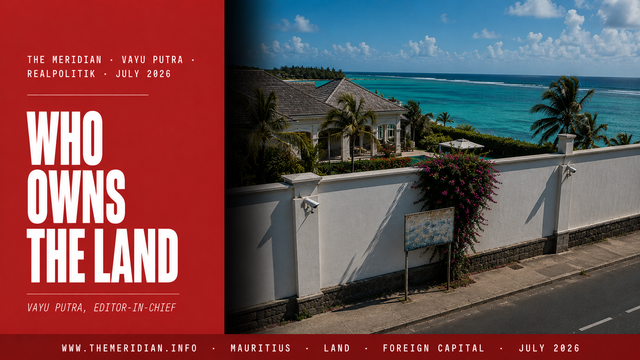
The grandparents of the current generation of Mauritians fished the lagoon that a foreign buyer now owns the view of. The road to the beach that those grandparents walked was built with Mauritian public funds. The electricity, water and sewage infrastructure serving the villa compound behind the perimeter wall was funded by Mauritian taxpayers. The Integrated Resort Scheme produced foreign direct investment. It also produced something that the investment figures do not capture: a systematic transfer of the island's most irreplaceable asset, its coastal land, to foreign ownership at exchange rates and tax terms that no Mauritian household could access.
Land is the only asset an island cannot produce more of. In a country whose entire economic identity is built around the beauty and accessibility of its coastline, the decision about who owns that coastline is not merely a property rights question. It is a question about the intergenerational distribution of the island's primary non-reproducible asset, about who captures the long-run appreciation of that asset as Mauritius's international profile grows, and about what the state chose to optimise when it designed the framework that determined the answer. The Integrated Resort Scheme, launched in 2002 and subsequently expanded and rebranded through the Property Development Scheme and the Smart City Scheme, was presented to the Mauritian public as a mechanism for attracting foreign direct investment. It was all of that. It was also a mechanism for transferring title to the island's coastline from Mauritian ownership to foreign ownership, on terms that were structurally advantageous to the foreign buyer in ways that the FDI headline figure was never designed to make visible.
The IRS, as originally designed, permitted foreign nationals to purchase residential property in Mauritius for a minimum investment threshold of USD 500,000, with the purchase conferring the right to Mauritian residency. This was the headline mechanism, and it was presented primarily as a residency-by-investment programme comparable to those offered by Malta, Portugal and other countries seeking to attract high-net-worth individuals. The residency benefit was real and has proven attractive to a specific category of international buyer: retirees and semi-retirees from France, South Africa, the United Kingdom and the Gulf states seeking a stable, English and French-speaking island environment with good weather, reliable healthcare, and favourable tax treatment.
What was not made equally prominent in the public presentation of the IRS was the FX arbitrage mechanism embedded in the scheme's structure. A French buyer spending EUR 500,000 on an IRS villa in 2005, when the euro-rupee exchange rate was approximately 42, was purchasing an asset whose rupee value was Rs 21 million. By 2026, with the euro-rupee rate at approximately 48, the same asset's value in euros has appreciated with Mauritian property market growth, but its rupee value has appreciated even faster because the rupee has depreciated against the euro across the intervening two decades. The foreign buyer purchased a hard currency claim on a rupee-denominated asset in an economy where the rupee's long-run trajectory, driven by the import dependency and dollar vulnerability that the Captured Economy essay in this edition documents, is structurally downward against the currencies of the buyers' home economies. The FX dynamic made the IRS a structurally advantageous investment for the foreign buyer in ways that went beyond the property fundamentals.
The IRS and PDS frameworks include a tax structure that is explicitly unavailable to the Mauritian citizen who purchases a non-IRS property in their own country. A foreign buyer who acquires IRS or PDS residential property in Mauritius and becomes a resident under the scheme pays no Mauritian tax on income earned outside Mauritius. There is no capital gains tax on the eventual sale of the property. There is no inheritance tax in Mauritius that would apply to the transfer of the asset to their heirs. The combination of zero foreign income tax, zero capital gains, and zero inheritance tax on a hard currency asset in a stable, well-governed island economy with a strong legal system is, by the standards of international wealth management, an extraordinarily attractive structure.
The Mauritian citizen who purchases a property in their own country does so with income that has been subject to Mauritian income tax, in a transaction subject to registration duties, on an asset whose future sale will not benefit from any equivalent exemption structure. They are buying in rupees, with rupee-denominated income, in an economy whose currency is structurally vulnerable to the dollar dependency that the Captured Economy essay documents. The foreign IRS buyer and the Mauritian citizen are purchasing property in the same country. They are doing so under fundamentally different fiscal and currency conditions, structured by the state to be advantageous to the foreign buyer in ways that reflect a deliberate policy choice about whose interests the land sale framework was designed to serve.
The grandparents fished the lagoon. The parents watched the perimeter wall go up. The children read a sign that says public beach access and follow the path that leads to a gate with a security camera. The IRS did not privatise the beach in law. It privatised the approach to it in practice.
The IRS villa does not exist in isolation from the Mauritian public economy. The road that provides access to the compound was maintained, and in many cases built or upgraded, with Mauritian public funds. The CEB connection that supplies electricity to the villa was installed and maintained by the state monopoly whose administered prices are funded by all Mauritian consumers. The CWA water supply serving the compound, the sewage infrastructure, the coastal road lighting, the emergency services that cover the surrounding area: all of these are public goods funded by Mauritian taxpayers, whose value is capitalised into the price of the IRS property that the foreign buyer purchased.
This is the public infrastructure subsidy that the FDI headline figure consistently obscures. When a foreign buyer pays USD 500,000 for an IRS villa and the Mauritian Board of Investment records a USD 500,000 FDI inflow, the accounting is accurate as far as it goes. What it does not record is the present value of the public infrastructure that Mauritius has committed to maintaining for the benefit of that property in perpetuity, funded by taxpayers who receive no share in the property's appreciation. The IRS was designed to attract foreign capital. It was not designed to ensure that the Mauritian taxpayer who funds the infrastructure serving IRS compounds captures any of the value that infrastructure creates.
The IRS FX arbitrage mechanism operates through a simple but powerful dynamic that the Mauritian public conversation has consistently underweighted. Foreign buyers purchase rupee-denominated assets with hard currency. The rupee's long-run trajectory against the euro, the dollar and the South African rand has been downward, driven by the structural import dependency and current account dynamics that characterise a small island economy that imports labour, raw materials, machinery and a significant proportion of its food.
This means that a foreign buyer who purchased an IRS villa in 2005 at EUR 500,000 holds an asset that, in their home currency terms, has appreciated with the property market and additionally benefited from the rupee's depreciation against the euro over the intervening two decades. The rupee cost of that villa has risen in nominal terms. The euro cost has risen more slowly, and in some periods has not risen at all from the buyer's perspective, because the currency movement has absorbed part of the rupee price increase.
The foreign buyer is long a rupee asset with a euro liability structure: they earn in euros, the asset is priced in a depreciating currency, and the tax framework exempts any gain from Mauritian taxation. The Mauritian citizen buying the house next door is short the same dynamic: they earn in rupees, the asset is priced in rupees, and every input to their daily life that is dollar-denominated becomes more expensive as the rupee depreciates. Same island. Different economic universe.
The IRS economy generates employment. This is the argument that has most consistently been used to defend it against criticism, and it is not without substance. The construction of IRS villas employs Mauritian construction workers. The maintenance and management of completed compounds employs domestic service workers, gardeners, security staff, and property managers. The spending of IRS residents in the local economy generates revenue for Mauritian service businesses.
What the IRS labour market does not generate, in any significant volume, is the high-skill, high-wage employment that the human capital trap essay documents as the category of employment the Mauritian economy most conspicuously fails to produce. The IRS economy's labour demand is concentrated at the lower end of the skill and wage distribution: domestic service, maintenance, security, construction. These are not the occupations that retain the engineers, the doctors, the accountants and the IT professionals that the Mauritian education system produces and the UK, Canada and Australia then hire. The IRS economy and the human capital trap are not unrelated phenomena. They are complementary features of the same economic structure: a captured economy in which the most internationally visible economic activity, the luxury villa market, generates demand for low-skill labour while the high-skill labour the education system produces finds no market and leaves.
The political economy of the IRS and PDS follows the same logic as the political economy of the captured economy more broadly. The beneficiaries of the IRS framework are identifiable, politically connected, and concentrated. The landowners and developers who sell IRS properties capture the USD 500,000 minimum threshold plus whatever premium the market supports above it. The construction companies that build the villas, which are drawn substantially from the same politically connected corporate network that benefits from public procurement in other contexts, capture the development margin. The professional services firms, law firms, property management companies, and financial advisers who structure and service IRS transactions capture their fees. The foreign buyers capture the asset, the residency, the tax structure and the FX arbitrage.
The people who bear the cost of this arrangement are the Mauritian taxpayers who fund the public infrastructure serving IRS compounds without capturing any of the value that infrastructure creates; the Mauritian households priced out of coastal land by an IRS market that has placed premium on properties that were previously accessible to a broader segment of the population; and the Mauritian fishermen, the beach-goers, and the communities whose relationship with the coastline their grandparents worked was gradually replaced by perimeter walls, security cameras, and access signs that lead to gates that do not open.
The IRS and PDS are not inherently wrong as policy instruments. Small island economies with Mauritius's profile have legitimate reasons to attract foreign capital, to offer residency incentives to high-net-worth individuals, and to develop the property market in ways that generate construction employment and tourism spillovers. None of that is the argument this essay makes.
The argument is about the terms of the deal. A framework that transfers title to irreplaceable coastal land at FX rates structurally advantageous to the foreign buyer, under a tax architecture explicitly unavailable to the Mauritian citizen, serviced by public infrastructure funded by Mauritian taxpayers who capture none of the resulting land value appreciation, is a framework designed to optimise the return to the foreign buyer and to the politically connected developers who supply the product. It was not designed to optimise the return to Mauritius.
The question Mauritius has never publicly answered, because the political economy of those who benefit from the IRS framework has ensured it is never seriously asked, is what share of the long-run appreciation of its most irreplaceable asset should accrue to the Mauritian public that funded the infrastructure, maintained the legal system, and built the stable governance environment that makes the asset valuable in the first place. That is the question the IRS registry answers, quietly, every time a foreign name appears as the registered owner of another piece of the shoreline that the grandparents fished.
Add comment
Comments