The Tiger With No Claws: Mauritius, the Trade Deficit and the Economy That Imports Everything It Needs to Survive
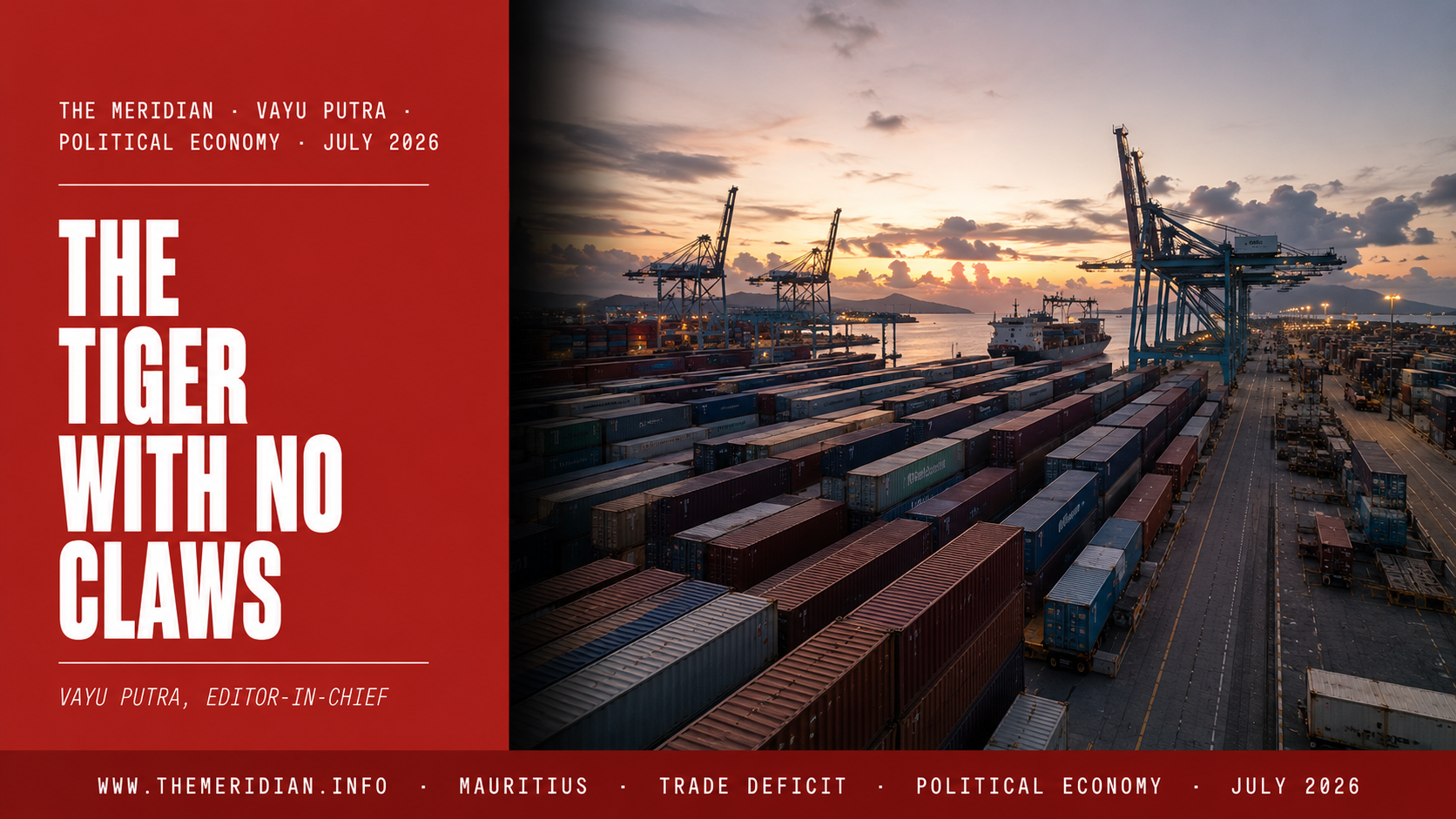
Mauritius calls itself the Tiger of Africa. The brand is polished, the rankings are favourable, and the pitch to international investors is compelling. Then you look at the balance sheet. In May 2026, Mauritius imported Rs 31.64 billion of goods and exported Rs 9.28 billion. The monthly trade deficit was Rs 22.36 billion. Fuel alone cost Rs 11.31 billion, purchased through a state monopoly that has never faced a competitor. This article explains what that means, why it matters, and why the answer is not more administration but genuine economic freedom.
Let us begin with something most Mauritians have never been taught because the school curriculum does not teach it and the political class does not discuss it: what a trade deficit actually is, why it matters, and why the number that Statistics Mauritius published on 17 July 2026 is one of the most important economic facts about this country that most of its citizens will never see reported with the seriousness it deserves. A trade deficit is not complicated. It is a household budget problem applied to an entire country. If your household earns Rs 9,000 a month and spends Rs 32,000 a month, you have a deficit of Rs 23,000. You cover that gap through savings, through borrowing, or through selling something. When the savings run out and the borrowing becomes expensive, the gap becomes a crisis. Mauritius has been running this household budget at national scale for decades, and the May 2026 figures are not an anomaly. They are the arithmetic of an economy that has chosen, through its structural design, to buy far more from the world than it sells to it.
Statistics Mauritius published the May 2026 external trade figures on 17 July 2026. Total imports for the month reached Rs 31.64 billion, a 19.7 per cent increase from Rs 26.44 billion in May 2025. Total exports for the same month were Rs 9.28 billion. The trade deficit for May alone was Rs 22.36 billion. For context, the annual trade deficit for the first eleven months of 2025 reached Rs 190 billion, with imports of Rs 289 billion against exports of Rs 99 billion. In 2024, Mauritius imported USD 6.7 billion of goods and exported USD 1.7 billion, a full-year deficit of USD 5 billion. The single most important line in the May 2026 figures is fuel. Rs 11.31 billion in one month. That is 35.7 per cent of the entire import bill for May, spent on a single commodity category, purchased through a single state entity, at a price determined by government rather than a competitive market. Food imports added another Rs 5.07 billion. Beverages and cigarettes accounted for Rs 392 million.
A trade deficit is covered by four things. Tourism earnings, which bring foreign exchange into the economy when visitors spend on the island. Financial services revenue from the offshore sector. Remittances from the Mauritian diaspora in the United Kingdom, France, Australia and Canada. And borrowing, which defers the problem rather than solving it and accumulates as public debt that future generations service. When those four sources are sufficient to cover the gap, the economy functions. When they are not, two things happen. The rupee weakens because more rupees are chasing dollars to pay for imports than dollars are entering the economy from exports. And the cost of everything dollar-denominated, which in a country that imports fuel, food, machinery and raw materials means almost everything, rises with the exchange rate. This is not a theory. It is the arithmetic of a decade of rupee depreciation. The rupee has lost value against the dollar, the euro and the pound not because of bad luck but because the structural trade imbalance makes it mathematically inevitable over the long run.
A tiger earns its own living. An economy that imports 35.7 per cent of its monthly import bill in fuel alone, through a state monopoly, while calling itself the Tiger of Africa, is not a tiger. It is a dependent economy wearing a tiger costume for the benefit of the investment brochure.
The State Trading Corporation controls fuel pricing in Mauritius. It does not produce fuel. It does not refine fuel. It purchases petroleum products on international markets at dollar-denominated prices and sells them domestically at administratively determined rupee prices. It is a purchasing agent with a legal monopoly, performing price administration rather than value creation. When you fill your car at a Mauritian petrol station, you are not paying a market price. You are paying whatever the STC has decided to charge through a regulatory process that is formally subject to oversight but is in practice a political decision about who absorbs the cost of international price movements.
The STC also administers a subsidy basket for essential commodities: flour, cooking gas, rice. These are priced below their market cost through a cross-subsidy mechanism. A levy collected on fuel sales is redistributed as a subsidy on essential food items. This means that when you fill your tank, part of what you pay funds the price of someone else's bag of flour and cylinder of gas. The subsidy's intention, protecting the purchasing power of low-income households on essential nutrition, is legitimate. The mechanism is not. A blunt cross-subsidy applied to the entire population regardless of income means that the wealthiest Mauritian household and the most economically vulnerable one receive the same administered price on the same bag of rice. The subsidy protects everyone equally, which means it protects the vulnerable inadequately and the affluent unnecessarily, at a fiscal cost the entire taxpaying population bears.
The Meridian's Tin Tuna Index measures the purchasing power of the minimum wage in terms of the most basic nutritional unit available in the domestic economy. Field observation in a Mauritian supermarket in July 2026 recorded the following prices, all VAT ZERO: Tropical Tuna Flake in Brine 170g at Rs 15.00 (cheapest available); Tropical Tuna Flakes in Oil 170g at Rs 20.05; Tropical Tuna Solid in Oil 170g at Rs 52.25; Tropical Tuna Chunks in Oil 170g at Rs 51.70; Tropical Tuna Chunks in Lemon Oil 160g at Rs 83.00.
At the current NMW of Rs 17,110 per month, working 208 hours, the hourly rate is Rs 82.26. One tin of the cheapest tuna costs approximately 10.9 minutes of minimum wage labour. The VAT Zero designation on every label is a tax subsidy embedded in the administered price — without it, the Rs 15.00 tin would cost approximately Rs 17.25 at the standard 15% VAT rate.
Also observed: deep-sea Oreo fish imported from China via Chinese processing, priced at approximately Rs 235 for three to four fillets. Mauritius sits in the middle of the Indian Ocean, one of the world's richest fishing grounds, and imports deep-sea fish from the Southern Ocean processed in China. That single observation is the import dependency trap made visible on a supermarket shelf.
Rs 11.31 billion in fuel imports in a single month. Through a single state entity with no competitor. On an island that has been discussing solar transition, wind energy and energy independence for thirty years without building the infrastructure that would make any of it real at scale. The STC's fuel monopoly is not protecting Mauritians from high energy prices. It is administering high energy prices through a monopoly structure that eliminates the competitive pressure that would force investment in alternatives.
I call for the liberalisation of the fuel distribution sector. Not as an abstract ideological position but as an economist's assessment of what competition would produce. If BP, Shell, TotalEnergies and Vivo Energy were permitted to compete for the Mauritian retail fuel market, three things would happen immediately. Retail margins would compress through price competition. International companies with global procurement scale would negotiate better supply contracts than the STC can obtain as a single small-island purchaser of Rs 11 billion per month. And the exchange rate risk that the STC currently absorbs on behalf of consumers, hiding the true dollar cost of fuel from the population, would become visible in the pump price, giving Mauritians an honest signal about what their energy actually costs and creating a genuine economic incentive to invest in renewable alternatives that currently face no competitive pressure to develop.
The political economy of why fuel liberalisation has not happened is identical to the political economy of every other captured sector described in the companion Captured Economy essay in this edition. The government of the day controls the retail fuel price. That control is the most powerful instrument of pre-election economic management available to any Mauritian administration. Hold fuel prices below market cost in the months before an election and the population feels the benefit. Absorb the cost through the STC's balance sheet and recover it later through a price adjustment after the votes are counted. Liberalise fuel and you lose that instrument permanently. Not because the economics do not support it. Because the political class does not want to give up the lever.
The trade deficit has historically been partially offset by financial services revenue from the offshore sector, which Mauritius built from the 1980s as a routing jurisdiction for investment into India and Africa. At its peak, the India-Mauritius DTAA accounted for 34 per cent of all foreign direct investment into India being channelled through Mauritius, providing close to USD 100 billion of FDI equity between 2000 and 2015. In May 2016, India amended the DTAA to remove the capital gains tax exemption that had made Mauritius the preferred routing jurisdiction. From April 2017, India gained the right to tax capital gains on sales of shares in Indian companies acquired through Mauritius. Moody's called the amendment credit negative for Mauritius, estimating a reduction in balance of payments inflows of 1 to 2 per cent of GDP annually. Additional anti-abuse provisions including a Principal Purpose Test have since been added, requiring investors to demonstrate genuine business substance in Mauritius rather than a structure existing solely for tax advantage.
The sector has adapted, diversifying into Africa-focused funds and compliance-intensive structures competing on institutional quality rather than tax arbitrage. But competition has intensified. Kigali International Financial Centre, Casablanca Finance City, and Seychelles are all competing for the same Global Business flows. The offshore sector remains important. It is no longer the structural advantage it was before 2016, and the trade deficit it helped offset has continued to widen.
The Tiger of Africa label has its legitimate basis. Mauritius has the highest GDP per capita in sub-Saharan Africa. Its institutions are comparatively strong. Its legal system functions. Its political transitions have been peaceful. Its literacy rate and human development indicators are among the best on the continent. These achievements are real.
What the Tiger label obscures is the structural vulnerability underneath the rankings. An economy that imports 35.7 per cent of its monthly import bill in fuel through a state monopoly is an economy whose cost base is determined by the international oil price and the rupee-dollar exchange rate, both of which it does not control. An economy that imports Oreo fish from China while processing Indian Ocean tuna for European supermarkets is an economy whose domestic food system has not been built to serve its own people. An economy whose offshore competitive advantage was built substantially on a tax treaty that India has spent a decade systematically dismantling is an economy whose most lucrative service sector was always more fragile than the foreign exchange figures suggested.
The May 2026 trade figures are not a crisis. They are the steady-state arithmetic of an economy whose structural design produces them reliably, month after month, year after year. Rs 22.36 billion out more than in, every month, covered by tourism earnings that fluctuate with global travel patterns, financial services revenue under structural pressure since 2016, diaspora remittances that the human capital trap reduces with every emigrating graduate, and bilateral borrowing from India and China on terms whose conditionalities are not published.
The answer is not more administration of the same captured economy. It is genuine liberalisation of the fuel sector, competitive pricing of energy that creates the incentive to invest in renewable alternatives, a trade policy that builds domestic processing capacity rather than exporting raw materials and importing finished goods, and an offshore strategy that competes on institutional quality rather than tax arbitrage that a single bilateral treaty amendment can remove overnight.
Mauritius has the institutions, the legal system, the geographic position, and the educated workforce to build an economy that earns its own living. It has chosen instead to administer a captured economy, import what it needs, and call the result a tiger. The balance sheet tells a different story. It is time the brand caught up with the arithmetic.
Add comment
Comments