The 81-Year-Old and the Colonial Law: The Supreme Court Case, the Privy Council Paradox, and the Hypocrisy of the Systems That Govern Mauritius's Drug Law
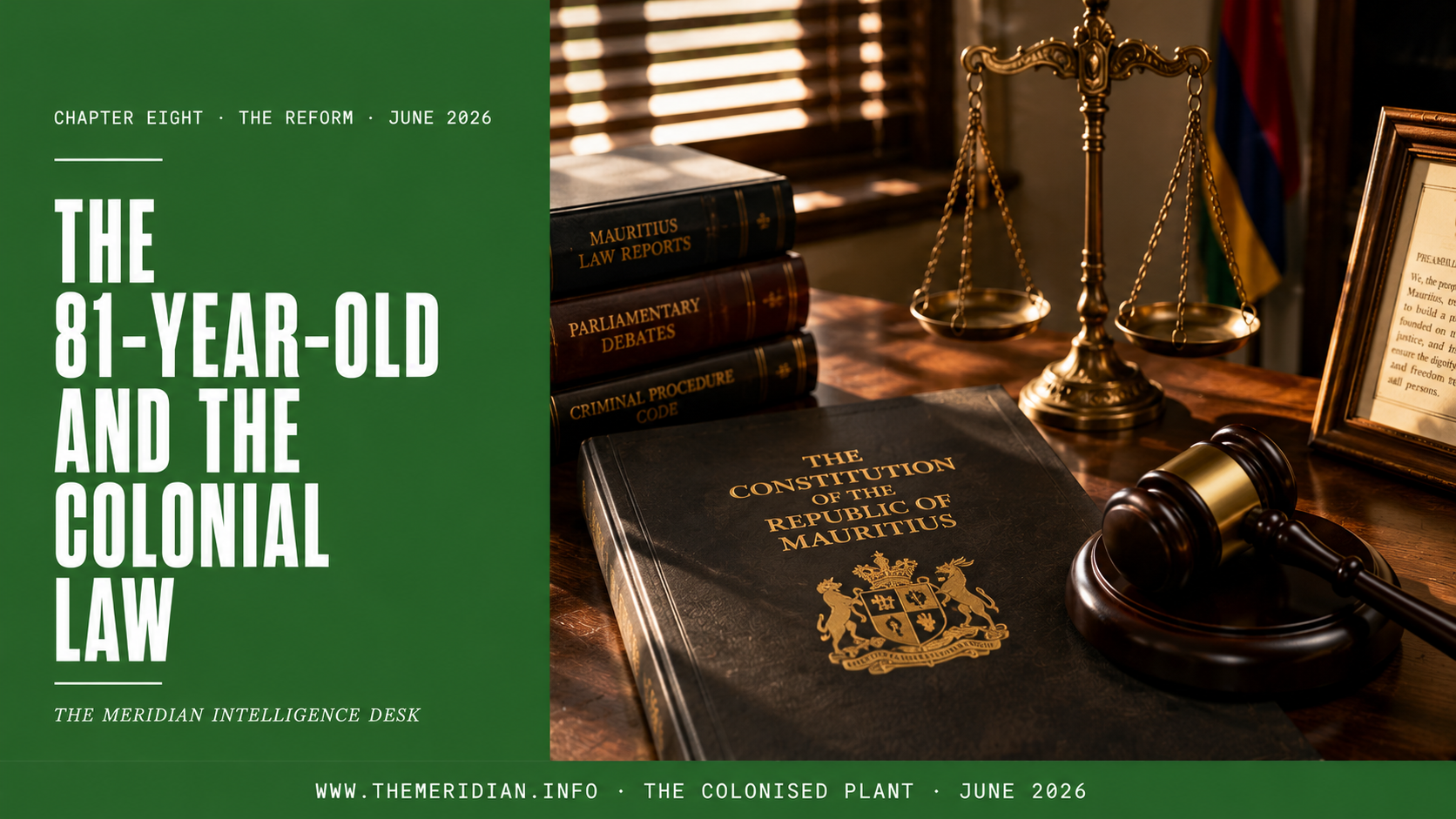
An unnamed 81-year-old Mauritian citizen cultivates cannabis for personal medical use. He faces up to 25 years in prison under the Dangerous Drugs Act 2000. He is before the Supreme Court of Mauritius seeking constitutional relief on the same grounds that struck down the colonial sodomy law in October 2023. The United Kingdom, whose Privy Council is Mauritius's final court of appeal and whose common law forms the backbone of Mauritian public law, has had legal medical cannabis available by NHS and private prescription since November 2018. France, whose Code Civil forms the backbone of Mauritian private law and whose legal tradition Mauritius inherited directly, has had a medical cannabis pilot programme since 2021. Mauritius has an unproclaimed 2022 amendment and an 81-year-old facing 25 years. The Meridian examines the case, the precedent, and the legal paradox that makes the prohibition intellectually indefensible.
There is a man in Mauritius, aged 81, who grows a plant in his home for his own medical relief. He is not trafficking. He is not supplying. He is not enriching criminal networks or contributing to the chimique crisis or placing Grade 6 pupils in police files. He is an elderly man managing his medical condition with a botanical remedy that five thousand years of documented therapeutic use, the endocannabinoid system in his own body, and the peer-reviewed literature of every major medical journal on earth confirms is effective. Under the Dangerous Drugs Act 2000, he faces a maximum sentence of 25 years in prison. He is before the Supreme Court of Mauritius asking whether the constitution of the Republic of Mauritius permits this. The Meridian examines his case, the legal precedent that supports it, and the extraordinary hypocrisy of the two legal systems that Mauritius simultaneously inherits and ignores.
81-year-old Mauritius Supreme Court cannabis constitutional challenge personal medical cultivation Dangerous Drugs Act 2000 25 years prison 2025 2026
Ah Seek v State Mauritius 2023 sodomy Section 250 struck down Chan Kan Cheong Gunesh-Balaghee constitutional privacy liberty colonial law parallel cannabis
On 4 October 2023, the Supreme Court of Mauritius delivered a judgment that removed from the statute books a law that had been in force since 1838. Section 250(1) of the Mauritian Criminal Code had criminalised anal sex between consenting male adults. It was a colonial inheritance from British law of the same era, retained by Mauritius on independence in 1968 while England had removed the equivalent provision from its own statute books in 1967. It had remained in Mauritian law for 56 years after England repealed it, for the simple reason that Mauritius had to act independently to remove it and had not done so. The Supreme Court moved when the parliament would not.
Law: Section 250(1) of the Criminal Code, inherited from British colonial statute of 1838.
Act: Consensual, private, between adults. Harming no one outside the participants.
Constitutional grounds: Sections 1, 7, and 16 of the Constitution. Right to liberty. Right to privacy. Right to non-discrimination.
The court found: "The threat of arrest, prosecution and conviction hangs like the sword of Damocles over the heads of homosexual men." Struck down as unconstitutional.
Parliament action before the case: None. Parliament had not reformed the law despite 56 years of English precedent for doing so.
Law: Dangerous Drugs Act 2000, built on UN classification inherited from American prohibition politics of the 1960s.
Act: Private medical cultivation in his own home. Harming no one outside his own person.
Constitutional grounds: Sections 1, 7, and 9 of the Constitution. Right to liberty. Right to privacy. Right to personal autonomy.
The argument: The threat of 25 years in prison hangs over an 81-year-old man growing a plant for medical relief, in private, for himself. The UN has removed the classification the law was built on. The parliament passed an amendment it has not proclaimed. The court is asked to act where the parliament has not.
Parliament action before the case: The 2022 amendment was passed. It was never proclaimed. The 81-year-old remains exposed to 25 years.
The legal strategy in the 81-year-old's case mirrors the Ah Seek precedent exactly. In both cases, a colonial law of extreme severity is applied to a private act that harms no one beyond the person performing it. In both cases, the constitutional arguments centre on the rights to liberty, privacy, and personal autonomy. In both cases, parliament had the power to reform the law and declined to exercise it fully. In Ah Seek, the court found the law unconstitutional. The 81-year-old's legal team is asking the same court, citing the same constitutional provisions, drawing on the same tradition of judicial independence from parliamentary inaction, to reach the same conclusion about a different colonial law.
England removed the sodomy law from its statute books in 1967. Mauritius retained it until the Supreme Court struck it down in 2023. The UK made medical cannabis available by prescription in 2018. Mauritius has an unproclaimed 2022 amendment and an 81-year-old facing 25 years. The pattern is identical. The institution that can break it is the same.
UK cannabis law 2026 medical prescription NHS France cannabis law 2026 pilot programme Mauritius inheritance comparison hypocrisy parent legal systems
Mauritius's legal system is a documented hybrid of two colonial inheritances. French private law, codified in the Code Civil Mauricien, governs contracts, property, marriage, and succession. English public law and criminal procedure, inherited from British colonial administration, govern the criminal justice system. The Constitution follows the Westminster model. The Privy Council in London is the final court of appeal. Both parent systems are still active in Mauritius's institutional life. Neither parent system's reforms are automatically inherited. Mauritius must act to adopt them independently. Here is what both parent systems say about cannabis in 2026.
Medical cannabis: Legal by prescription since 1 November 2018. Available through the National Health Service and private specialist doctors for qualifying conditions including chronic pain, multiple sclerosis spasticity, epilepsy, and chemotherapy-induced nausea. An 81-year-old in the UK with a qualifying medical condition can legally obtain cannabis on prescription from his GP.
Recreational cannabis: Remains illegal under the Misuse of Drugs Act 1971, classified as Class B. Maximum possession penalty: 5 years. Maximum supply penalty: 14 years. Enforcement is highly discretionary in practice. A 2026 YouGov poll found 56% of Britons support some form of cannabis law reform. 53% of MPs support reform.
CBD products: Fully legal and widely sold on the high street, in pharmacies, and online, provided THC content is below the legal threshold. Available in every major supermarket. No prescription required.
The paradox for Mauritius: The Judicial Committee of the Privy Council, sitting in London, is Mauritius's final court of appeal. If the 81-year-old's case reaches the JCPC, the judges deciding it will be based in a country where his condition would entitle him to a legal medical cannabis prescription. They will apply Mauritian law, not English law. But the intellectual and legal climate in which that final appeal would be heard is not a climate of 25-year prison sentences for elderly medical patients.
Medical cannabis: France launched a medical cannabis pilot programme on 26 March 2021. An 81-year-old in France with qualifying conditions, including neuropathic pain, severe epilepsy, cancer-related nausea, or painful spasticity from multiple sclerosis, can access cannabis-based treatment through the national health system under physician prescription. The pilot programme was extended to 31 March 2026 and a permanent framework is being finalised.
Recreational cannabis: Illegal under the Law of 31 December 1970. However, enforcement for small personal possession was substantially reformed in 2019 with the introduction of the forfaitisation system: an on-the-spot fixed fine of 200 euros for first-time personal possession, replacing criminal prosecution. Cannabis is not treated as equivalent to heroin in practice. In Mauritius, under the Dangerous Drugs Act 2000, it is.
CBD products: Legal within EU THC limits. France is the largest industrial hemp producer in the EU, growing approximately 40% of the EU's total hemp output. Thousands of licensed CBD retailers operate legally across the country.
The paradox for Mauritius: Mauritian private law is the Code Civil Mauricien, a modified version of the French Code Civil. Mauritius traces its private legal tradition directly to France. France's medical cannabis programme has been operational for five years. The Mauritian legislature passed a medical cannabis amendment in 2022. The French legal tradition Mauritius inherited did not include cannabis prohibition as a primary feature. The British colonial administration imposed the criminal drug framework. Both parent systems have moved. Mauritius has not.
Medical cannabis: The Dangerous Drugs (Amendment) Act 2022 was passed by the National Assembly to create a medical cannabis framework. It has not been proclaimed into force as of June 2026. No medical cannabis is legally accessible to any Mauritian patient, including the 81-year-old before the Supreme Court.
Personal cultivation: Up to 25 years imprisonment under the Dangerous Drugs Act 2000. The same penalty that the 81-year-old plaintiff faces for growing a plant in his own home for his own medical relief.
Recreational possession: Maximum 2 years imprisonment and a fine of up to Rs 50,000 under the DDA 2000. Two Grade 6 pupils were placed under police investigation for cannabis on 27 May 2026. They are approximately 11 years old.
The legal architecture: Mauritius inherits English public law through the common law tradition and applies it through English-modelled criminal procedure. It references English case law in its courts. Its final appeal goes to London. It inherited the British colonial cannabis prohibition framework and has not updated it. The English system that generated that framework updated its own medical cannabis law in 2018. Mauritius has not followed. Colonial inheritance operates in one direction only: the control structures are retained. The reforms are not automatically adopted.
Mauritius dual legal system colonial laws not automatic repeal England reform Privy Council applies Mauritian law not English law inheritance paradox
The Mauritian legal system is formally described in academic literature as bi-systemic: French civil law governs private matters, English common law governs public and criminal matters. The Constitution follows the Westminster export model. This is not a design flaw; it is the documented consequence of two successive colonial administrations leaving their legal frameworks in place at the point of independence in 1968.
The critical institutional fact is this: when England repeals or reforms a law, that repeal has zero automatic effect on Mauritius. The Dangerous Drugs Act 2000 is Mauritian legislation. When the UK government rescheduled medical cannabis in November 2018, making it available by prescription, that rescheduling applied to England, Wales, Scotland, and Northern Ireland. It applied to no former British territory. Mauritius had to legislate independently to achieve the same result. It passed the 2022 amendment. It did not proclaim it.
The same logic applies to France. When France launched its medical cannabis pilot in 2021, the Code Civil Mauricien, the version of the French Civil Code that governs Mauritian private law, was not updated. The two systems have diverged. Mauritius holds both inheritances and updates neither.
The Privy Council adds the sharpest edge of the paradox. The JCPC applies the law of the jurisdiction whose case it is hearing. If the 81-year-old's case reaches the Privy Council, the judges sitting in London will apply Mauritian law, not English law. They will not say: "in England this man would have a legal medical cannabis prescription, therefore Mauritius must permit his cultivation." They will examine whether the Mauritian Constitution, as written, permits 25 years in prison for private medical cultivation. The answer to that constitutional question is what the Supreme Court in Port Louis is being asked to provide first.
Mauritius cannabis paradox UK France legal reform not followed colonial law retained Privy Council London judges legal medical cannabis Supreme Court 81-year-old
Mauritius inherits English public law. The country that is the source of that law has had legal medical cannabis since 2018. The Mauritian public law tradition that criminalises an 81-year-old for personal medical cultivation was not updated when the English source updated itself.
Mauritius inherits French private law. The country that is the source of that law has had a medical cannabis pilot programme since 2021 and is moving to a permanent framework. The Mauritian civil law tradition that coexists with the English criminal prohibition was not updated when the French source moved toward medical access.
The Privy Council in London is Mauritius's final court of appeal. The judges sitting on that council are based in a jurisdiction where cannabis is a prescribable medicine. They apply Mauritian law, not English law, when they hear a Mauritian case. But they exist in a legal and intellectual environment in which the criminalization of an 81-year-old for personal medical cultivation would be considered an affront to medical ethics and constitutional liberty.
The Supreme Court of Mauritius struck down a colonial law of 1838 in 2023 using the exact same constitutional provisions the 81-year-old's legal team is now invoking. The precedent is Mauritian. The constitution is Mauritian. The judges are Mauritian. The only ingredient missing is the political will that the court does not require, because constitutional adjudication does not depend on political will. It depends on whether the constitution says what the plaintiff says it says. And in Mauritius in 2026, there is substantial reason to believe it does.
The constitutional case: The 81-year-old's constitutional challenge is before the Supreme Court of Mauritius. The case was filed in late 2025. As of June 2026 the full hearing date has not been confirmed. The Meridian documents the case in the public interest without identifying the plaintiff, in accordance with our editorial policy on vulnerable individuals in active legal proceedings.
Ah Seek v State of Mauritius (2023): D. Chan Kan Cheong and K.D. Gunesh-Balaghee JJ, Supreme Court of Mauritius, 4 October 2023. The judgment struck down Section 250(1) of the Criminal Code as unconstitutional on grounds of discrimination under Section 16 and violation of the rights to liberty and privacy. Available through the Blackstone Chambers case summary and the Human Dignity Trust case database. Reported by JURIST, 10 October 2023.
UK cannabis law 2026: Misuse of Drugs Act 1971, as amended. Medical cannabis rescheduled 1 November 2018 under the Misuse of Drugs Regulations 2001. House of Commons Library research briefing CBP-8355, updated 2026. Hemp Gazette, "UK Medical Cannabis Laws in 2026," published 2026. Class B possession: maximum 5 years. Supply/cultivation: maximum 14 years.
France cannabis law 2026: Law of 31 December 1970 (Loi Evin). Medical cannabis pilot programme launched 26 March 2021 by ANSM. Extended to 31 March 2026. Fixed penalty fine of 200 euros for personal possession introduced 2019. Cannabis Europa country guide, France, April 2026. CannabisIndustryLawyer.com French cannabis law analysis, 2025.
Mauritius bi-systemic legal system: "Judicial Review in Mauritius and the Continuing Influence of English Law," International and Comparative Law Quarterly, Vol. 46, Issue 4, October 1997, Cambridge University Press. NYU Law Global, "The Mauritian Legal System and Research," globalex.nyulawglobal.org. The Code Civil Mauricien as modified from the French Code Civil is documented in the Revision of Laws Act 1974, Section 7.
The 2022 amendment: Dangerous Drugs (Amendment) Act 2022, Act No. 13 of 2022, National Assembly of Mauritius. Not proclaimed as of June 2026. Confirmed by the absence of a proclamation notice in the Government Gazette of Mauritius.
This article is part of Chapter Eight: The Reform, in The Colonised Plant: The Cannabis Edition, June 2026. It should be read alongside the article on the Shirish Rummun constitutional challenge of 2019, which represents the earlier case of a citizen asking the Mauritian courts to recognise a right that parliament refused to create. The complete edition is published at themeridian.info/june-2026.
Add comment
Comments