The Racism Behind the Plant: From Anslinger's Files to the Dangerous Drugs Act 2000
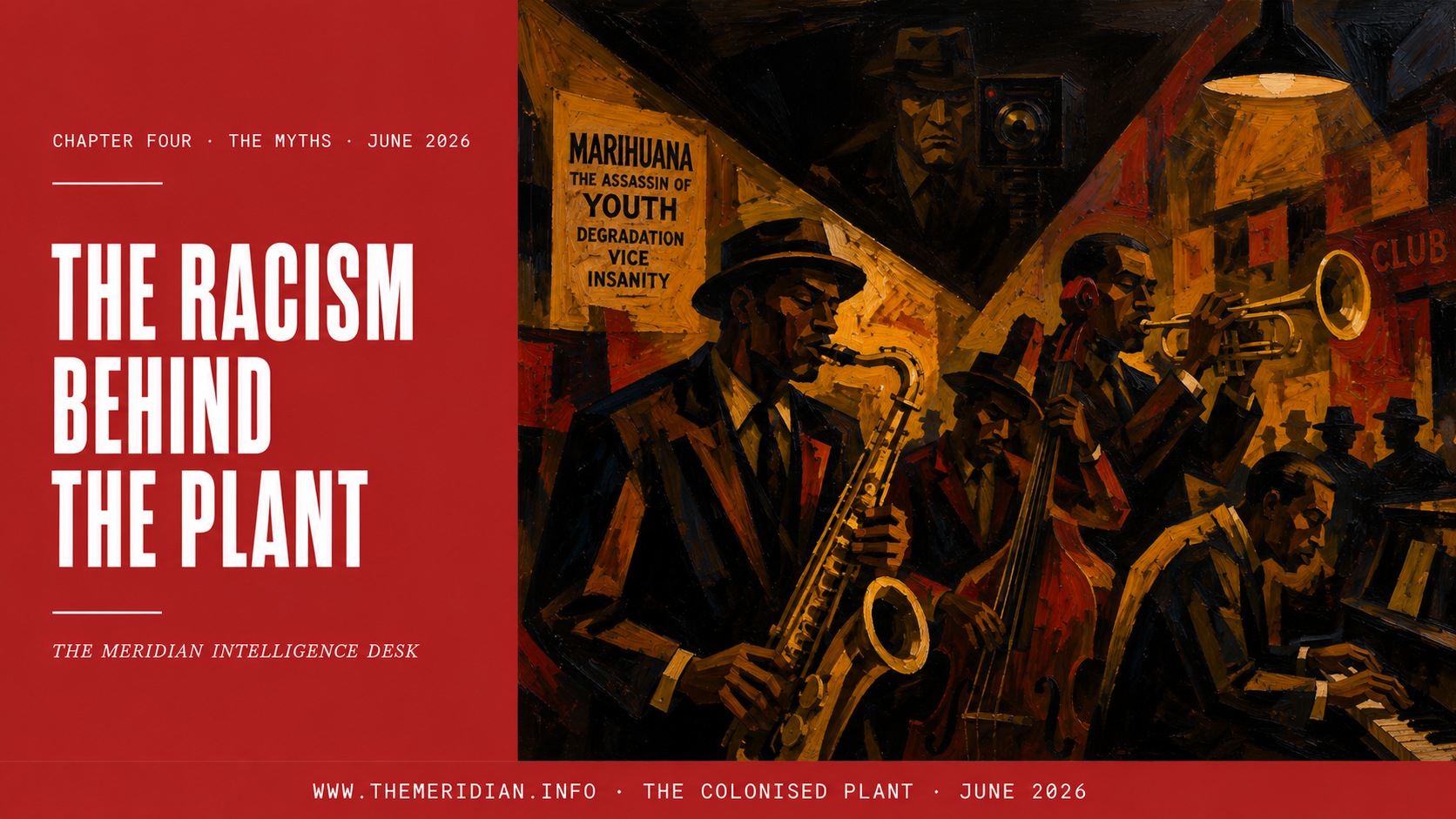
Cannabis prohibition was not designed as a public health measure. It was designed as a mechanism of racial and political control, and this is not a claim made by activists. It is a documented fact confirmed by the architect of the policy himself. Harry Anslinger built the federal prohibition campaign on explicit racial targeting. John Ehrlichman, Nixon's domestic policy chief, confirmed in a recorded interview that the War on Drugs was deliberately designed to criminalise Black Americans and the anti-war left. The ACLU found that Black Americans are 3.73 times more likely to be arrested for cannabis despite identical use rates. In Mauritius, the demographic pattern of enforcement under the Dangerous Drugs Act 2000 mirrors the colonial racial architecture that cannabis prohibition has always served.
This is the article that the prohibitionist narrative is most desperate to prevent being written, because it names the mechanism. The gateway myth can be argued about. The addiction data can be disputed. The psychosis claim can be hedged. But the racism behind cannabis prohibition is not a matter of interpretation. It is a matter of documented institutional history, confirmed by primary sources, corroborated by enforcement data across every jurisdiction that has examined it, and acknowledged by the people who designed the system. The Dangerous Drugs Act 2000 did not emerge from a racist intent in the minds of the Mauritian legislators who passed it. It emerged from a racist intent in the minds of the American administrators who built the international framework it inherited, and it operates with a racially patterned enforcement outcome in the communities it targets. This article names both.
Harry Anslinger cannabis racist campaign Black jazz musicians Mexican immigrants Federal Bureau Narcotics 1930s explicit racial targeting documented
Harry Anslinger, the first commissioner of the Federal Bureau of Narcotics, did not target cannabis because of pharmacological evidence. He targeted it because of who was using it. His congressional testimony and his public statements named his targets explicitly. The following is drawn directly from documented sources cited in Chapter Three of this edition.
Anslinger directed his bureau to target Black American jazz musicians with explicit focus. He described their music publicly as "satanic" and driven by marijuana use. He testified before Congress that the drug caused Black men to look at white women. His files on individual musicians, now held in the Penn State University Libraries Special Collections, show sustained surveillance and targeting of Black cultural figures. The use of cannabis as a pretext to harass, arrest, and discredit Black artists was not incidental to his campaign. It was the campaign's primary function in its domestic social control dimension. The criminality of the plant was the mechanism. The target was the culture.
The term "marihuana" was Anslinger's deliberate linguistic weapon. American farmers, pharmacists, and physicians knew the plant as cannabis or hemp. The Mexican-Spanish slang term was adopted systematically by Anslinger's bureau and Hearst's newspaper empire specifically to associate the plant with Mexican immigrants crossing the southern border during and after the Mexican Revolution of 1910 to 1920. The state bans in California (1913) and Texas (1914) preceded Anslinger and were themselves tools for searching, arresting, and deporting Mexican refugees. Anslinger's federal campaign amplified this mechanism to the national level.
Nixon's 1971 War on Drugs extended Anslinger's racial targeting to the political opposition. The anti-war movement of the late 1960s was culturally associated with cannabis use. By criminalising the plant and enforcing the prohibition heavily against counter-culture communities, the Nixon administration created a legal mechanism to disrupt, arrest, and discredit political opponents without requiring evidence of any political crime. John Ehrlichman confirmed this in 1994. The War on Drugs was not a response to a drug crisis. It was the drug law weaponised as political repression.
Ehrlichman confession 1994 Nixon War on Drugs designed criminalise Black Americans anti-war left Harper's Magazine Dan Baum recorded interview
Ehrlichman's statement is not the claim of a conspiracy theorist. It is the testimony of the man who designed the policy, speaking about his own decisions, published in one of America's oldest magazines, available to read at harpers.org. Every cannabis arrest in every country that adopted the American prohibition model is, in some measure, the downstream consequence of a policy that its own architect described as a deliberate lie targeted at specific racial and political communities. The Dangerous Drugs Act 2000 in Mauritius sits in that downstream. The communities it most disproportionately polices are not random.
ACLU cannabis racial arrest disparity Black Americans 3.73 times more likely identical use rates War on Marijuana Black White 2013 FBI data
Despite statistically identical rates of cannabis use between white and Black Americans, Black citizens were 3.73 times more likely to be arrested for cannabis possession according to the ACLU's analysis of millions of drug arrests across every county in the United States, using FBI Uniform Crime Report data and SAMHSA National Survey on Drug Use prevalence data.
The disparity is not explained by differential use. It is explained by differential enforcement: which neighbourhoods are policed, which communities are stopped and searched, which individuals are processed through the system rather than given a warning. The law is applied to the same behaviour at dramatically different rates depending on the race of the person engaging in it. This is not a fringe finding. It is documented across millions of arrest records in the world's most extensively studied drug enforcement jurisdiction.
The finding has been replicated in the UK, in Canada, and in every jurisdiction that has examined its cannabis enforcement data by demographic. Identical behaviour, different legal consequence, by race. This is the structural reality of cannabis prohibition wherever it operates.
Mauritius cannabis enforcement pattern Creole working class communities ADSU SST disproportionate arrest DDA 2000 racial demographic colonial inheritance
The Mauritian state does not publish demographic data on cannabis arrests broken down by ethnicity or residential community in the way the ACLU analysed US arrest records. The absence of published demographic data does not mean the absence of a demographic pattern. It means the pattern has not been subjected to the same systematic public accountability that the ACLU's analysis imposed on the American system.
What the available evidence does document is consistent with the global pattern. The Lam Shang Leen Commission of 2018, which examined drug enforcement in Mauritius across 260 pages, documented that enforcement operations were concentrated in specific working-class communities and raised concerns about the targeting and framing of individuals from those communities. The Special Striking Team, documented in Chapter Three of this edition, conducted its politicised drug operations against individuals from the same Creole working-class communities that have historically borne the weight of cannabis enforcement in Mauritius.
The communities most disproportionately policed under the Dangerous Drugs Act 2000 are the descendants of the enslaved and indentured populations documented in Chapter One of this edition: the Creole working class of Roche Bois, Cité La Cure, Pointe aux Sables, and the northern plain. These are the communities whose ancestors brought diamba to the island, who buried their healer with her pipes at Le Morne, whose musician was found dead in the Line Barracks cells after a cannabis decriminalisation rally. The people most harmed by the Dangerous Drugs Act 2000 are the direct descendants of the people the 1840 colonial gandia ban was originally designed to make more productively compliant on the sugar estates.
The colonial through-line is not metaphorical. It is structural, legal, and documented. The 1840 colonial ban targeted Indian indentured workers on Mauritian plantations. The 1961 UN Convention was built on American prohibition politics targeting Black Americans and Mexican immigrants. The Dangerous Drugs Act 2000 inherited both frameworks. The communities at the receiving end in 2026 are the same communities that were at the receiving end in 1840. The law changed its name. The targets did not change.
The prohibition of cannabis has never been, anywhere in its documented history, a pharmacologically driven public health response. It has been a racially and politically targeted mechanism of social control, confirmed by the people who built it, documented by the data that measures it, and inherited by every jurisdiction that adopted the American prohibition framework without examining what it was designed to do.
cannabis prohibition structural racism verdict Mauritius colonial inheritance racial enforcement DDA 2000 Anslinger Ehrlichman ACLU documented
The architect named the targets. Anslinger's congressional testimony and public statements explicitly named Black jazz musicians and Mexican immigrants as the communities his prohibition campaign was designed to disrupt. This is not inference. It is quotation from the primary sources.
The designer confirmed the intent. Ehrlichman's 1994 confession, published in Harper's Magazine in 2016, confirmed that the War on Drugs was deliberately designed to criminalise Black Americans and the anti-war left. The drugs were not the target. The communities were the target. The drugs were the mechanism.
The data documents the outcome. The ACLU's analysis of millions of arrest records confirms that cannabis prohibition produces dramatically different enforcement outcomes for different racial communities despite identical behaviour. 3.73 times more likely to be arrested. Not for different behaviour. For the same behaviour, in a different body, in a different neighbourhood.
The Dangerous Drugs Act 2000 is Mauritian legislation. Its authors did not sit in a room and design a racist law. But they inherited a legal and institutional framework built by people who did, at every stage of its development from the 1840 colonial gandia ban through the 1925 Geneva compromise to the 1961 UN Single Convention to Nixon's 1971 declaration. The racism is not in the intent of the 2000 legislators. It is in the architecture of the law they passed and the demographic pattern of the enforcement it enables. Those two things are documented. The Meridian documents them.
Anslinger's racial targeting: McWilliams JC, "The Protectors: Harry J. Anslinger and the Federal Bureau of Narcotics, 1930-1962," University of Delaware Press, 1990. The standard academic biography of Anslinger. Also: Musto DF, "The American Disease: Origins of Narcotic Control," Oxford University Press, 1999. Anslinger's files on individual musicians are held at Penn State University Libraries Special Collections.
Ehrlichman confession: Baum D, "Legalize It All: How to Win the War on Drugs." Harper's Magazine, April 2016. Interview conducted 1994. Available at harpers.org. The quotation cited is verbatim from the published interview. Not retracted. Not disputed by Ehrlichman's estate or the Nixon library.
ACLU racial arrest disparity: American Civil Liberties Union, "The War on Marijuana in Black and White," June 2013. Available at aclu.org. Analysis of FBI Uniform Crime Report arrest data cross-referenced with SAMHSA National Survey on Drug Use and Health prevalence data. The 3.73 figure represents the national average disparity; individual county disparities reach significantly higher multiples in some jurisdictions.
Lam Shang Leen Commission (Mauritius enforcement pattern): Commission of Inquiry on Drug Trafficking, Republic of Mauritius, 2018. Chaired by former Supreme Court Judge Paul Lam Shang Leen. 260 pages. Documents enforcement patterns, community targeting, and the risk of framing in the ADSU operations.
Colonial through-line: The 1840 Mauritius colonial gandia ban is documented in British colonial records held at the National Archives, Kew, London, under the Colonial Office series CO 167. The connection between the 1840 ban and subsequent prohibition frameworks is established through the edition's Chapter Three chronology, fully sourced in Article 11 of this edition.
This is the fourth article of Chapter Four: The Myths and the Racism, in The Colonised Plant: The Cannabis Edition, June 2026. The next article takes the five institutional arguments the state deploys against cannabis reform and examines each against the peer-reviewed record. The complete edition is published at themeridian.info/june-2026.
Add comment
Comments