The Fake Addiction: Why Cannabis Dependence Is Not What You Were Told
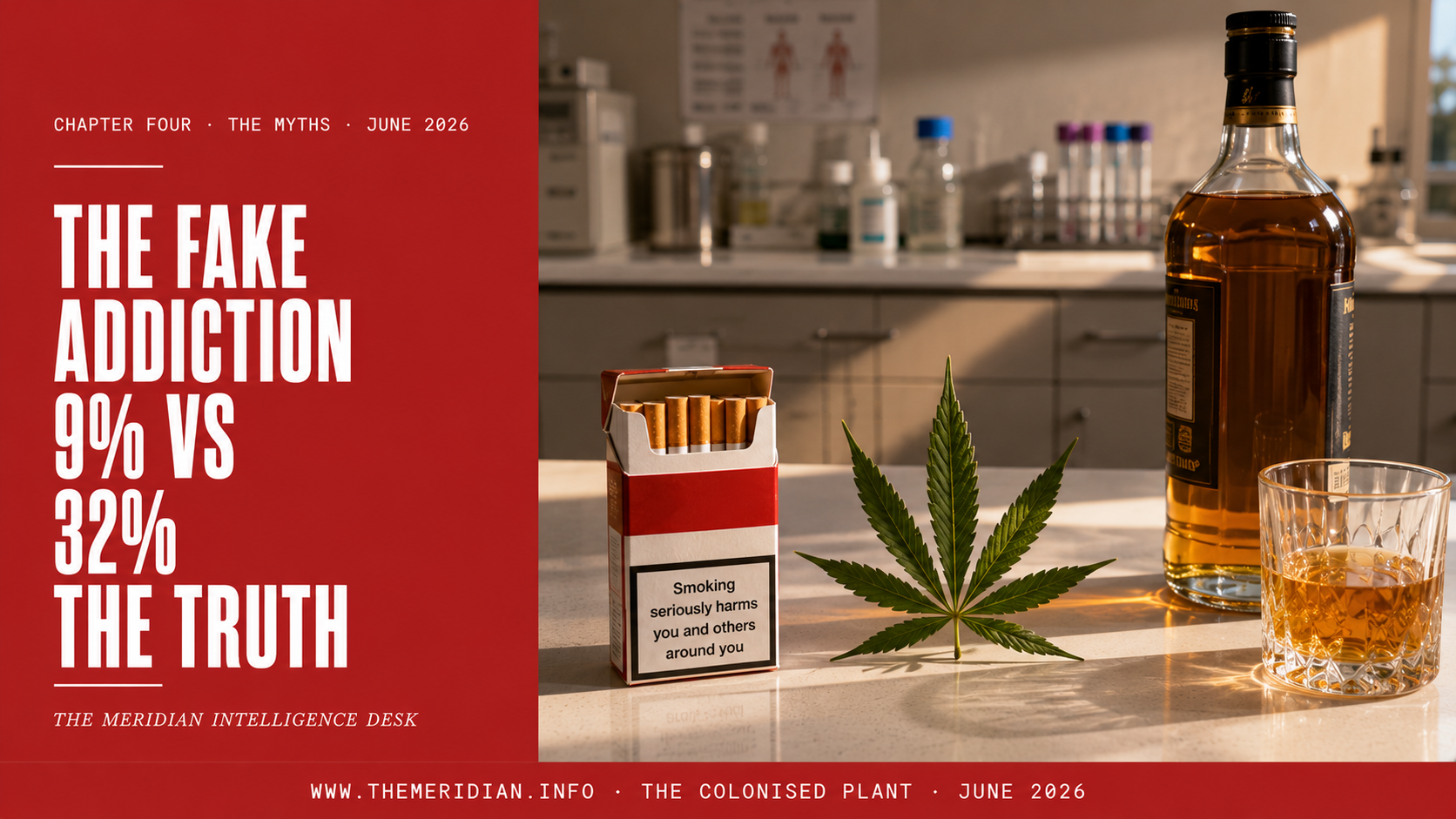
9% of cannabis users develop clinical dependency. 15% for alcohol. 17% for cocaine. 32% for tobacco. Cannabis withdrawal produces irritability and poor sleep. Alcohol withdrawal produces seizures and death. Tobacco kills 8 million people per year globally. Cannabis kills zero. The state criminalises the substance with the lowest dependence rate, the mildest withdrawal profile, and the only zero mortality record of any commonly consumed substance. It taxes and markets the ones that kill. The comparison is never made in public discourse because the moment it is made, the proportionality of the cannabis criminal penalty becomes impossible to defend.
The addiction argument is the last line of institutional defence when the gateway myth has been demolished, the psychosis claim has been qualified, the youth epidemic data has been examined, and the violence narrative has been traced back to Anslinger's fabricated congressional testimony. When all other arguments have been tested against the peer-reviewed record and found wanting, the politician reaches for the word addiction. Cannabis is addictive. We cannot legalise addiction. The argument sounds unanswerable because it contains a kernel of truth wrapped in a profound and deliberate misrepresentation. Cannabis does produce dependency in a minority of users. Everything that follows from that accurate statement , the implication that this justifies criminal prohibition, that it is a serious addiction by any clinical measure, that it is comparable to the addictions produced by the substances the state freely licenses and taxes , is false. The Meridian examines the clinical record.
cannabis dependence rate 9 percent clinical definition DSM-5 National Comorbidity Survey 1994 tobacco 32 percent alcohol 15 percent comparison
The 1994 National Comorbidity Survey, the definitive peer-reviewed study on comparative drug dependence, found that 9% of people who try cannabis develop a clinical dependency as defined by DSM diagnostic criteria. This figure is accurate. It is also the only figure the state ever cites when making the addiction argument. What it never cites is the denominator that makes the figure meaningful: tobacco produces clinical dependency in 32% of users. Cocaine in 17%. Alcohol in 15%. Heroin in 23%. Cannabis, the only substance on this list for which the state imposes criminal penalties on its users, has the lowest dependence rate of all of them. The state taxes the one that addicts 32% of users and kills 8 million people per year. It imprisons people for the one that addicts 9% and kills nobody.
cannabis use disorder DSM-5 clinical definition mild moderate severe symptoms comparison alcohol opioid dependency severity
The 9% figure requires clinical context to be understood accurately. Clinical dependency, or Cannabis Use Disorder in DSM-5 terminology, is defined as a pattern of use leading to clinically significant impairment across a range of criteria including tolerance, withdrawal, use in larger amounts than intended, and continued use despite adverse consequences. The criteria are designed to capture a spectrum of severity: mild (two to three criteria), moderate (four to five), and severe (six or more). The majority of people who meet the clinical definition of Cannabis Use Disorder fall into the mild category.
Critically, the physical withdrawal profile of cannabis is dramatically different from the substances the state permits. Alcohol withdrawal can produce delirium tremens, grand mal seizures, and death. Opioid withdrawal produces severe physical agony: vomiting, diarrhoea, muscle cramping, and uncontrollable sweating lasting days. Cannabis withdrawal, when it occurs, produces irritability, sleep disturbance, reduced appetite, and mild anxiety for approximately one to two weeks. It is genuinely unpleasant. It is not medically dangerous. No recorded death from cannabis withdrawal exists in the medical literature.
cannabis alcohol tobacco comparison addiction death rate criminal penalty legal status legislative hypocrisy drug policy
| Substance | Dependence Rate | Annual Deaths (Global) | Withdrawal Danger | Legal Status in Mauritius |
|---|---|---|---|---|
| Tobacco | 32% | 8 million | Moderate (cravings, mood) | Legal. Taxed. Sold in shops. |
| Alcohol | 15% | 3 million | Severe (seizures, death) | Legal. Taxed. Sold in shops. |
| Heroin | 23% | High | Severe (pain, vomiting) | Illegal. Max 60 years. |
| Cocaine | 17% | Significant | Moderate (depression) | Illegal. Max 60 years. |
| Cannabis | 9% | Zero | Mild (irritability, sleep) | Illegal. Up to 25 years. |
The table above is the comparison the state never makes. The substance with the lowest dependence rate, the mildest withdrawal profile, and the only zero mortality record in the entire table is the one classified as a dangerous narcotic under the Dangerous Drugs Act 2000 and prosecuted with up to 25 years in prison. The substance that addicts 32% of its users and kills 8 million people per year is sold openly at every petrol station and supermarket in Mauritius, with the state collecting excise tax on each transaction. This is not a policy rooted in pharmacology. It is a policy rooted in history , specifically, the racially engineered history documented in Chapter Three of this edition.
The state criminalises the substance with the lowest dependence rate, the mildest withdrawal profile, and the only zero mortality record of any commonly used substance. It taxes and markets the ones that kill. If addiction were the real argument, this would be the comparison made. It is never made because the moment it is made, the prohibition collapses.
cannabis 91 percent users no dependence moderate recreational use majority experience proportion policy framing distortion
The addiction argument also consistently inverts the proportional framing. When the state says cannabis is addictive, it implies that addiction is the typical outcome of cannabis use. The clinical data shows the opposite. 91% of people who try cannabis do not develop a clinical dependency. They may use it occasionally or regularly, and they stop when they choose to. The 9% figure describes a minority outcome, not a typical one. Public discourse on cannabis treats the minority experience as the defining characteristic of the substance and builds prohibition policy around it. Alcohol and tobacco policy treats the majority experience of non-fatal, non-catastrophic use as the defining characteristic and builds a regulatory framework around it.
The policy asymmetry is not explained by the pharmacological data. It is explained by the historical and racial architecture of prohibition that Chapter Three of this edition documents in full. The 1937 Marihuana Tax Act was not passed because of a clinical assessment of cannabis's dependence potential. Harry Anslinger's congressional testimony did not cite the National Comorbidity Survey , it would not be published for another 57 years. The addiction argument is a post-hoc rationalisation for a law whose actual foundations were racial subjugation and political control. John Ehrlichman confirmed it in 1994. The dependence data has been public since the same year. The law has not changed.
To maintain the addiction argument for cannabis prohibition, the Mauritian state must simultaneously pretend that tobacco, which addicts 32% of users and kills 8 million people globally per year, is an acceptable legal commerce that the state should tax and regulate rather than prohibit.
It must pretend that alcohol, which addicts 15% of users, kills 3 million people annually, produces withdrawal that can cause fatal seizures, and is causally linked by pharmacological mechanism to domestic violence and road deaths, is an acceptable legal commerce.
It must pretend that the substance with a 9% dependence rate, zero deaths by overdose, zero deaths by withdrawal, and a withdrawal profile that produces irritability and poor sleep rather than grand mal seizures, is the one that requires a criminal penalty of up to 25 years in prison under the Dangerous Drugs Act 2000.
The addiction argument for cannabis prohibition is not a scientific position. It is a political position dressed in scientific language, applied with radical selectivity to a substance whose actual pharmacological risk profile is the least severe of any substance the state has chosen to address through law. The 9% figure is real. What it justifies is not.
Primary dependence data: Anthony JC, Warner LA, Kessler RC, "Comparative Epidemiology of Dependence on Tobacco, Alcohol, Controlled Substances, and Inhalants." Experimental and Clinical Psychopharmacology, Vol. 2, No. 3, 1994, pp. 244-268. Standard reference in addiction medicine globally. The 9% cannabis, 15% alcohol, 17% cocaine, 23% heroin, 32% tobacco figures are drawn directly from this study.
Cannabis Use Disorder clinical definition: American Psychiatric Association, Diagnostic and Statistical Manual of Mental Disorders, Fifth Edition (DSM-5), 2013. Cannabis Use Disorder defined at pp. 509-519. The mild, moderate, and severe spectrum is established in DSM-5 criteria. Available through the APA and major university library systems.
Cannabis withdrawal syndrome: Budney AJ et al., "The time course and significance of cannabis withdrawal." Journal of Abnormal Psychology, 112(3), 2003. American Society of Addiction Medicine (ASAM), "Cannabis Withdrawal," 2020. The absence of recorded deaths from cannabis withdrawal is established across the literature; no documented case exists in the medical literature.
Alcohol withdrawal fatality: DeCarolis DD et al., "Symptom-driven lorazepam protocol for treatment of severe alcohol withdrawal delirium in the intensive care unit." Pharmacotherapy, 2007. The life-threatening nature of severe alcohol withdrawal (delirium tremens, seizures, death) is standard clinical knowledge documented across addiction medicine literature.
Tobacco mortality: World Health Organisation, "Tobacco," Fact Sheet, 2023. Available at who.int. 8 million annual deaths figure.
Alcohol mortality: World Health Organisation, Global Status Report on Alcohol and Health, 2018. 3 million annual deaths figure. Available at who.int.
This is the third article of Chapter Four: The Myths and the Racism, in The Colonised Plant: The Cannabis Edition, June 2026. The next article examines the racism behind the plant: from Anslinger's deliberate targeting of Black jazz musicians and Mexican immigrants to the structural enforcement disparity documented by the ACLU, to the demographic pattern of cannabis enforcement under the Dangerous Drugs Act 2000 in Mauritius. The complete edition is published at themeridian.info/june-2026.
Add comment
Comments