The Countries That Changed Their Minds: The Complete Global Cannabis Legal Status Map 2026
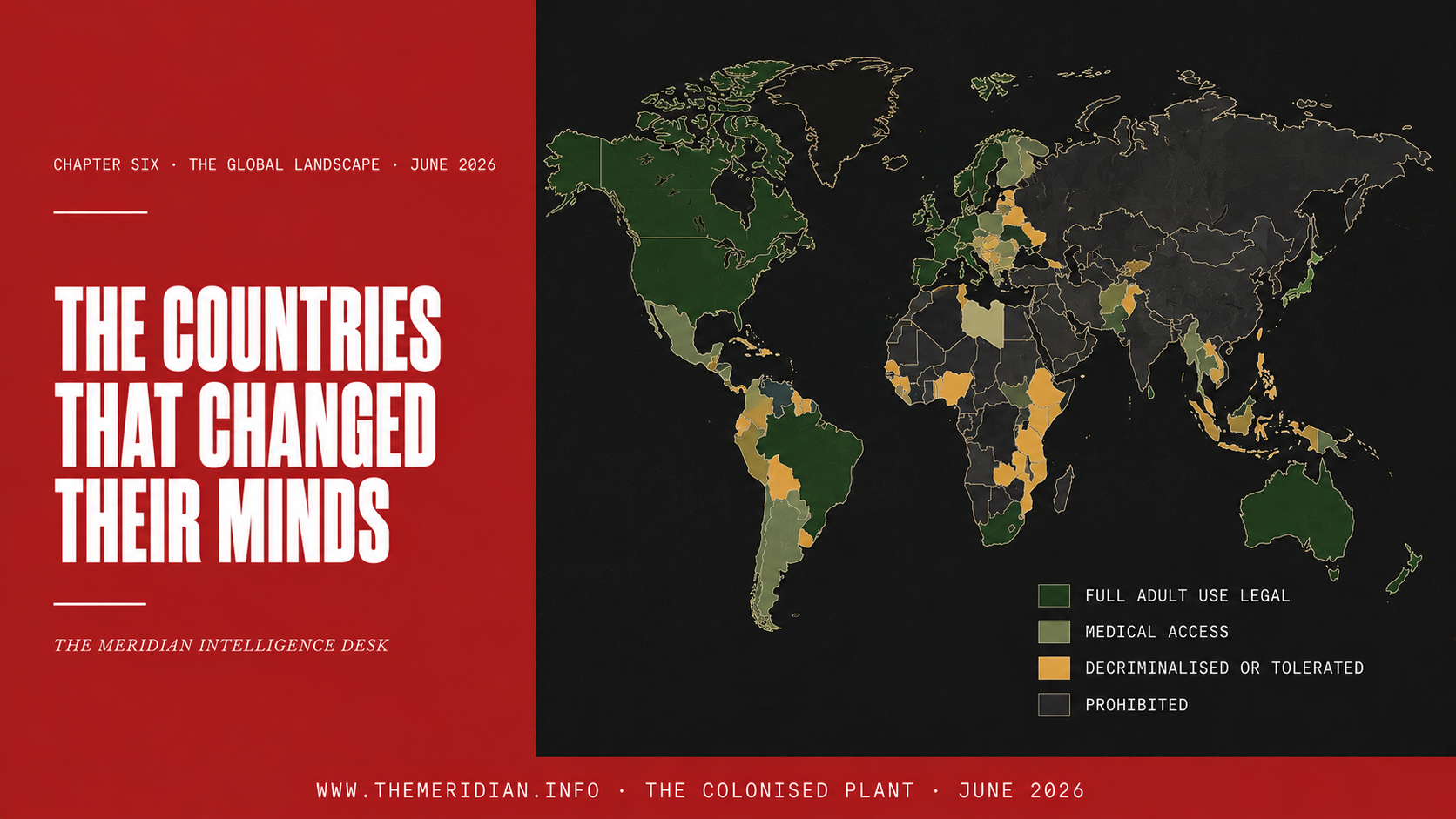
The United Nations Single Convention on Narcotic Drugs of 1961 is, for all practical purposes, dead. By June 2026, the global consensus on cannabis prohibition has completely fractured. The world is no longer divided simply into states that allow drugs and states that do not. It is now split across a vast and complex geopolitical spectrum. On one end, sovereign nations collect billions in excise taxes from state-regulated cannabis dispensaries. On the exact opposite end, states are actively executing their citizens for possessing the exact same plant. The Meridian Intelligence Desk maps every major jurisdiction on the global cannabis spectrum, verified to June 2026, and documents exactly where the Republic of Mauritius sits on the scale.
To understand how isolated Mauritius's drug policies have become, one must look at the global map and read it honestly. The nations leading the global economy, the G7 countries, the most advanced democracies, and the most progressive judiciaries have all concluded, through their respective legal and political processes, that the absolute criminalisation of a botanical plant with a zero-death record is indefensible. Some reached that conclusion through the courts. Some through parliament. Some through decades of pragmatic non-enforcement. The destination is the same regardless of the route. The question that the global map forces upon Mauritius is direct: if Canada, Germany, Uruguay, South Africa, Malta, Luxembourg, Thailand, and twenty-four American states have all moved, what is the Mauritian executive waiting for?
global cannabis legal status map 2026 every country legalisation decriminalised tolerated prohibited death penalty Canada Germany Uruguay South Africa Netherlands Portugal Spain Switzerland Singapore Saudi Arabia Mauritius where does Mauritius sit
These jurisdictions have passed federal or state laws explicitly legalising the cultivation, retail sale, and adult consumption of cannabis. The plant has been removed from the criminal code and placed in the tax code. Law enforcement resources previously consumed by cannabis enforcement have been redirected. Tax revenues have been generated. Quality control has been introduced. Youth access, paradoxically, has not increased and in several jurisdictions has declined following age-gated regulation.
| Country or Jurisdiction | Year | Status | Key Provision |
|---|---|---|---|
| Uruguay | 2013 | Full Legal | First nation to fully legalise. State-controlled cultivation and retail. Citizens purchase from licensed pharmacies. Regulated price suppresses black market. |
| Canada | 2018 | Full Legal | Federal Cannabis Act. Licensed retail in all provinces. Age-gated, lab-tested, child-proof packaging. Multi-billion dollar regulated industry generating significant excise tax revenue. |
| South Africa | 2018 | Full Legal (Private) | Constitutional Court ruling in Prince v Minister of Justice. Private cultivation and consumption by adults declared a constitutional right. Commercial retail framework under legislative development. |
| Malta | 2021 | Full Legal | First EU member state to legalise personal possession and home cultivation. Up to 7 grams personal possession. Up to 4 plants per household. Cannabis Social Clubs licensed. |
| Luxembourg | 2023 | Full Legal | Home cultivation legalised for adults. Up to 4 plants per household. Personal possession of up to 3 grams in public. Full retail legalisation framework under development. |
| Germany | 2024 | Full Legal | Cannabisgesetz (CanG) in force 1 April 2024. Removed from Narcotics Act. Home cultivation permitted. Non-profit Cannabis Social Clubs established. Largest European cannabis legalisation to date. |
| Thailand | 2022 | Effectively Legal | Decriminalised and effectively legalised 2022. Rapid growth of medical and consumer cannabis market. Regulatory framework under ongoing legislative revision. |
| Netherlands | 1976 | Regulated Tolerance | Gedoogbeleid (tolerance policy). Cannabis technically illegal but actively regulated through licensed coffee shops since 1976. State collects taxes. Supply chain legalisation under active debate. |
| United States (24 States) | 2012–2024 | Full Legal (State) | Colorado and Washington first in 2012. 24 states plus Washington DC now operate fully legal, taxed, recreational markets covering over half the US population. Federal scheduling moved to Schedule III in April 2026. |
More than fifty nations have now established formal medical cannabis access frameworks, constituting a legislative acknowledgement that cannabis has verified therapeutic value. The logical contradiction embedded in these frameworks is significant and increasingly untenable: a plant the state acknowledges as medicine for patients cannot simultaneously be so dangerous that adults who consume it recreationally must face criminal prosecution. That contradiction is the primary political pressure moving these nations toward full legalisation.
| Country or Jurisdiction | Year Medical | Status | Key Provision |
|---|---|---|---|
| United Kingdom | 2018 | Medical Only | Specialist physicians may prescribe cannabis-based medicines including Epidiolex and Sativex. Recreational use remains a Class B criminal offence carrying up to 5 years imprisonment. |
| France | 2021 | Pilot Programme | Medical cannabis pilot programme initiated March 2021. Extended and expanded through 2024 and 2025. Full medical framework under legislative development. |
| Italy | 2013 | Medical + Judicial Tolerance | Medical cannabis legal since 2013. Supreme Court of Cassation ruling in December 2019 declared small-scale home cultivation below criminal threshold as a matter of statutory interpretation. |
| Australia | 2016 | Medical Only | Therapeutic Goods Administration framework for prescription access. Australian Capital Territory legalised personal possession and home cultivation in 2020. |
| Israel | 1990s | Medical + Partial Reform | One of the world's oldest and most advanced medical cannabis programmes. Major global cannabis research and export hub. Personal decriminalisation introduced 2019. |
| Colombia | 2016 | Medical + Constitutional | Medical legal 2016. Constitutional Court decriminalised personal possession as far back as 1994. Major cannabis export industry established. Full legalisation under active legislative consideration. |
| Mexico | 2017 | Medical + Constitutional | Medical legal 2017. Supreme Court jurisprudencia declared recreational prohibition unconstitutional 2018. Legislative framework for full legalisation stalled in Congress as of June 2026. |
| Lesotho | 2017 | Medical and Export | First African nation to issue medical cannabis cultivation licences. Export-oriented framework. Significant smallholder farmer participation. Benchmark for African cannabis policy. |
| Zimbabwe | 2018 | Medical and Export | Medical cultivation and export legalised 2018. Cannabis export industry developed to generate foreign exchange earnings. |
| Ghana | 2020 | Industrial Hemp | Industrial hemp cultivation decriminalised 2020. Medical framework under development. Personal use remains a criminal offence. |
| Morocco | 2021 | Industrial and Medical | Law 13-21 legalised cannabis cultivation for industrial, medical, and cosmetic use. Major traditional producer with established export infrastructure. |
| Malawi | 2020 | Industrial Hemp | Cannabis legalised for commercial and industrial use 2020. Export-oriented regulatory framework targeting European and Asian medical markets. |
| Zambia | 2020 | Medical and Export | Industrial hemp and medical cannabis cultivation licences issued from 2020. Export-oriented framework with significant foreign investment. |
| Mauritius | 2022* | Amendment Unproclaimed | Dangerous Drugs (Amendment) Act 2022 passed by National Assembly. Never proclaimed by the executive. No operational medical access exists. An 81-year-old man faces 25 years for cultivating for personal medical use while the law that would have protected him sits dormant. |
The asterisk beside Mauritius in the medical access table is the most damning entry in the database. The Mauritian Parliament passed the legislative instrument for medical access in 2022. The executive has simply declined to activate it. Mauritius is not in the medical access tier by any operational measure. It has the legislation on paper. It does not have the access in practice.
In these nations, cannabis remains technically illegal on the statute books, but the state has formally decided that prosecuting citizens for personal possession is an inefficient use of police resources, judicial capacity, and public funds. No one in Portugal, the Czech Republic, or Switzerland goes to prison for a joint. These nations discovered, through evidence rather than ideology, that criminalisation does not reduce consumption, does not protect public health, and does not justify the enormous institutional cost it imposes. Portugal's 2001 reform is the most documented case in global public health history.
| Country | Year | Status | Key Provision |
|---|---|---|---|
| Portugal | 2001 | Full Decriminalisation | Gold standard of harm reduction. Decriminalised personal possession of all drugs. Possession leads to referral to a dissuasion commission focused on health. Overdose deaths fell 80%, HIV infections by 95%, in the years following the policy shift. |
| Spain | 1994+ | Constitutional Privacy | Constitutional Court rulings established privacy rights over home cultivation and consumption. Public possession heavily fined. Massive proliferation of private Cannabis Social Clubs in Barcelona, Madrid, and other cities. |
| Switzerland | 2013+ | Decriminalised + Pilots | Personal possession of up to 10 grams decriminalised to a minor fine since 2013. State-sponsored full legalisation pilot programmes running in Zurich, Basel, Bern, and Geneva from 2023, with tens of thousands of registered participants. |
| Czech Republic | 2010 | Decriminalised | Personal possession of up to 10 grams not a criminal offence since 2010. Civil fine only. Full legalisation framework under active legislative consideration in 2025 to 2026. |
| Jamaica | 2015 | Decriminalised + Medical | Possession of up to 2 ounces decriminalised 2015, partly in recognition of the Rastafari community's religious and cultural relationship with the plant. Medical framework established. Licensed cannabis tourism developing. |
| Argentina | 2009 | Judicially Decriminalised | Supreme Court ruling in Arriola case declared personal possession decriminalised on privacy and autonomy grounds. Medical cannabis legal since 2017. |
| Ecuador | 2019 | Decriminalised | Constitutional Court decriminalised personal possession up to defined quantity thresholds. Medical access framework under development. |
Portugal decriminalised all personal drug use in 2001 and redirected enforcement budgets into public health. Overdose deaths fell by 80 per cent. HIV infections fell by 95 per cent. The evidence has been published and verified for twenty-five years. The Mauritian state has chosen not to consult it.
These nations enforce absolute prohibition through the ultimate institutional violence: capital punishment. The same plant that is sold in a licensed dispensary in Berlin, taxed by the government in Ottawa, and prescribed by a physician in London is, in these jurisdictions, grounds for execution. The political philosophies that sustain this position share a common characteristic: they treat the autonomy of the citizen as subordinate to the disciplinary power of the state.
| Country | Status | Maximum Penalty | Key Provision |
|---|---|---|---|
| Singapore | Death Penalty | Mandatory Death | Misuse of Drugs Act: importing more than 500 grams carries a mandatory death sentence. The state continues to execute citizens for cannabis trafficking offences. No medical access. No tolerance. No exceptions. |
| Saudi Arabia | Death Penalty | Execution | Drug trafficking historically punishable by execution. Even minor possession by foreign nationals routinely results in lengthy imprisonment and deportation. No medical access framework. |
| United Arab Emirates | Death Penalty | Life Imprisonment | Trafficking carries potential death penalty or life imprisonment. Trace amounts in the bloodstream of foreign travellers have resulted in imprisonment. Zero tolerance enforced with particular severity against non-nationals. |
| China | Death Penalty | Execution | Drug trafficking punishable by execution. State known to conduct mass public sentencing events. Cannabis classified identically to heroin and methamphetamine under the Narcotic Drugs Control Law. |
| Malaysia | Death Penalty | Mandatory Death | Possession of more than 200 grams triggers mandatory death sentence presumption under the Dangerous Drugs Act 1952. Death row has included cannabis cases. |
| Indonesia | Death Penalty | Death or 20 Years | Drug trafficking carries the death penalty. High-profile executions of foreign nationals for drug offences. Personal possession results in lengthy mandatory minimum sentences. |
When evaluating the legal mechanisms of the Mauritian state against the global spectrum documented above, the Republic does not sit in the Regulated Vanguard of Tier One, nor does it possess the pragmatic intelligence of Tier Three. It claims medical access in Tier Two but refuses to activate the legislation that would make that claim operationally real.
The practical enforcement reality of the Dangerous Drugs Act 2000 places Mauritius considerably closer to Tier Four than to the pragmatic reformers of Tier Three. The state abolished the death penalty in 1995, but it retained a twenty-five-year maximum sentence for cultivating a botanical plant. It deploys the provisional charge mechanism to convert consumers into traffickers. It has spent an estimated Rs 200 million annually on aerial cannabis eradication while 652 adolescents were hospitalised by the synthetic market that the eradication programme directly created by pricing the natural plant out of reach.
The global map is unambiguous. The nations leading the global economy and commanding the highest human development indices have all moved to regulate cannabis. The nations that have not are, with few exceptions, either authoritarian states that execute citizens for drug offences, or small developing nations without the institutional capacity to reform. Mauritius has the institutional capacity. It passed the amendment in 2022. It simply lacks the political will to activate it. The map asks a question the Mauritian executive must eventually answer: which tier does the Republic of Mauritius wish to be associated with?
This is the second article of Chapter Six: The Global Landscape, in The Colonised Plant: The Cannabis Edition, June 2026. The next article examines the tolerance paradox in depth: the Netherlands, Portugal, Spain, and Switzerland, and what Mauritius could adopt without a single legislative amendment. The complete edition is published at themeridian.info/june-2026.
Add comment
Comments