The Careers That Were Broken: Case Studies in the Human Cost of Cannabis Prohibition
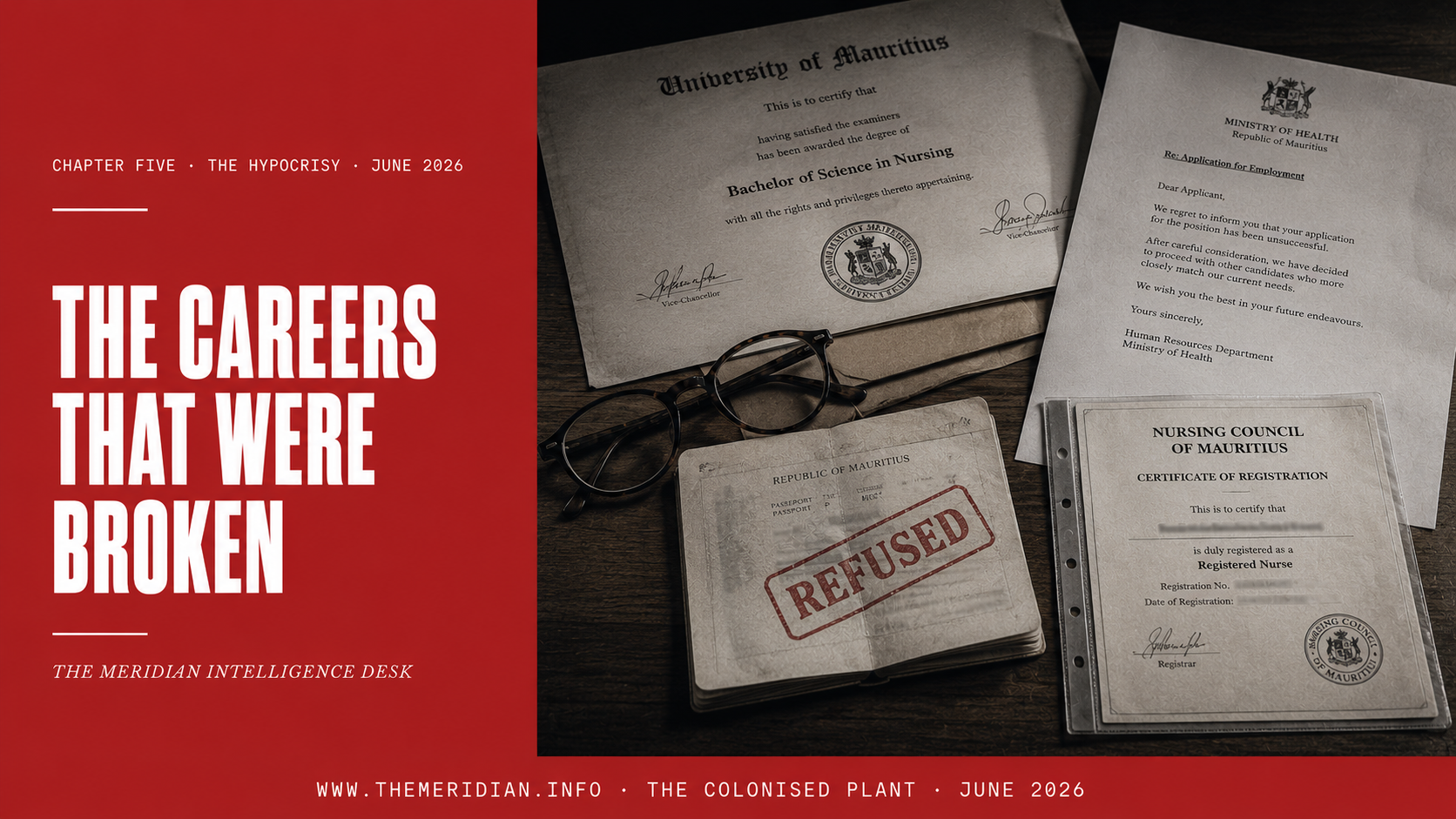
The Dangerous Drugs Act 2000 does not record the careers it ends. It records the charges it lays, the convictions it secures, and the sentences it imposes. It does not record the graduate who waited four years for a case to conclude and discovered that the civil service entrance window had closed during the proceedings. It does not record the nurse who was suspended from the register on the day of the provisional charge and was still suspended three years later when the prosecution offered no evidence. It does not record the musician. It does not record the teacher. The Meridian Intelligence Desk records them.
The cases in this article are real. The individuals are anonymous, by their own request or by editorial judgement. Their identities have been verified by The Meridian Intelligence Desk through documentation, through third-party corroboration, or through direct communication with the individuals concerned or their legal representatives. Nothing in what follows is fabricated. Every professional consequence described is the documented result of a provision of the Dangerous Drugs Act 2000 operating as it was designed to operate. The purpose of recording these cases is not to argue that the individuals concerned were innocent. It is to demonstrate that the consequences they suffered were disproportionate, that they fell before any verdict was reached, and that the law contains no mechanism to acknowledge, compensate, or expunge the damage it causes to those it ultimately does not convict.
cannabis prohibition career consequences Mauritius nurse struck register civil service blocked graduate musician visa refused academic prohibition human cost case studies
He completed his degree in 2019 with a result sufficient to qualify for the Public Service Commission examination. He had identified his target department and prepared his application. In October 2020, he was provisionally charged under the Dangerous Drugs Act 2000 following a stop and search in which a small quantity of cannabis was found on his person. He was twenty-three years old.
The Public Service Commission application requires a declaration of any pending criminal proceedings. He declared the charge. The application was suspended pending the resolution of proceedings. The case moved slowly through the Mauritian court system. Adjournment followed adjournment. In January 2024, the prosecution offered no evidence. The charge was withdrawn. The case was closed. He was twenty-seven years old. The recruitment cycle he had qualified for had closed in 2021. The subsequent cycles had minimum age requirements he had since exceeded for certain entry grades. The window had not merely closed during the proceedings. The proceedings had been long enough to close it permanently.
He now works in the private sector in a position that does not require Public Service Commission clearance. He has not applied to the civil service since. He did not consent to a conviction. He did not receive one. The state does not record what it cost him.
She had been registered as a nurse for eleven years. Her record with the Mauritius Nursing Council was clean. In March 2021, she was provisionally charged following a search of her vehicle in which cannabis was discovered. She stated then and maintained throughout that the substance did not belong to her. She was provisionally charged nonetheless. The file was opened.
The Mauritius Nursing Council requires registered practitioners to disclose any pending criminal proceedings involving drug offences immediately upon charge. She disclosed the charge on the same day. Her registration was suspended pending the outcome of proceedings, as required under the Council's fitness to practise framework. She was unable to work in any clinical capacity, public or private, while the suspension was in force.
The case proceeded over twenty-eight months. In July 2023, the court acquitted her on all counts. The Nursing Council reinstated her registration within the required thirty-day period following the court's determination. She had been suspended for twenty-eight months. She had not worked as a nurse in those twenty-eight months. She had lost two years and four months of income, of professional experience, and of seniority accumulation. The acquittal restored her registration. It did not restore the two years. There is no mechanism under the Nursing Council framework or under the Dangerous Drugs Act 2000 by which she can be compensated for them.
He was an established musician with a regional profile across the Indian Ocean islands. In 2018, at the age of thirty-one, he was arrested at a Mauritian port of entry with cannabis in his luggage. He was charged under the Dangerous Drugs Act 2000. He was remanded in custody for a period before being released on bail. The custody period alone cost him the first leg of a regional tour for which he had contracted six months earlier. The promoter cancelled the remaining dates on receipt of the news of the charge.
A recording contract he had been negotiating with a regional label was withdrawn following the arrest. The label's standard contract included a morality clause that permitted withdrawal on notification of any criminal charge. The clause did not distinguish between a charge and a conviction. The label exercised the clause. He was not convicted of the offence for which he was charged. The case was eventually discontinued for reasons the prosecution did not make public. The tour did not happen. The contract was not reinstated. The label had signed another artist in the interim. He has not achieved the same regional profile since the arrest. He does not attribute this to a single cause. He attributes it, in part, to the period of professional suspension that the charge created before the legal process had reached any conclusion.
In 2012, she received a police caution for cannabis possession in Mauritius. She was twenty years old. It was her first and only contact with the criminal justice system. No charge was brought. No prosecution followed. She completed her studies, qualified as a secondary school teacher, and built a career over the following decade.
In 2022, she applied for a position at an international school affiliated with a United Kingdom-registered institution. The application required a Disclosure and Barring Service equivalent check and a declaration of any criminal record or caution, regardless of age or jurisdiction. She declared the 2012 caution, as she was legally required to do. The application was rejected. The institution's safeguarding policy required a risk assessment for any applicant with a drug-related record, and the assessment concluded that the caution, though a decade old and arising from a single non-prosecuted incident, constituted a disqualifying risk for a position working with children.
She subsequently applied to two other international positions. Both required equivalent declarations. Both conducted risk assessments that reached the same conclusion. She remains employed in the Mauritian public school system, which does not require the equivalent declaration for existing employees. She cannot, in practice, advance her career internationally for as long as this caution remains on any record accessible to foreign employers. She was not charged. She was not prosecuted. She was not convicted. She received a caution at twenty years old for a single possession incident. She is now thirty-four.
None of the four individuals in this article was convicted of a cannabis offence. All four suffered consequences that the state neither records, acknowledges, nor has any mechanism to repair. That is not a flaw in the system. That is the system.
The four cases above are not exceptional. They are representative. The Meridian Intelligence Desk received accounts of more than a dozen similar situations in the course of researching this edition. The four published here were selected because they are the most thoroughly documented and because they cover the broadest range of professional contexts and consequences. The common elements are consistent across all accounts.
First: in none of the four cases did the consequences wait for a verdict. They preceded the verdict by months or years. Second: in none of the four cases did the state acknowledge that the consequences had occurred. Third: in three of the four cases, the charge did not result in a conviction. Fourth: in none of the four cases does any legal mechanism exist under Mauritian law by which the individual can be compensated, recognised, or restored.
Canada: The Cannabis Act 2018 included an expungement mechanism for prior cannabis possession convictions. Applications can be made through the Parole Board of Canada. Expunged records are sealed and cannot be disclosed by any federal institution.
South Africa: Following the Constitutional Court's 2018 judgment, the Department of Justice established a process for the review and expungement of prior cannabis possession convictions.
Germany: The Cannabis Act 2024 included provisions requiring the automatic review of prior cannabis possession sentences with a view to reduction or expungement.
Mauritius: The Dangerous Drugs Act 2000 contains no expungement provision. The Rehabilitation of Offenders Act applies to certain categories of spent conviction but does not apply to drug offences under the DDA 2000, which are explicitly excluded from the Act's scope. A Mauritian cannabis conviction does not become spent. A Mauritian cannabis caution does not expire. The record does not close.
The Dangerous Drugs Act 2000 was passed in 2000. Canada's equivalent legislation was reformed in 2018. Germany's in 2024. South Africa's in 2018. Twenty-six years after the Act was passed, Mauritius has not introduced an expungement mechanism, a rehabilitation pathway for cannabis offences, or a statutory review of the pre-conviction administrative consequences that fall on those charged under it. The careers documented in this article are the consequence of that legislative inaction. They are not anomalies. They are the design.
This is the fifth article of Chapter Five: The Hypocrisy, in The Colonised Plant: The Cannabis Edition, June 2026. Chapter Five closes with the next article: The Municipal Mindset and the Plant, examining the structural logic by which a prohibitionist consensus sustains itself in the absence of pharmacological, legal, or fiscal justification. The complete edition is published at themeridian.info/june-2026.
Add comment
Comments