The Municipal Mindset and the Plant: How Cannabis Prohibition Sustains Itself Without Justification
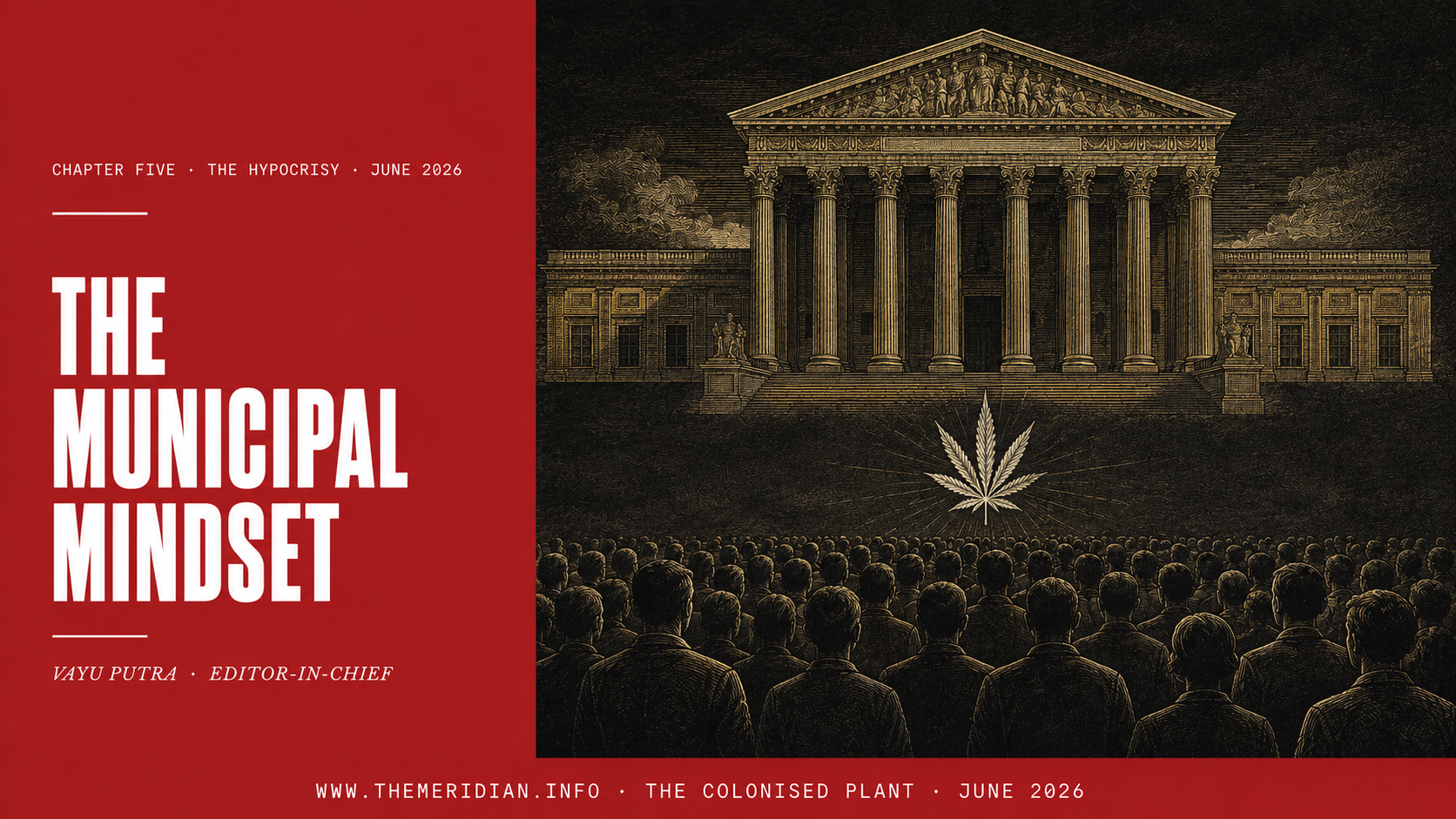
The Municipal Mindset is The Meridian's analytical framework for describing the condition in which a citizen internalises the institutional logic of a system that operates against their own interests, and defends it. It was developed to explain why Mauritians accept the Import Dependency Trap, the hotel wage paradox, the conglomerate capture of the health system. It applies, with equal precision, to cannabis prohibition. The citizen who defends the Dangerous Drugs Act 2000 is defending the law that a government passed one year after its police force killed the musician who challenged it. This essay is an attempt to understand why.
There is a question that Chapter Five has been building toward across five articles. The pharmacological case against cannabis prohibition is comprehensive and published. The human rights case is documented and has been upheld by constitutional courts on three continents. The economic case is arithmetically straightforward. The historical case is damning. The comparative case is overwhelming. And yet the prohibition stands. Not because the evidence is absent. Not because the arguments have not been made. Because a significant portion of the Mauritian population, including many of those most harmed by the law, defends it. The Municipal Mindset framework is the analytical tool for understanding how that happens.
Municipal Mindset cannabis prohibition Mauritius internalisation Gramsci hegemonic consent Bourdieu symbolic violence Fanon post-colonial prohibition self-policing
The Municipal Mindset, as developed in The Meridian's Mauritius political economy series, describes a specific cognitive and social condition. It is the condition in which the citizen of a small, structurally dependent economy internalises the institutional frameworks imposed by the systems that govern them, to the point where they actively reproduce those frameworks in their own thinking, their own social judgements, and their own political positions. The Municipal Mindset citizen does not experience themselves as constrained. They experience themselves as correct. The constraint has been absorbed into the identity. The cage has become the house.
Applied to cannabis prohibition, the Municipal Mindset operates with particular efficiency. The plant has been illegal for the entirety of most Mauritian adults' conscious lives. The law that criminalises it is not experienced as a historical contingency, as the product of a specific political moment in 1999, as the legislative response of a government whose police force had just killed a musician in custody. It is experienced as a fact of nature. Cannabis is illegal because cannabis is dangerous. Cannabis is dangerous because cannabis is illegal. The tautology is not examined because it does not present itself as a tautology. It presents itself as common sense.
The most effective form of institutional power is the power that does not need to be exercised because the governed have agreed to exercise it on the institution's behalf.
Three intellectual traditions illuminate different dimensions of how the Municipal Mindset operates in the specific context of cannabis prohibition in Mauritius. They are not competing explanations. They are complementary lenses, each revealing a different layer of the same structure.
Gramsci's concept of hegemony describes the process by which a ruling class sustains its dominance not primarily through coercion but through the manufacture of consent. The dominated class comes to accept the worldview of the dominant class as natural, as common sense, as simply the way things are. The coercive apparatus, the police, the courts, the prisons, remains available and is used. But it does not need to be the primary mechanism of control. The primary mechanism is ideological: the internalisation of the dominant class's values by those whom those values disadvantage.
Cannabis prohibition in Mauritius operates precisely on this logic. The ADSU and the Dangerous Drugs Act 2000 are the coercive apparatus. They are real and they are used: 652 adolescents hospitalised from synthetic cannabinoids in four years, two Grade Six children in police files, an 81-year-old facing twenty-five years. But the deeper mechanism of prohibition's durability is not the coercive apparatus. It is the Mauritian citizen who has accepted the prohibition as legitimate, who repeats the state's arguments as their own, and who regards anyone who challenges the law with social suspicion rather than political solidarity. The ADSU could not maintain prohibition alone. Hegemonic consent does most of the work.
Bourdieu's concept of symbolic violence describes a form of domination that is exercised with the tacit complicity of those who are dominated. It is not physical violence. It is the imposition of categories of perception and thought, of ways of seeing the social world, that serve the interests of the dominant while being experienced by the dominated as natural and inevitable. The key word is complicity. The dominated are not passive victims of symbolic violence. They are active participants in it. They reproduce the categories that disadvantage them because those categories have become their own.
The Mauritian cannabis user who experiences shame, who accepts that their arrest is a legitimate consequence of their choice, who does not question why the same plant is sold legally in a German dispensary, is experiencing and reproducing symbolic violence in Bourdieu's precise sense. The legal framework has installed a set of perceptual categories in which the criminalised person is the problem, not the criminalising law. The person who was found with cannabis at a party is understood, by themselves and by their community, as someone who made a bad choice. The government that passed the DDA 2000 twelve months after Kaya died in a police cell is not understood as a government that made a bad law. The symbolic violence consists precisely in this inversion: the victim carries the moral burden of the structure.
Fanon's analysis of the post-colonial condition identifies a specific pathology: the newly independent nation that reproduces the structures of its coloniser, not under external compulsion but through the internalisation of colonial values by the post-colonial ruling class. The coloniser leaves. The colonial institutions remain. They remain not because no one could change them but because the class that inherited power has absorbed the coloniser's logic as its own. They administer the inherited structures, including the inherited legal frameworks, with the same assumptions and the same hierarchies of value that the coloniser installed.
Cannabis prohibition in Mauritius is, at its structural root, a colonial inheritance. The British colonial government taxed and regulated cannabis trade across the Indian Ocean empire. The 1894 Indian Hemp Drugs Commission recommended against prohibition. The international prohibition framework was imposed through colonial treaty architecture at Geneva in 1925. The Dangerous Drugs Act 2000 is the post-colonial Mauritian state's own enforcement of that colonial framework, sharpened and applied with considerable domestic enthusiasm. The plant that the Ghirmitya brought from India as medicine and as sacrament was criminalised by the colonial state. The post-colonial state has maintained that criminalisation without revisiting the logic behind it. Fanon would recognise the pattern precisely.
The three frameworks converge on a single description of the Municipal Mindset as applied to cannabis prohibition. The Mauritian citizen who defends the DDA 2000 is not uninformed, not stupid, and not acting in bad faith. They are acting rationally within the perceptual categories that the state, the colonial inheritance, and the social reproduction of symbolic violence have installed in them. They have been taught that cannabis is dangerous, that the law exists to protect them, that the person who challenges the law is a threat to social order. They have not been given access to the pharmacological record, the historical record, or the human rights record that would allow them to interrogate those categories. The Municipal Mindset is not a failure of intelligence. It is a failure of access to the institutional conditions for critical thought.
The Municipal Mindset defence of prohibition takes several recognisable forms in Mauritius. The first is the public health argument: cannabis is harmful and prohibition protects the vulnerable. This argument does not acknowledge that the same citizen can purchase alcohol, that tobacco kills eight million people annually worldwide, or that synthetic cannabinoids are hospitalising Mauritian adolescents precisely because the prohibition of natural cannabis has left that market to compounds with no safety ceiling. The public health argument is the state's argument, absorbed and reproduced as the citizen's own.
The second is the moral argument: cannabis use is a personal failing, a weakness, a social disgrace. This argument carries the full weight of Bourdieu's symbolic violence. It locates the problem in the individual rather than in the legal structure that criminalises a substance with a zero-death record. The person who uses cannabis is understood as someone who chose badly. The person who sells synthetic cannabinoids at Rs 100 a dose to a fifteen-year-old is a consequence of a policy that the Municipal Mindset citizen defends. The moral inversion is complete and invisible to those inside it.
The third is the cultural argument: the Vedic communities that brought cannabis to Mauritius as medicine and sacrament, the Rastafari community for whom it is a theological practice, the working-class communities who have used it for pain and sleep relief across generations, have all been taught to regard their own traditional relationship with the plant as shameful. The colonial prohibition severed communities from their botanical heritage and replaced it with a criminalisation narrative. The post-colonial state maintained that severance. The Municipal Mindset citizen who views their grandparent's use of bhang as a primitive practice and the DDA 2000 as progress is demonstrating Fanon's post-colonial internalisation in its most acute form.
The citizen who defends the law that harms them is not the exception in the Municipal Mindset framework. They are the primary product of it. The cage has become the house. The constraint has become the identity. And the most reliable defender of the prohibition is the person it has most damaged.
Gramsci identified the organic intellectual as the mechanism through which hegemonic consent could be challenged. The organic intellectual is not the detached academic who produces knowledge for its own sake but the intellectual who is embedded in the community whose interests they serve and who produces knowledge that makes those interests legible to those who hold them. The Municipal Mindset can only be dissolved from inside by a counter-hegemonic project: the systematic presentation of the pharmacological record, the historical record, the comparative record, and the human rights record in terms that the citizen can access and use to interrogate the categories they have been given.
That is what The Colonised Plant is. It is not a polemic. It is not advocacy in the narrow sense. It is an institutional counter-hegemonic project: the assembly of the complete evidentiary record against cannabis prohibition in Mauritius, published in the institutional register of a publication positioned as the analytical equivalent of The Economist for the Global South, and made available without a paywall to every Mauritian with an internet connection. The Municipal Mindset dissolves when the citizen has access to the record. The record is the intervention.
Chapter Five opened with the global disparity: one endocannabinoid system, different laws. It documented the human rights case, the price of the prohibition premium, the provisional charge as a pre-conviction punishment mechanism, the careers destroyed before any verdict was reached. This closing essay has attempted to name the deeper mechanism that allows all of that documented harm to coexist with a majority defence of the law that causes it.
The Municipal Mindset is the answer. The prohibition does not require the evidence to be on its side. It requires only that the counter-evidence be inaccessible, that the alternative framing be absent from the institutional discourse, and that the social cost of challenging the consensus exceed the social reward of doing so. All three conditions have been met in Mauritius for twenty-six years.
The Colonised Plant is a direct intervention into the third condition. The institutional register of this publication, the rigour of the pharmacological, legal, and comparative evidence assembled across thirty-four articles, and the authority with which that evidence is presented are a deliberate counter-hegemonic move. The Municipal Mindset cannot survive contact with the full record. Chapter Five has presented the full record. Chapter Six begins the global map of the world that chose differently.
This is the sixth and closing article of Chapter Five: The Hypocrisy, in The Colonised Plant: The Cannabis Edition, June 2026. Chapter Six opens the global landscape: the countries that changed their minds, the African cannabis moment, and the Mauritius window that the executive has declined to open. The complete edition is published at themeridian.info/june-2026.
Add comment
Comments