The Courts That Changed the Law: The Constitutional Cases That Broke Cannabis Prohibition
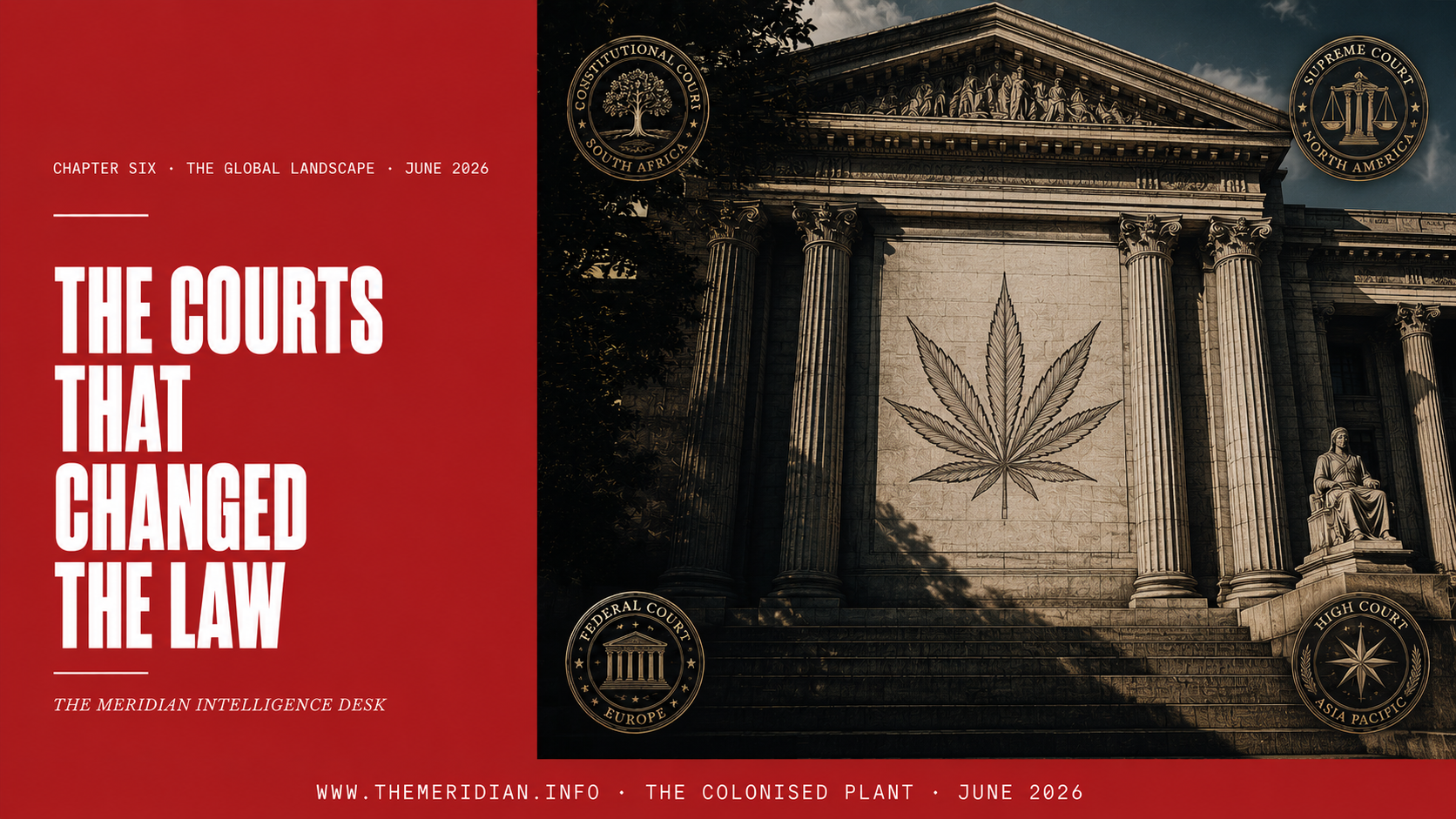
Politicians rarely surrender carceral power willingly. The collapse of the global cannabis prohibition consensus over the last decade was not initiated by legislative benevolence. It was forced by the judiciary. Across the globe, citizens dragged their governments into their highest constitutional courts and forced judges to weigh the drug war against fundamental human rights. When the rhetoric of prohibition was stripped away and subjected to strict legal scrutiny, the absolute criminalisation of a botanical plant repeatedly failed the test of constitutional proportionality. As the Supreme Court of Mauritius prepares to hear the historic constitutional challenge of an 81-year-old medical cannabis cultivator, The Meridian Intelligence Desk examines the landmark global jurisprudence that paved the way.
The legal architecture of cannabis prohibition was not built on science. It was built on political consensus: the 1925 Geneva Convention, the 1937 Marihuana Tax Act, the 1961 UN Single Convention. Each of those structures was constructed through legislative and diplomatic action, not through pharmacological evidence or constitutional analysis. When citizens began challenging prohibition not as a policy preference but as a violation of constitutional rights, they exposed a structural weakness that the prohibition consensus had never needed to address. The constitutional courts, applying proportionality analysis to laws that had never been subjected to it, found those laws wanting. The record of that finding spans three decades and six continents. It is the record that the Mauritian Supreme Court is now being asked to join.
South Africa cannabis constitutional court Prince Minister Justice 2018 privacy Mexico SCJN jurisprudencia Colombia Carlos Gaviria Canada R v Parker Germany CanG Italy Supreme Cassation Mauritius 81-year-old challenge
In September 2018, the Constitutional Court of South Africa handed down a unanimous judgment that dismantled the state's prohibition apparatus in a single ruling. The court did not rule that cannabis was completely harmless, nor did it establish a universal right to intoxication. It focused entirely on the constitutional boundary of the state itself.
The court struck down sections of the Drugs and Drug Trafficking Act of 1992, ruling that criminalising an adult for cultivating or consuming cannabis within the privacy of their own home constituted a profound violation of Section 14 of the Constitution: the right to privacy. Acting Chief Justice Raymond Zondo noted that the state could present no cogent evidence that private cannabis use caused violent criminal behaviour or direct harm to others. By ruling that the state has no jurisdiction over what a citizen organically cultivates and consumes behind closed doors, South Africa became the first African nation to judicially dismantle prohibition.
The ruling's direct relevance to Mauritius is precise. The 81-year-old man before the Supreme Court of Mauritius cultivated cannabis privately, for personal medical use, harming no one outside his own person. The South African Constitutional Court's proportionality analysis, applied to equivalent facts, produced an unambiguous outcome. The Mauritian Supreme Court is being asked to apply the same analysis to the same facts under a different national constitution. The constitutional text of Mauritius, specifically Section 9 protecting personal liberty, supports an equivalent argument.
While South Africa anchored its ruling in privacy, the constitutional courts of Latin America dismantled prohibition using a more expansive and philosophically profound legal doctrine: the right to personal autonomy, expressed in their constitutional traditions as the free development of the personality.
Colombia was decades ahead of the world. In 1994, despite extreme pushback from the political establishment and the United States government, the Colombian Constitutional Court issued a landmark ruling drafted by Magistrate Carlos Gaviria. The court struck down criminal penalties for personal possession of drugs, not merely cannabis, across the board.
Gaviria argued with precision that absolute prohibition violated the constitutional guarantee to the free development of the personality (libre desarrollo de la personalidad). The state, the court ruled, cannot criminalise self-regarding conduct that causes no direct harm to others. The government may educate, counsel, and offer treatment. It cannot incarcerate a citizen for the purpose of protecting them from their own choices. The individual's relationship with their own body and consciousness falls within a protected sphere of autonomy that the state may not penetrate with the criminal law.
The ruling was extraordinary for 1994. It anticipated by more than two decades the pharmacological consensus, the comparative policy record, and the human rights jurisprudence that would eventually break the prohibition consensus globally. Carlos Gaviria's reasoning in C-221 is the intellectual foundation on which the Mexican Supreme Court, twenty years later, built the binding jurisprudence that ended prohibition in the second largest country in the Americas.
Twenty years after Colombia's C-221, the Supreme Court of Justice of the Nation in Mexico adopted Carlos Gaviria's exact legal philosophy and applied it through a uniquely Mexican legal mechanism. Beginning in 2015 with a case brought by the advocacy group SMART (Sociedad Mexicana de Autoconsumo Responsable y Tolerante), the Mexican Supreme Court ruled that prohibiting individuals from growing and consuming cannabis for personal use violated the constitutional right to the free development of personality.
Under Mexican law, a binding national precedent (jurisprudencia) is only established when the Supreme Court issues five consecutive rulings on the same legal issue reaching the same conclusion. This requirement exists precisely to ensure that binding precedent reflects settled constitutional interpretation rather than a single judicial opinion. On 31 October 2018, the court issued its fifth ruling on cannabis prohibition. The jurisprudencia threshold was crossed. The absolute criminal prohibition of cannabis for personal use was declared definitively unconstitutional, and that declaration became binding on every court in Mexico.
The jurisprudencia did not automatically legalise cannabis in Mexico. It forced the Mexican Congress to begin drafting the regulatory framework that would comply with the constitutional position the Supreme Court had established. It demonstrated a structural truth about prohibition: when the constitutional courts are given the opportunity to apply proportionality analysis to the criminal prohibition of a substance with a zero-death record, they consistently find that prohibition fails the test.
Not all legal systems permitted a single, sweeping constitutional strike-down. Other nations reached the same destination through narrower judicial interpretations, forced legislative action, or the creative re-reading of existing penal codes. The paths were different. The direction was identical.
In R v Parker (2000), Terry Parker, a Canadian citizen with severe epilepsy, argued that the prohibition on cultivating cannabis for his own medical use violated his constitutional rights. The Ontario Court of Appeal agreed. The court ruled that prohibiting a patient from growing cannabis to treat a severe medical condition violated Section 7 of the Canadian Charter of Rights and Freedoms: the right to life, liberty, and security of the person.
The court did not legalise cannabis. It forced the Canadian federal government to create a regulated medical exemption permitting patients with serious conditions to access cannabis therapeutically. That exemption, combined with two decades of sustained advocacy, accumulating pharmacological evidence, and the growing absurdity of maintaining prohibition alongside a licensed medical market, laid the groundwork for the Cannabis Act of 2018: full federal adult-use legalisation for all Canadians. One constitutional medical case in 2000 produced full national legalisation eighteen years later. The causal chain is direct and documented. It begins with a single epileptic patient and ends with government-licensed cannabis retail in every province of the world's second largest country by land area.
Italy produced one of the most elegant solutions in the global jurisprudential record. Rather than striking down a law through constitutional review, the United Sections of Italy's Supreme Court of Cassation did something more surgically precise: it re-interpreted the existing penal code without touching a single word of the legislative text. In December 2019, the court ruled that the criminal offence of drug cultivation simply does not apply to small-scale, domestic cultivation activities intended exclusively for the grower's personal use.
No legislative amendment was required. No constitutional challenge needed to succeed. The court read the law as it was written and declared that a citizen growing a few cannabis plants at home does not, as a matter of statutory interpretation, meet the legal threshold for criminal conduct under that law. The ruling bypassed parliament entirely by locating the proportionality principle not in a constitutional right but in the ordinary reading of the penal statute itself. It is an approach directly relevant to Mauritius: the Ah Seek judgment of October 2023 demonstrated that the Mauritian Supreme Court is similarly prepared to read colonial-era criminal statutes against their own text and against the Constitution. The Italian path is available without requiring a constitutional strike-down.
Germany took the inverse path and arrived at the same destination. In 1994, the Federal Constitutional Court (Bundesverfassungsgericht) declined to strike down the narcotics law, ruling that there is no constitutional right to intoxication and deferring the matter entirely to parliament. The court maintained that position as recently as 2023. With the judiciary declining to force the issue, the political pressure accumulated through a different channel: public opinion, coalition politics, the manifest absurdity of prohibition alongside the documented pharmacological record, and the economic argument from the thirty-billion-dollar legal cannabis market operating in jurisdictions that had moved first.
The government eventually acted without judicial compulsion. The Cannabis Act (Cannabisgesetz, CanG), passed by the Bundestag and entering force on 1 April 2024, removed cannabis from the Narcotics Act, permitted adults to possess and home-cultivate cannabis, and established a framework for cannabis social clubs. Germany became the largest country in Europe to legalise adult cannabis use. The German case demonstrates a structural truth: prohibition's collapse is a matter of when, not whether, and the route through the legislature, though slower, produces the same outcome as the judicial route. For Mauritius, the 2022 amendment already enacted by parliament but never proclaimed is the equivalent: the legislative will exists. The executive inaction is the only remaining obstacle.
When the rhetoric of prohibition is stripped away and subjected to strict legal scrutiny, the absolute criminalisation of a botanical plant with a zero-death record repeatedly fails the test of constitutional proportionality. This is not a political observation. It is a documented pattern across the highest courts of three continents.
When the Mauritian state argues that cannabis prohibition is an immutable legal necessity, it requires the public to ignore a thirty-year global jurisprudential record. The arguments available to the 81-year-old man before the Supreme Court of Mauritius are not experimental or untested. They are the same arguments that the South African Constitutional Court accepted in 2018, that the Colombian Constitutional Court accepted in 1994, and that the Mexican Supreme Court accepted across five consecutive rulings between 2015 and 2018.
The right to privacy. The state has no jurisdiction over what a citizen cultivates and consumes privately within their own home, causing no harm to others. South Africa applied this doctrine in 2018. The Mauritian Constitution's Section 9 protects personal liberty. The Ah Seek judgment of October 2023 demonstrated that the Mauritian Supreme Court is prepared to apply constitutional scrutiny to colonial-era criminal statutes. The privacy doctrine is available and applicable.
The right to health. The Dangerous Drugs (Amendment) Act 2022, passed by the Mauritian National Assembly, constitutes a legislative acknowledgement that cannabis has medical value. The executive's refusal to proclaim it is a political decision to deny that acknowledged medical value to citizens who require it. The right to health under Section 25 of the Universal Declaration of Human Rights, to which Mauritius is a signatory, supports a constitutional challenge to that executive inaction.
The global judiciary has already decided, in multiple jurisdictions across three decades, that locking citizens in cages for cultivating a plant with a zero-death record is a disproportionate abuse of state power. The question before the Supreme Court of Mauritius is not novel. It is settled. The question is whether the Mauritian judiciary will consult the record and follow it.
This is the first article of Chapter Six: The Global Landscape, in The Colonised Plant: The Cannabis Edition, June 2026. The next article presents the complete verified global cannabis legal status map: every jurisdiction from full adult-use legalisation to capital punishment, with the legal doctrine, the year of change, and the current enforcement status for each. The complete edition is published at themeridian.info/june-2026.
Add comment
Comments