Africa's Cannabis Moment: Lesotho, South Africa, Ghana and the Continent That Moved First
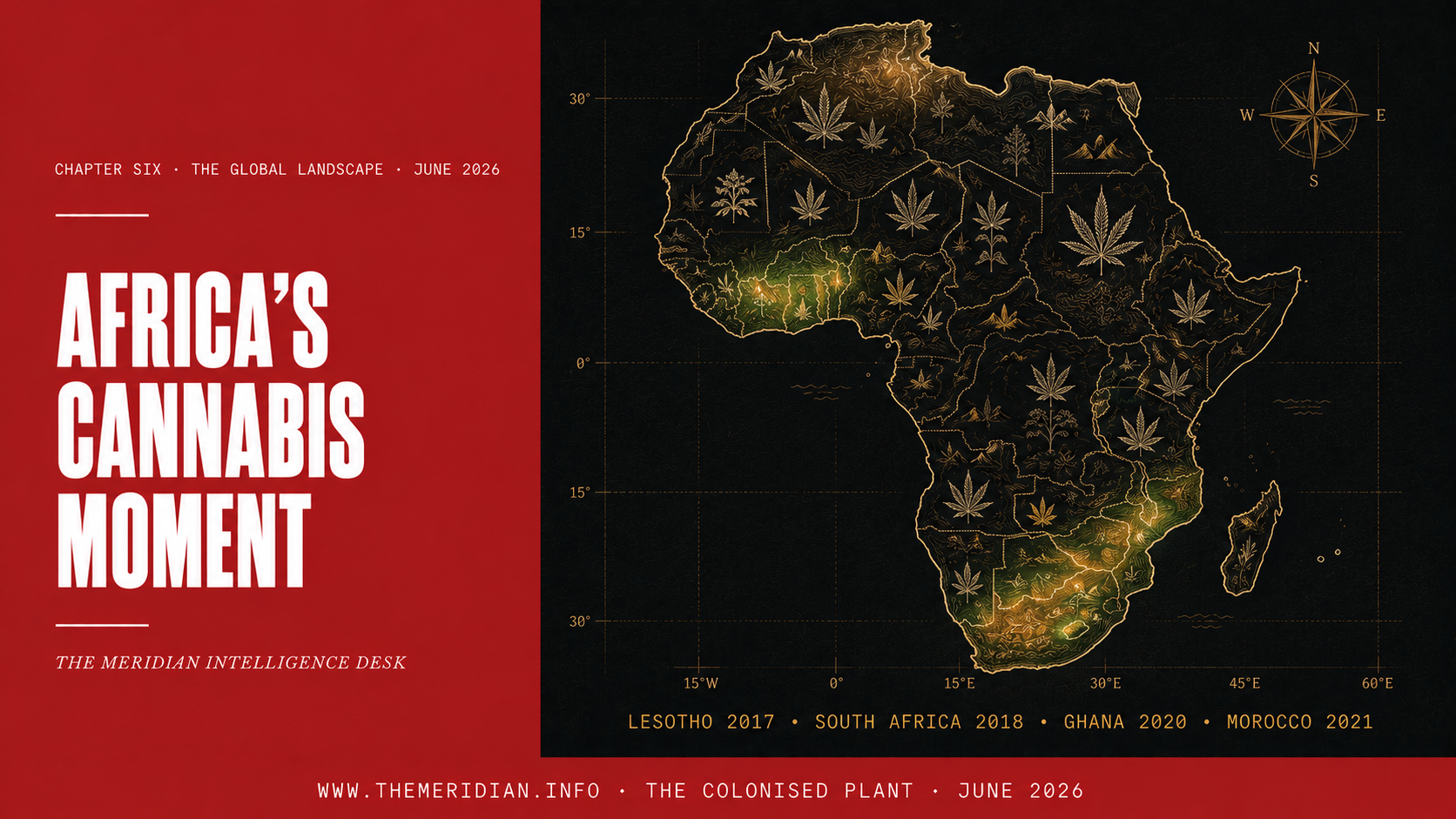
The cannabis plant did not arrive in Africa with colonial prohibition. It was there long before the 1925 Geneva Convention, long before Harry Anslinger, long before the 1961 UN Single Convention placed it in Schedule IV alongside heroin. Cannabis cultivation is documented across the continent for centuries, embedded in traditional medicine, in cultural practice, in the agricultural heritage of communities from the Lesotho highlands to the Rif mountains of Morocco. Colonial prohibition did not eradicate that heritage. It criminalised it. The African cannabis reform movement of the last decade is not a wholesale import of Western legalisation politics. It is, in significant part, the regulatory reclamation of a botanical heritage that colonial law criminalised in the first place. Lesotho moved first. South Africa's Constitutional Court followed. Then Ghana, Zimbabwe, Morocco, Malawi, Zambia, and Eswatini. The Meridian Intelligence Desk maps Africa's cannabis economy and examines what it means for the Republic of Mauritius, which sits at the centre of the Indian Ocean and has done nothing.
The African cannabis reform story has a structural logic that distinguishes it from the European and North American models. In Canada and Germany, legalisation was driven primarily by civil liberties arguments, public health evidence, and the economic attraction of a regulated tax-generating market. In Africa, those same arguments are present, but a fourth dimension is added: the recognition that cannabis prohibition was a colonial imposition that criminalised traditional practice, disrupted rural agricultural economies, and transferred the economic value of a locally cultivated crop to criminal distribution networks that serve no public interest. The African cannabis reform movement is, in part, a decolonisation project. It is the continent taking back regulatory authority over a plant that was its own before the Geneva Convention of 1925 made it contraband.
Africa cannabis legalisation Lesotho 2017 first African medical cannabis licence South Africa Constitutional Court 2018 Ghana Zimbabwe Morocco Malawi Zambia Eswatini cannabis industry export Mauritius Indian Ocean strategic position
In 2017, the Kingdom of Lesotho issued a medical cannabis cultivation licence to the South African company Medigrow, making it the first African nation to formally enter the regulated medical cannabis market. The decision was not primarily ideological. It was agricultural and economic. Lesotho's highland climate and altitude produce cannabis of exceptional quality. The country's rural economy had long depended on informal cannabis cultivation as a supplement to subsistence agriculture. The government made a pragmatic decision: rather than criminalising what smallholder farmers were already growing, it would regulate the activity, issue licences, collect taxes, and develop an export market in the rapidly growing global medical cannabis industry.
The Lesotho model attracted immediate international attention precisely because it demonstrated that a small, landlocked African developing nation could establish a functional cannabis regulatory framework without the institutional infrastructure of Canada or Germany. The licensing authority was the Lesotho Narcotics Bureau. The regulatory framework was built on amendments to existing narcotics legislation. The initial licences covered cultivation and processing for export to medical markets in Europe, North America, and Australia. Smallholder farmers were integrated into the supply chain through cooperative and outgrower models, ensuring that the economic benefit of legalisation reached rural communities rather than accumulating exclusively in the hands of foreign-licensed commercial operators.
Lesotho's significance for the broader African cannabis narrative is not its scale. It is its precedent. By 2017, before Germany, before Luxembourg, before Malta, a small African kingdom in the southern highlands had already established that a developing nation could regulate cannabis and that doing so was consistent with international treaty obligations, with agricultural development policy, and with rural economic development. Every subsequent African cannabis licensing decision was made in the regulatory precedent that Lesotho established.
South Africa's contribution to the African cannabis moment is juridical rather than regulatory. The Constitutional Court's unanimous ruling in Minister of Justice and Constitutional Development and Others v Prince, delivered in September 2018, established that the private cultivation and consumption of cannabis by adults is a constitutional right protected by Section 14 of the South African Constitution, the right to privacy. The ruling struck down sections of the Drugs and Drug Trafficking Act of 1992 as unconstitutional. Acting Chief Justice Raymond Zondo noted that the state could produce no evidence that private cannabis use caused harm to others sufficient to justify the constitutional intrusion of criminalisation.
The ruling was unanimous. It was written with precision. It applied the doctrine of constitutional proportionality to a substance with a zero-death record and found that absolute prohibition failed the test. South Africa became the first African nation to decriminalise private cannabis use through a constitutional ruling, and in doing so, produced the most directly applicable judicial precedent for the 81-year-old Mauritian currently before the Supreme Court of Mauritius on an equivalent constitutional argument.
Commercial cannabis retail remains legally unregulated in South Africa as of June 2026, operating in a legal grey zone between the constitutional protection of private use and the absence of a licensed retail framework. The South African government has been developing a regulatory framework for commercial cannabis since 2018. The Cannabis for Private Purposes Act was passed in 2024, formally codifying the constitutional right established by the Prince ruling. South Africa's cannabis market, spanning medical exports, industrial hemp, and an active informal retail sector, is estimated at several billion rand annually.
Following Lesotho's 2017 precedent and South Africa's 2018 constitutional ruling, a wave of cannabis regulatory reform spread across the continent. Each nation approached reform through the lens of its own political economy: some prioritising export revenue, some rural agricultural development, some industrial hemp as a textile and construction material, some the medical access that their citizens had historically obtained through traditional botanical practice. The common thread is the recognition, reached independently across eight African nations over seven years, that the colonial prohibition framework was producing no public health benefit and significant economic cost.
| Nation | Year | Framework | Primary Rationale and Key Provisions |
|---|---|---|---|
| Zimbabwe | 2018 | Medical and Export | Statutory Instrument 62 of 2018 legalised cannabis cultivation and processing for medical and scientific purposes. Export-oriented from inception. Licensed cultivation generating significant foreign exchange. Government licences issued to both large commercial operators and smallholder cooperatives. |
| Zambia | 2020 | Medical and Export | Statutory Instrument 8 of 2020 legalised industrial hemp and medical cannabis cultivation under licence. Export-oriented regulatory framework. Foreign investment attracted from European and North American cannabis operators seeking African production bases with preferential trade access. |
| Ghana | 2020 | Industrial Hemp | Narcotics Control Commission Act 2020 decriminalised industrial hemp cultivation up to 0.3% THC content. Medical framework under active development. Personal cannabis use remains a criminal offence. Ghana is developing one of West Africa's first regulated hemp industries. |
| Eswatini | 2021 | Medical and Export | Cannabis Bill 2021 legalised medical cannabis cultivation and export. Eswatini has a long tradition of cannabis cultivation in its highland regions. The regulatory framework integrates traditional cultivation communities into the licensed export supply chain. |
| Morocco | 2021 | Industrial, Medical and Cosmetic | Law 13-21 legalised cannabis cultivation for industrial, medical, and cosmetic purposes. Morocco is the world's largest cannabis producer by volume, with centuries of cultivation history in the Rif mountain region. The 2021 law brings an existing multi-billion dollar informal market under regulatory control, generating tax revenue and export capacity for the European medical market. |
| Malawi | 2020 | Industrial and Commercial | Industrial Hemp Act 2020 legalised cannabis cultivation for commercial and industrial purposes. Malawi historically exported significant volumes of cannabis informally. The 2020 Act redirects that established cultivation capacity toward regulated export markets in Europe, North America, and Asia. |
The continent that watched colonial prohibition criminalise its own botanical heritage is now constructing a multi-billion dollar regulated cannabis industry. Africa did not copy the European legalisation model. It built its own, rooted in its own agricultural heritage, its own constitutional jurisprudence, and its own economic development priorities.
The African cannabis market is not a future aspiration. It is a present economic reality. The regulatory frameworks established across eight nations since 2017 have attracted significant foreign direct investment, created rural agricultural employment, generated export revenue in high-value medical and pharmaceutical markets, and in South Africa's case, produced a constitutional framework that extends individual rights and reduces the carceral burden on the justice system simultaneously.
Morocco's Law 13-21 alone is projected to generate several billion euros in annual regulated export revenue from a market that previously generated equivalent or greater value entirely outside the tax and regulatory system. Lesotho's export licences have produced investment from European, North American, and Israeli cannabis companies seeking African production bases with competitive production costs, suitable climate conditions, and access to preferential trade frameworks with the European Union. Zimbabwe's foreign exchange earnings from licensed cannabis exports have grown year on year since 2018. Malawi's Industrial Hemp Act has redirected established cultivation infrastructure toward regulated channels.
The aggregate picture is one of a continent that has identified cannabis as a legitimate development sector, applied regulatory frameworks appropriate to its own institutional capacity and economic priorities, and begun capturing the economic value of a plant it has cultivated for centuries from the criminal distribution networks that prohibition created and sustained.
The Mauritius strategic position in the African and Indian Ocean cannabis economy is one of diminishing advantage. In 2022, when the Mauritian Parliament passed the Dangerous Drugs (Amendment) Act creating a medical cannabis framework, Mauritius was still in a position to position itself as a regional medical cannabis hub: a small island developing state with a highly educated pharmaceutical and agricultural workforce, established international trade relationships, a strong regulatory institutional framework, and a geographic position at the centre of the Indian Ocean linking African production with Asian and European markets.
That positioning opportunity has not disappeared. But it is being eroded with each year of executive inaction. Lesotho established its export relationships with European medical cannabis importers in 2017 and 2018. Zimbabwe established its foreign exchange framework in 2018 and 2019. Morocco's Law 13-21 is now three years into implementation, with Moroccan operators developing established trade relationships with European pharmaceutical companies. Every year that the Mauritius 2022 amendment remains unproclaimed is a year in which Mauritius's potential first-mover advantage in the Indian Ocean medical cannabis market is captured by other jurisdictions.
The irony is precise. Mauritius is a small island developing state with a cannabis heritage rooted in the Ghirmitya community's Vedic botanical traditions. It sits in the Indian Ocean, equidistant between the African continent whose cannabis industry it could supply and the Asian markets whose medical demand it could serve. It has a parliament that already voted to create the legal framework. It has a Supreme Court that has demonstrated willingness to apply constitutional scrutiny to colonial-era drug statutes. It has an 81-year-old man before that court asking for the right to grow medicine in his garden. And it has a government that has looked at everything Lesotho, South Africa, Ghana, Zimbabwe, Morocco, Malawi, Zambia, and Eswatini have built since 2017, and decided to do nothing.
The African cannabis moment is not waiting for Mauritius. The continent is building the industry. The question is whether Mauritius will participate in it or observe it from the outside with an unproclaimed amendment gathering dust in the Government Gazette.
This is the fourth article of Chapter Six: The Global Landscape, in The Colonised Plant: The Cannabis Edition, June 2026. The final article of Chapter Six examines the Mauritius Cannabis Window directly: the economic case for proclamation, the FAREI hemp pilot, the first-mover analysis, and the cost of continued executive inaction. The complete edition is published at themeridian.info/june-2026.
Add comment
Comments