The Mauritius Cannabis Window: First Mover or Last Laggard?
In 2022, the Mauritian National Assembly passed the Dangerous Drugs (Amendment) Act, creating for the first time a legislative framework for medical cannabis access in Mauritius. The executive has never proclaimed it. The window that Parliament opened four years ago remains technically ajar and operationally closed. Lesotho issued its first medical cannabis cultivation licence in 2017. South Africa's Constitutional Court ruled in 2018. Ghana, Zimbabwe, Morocco, Malawi, Zambia, and Eswatini have each built regulatory frameworks in the years since. The synthetic cannabinoid market is hospitalising Mauritian adolescents because natural cannabis costs Rs 3,000 a gram under a prohibition that Parliament voted to partially lift in 2022 and the executive has chosen to maintain. The Meridian Intelligence Desk constructs the economic, public health, and strategic case for proclamation, and documents with precision what the executive's inaction is costing the Republic.
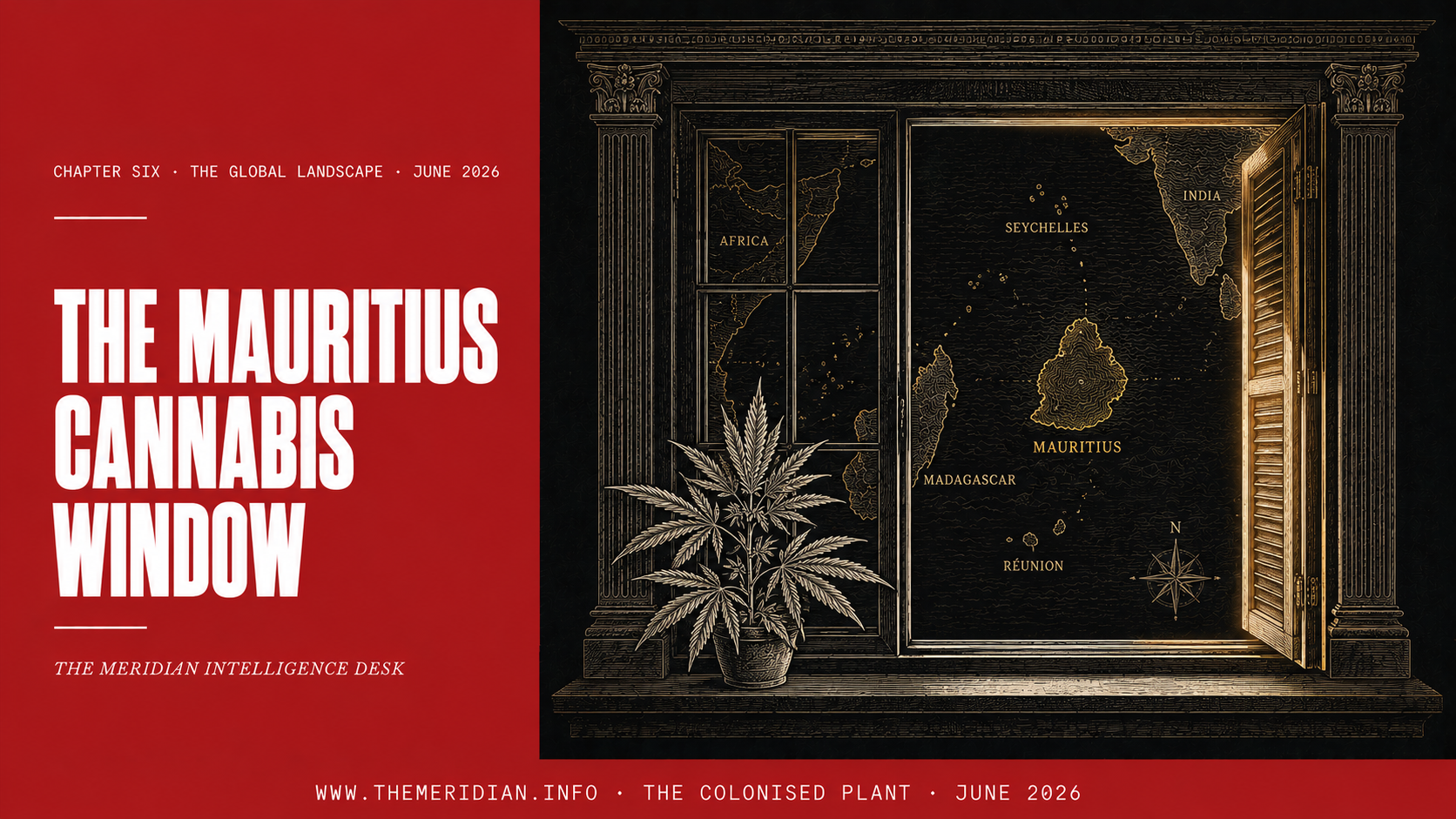
The Mauritius cannabis window is not a metaphor. It is a specific legislative instrument: the Dangerous Drugs (Amendment) Act 2022, passed by the National Assembly of Mauritius, published in the Government Gazette, and awaiting only a ministerial proclamation to enter legal force. The window exists. It is open by parliamentary vote. The question that Chapter Six of The Colonised Plant has been building toward since its first article is whether the Mauritian executive will step through it, and what it will cost the Republic if it does not.
Mauritius cannabis window DDA Amendment Act 2022 unproclaimed medical cannabis FAREI hemp pilot first mover Indian Ocean economic case proclamation synthetic market suppression adolescent hospitalisation
The Dangerous Drugs (Amendment) Act 2022 amended the principal Dangerous Drugs Act 2000 to create a structured framework for medical cannabis access in Mauritius. The amendment established the legal basis for the Minister of Health to prescribe, by regulations, the conditions under which cannabis and cannabis-derived products may be cultivated, processed, distributed, and dispensed for medical purposes. It established that medical cannabis access would be licence-based, regulated by the Ministry of Health, and subject to a pharmacovigilance framework. It did not create an open market. It created a tightly controlled medical channel, precisely the kind of conservative, health-focused regulatory framework that every international institution concerned with drug policy has recommended as the appropriate first step for small island developing states.
The amendment passed the National Assembly. It was published in the Government Gazette. It requires a ministerial proclamation to enter legal force. As of June 2026, that proclamation has not been issued. The Ministry of Health Steering Committee, established to develop the implementing regulations that proclamation would require, has met and produced no publicly available terms of reference, no draft regulations, and no implementation timeline.
The 81-year-old man currently before the Supreme Court of Mauritius, seeking constitutional relief from a potential twenty-five-year sentence for cultivating cannabis for personal medical use, is seeking a right that Parliament acknowledged in principle in 2022 and that the executive has declined to activate. He is asking the courts to do what the government has refused to do: make the 2022 acknowledgement operationally real.
The argument that Mauritius lacks the agronomic capacity to cultivate cannabis is not available to the executive. The Food and Agricultural Research and Extension Institute (FAREI) conducted an industrial hemp cultivation pilot at its Reduit research station that demonstrated successful cultivation of cannabis varieties under Mauritian soil and climate conditions. The pilot was not a gesture. It was a state-sponsored agronomic investigation that produced a positive technical finding: cannabis can be cultivated in Mauritius, the island's tropical climate and soil conditions are suitable, and the cultivation infrastructure already present in the sugar and horticulture sectors is transferable to a regulated cannabis production framework.
The FAREI pilot's significance extends beyond the agronomic finding. It represents a formal acknowledgement by a Mauritian government institution that cannabis cultivation has legitimate agricultural and economic dimensions that warrant scientific investigation. A government that was philosophically opposed to any form of cannabis regulation would not have commissioned a cultivation pilot at its own agricultural research institute. The FAREI pilot is evidence that the executive's own institutional infrastructure had already moved toward a position of pragmatic engagement with cannabis regulation before Parliament passed the 2022 amendment. The 2022 amendment is the legislative expression of that institutional movement. Its non-proclamation is the political reversal of it.
| Jurisdiction | Year of Action | Framework | What Four Years of Action Has Produced |
|---|---|---|---|
| Lesotho | 2017 | Medical Export Licences | Nine years of established export relationships with European and North American medical cannabis importers. Smallholder agricultural income generation. Foreign direct investment from international cannabis operators. A continental regulatory precedent that influenced seven subsequent African jurisdictions. |
| South Africa | 2018 | Constitutional Right | Eight years of legal private cultivation and use. Cannabis for Private Purposes Act 2024 codifying the constitutional right. An established informal cannabis retail sector generating significant economic activity. A constitutional precedent directly applicable to the Mauritian Supreme Court challenge. |
| Zimbabwe | 2018 | Medical Export | Eight years of foreign exchange earnings from licensed cannabis exports. Established relationships with pharmaceutical importers. Rural agricultural employment in licensed cultivation cooperatives. A functioning regulatory framework that has generated consistent government revenue. |
| Morocco | 2021 | Industrial, Medical, Cosmetic | Five years of Law 13-21 implementation. Established export supply chains to European pharmaceutical and cosmetic markets. Regulatory infrastructure built on centuries of cultivation heritage. A legal framework that brings multi-billion euro informal market activity into the regulated economy. |
| Germany | 2024 | Full Adult-Use Legal | Two years of the Cannabisgesetz. Cannabis Social Clubs established across the country. Home cultivation legal. The largest European economy has moved to full regulation. Medical cannabis prescription volume increasing year on year. |
| Mauritius | 2022* | Amendment Unproclaimed | Four years of parliamentary acknowledgement that cannabis has medical value, combined with zero operational access for any Mauritian patient. The 2022 amendment created the legal framework. The executive has not activated it. The synthetic market continues. The adolescent hospitalisations continue. The 81-year-old faces 25 years. |
The Mauritius cannabis window was opened by Parliament in 2022. It has not been walked through. Every year of non-proclamation is a year in which the Indian Ocean medical cannabis hub opportunity is captured by another jurisdiction and a year in which Mauritian adolescents are hospitalised by the synthetic market that prohibition sustains.
The strategic case for Mauritius as a medical cannabis hub in the Indian Ocean region rests on four converging advantages that no other jurisdiction in the region currently possesses simultaneously. First, geographic position: Mauritius sits at the intersection of the African cannabis production corridor and the Asian and European medical import markets, with established air freight infrastructure connecting to both. Second, regulatory credibility: Mauritius's institutional framework, its independent judiciary, its established pharmaceutical regulatory authority, and its Financial Services Commission provide the compliance infrastructure that international cannabis operators require for export licensing. Third, agronomic viability: the FAREI pilot confirmed that Mauritius can cultivate cannabis. The island's year-round tropical climate and established horticulture sector provide the production infrastructure. Fourth, legislative readiness: the 2022 amendment is already drafted, already passed, already in the Government Gazette. Proclamation requires a ministerial decision, not a new legislative process.
A proclaimed 2022 amendment would not immediately create a large commercial cannabis market. It would create the medical access channel that an 81-year-old currently before the Supreme Court requires, that patients with chronic pain, oncology diagnoses, and neurological conditions require, and that the medical profession has been unable to provide because the legal framework, while passed, has not been activated. From that medical channel, with the regulatory infrastructure established and the institutional precedent set, a broader licensing framework encompassing cultivation, processing, and export could be developed incrementally, as Lesotho developed its framework from a single initial licence in 2017 to a multi-operator export industry by 2024.
The synthetic market suppression case is arithmetically simple. Cannabis costs Rs 25 per gram to produce legally. It costs Rs 3,000 per gram on the Mauritian black market. Chimique costs Rs 100 per dose. The adolescent who cannot afford Rs 3,000 for natural cannabis buys chimique. A regulated medical cannabis market, even at a conservative retail price of Rs 300 per gram, would eliminate the economic incentive that drives the synthetic market. The 652 adolescent hospitalisations documented in parliamentary data between 2021 and 2025 are not a cannabis problem. They are a prohibition arithmetic problem. Proclamation changes the arithmetic.
Chapter Six of The Colonised Plant has mapped the global cannabis landscape from every relevant dimension. The courts that broke prohibition across South Africa, Colombia, Mexico, Canada, Italy, and Germany. The countries that moved from full legalisation through medical access through decriminalisation to the death penalty. The tolerance paradox of the Netherlands, Portugal, Spain, and Switzerland. The African cannabis moment from Lesotho in 2017 through eight subsequent national frameworks. And now, in this final article, the Mauritius cannabis window: the specific legislative instrument that Parliament created in 2022 and the executive has chosen not to activate.
The answer to the question this article poses is currently: last laggard. Mauritius is behind Lesotho by nine years. Behind South Africa by eight years. Behind Zimbabwe by eight years. Behind Morocco by five years. Behind Germany by two years. It passed an amendment in 2022 that would have placed it ahead of several of those jurisdictions on the medical access timeline, and then chose not to implement it.
The window can still be walked through. The 2022 amendment is still on the books. The FAREI pilot evidence is still valid. The Indian Ocean hub opportunity, while diminishing, has not closed. The Supreme Court challenge by the 81-year-old may force the legal question that the executive has declined to address voluntarily. And the synthetic cannabinoid crisis that is hospitalising Mauritian adolescents provides a public health imperative that the government's own parliamentary statements have acknowledged.
The question is not whether Mauritius has the instruments to act. It does. The question is whether the political decision will be made before the window closes entirely, or whether Mauritius will be catalogued in the history of cannabis policy reform as the island that passed the amendment, watched the continent build the industry, watched its adolescents get hospitalised by the synthetic market, and still did not proclaim the law it had already written.
This is the fifth and closing article of Chapter Six: The Global Landscape, in The Colonised Plant: The Cannabis Edition, June 2026. Chapter Seven opens the economics of cannabis prohibition in Mauritius: the Rs 2.5 billion shadow economy, the incarceration cost, and the medicated island. The complete edition is published at themeridian.info/june-2026.
Add comment
Comments