Shirish Rummun: The Olympic Weightlifter, the Breast Cancer, and the Constitutional Challenge That Outlived Him
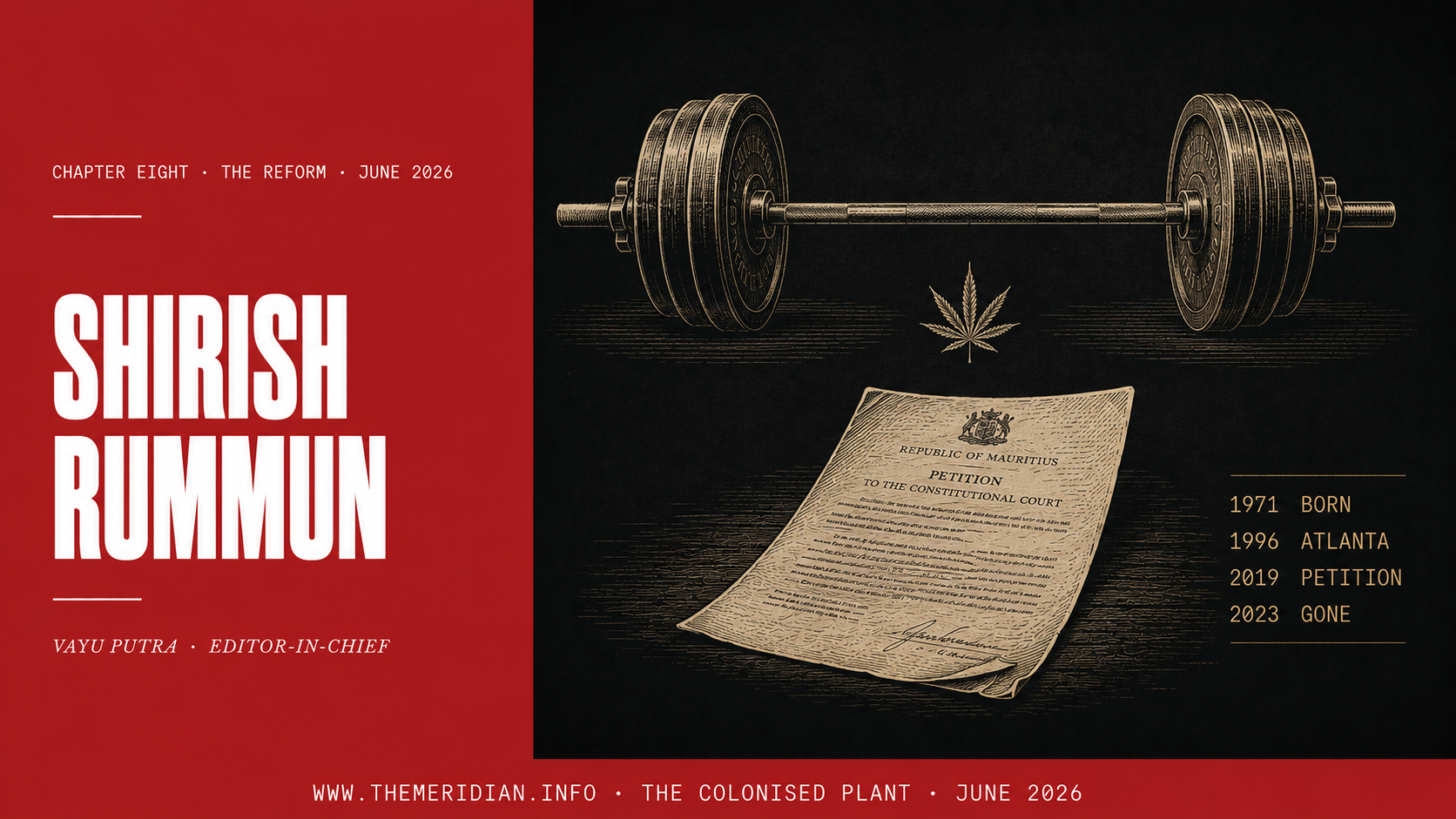
There are cases in the legal record of every country that carry more than precedent. They carry a person. Shirish Rummun carried Mauritius's flag into the weightlifting arena at the 1996 Atlanta Olympic Games. He carried gold at the 1998 Indian Ocean Island Games. He carried, from December 2018, a breast cancer diagnosis that brought him to South Africa for treatment he could not afford in Mauritius, accumulating Rs 3 million in medical debt. And on 23 December 2019, from a hospital or a recovery room, he carried a constitutional petition to the Supreme Court of Mauritius, arguing that the Dangerous Drugs Act 2000 violated his fundamental rights by denying him access to medical cannabis. He died on 2 September 2023. The case was not resolved. His constitutional challenge remains in the court record. The Meridian publishes the full account of a life that should not have ended in a legal fight for medicine.
The story of Shirish Rummun is not, in the first instance, a story about cannabis. It is a story about what a country owes the people who carried its name. It is a story about what the Mauritian state provided when one of its Olympians needed medicine, and what it did not provide, and what legal action he was forced to take in the final years of his life to assert a right that other countries had already recognised as obvious. The cannabis question enters the story in December 2018, when the diagnosis arrived. But the story begins twenty-seven years earlier, when a young man began lifting weights that would eventually carry him to Atlanta.
Shirish Rummun Mauritius Olympic weightlifter 1996 Atlanta cannabis constitutional challenge DDA 2000 breast cancer medical cannabis petition Supreme Court 2019 died 2023 reform
Shirish Rummun's constitutional petition was not a radical legal argument. It was, in the language of constitutional law, a proportionality challenge: the claim that the absolute prohibition of a substance with a documented therapeutic profile, for a patient with a confirmed medical condition, is a disproportionate exercise of state power that violates constitutional rights whose protection the state is obligated to provide.
The rights he invoked were precise. Section 3 of the Constitution of Mauritius protects the right to life and personal liberty. The right to life has been interpreted by constitutional courts across multiple jurisdictions, including the Indian Supreme Court and the South African Constitutional Court, to encompass the right to access medical treatment that sustains life and alleviates suffering. Section 9 protects personal liberty. The right to autonomy over one's own body and medical decisions is a component of personal liberty in the constitutional jurisprudence of every common law jurisdiction. The petition placed those rights against the DDA 2000's absolute prohibition and asked the Supreme Court to find that the prohibition, applied to a terminally ill patient seeking palliative medicine, failed the constitutional test of proportionality.
The argument had strong comparative precedent on its side. The South African Constitutional Court had applied equivalent reasoning to cannabis prohibition in 2018 and found in favour of the petitioner. The Canadian constitutional challenge that produced R v Parker in 2000 had applied Section 7 of the Canadian Charter and found that prohibiting a patient from accessing cannabis as medicine violated the right to life, liberty, and security of the person. Shirish Rummun's petition was not novel. It was Mauritian.
He did not ask the court for permission to get high. He asked the court for permission to manage his pain. He asked for the right to access a medicine that the FDA had approved in 1985, that 50 nations prescribe, and that Parliament acknowledged in 2022 by passing an amendment it then declined to activate. He asked for what the Mauritian state owed the man who carried its flag to Atlanta. He died before the court could answer.
When a petitioner in a constitutional challenge dies before the case is resolved, the legal consequence varies by jurisdiction and by the nature of the right being asserted. Where the challenge concerns a right that is personal to the petitioner, the case may be discontinued. Where the challenge concerns a right of broader constitutional significance, the court may allow the estate or an interested party to continue the proceedings, or may treat the constitutional question as one requiring resolution regardless of the individual petitioner's circumstances.
Shirish Rummun's constitutional petition raises a question that is not personal to him: whether the Dangerous Drugs Act 2000's absolute prohibition of medical cannabis is proportionate to its stated public health objective, and whether that prohibition violates the constitutional rights of Mauritian citizens who require cannabis for medical purposes. That question did not die with him. It is the same question that the 81-year-old currently before the Supreme Court is asking. It is the same question that the Ah Seek judgment of October 2023 established the Mauritian Supreme Court is prepared to engage with substantively. The court record created by Shirish Rummun's petition is part of the constitutional landscape that the 81-year-old's case is being argued within.
The significance of Rummun v The State is not only legal. It is documentary. It establishes, in the formal record of the Supreme Court of Mauritius, that a Mauritian Olympian, a gold medallist, a man who gave this country what it asked of him on the international sporting stage, was denied access to medicine he sought, was forced to file a constitutional petition to ask for it, accumulated Rs 3 million in medical debt seeking treatment abroad because the medicine was unavailable at home, and died before his government answered the question he had formally put to the court. That record cannot be expunged. It sits in the court archive alongside every other case in Mauritius's legal history. The Dangerous Drugs Act 2000 has a face in that archive. It is the face of Shirish Rummun.
The Mauritian state sends its athletes to the Olympic Games. It provides training infrastructure, national federation support, and the administrative apparatus through which Mauritian athletes access international competition. It receives, in return, what Shirish Rummun provided in Atlanta and again in 1998: the national pride of a small island developing state represented at the highest level of its sport, its flag carried, its anthem played, its name heard on the podium.
The transaction between athlete and state carries an implicit obligation. The state that asks a young man to train for years, to sacrifice his body to the pursuit of athletic excellence, to carry its name to Atlanta and to the Indian Ocean Island Games podium, incurs a debt to that man. The debt is not financial, though financial obligations exist. It is the debt of care: the obligation to provide, when that man needs medicine, the institutional framework through which that medicine can be accessed.
Mauritius did not provide that framework. When Shirish Rummun was diagnosed with cancer in December 2018, he travelled to South Africa for treatment because the oncology infrastructure he required was not available at home. He incurred Rs 3 million in debt because the medicine was not available. He filed a constitutional petition because the legal framework for medical cannabis was not in place. The National Assembly passed the 2022 amendment that would have created that framework. The executive did not proclaim it. He died before it mattered.
Olympian. IOIG gold medallist. Patient. Petitioner. He carried Mauritius to Atlanta in 1996. He stood on the gold podium in 1998. He filed a constitutional petition in 2019 asking his country to acknowledge what the FDA had acknowledged in 1985, what fifty nations had acknowledged in their medical frameworks, and what Parliament acknowledged in 2022 without the courage to activate.
He died on 2 September 2023. His challenge remains in the court record. The law he challenged is still in force. The amendment that would have answered his petition is still unproclaimed. The 81-year-old who filed his own challenge in 2023 is still before the Supreme Court. The Grade Six children placed under police investigation on 27 May 2026 have their files opened. The Dangerous Drugs Act 2000 continues to work exactly as it was designed to work.
The Meridian records his name in the reform chapter of The Colonised Plant because his petition is part of the reform record. Because his story is the reform argument made in human terms rather than fiscal or pharmacological ones. Because the question this publication has been asking across forty-four articles and eight chapters is the same question he put to the Supreme Court of Mauritius on 23 December 2019: what does this law owe the people it claims to protect?
He did not receive his answer. The question is still open.
This is the third article of Chapter Eight: The Reform, in The Colonised Plant: The Cannabis Edition, June 2026. The next article presents The Meridian's model bill for cannabis regulation in Mauritius: the six instruments that proclamation of the 2022 amendment requires, drafted from the Canadian, German, South African, and Lesotho regulatory precedents, applied to the specific constitutional and fiscal context of a small island developing state. The complete edition is published at themeridian.info/june-2026.
Add comment
Comments