The Medicated Island: How Cannabis Could Reduce Pressure on a Health System That Cannot Cope
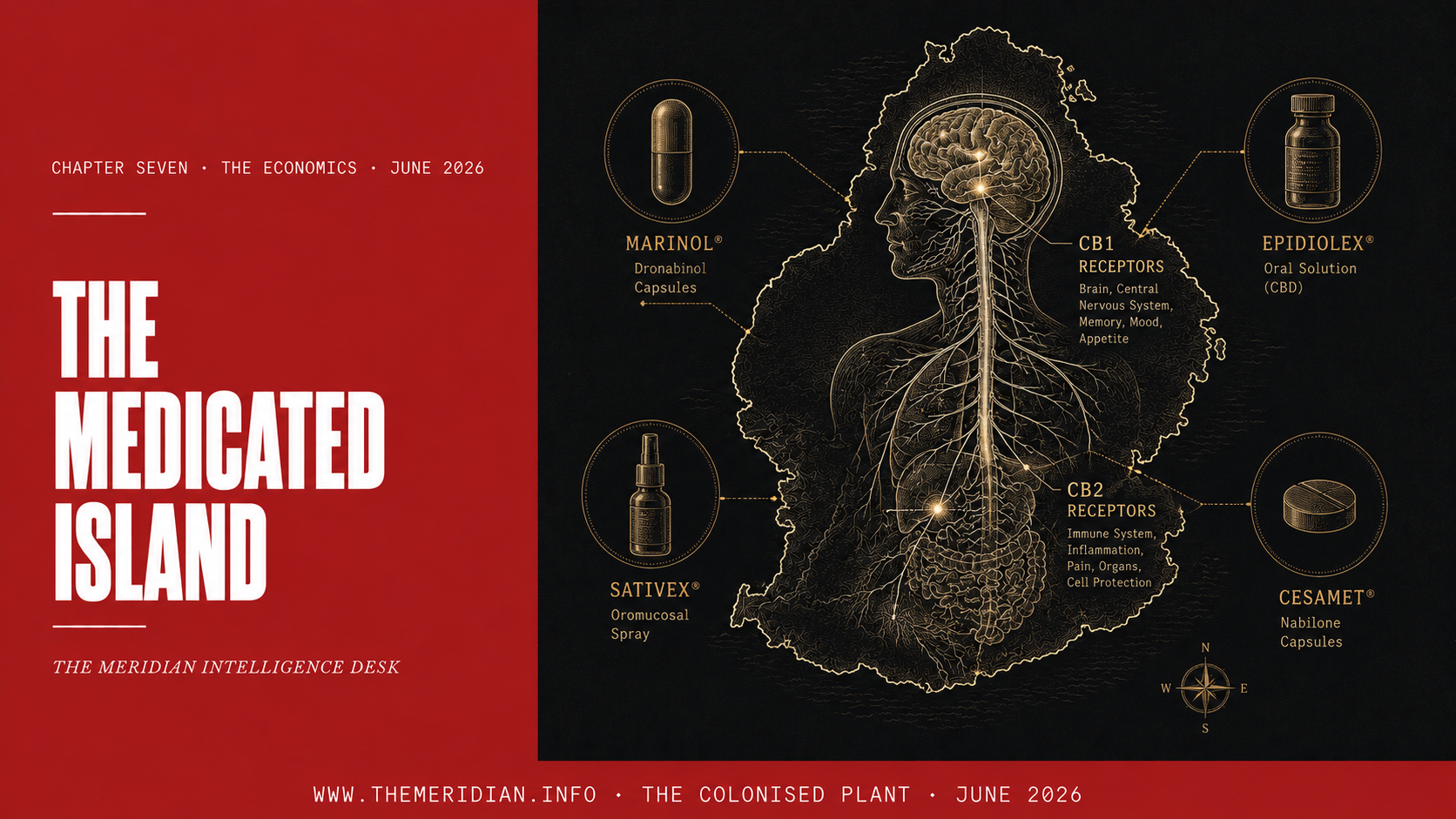
The Mauritius public health system is under structural strain that its current institutional configuration cannot resolve. One in five citizens has been diagnosed with Type 2 diabetes. Seventy-five per cent of the public health budget is consumed by staff costs, leaving the remaining quarter to fund medicines, equipment, and capital infrastructure for a population with one of the highest chronic disease burdens in the Indian Ocean region. The oncology ward at Candos Hospital operated under a tarpaulin roof for an extended period while the Presidential Palace renovation received a Rs 600 million allocation. Into this context, the Dangerous Drugs Act 2000 actively criminalises a family of compounds that the United States Food and Drug Administration has approved as medicines, that 30 countries prescribe for neuropathic pain, that 50 countries provide through licensed medical frameworks, and that the human body was biologically designed to receive. The Meridian Intelligence Desk examines the clinical case for cannabis as a structural health system intervention in a country that cannot afford the pharmaceutical alternatives it is currently using.
The clinical case for medical cannabis in Mauritius is not a speculative argument about future pharmaceutical possibilities. It is a present argument about approved, prescribed, peer-reviewed medicines that Mauritian patients cannot access because the Dangerous Drugs Act 2000 criminalises the compounds they contain. The FDA approved dronabinol, a synthetic THC, for chemotherapy-induced nausea in 1985. It approved nabilone for the same indication in 1985. It approved Epidiolex, a purified plant-derived CBD, for paediatric epilepsy in 2018. The UK prescribes cannabis-based Sativex for neuropathic pain. Israel has operated one of the world's most advanced medical cannabis programmes for decades. None of this medicine is available to Mauritians with cancer, diabetes, epilepsy, or chronic pain. The DDA 2000 has ensured that the most documented botanical therapeutic in medical history remains a criminal matter in the island that needs it most.
Mauritius diabetes cannabis THCV diabetic neuropathy clinical cannabinoid treatment chemotherapy nausea Marinol Cesamet FDA approved Epidiolex paediatric epilepsy Sativex neuropathic pain health system intervention DDA 2000 criminalises medicine
Before examining the clinical evidence, one distinction must be established precisely. Cannabis does not cure diabetes. It does not cure cancer. It does not reverse the pathological processes that produce either condition. The clinical case for cannabis in Mauritius is not built on therapeutic exaggeration. It is built on a more modest and more defensible claim: that cannabis compounds address specific symptoms and treatment side effects that the current pharmaceutical toolkit manages poorly, at a cost that the Mauritian health system can afford, without the addiction, overdose, and organ damage risks that the pharmaceutical alternatives carry.
That distinction matters because the state's argument against medical cannabis implicitly requires the opposite claim to be made. The state argues that cannabis has no accepted medical value. That argument requires ignoring the FDA's approvals of dronabinol in 1985, nabilone in 1985, and Epidiolex in 2018. It requires ignoring the regulatory decisions of fifty-plus nations. It requires ignoring Mauritius's own parliamentary record, which in 2022 formally acknowledged that cannabis has medical value by passing an amendment to create access to it. The 2022 amendment is itself a legislative refutation of the state's stated position on cannabis's medical value. The state passed the amendment. It simply declined to activate it.
Diabetes produces a devastating long-term complication in a significant proportion of patients: diabetic peripheral neuropathy (DPN). Chronically elevated blood glucose physically damages the nerve endings in the extremities, typically the feet and hands. These damaged nerves begin to misfire, sending constant signals of burning, stabbing, or electric pain to the brain in the absence of any physical stimulus. The condition is chronic, progressive, and in advanced cases, disabling. It is among the leading causes of lower limb amputation globally.
The pharmaceutical management of DPN in Mauritius relies heavily on opioid analgesics, including tramadol. The clinical evidence for opioid efficacy in neuropathic pain, as opposed to nociceptive pain, is poor. Opioids work by blunting the central nervous system broadly. They do not address the specific mechanism of neuropathic pain, which is generated at the peripheral nerve level rather than in the brain's pain processing centres. Patients require escalating doses to maintain any effect, producing dependency rates of fifteen to twenty-three per cent and carrying the risk of respiratory depression at high doses.
Cannabinoids, particularly CBD and THCV, address neuropathic pain through a mechanism that opioids cannot replicate. CB1 receptors are concentrated at the presynaptic terminals of peripheral sensory nerves, precisely the location where neuropathic pain signals originate. When a cannabinoid binds to these receptors, it inhibits the release of excitatory neurotransmitters including glutamate, physically reducing the misfiring signal at its source. The effect is targeted, proportional, and does not produce opioid-equivalent respiratory depression or addiction risk. The clinical dependency rate for cannabis is nine per cent, compared to fifteen to twenty-three per cent for the opioid alternatives currently prescribed for DPN in Mauritian public hospitals. Nabiximols (Sativex), a cannabis-derived oral spray, is prescribed specifically for neuropathic pain in 30 countries. It is not available in Mauritius.
Chemotherapy does not kill cancer patients solely through tumour progression. It kills through cachexia, the severe wasting syndrome produced when a patient's body cannot maintain nutritional intake against the relentless nausea triggered by chemotherapeutic toxins. The human brain detects circulating chemotherapeutic agents as toxins and activates the vomiting centre in the brainstem, the medulla oblongata, to expel them. The nausea is violent, relentless, and in a significant proportion of patients, entirely refractory to standard antiemetic medications including ondansetron (Zofran). A patient who cannot eat cannot survive their own treatment.
The United States Food and Drug Administration approved dronabinol, a synthetic THC marketed as Marinol, for chemotherapy-induced nausea and vomiting in 1985. It approved nabilone, a synthetic cannabinoid marketed as Cesamet, for the same indication in the same year. Both approvals were based on the documented mechanism by which THC binds to CB1 receptors concentrated within the medulla oblongata, physically blocking the neurochemical signals that trigger the vomiting reflex. The mechanism is precise, the clinical evidence is forty years old, and the FDA approval is unambiguous.
Simultaneously, THC's action on the hypothalamus stimulates the release of ghrelin, the hunger hormone, while suppressing the neurons that signal satiety. In a recreational context this is known colloquially as increased appetite. In a Mauritian oncology ward, where a patient with stage three cancer cannot maintain body weight sufficient to continue their chemotherapy regimen, it is a life-sustaining medical mechanism that forces nutritional intake and prevents the cachexia that would otherwise kill the patient before the treatment could work. Dronabinol and nabilone are not available in Mauritius. The DDA 2000 schedules their parent compound alongside heroin as having no accepted medical value, forty years after the FDA reached the opposite conclusion.
Epidiolex is a purified plant-derived cannabidiol approved by the United States FDA in June 2018 for the treatment of seizures associated with Lennox-Gastaut syndrome, Dravet syndrome, and tuberous sclerosis complex in patients aged one year and older. These are severe, often treatment-resistant forms of childhood epilepsy that produce multiple daily seizures and cause cumulative neurological damage with each seizure event. Epidiolex is not a first-line treatment. It is approved for patients who have failed multiple conventional anticonvulsant regimens.
The clinical trial data supporting the Epidiolex approval, published in the New England Journal of Medicine, demonstrated a median 41.9% reduction in seizure frequency compared to placebo in Lennox-Gastaut syndrome patients. In Dravet syndrome, the reduction was 38.9% compared to placebo. These are clinically significant effects in a population for whom no effective alternative exists. Epidiolex was approved in the European Union in 2019 under the brand name Epidyolex. It is available by prescription in the UK, Germany, France, and across the EU. It is not available in Mauritius. The DDA 2000 classifies its active compound as a Schedule I substance with no accepted medical use.
Nabiximols, marketed as Sativex, is a whole-plant cannabis extract formulated as an oromucosal spray combining THC and CBD in a 1:1 ratio. It is licensed in 30 countries including the United Kingdom, Canada, Germany, Spain, and Australia for the treatment of moderate to severe spasticity in adults with multiple sclerosis who have not responded adequately to other treatments. In Canada and several other jurisdictions, it is also licensed for neuropathic pain in cancer patients.
The mechanism operates through the same CB1 and CB2 receptor pathways documented in Chapter Two of The Colonised Plant. The THC component provides analgesia through CB1-mediated inhibition of pain signal transmission. The CBD component modulates the psychoactive effects of THC while contributing its own anti-inflammatory action through CB2 receptors in the immune system. The combined formulation produces a clinical effect that pure THC cannot replicate and that no current pharmaceutical alternative achieves through a comparable mechanism without the addiction, organ damage, or overdose risks that accompany opioid analgesics.
For Mauritian patients with multiple sclerosis, cancer-related neuropathic pain, or post-diabetic nerve damage, Sativex is a clinically appropriate option that their physicians cannot prescribe. Their physicians can prescribe tramadol, which produces a 15% clinical dependency rate and carries a real risk of fatal respiratory depression at high doses. They cannot prescribe the cannabis-derived spray that 30 countries have determined is safe and effective for the same indication. The DDA 2000 makes that clinical decision for Mauritian physicians, regardless of what the peer-reviewed evidence or international regulatory consensus says.
The clinical case for medical cannabis in Mauritius is strengthened by comparing it against the pharmaceutical alternatives that Mauritian public hospitals currently use for the same indications. The comparison is not flattering to the prohibition position.
| Clinical Metric | Opioids (Tramadol, Morphine) | Medical Cannabinoids (THC/CBD) |
|---|---|---|
| Efficacy for nerve pain | Poor to moderate | High (CB1 receptor mechanism at pain origin) |
| Clinical dependency rate | 15% to 23% | 9% (National Comorbidity Survey) |
| Lethal overdose risk | Real: respiratory depression at high doses | Zero: cannabinoid receptors do not control breathing |
| Organ damage risk | Liver damage, renal impairment with chronic use | No documented equivalent risk at therapeutic doses |
| Anti-nausea efficacy (chemotherapy) | Poor: opioids cause nausea rather than treating it | High: FDA approved 1985 (Marinol, Cesamet) |
| Legal status in Mauritius | Fully legal and prescribed daily | Criminalised under DDA 2000 as Schedule I |
| Production cost | High: pharmaceutical synthesis and import costs | Rs 25 per gram under regulated local cultivation |
The Mauritian state prescribes tramadol for the nerve pain its diabetic citizens endure, at a fifteen per cent addiction rate and a real risk of fatal overdose. It criminalises the alternative with a nine per cent dependency rate and a zero overdose death record in the entirety of human history. This is not a clinical decision. It is a political one.
Chapter Seven of The Colonised Plant has built the economic case for cannabis regulation in Mauritius across three interconnected arguments. The Rs 2.5 billion shadow economy documents what prohibition costs in foregone revenue and criminal network enrichment. The incarceration economy documents what prohibition costs in institutional resource deployed to no public benefit. This closing article documents what prohibition costs in clinical terms: the specific medicines that Mauritian patients cannot access, the specific conditions those medicines address, and the pharmaceutical alternatives that their hospitals are using instead at higher cost, higher addiction risk, and with documented organ damage profiles that cannabis compounds do not share.
The Mauritian public health system spends seventy-five per cent of its budget on staff, leaving twenty-five per cent for everything else. It manages one of the world's highest diabetes prevalence rates with pharmaceutical tools that are expensive, addictive, and poorly suited to the neuropathic pain complications that diabetes produces. It manages an oncology caseload with antiemetics that fail a significant proportion of patients, while the FDA-approved cannabinoid antiemetics that could supplement those treatments remain criminalised. It manages a paediatric epilepsy caseload while Epidiolex, approved by the FDA in 2018 and available across the EU, is inaccessible because the DDA 2000 schedules its active compound alongside heroin.
Cannabis is not the solution to the Mauritian health crisis. It is one clinical tool among many that a rational health system would deploy to reduce the pressure on the tools it already has. The state cannot afford the pharmaceutical alternatives it is using. It is criminalising the alternative that its own agricultural research institute demonstrated it could grow for Rs 25 per gram. The 2022 amendment exists to change this. It has not been proclaimed. The health system continues to cope without the clinical tool that Parliament decided in 2022 it should have access to. The patients continue to wait.
This is the third and closing article of Chapter Seven: The Economics, in The Colonised Plant: The Cannabis Edition, June 2026. Chapter Eight opens the reform record: the voices, the constitutional challenges, the model bill, and the closing essays. The complete edition is published at themeridian.info/june-2026.
Add comment
Comments