What Was Decided at the 9th Indian Ocean Conference in Mauritius 2026?
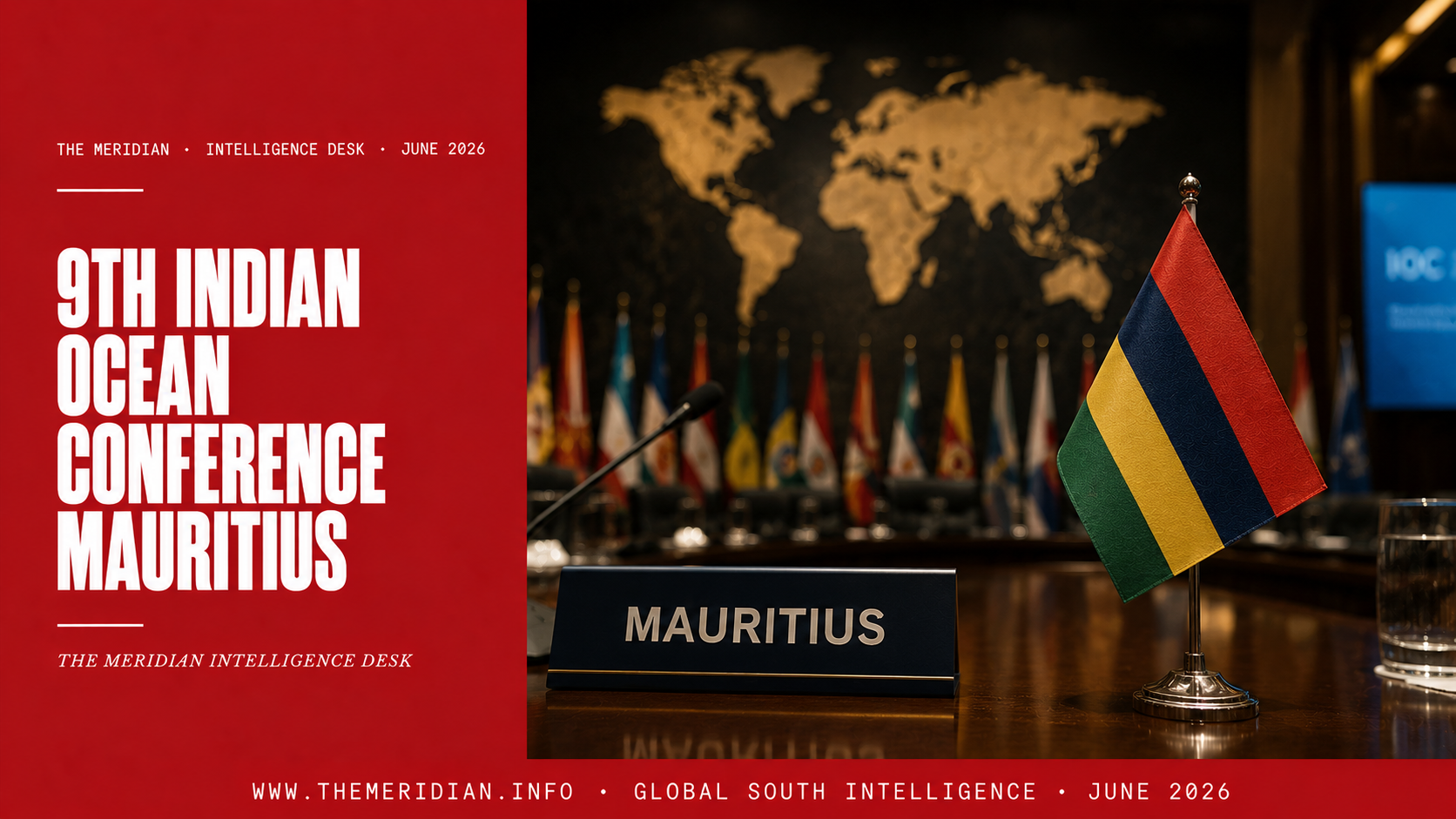
The 9th Indian Ocean Conference was held in Port Louis, Mauritius from 10 to 12 April 2026, under the theme Collective Stewardship for Indian Ocean Governance. It was the first time in the conference's ten-year history that it was hosted in Africa. Delegates from over 40 countries gathered as the West Asia conflict escalated, Strait of Hormuz anxieties intensified, and the Indian Ocean's role as the world's most consequential strategic waterway grew more contested than at any point in recent memory. India finalised an energy pact with Mauritius, Jaishankar outlined a new strategic doctrine, Seychelles signed seven bilateral agreements, and the Maldives sent no delegation. The Meridian Intelligence Desk reports what was decided, what was left unresolved, and what the conference signals for the Indian Ocean region's political order.
The Indian Ocean Conference began in Singapore in 2016 with thirty participating countries and a mandate to provide the Indian Ocean region with a serious institutional forum for discussing shared governance challenges. By its ninth edition, held in Port Louis in April 2026, the conference had expanded to over forty nations and had moved from a dialogue platform to a forum where concrete bilateral commitments were signed on the sidelines. The choice of Mauritius as host was deliberate. It was the first time an African country had hosted the conference, and it placed the island republic at the centre of a conversation that concerns every state bordering or depending on the Indian Ocean, from Australia to Mozambique, from Sri Lanka to Seychelles. The question this article answers is straightforward: what actually happened?
9th Indian Ocean Conference Mauritius 2026 outcomes what was decided IOC 2026 Port Louis Jaishankar India energy pact Seychelles bilateral agreements chokepoints maritime security blue economy
The Indian Ocean Conference is organised by India Foundation in collaboration with regional governments and think tanks. It is not a binding treaty body. It does not produce enforceable resolutions. What it produces is a concentrated moment of high-level dialogue, bilateral meeting opportunities, and strategic signalling that reveals where the principal powers of the Indian Ocean region stand relative to each other and relative to the global order. In a period of accelerating geopolitical fragmentation, that signalling function is more consequential than any formal institutional output.
The 2026 edition was the most geopolitically charged in the conference's history. It took place against the backdrop of the escalating West Asia conflict, which had placed the Strait of Hormuz under acute strategic pressure, disrupted fertiliser and energy supply chains across the Indian Ocean littoral, and raised the spectre of maritime chokepoint disruption on a scale that would affect every country in the region. The conference's theme, Collective Stewardship for Indian Ocean Governance, was chosen before that escalation intensified. By the time delegates arrived in Port Louis, it had acquired an urgency that no conference programme planner could have anticipated.
The most concrete bilateral outcome of the conference was the announcement by External Affairs Minister Dr S. Jaishankar that India is finalising a Government-to-Government agreement for the supply of oil and gas to Mauritius. Speaking in Port Louis, Jaishankar stated directly: "We are finalising a Government-to-Government agreement for the supply of oil and gas, which will play an important role in reinforcing energy security for Mauritius."
The timing of this announcement is not incidental. The West Asia conflict had disrupted Mauritius's existing energy supply chains and placed upward pressure on fuel costs for an import-dependent small island economy. An Indian G-to-G energy agreement provides Mauritius with a more reliable and politically insulated supply arrangement outside the volatile spot market. It also deepens the India-Mauritius Enhanced Strategic Partnership announced during Prime Minister Modi's state visit to Mauritius in March 2025, which elevated bilateral ties to their highest institutional level.
Beyond the energy pact, India confirmed it will position a Defence Attaché in Mauritius — a significant step in the security partnership — and is handing over the final consignment of electric buses to Mauritius to support sustainable public transportation. An Indian public sector enterprise is also developing Mauritius's first floating solar power project, extending the bilateral clean energy footprint.
Jaishankar used the Port Louis platform to articulate what amounts to a recalibrated Indian strategic doctrine for the Indian Ocean region. He framed the Indian Ocean explicitly as a "Global South ocean" — a deliberate rhetorical positioning that rejects the framing of the region as a theatre of great power competition between India, China, and the United States, and instead anchors it within the political economy of the developing world.
He outlined five priorities that now govern India's approach. First, viewing the ocean as an integrated ecosystem rather than a set of bilateral corridors. Second, overcoming colonial legacies that structured the region's institutional architecture in ways that continue to disadvantage its members. Third, adapting to a fragmented global order in which the multilateral rules-based system can no longer be relied upon to resolve disputes or manage crises. Fourth, addressing the chokepoint anxieties that the West Asia conflict has made acute. Fifth, building collective resilience among Global South states so that no single external power can exercise unilateral leverage over critical sea lanes.
India's claim to act as the "First Responder" in the Indian Ocean region was reiterated. Jaishankar cited Operation Sagarbandhu in Sri Lanka following Cyclone Ditwah, the response to oil spills off the coasts of Mauritius and Sri Lanka, and a USD 450 million aid package for Sri Lankan relief and reconstruction as evidence that India's regional role is substantive rather than declaratory.
The escalating West Asia conflict — and its implications for Indian Ocean energy flows and commercial shipping — dominated the substantive discussions at IOC 2026 in a manner that no previous edition of the conference had experienced. India used the platform to reaffirm its firm opposition to the targeting of civilians, infrastructure, and commercial shipping, calling explicitly for de-escalation and stability in the region.
The economic implications for Indian Ocean littoral states were outlined in detail. The conflict has disrupted energy security, trade flows, and fertiliser supply chains across the entire IOR. For countries that import both food and fuel — which describes the majority of small island developing states in the Indian Ocean, including Mauritius, Comoros, and the Maldives — the supply chain disruptions are not a distant geopolitical abstraction. They are a direct constraint on fiscal stability, food security, and public welfare.
Jaishankar underlined that maritime chokepoints have emerged as the defining source of global economic anxiety in 2026. The Strait of Hormuz, the Bab-el-Mandeb, and the Strait of Malacca were identified as the three critical bottlenecks whose disruption would cascade across the entire Indian Ocean trading system. The conference produced no binding mechanism for chokepoint protection — that was not its mandate — but it placed the issue at the centre of the regional governance agenda in a way that will shape subsequent diplomatic engagement.
On the margins of the conference, Mauritius and Seychelles signed seven bilateral agreements covering cooperation across key sectors of mutual interest, and issued a joint declaration on the Joint Management Area on Saya De Malha Bank — a submerged landmass in the Indian Ocean whose resource management arrangements have long-term implications for both countries' exclusive economic zones and blue economy development strategies.
Seychelles Foreign Minister Barry Faure conducted a series of bilateral meetings during the conference, including with Australia's High Commissioner Kate Chamley, focusing on maritime domain awareness and regional cooperation frameworks through the Indian Ocean Rim Association (IORA). The Mauritius-Seychelles bilateral track — formalised through the seven agreements — represents the most substantive island-to-island diplomatic output of the conference and has received almost no coverage in the international press.
The most diplomatically significant absence at IOC 2026 was the Maldives. No Maldivian delegate attended the conference. The reason is precise: diplomatic ties between Mauritius and the Maldives have been suspended over territorial differences related to the Chagos Islands dispute. In a conference explicitly themed around collective stewardship and regional cooperation, the absence of a small island state directly adjacent to the Indian Ocean's most contested maritime geography is a substantive signal, not a procedural footnote.
The Chagos issue casts a long shadow over Indian Ocean governance. The sovereignty dispute between Mauritius and the United Kingdom over the Chagos Archipelago — and the ongoing negotiations over the Diego Garcia military base — intersects with the Indian Ocean's strategic architecture at multiple levels. Any framework for collective stewardship of the Indian Ocean must eventually confront the question of what stewardship means when one of the ocean's most strategically critical territories remains under arrangements whose legitimacy is actively contested by the country whose waters surround it.
The Indian Ocean is no longer a theatre of background competition. It is the front line of the 2026 global order. Every chokepoint is contested. Every energy route is under pressure. Every small island state in the region is having to make strategic choices, at speed, with limited fiscal capacity, that will define their position in the order that emerges from this period of fragmentation. The 9th Indian Ocean Conference was the most consequential edition yet precisely because the stakes have never been higher.
The IOC is a dialogue platform, not a treaty organisation. It does not produce binding resolutions, enforceable frameworks, or institutional mandates. The critical gap that the 2026 edition exposed is the same gap that has characterised Indian Ocean governance since the Indian Ocean Rim Association was established in 1997: the absence of any enforcement mechanism for the collective stewardship principles that every participating delegation endorsed in Port Louis.
The chokepoint anxiety that dominated discussion at the conference has no collective Indian Ocean response architecture. Freedom of navigation in the Strait of Hormuz is currently a function of US naval power projection, not regional institutional capacity. The blue economy frameworks discussed at the conference remain aspirational in the absence of a regional financing mechanism of sufficient scale. The Maldives-Mauritius diplomatic rupture over Chagos was not addressed at the conference. And the question of how smaller Indian Ocean states — Comoros, Seychelles, Maldives, Mauritius — can exercise genuine agency in a strategic environment dominated by India, China, France, and the United States was named but not answered.
First, India has formalised its claim to strategic primacy in the Indian Ocean through the doctrine of First Responder status, the SAGAR framework, and the explicit naming of the ocean as a Global South space. The India-Mauritius energy pact and defence attaché appointment are not bilateral courtesies. They are the operational expression of that strategic claim, delivered in the host country of the conference.
Second, the West Asia conflict has elevated chokepoint anxiety from a long-term strategic concern to an immediate economic emergency for every Indian Ocean importing state. The conference identified the problem with precision. It produced no mechanism for addressing it beyond the bilateral energy and security arrangements that India is progressively formalising with individual countries.
Third, and most consequential for the long term: the conference confirmed that Indian Ocean governance remains essentially bilateral in practice and multilateral only in aspiration. Collective stewardship is the theme. The instruments of governance are country-to-country agreements, G-to-G energy pacts, and special economic packages negotiated in bilateral meeting rooms on the conference's margins. The gap between the theme and the mechanism is the defining structural challenge of Indian Ocean governance in 2026, and the 9th conference in Port Louis made that gap visible without closing it.
The Meridian Intelligence Desk covers Indian Ocean geopolitics, Global South political economy, and strategic affairs across Africa, Asia, and the Indian Ocean region. This article is part of The Meridian's June 2026 coverage. The complete edition is published at themeridian.info.
Add comment
Comments