Are They All Wrong and Mauritius Right? The Plant, the State, and the Citizen
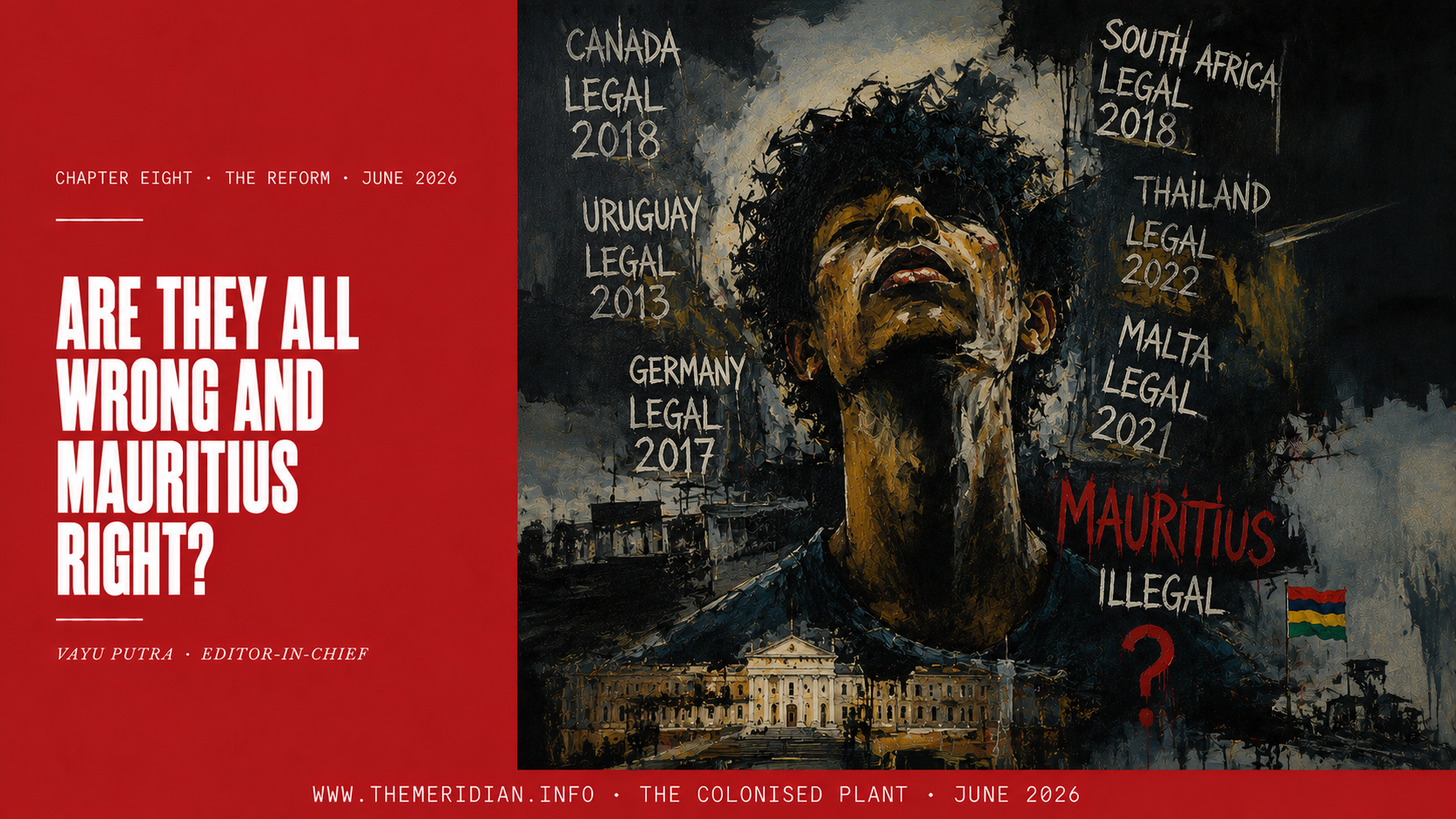
The question in the title of this essay is not rhetorical. It is the precise question that the Mauritian state's maintenance of cannabis prohibition requires the citizen to answer in the affirmative. Are they all wrong? Canada with its federal Cannabis Act, its licensed retail stores, its billions in excise revenue, and its documented decline in youth cannabis use following legalisation. Germany with its Cannabisgesetz, its cannabis social clubs, its constitutional court jurisprudence, and its pharmaceutical prescription framework. Uruguay, the first nation to fully legalise, in 2013. South Africa, whose Constitutional Court held unanimously in 2018 that private prohibition violated the right to privacy. Thailand, Malta, Luxembourg, Lesotho, and twenty-four American states. Are they all wrong, and is Mauritius, with its Dangerous Drugs Act 2000, its unproclaimed 2022 amendment, its Rs 200 million annual aerial eradication programme, its 652 adolescent synthetic cannabinoid hospitalisations, and its 81-year-old man facing twenty-five years for growing medicine in his garden, right? That is the question. This essay delivers the answer.
I want to begin with the scale of what is being claimed by the Mauritian state's position on cannabis. The maintenance of absolute prohibition in Mauritius, in June 2026, requires the claim that the pharmacological, constitutional, economic, and comparative policy consensus reached independently by the governments, courts, and legislatures of more than fifty nations is wrong. It requires the claim that the La Guardia Commission of 1944 was wrong, the Shafer Commission of 1972 was wrong, the WHO Expert Committee that recommended reclassification in 2019 was wrong, the South African Constitutional Court was wrong, the Colombian Constitutional Court was wrong, the Mexican Supreme Court was wrong across five consecutive rulings, the Ontario Court of Appeal in R v Parker was wrong, the Italian Sezioni Unite was wrong, the German Bundesverfassungsgericht was wrong to defer to a legislature that eventually legalised anyway, and the Mauritius National Assembly was wrong when it passed the 2022 amendment acknowledging that the plant has medical value. That is the intellectual position that the non-proclamation of the 2022 amendment requires. It is not a modest position.
are they all wrong Mauritius cannabis prohibition verdict closing essay global consensus Canada Germany South Africa constitutional court record pharmacological economic comparative policy final word Vayu Putra The Meridian
The pharmacological record is closed. Cannabis has produced zero confirmed overdose deaths in the entirety of documented medical history. The endocannabinoid system, identified by Raphael Mechoulam in the 1960s and 1990s, confirms that the human body was biologically designed to interact with cannabis compounds. The FDA approved cannabis-derived medicine in 1985. The British Pharmacopoeia listed cannabis as a therapeutic entry in 1864, one hundred and thirty-seven years before the DDA 2000 was passed. The Indian Hemp Drugs Commission recommended against prohibition in 1894, one hundred and six years before the DDA 2000 was passed. The record does not support prohibition. The record has never supported prohibition. The prohibition was built on Anslinger's fabricated testimony, Hearst's commercial interests, the racial targeting that Ehrlichman confirmed in 1994, and the geopolitical dynamics of a single afternoon in Geneva in February 1925. That is the foundation on which the DDA 2000 stands.
The constitutional record is equally clear. The South African Constitutional Court held in 2018 that private cannabis prohibition violated Section 14 of the Constitution. The Colombian Constitutional Court held in 1994 that prohibition violated the free development of personality. The Mexican Supreme Court issued five consecutive rulings between 2015 and 2018 declaring prohibition unconstitutional and establishing it as binding jurisprudence. The Ontario Court of Appeal held in R v Parker in 2000 that prohibiting a patient from growing medicine for a serious medical condition violated Section 7 of the Charter. The Mauritius Supreme Court, in the Ah Seek judgment of October 2023, demonstrated its willingness to apply constitutional scrutiny to colonial-era criminal statutes and to strike them down when they fail that scrutiny. The constitutional instruments are in place. The 81-year-old's case is before the court. The question is whether the Supreme Court of Mauritius will join the constitutional record that the courts of South Africa, Colombia, Mexico, Canada, Italy, and Germany have built, or whether it will stand alone against it.
The Mauritian state is not being asked to pioneer anything. It is being asked to follow the precedent that every comparable nation, in its own courts and in its own legislature, has already set. The pioneering was done by Uruguay in 2013. By Lesotho in 2017. By South Africa in 2018. By Malta in 2021. By Germany in 2024. Mauritius is being asked to follow. That is all.
The answer to the question in the title of this essay is no. They are not all wrong. The pharmacological consensus of the medical and scientific community is not wrong. The constitutional courts of South Africa, Colombia, Mexico, and Canada are not wrong. The legislatures of Germany, Canada, Uruguay, Malta, Luxembourg, and twenty-four American states are not wrong. The WHO Expert Committee that recommended reclassification in 2019 is not wrong. The Mauritius National Assembly that passed the 2022 amendment acknowledging the plant's medical value is not wrong. The Mauritian citizen who has read the forty-seven articles and eight chapters of The Colonised Plant and arrived at this final page is not wrong to conclude from that record that cannabis prohibition in Mauritius is indefensible.
The question the title asks is whether Mauritius is right. The same analysis provides the answer. The Mauritius position, in June 2026, is that an island of 1.3 million people, with one of the world's highest diabetes prevalence rates and a public health budget that is seventy-five per cent consumed by staff costs, should maintain the criminal prohibition of a compound that the FDA approved as medicine in 1985, that thirty countries prescribe for nerve pain, that Parliament acknowledged has medical value in 2022, and that costs Rs 25 per gram to produce legally but Rs 3,000 per gram under the prohibition that has driven 652 adolescents to synthetic cannabinoid hospitalisations in four years. The Mauritius position is that an Olympian should be allowed to die before the court answers his constitutional petition. The Mauritius position is that two Grade Six children should have police files opened against them. The Mauritius position is that a musician who asked for reform in public should die in a cell and the law that follows should be named a public health measure.
That position is not right. It was not right in 2000 when the DDA was passed. It was not right in 2022 when the amendment was passed and not proclaimed. It is not right now. The record that this publication has assembled across forty-seven articles and eight chapters does not permit a contrary conclusion. The record is the verdict.
I want to close this edition not with the state but with the citizen. Because the question in the title has two answers, and the second answer is the more important one. Are they all wrong and Mauritius right? The global consensus is not wrong. But the Mauritian citizen who has internalised the state's prohibition narrative, who defends the DDA 2000 as a public health measure, who regards cannabis reform advocates with social suspicion rather than intellectual engagement, is not wrong in the sense of being dishonest or malicious. They are wrong in the sense of being uninformed, specifically in the sense of having been systematically denied access to the record that would allow them to reach a different conclusion.
That is what The Colonised Plant was for. Not to tell the Mauritian citizen what to think. To give them what the state has withheld: the pharmacological record, the historical record, the constitutional record, the comparative record, the economic record, and the human record. Kaya. Shirish Rummun. The 81-year-old in the Supreme Court. The two Grade Six children in police files. The careers broken and the lives suspended by a provisional charge mechanism that imposes punishment before any verdict. The 652 adolescents hospitalised by the synthetic market that prohibition built. These are not arguments. These are people. They are the citizen's neighbours and children and parents. They are Mauritius.
The Municipal Mindset dissolves when the citizen has access to the record. This publication is that access. The forty-seven articles that precede this one are the record. The citizen who has read them is no longer operating inside the institutional framework that prohibition requires. They are operating with the pharmacological and historical and constitutional truth that the framework has spent decades suppressing. And a citizen with access to the truth is the only instrument that has ever, in any jurisdiction, produced the political will that the institutions alone have declined to generate.
They are not all wrong. Canada is not wrong. Germany is not wrong. South Africa is not wrong. Lesotho, Uruguay, Malta, Luxembourg, Thailand, and twenty-four American states are not wrong. The WHO Expert Committee is not wrong. The Colombian Constitutional Court is not wrong. The Mexican Supreme Court is not wrong. The Ontario Court of Appeal is not wrong. The Mauritius National Assembly that passed the 2022 amendment is not wrong.
The Dangerous Drugs Act 2000 is wrong. It was wrong when it was passed one year after a musician died in a police cell for asking for reform. It was wrong when it was maintained in force while Parliament passed the 2022 amendment acknowledging the plant's medical value and the executive declined to proclaim it. It is wrong now, in June 2026, as an 81-year-old man waits before the Supreme Court, as two Grade Six children have police files opened against them, and as the synthetic cannabinoid market that prohibition built hospitalises adolescents at a rate of 173 per year.
The record is assembled. The verdict is delivered. The instrument is in the Government Gazette. The signature is the government's to give. The Colonised Plant closes here.
This is the sixth and final article of Chapter Eight: The Reform, and the closing essay of The Colonised Plant: The Cannabis Edition, published by The Meridian in June 2026. The complete edition of forty-seven articles across eight chapters is available at themeridian.info/june-2026.
Add comment
Comments