Why the Strait of Hormuz Will Never Go Back to Normal: Qeshm Island, the Ceasefire, and the Future of International Maritime Law
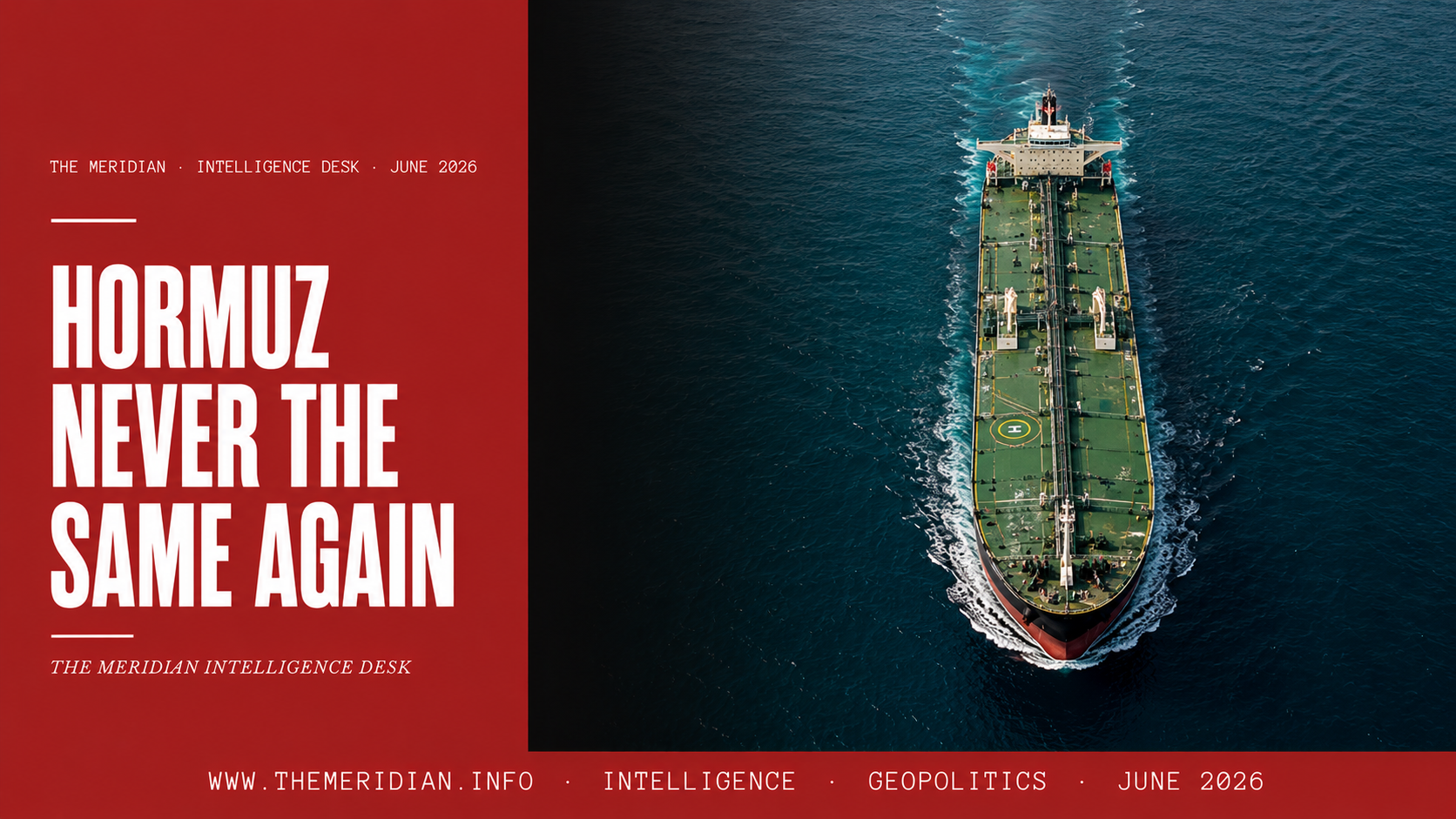
On day 96 of the Iran war, President Trump indicated that a settlement could come very soon. The diplomatic community is discussing ceasefire terms. The shipping industry is pricing in a reopening. All of them are making the same analytical error. Even if every clause of a settlement agreement is signed tomorrow, the Strait of Hormuz will not return to what it was on the morning of 28 February 2026. Iran has spent 96 days demonstrating something the world did not fully understand before this war began. The Meridian Intelligence Desk explains what that demonstration means for the Hormuz, for every other chokepoint on earth, and for 200 years of international maritime law.
The current phase of the conflict has moved into a pattern of calibrated exchange. The United States has struck Qeshm Island -- specifically its oil terminal and, in the last 36 hours, its radar installations. Iran has responded by hitting the naval base in Bahrain, the headquarters of the US Fifth Fleet, and Kuwait's airport, where one person has been killed and at least 64 injured. Neither strike broke the broader ceasefire framework. Both were precise enough to communicate a message without crossing the threshold into full escalation. The messages being communicated are more important than the strikes themselves.
US strikes: Qeshm Island oil terminal and radar installations. Qeshm is the largest island in the Persian Gulf, home to approximately 150,000 civilians, and the primary IRGC forward operating position for Hormuz control operations.
Iranian strikes: Bahrain naval base -- the headquarters of the US Fifth Fleet -- and Kuwait International Airport terminal building. One confirmed fatality. At least 64 injured. The Kuwait strike is the more strategically significant: it demonstrates Iran's willingness and ability to strike civilian infrastructure in third-party Gulf states that host US forces.
Iran's stated doctrine: Supreme Leader Khamenei has stated explicitly that all American bases in the region must now be regarded as vulnerable. The strikes on Bahrain and Kuwait are intended as operational proof of that doctrine, even acknowledging that not all Iranian missiles and drones penetrate available air defences.
To understand why a ceasefire cannot restore the pre-February Hormuz, it is necessary to understand what Qeshm Island is and what it contains. Qeshm is the largest island in the Gulf -- approximately 150,000 civilians, villages, fruit orchards, salt production, and a history of tourism that earned it the designation, at least from one nineteenth-century English traveller, as a plausible candidate for the original Garden of Eden. The Iranian Navy has no formal facilities on the island. The Islamic Revolutionary Guard Corps does.
Beneath Qeshm -- in tunnels that are widely understood by Western intelligence agencies to run extensively through the island -- the IRGC maintains a comprehensive forward capability: drone launch facilities, anti-ship missile batteries, miniature submarines capable of operating in the shallow Gulf waters, fast attack craft designed to swarm and overwhelm surface vessels, and the radar installations that the United States has now struck. The geographic position of Qeshm relative to the northern channel of Hormuz makes it the single most important piece of real estate for controlling what passes through the strait.
Iran does not need to physically block the Strait of Hormuz to make it impassable. It only needs to make it dangerous. With the assets on Qeshm Island and modern targeting technology, it can do that at any moment it chooses.
This is the core strategic insight that the war has converted from theory into demonstrated fact. The physical closure of a strait requires positioning vessels or mines across the entire navigable channel -- a visible, blockable act that invites direct military countermeasure. Making a strait dangerous requires only the credible threat of targeting any vessel that attempts transit. Iran has now proved, across 96 days of conflict, that it possesses both the capability and the willingness to exercise that threat. A ceasefire agreement does not remove the tunnels. It does not remove the missiles. It does not remove the drones. It does not even remove the demonstrated willingness to use them.
Before 28 February 2026, the vulnerability of the Strait of Hormuz was a theoretical concern debated in strategic studies journals and war-gaming exercises. After 96 days of this war, it is an empirical fact verified by the global shipping industry, every major navy, every energy market, and every government treasury that has watched oil prices behave accordingly. The world now knows, with a precision it did not have before, exactly how the Strait of Hormuz can be made dangerous, exactly what hardware makes it possible, and exactly how little warning time global markets and military planners have between a political decision in Tehran and a disruption in global energy flows.
This knowledge cannot be unknowed. A ceasefire that puts the IRGC assets back in their tunnels and the radar back on the hilltops of Qeshm does not erase the knowledge. Every shipping company that now pays a war risk premium for Hormuz transit will not immediately remove that premium on the day a settlement is signed. Every energy market that now prices a Hormuz risk factor into forward contracts will not immediately remove that factor. Every navy that has now repositioned assets in response to the demonstrated threat will not immediately reposition them back. The strategic environment has been permanently repriced.
The permanent repricing of the Hormuz is not a contained problem. International maritime law rests on a doctrine of freedom of navigation that evolved over two centuries of Western maritime dominance -- a doctrine that assumed the right of innocent passage through international straits was effectively self-enforcing because no regional power had the capability to credibly threaten it. The war has invalidated that assumption for Hormuz. The question now being asked in every strategic capital is which other strait is the next Hormuz.
International maritime law -- specifically the doctrine of innocent passage through international straits -- is built on legal frameworks that evolved when Western naval power was sufficient to enforce them globally. UNCLOS and its predecessors assumed that the right of free passage was not merely a legal entitlement but a physically defensible one. The war has exposed the gap between the legal entitlement and the physical reality in one of the world's most critical waterways. That gap does not close when the war ends.
What it opens is a more fundamental question: if a regional power with IRGC-scale asymmetric capabilities can credibly threaten the closure of an international strait at will, and can do so in ways that fall short of the formal acts of war that international law was designed to prohibit, does the doctrine of freedom of navigation still function as a self-enforcing norm? The answer that 96 days of this war has produced is not reassuring. The doctrine survives when the costs of violating it exceed the benefits. Iran has now demonstrated that the calculus can be made to run the other way.
When President Trump signals that a settlement is coming very soon, he is describing the end of active hostilities. He is not describing the restoration of the pre-February Hormuz. No clause in any ceasefire agreement removes the tunnels on Qeshm Island. No diplomatic formula erases the knowledge that was transferred to every shipping company, energy trader, naval planner, and rival regional power over the course of 96 days. No signed document returns global energy markets to a pricing environment that does not contain a permanent Hormuz risk factor.
Iran has achieved something in this conflict that will outlast any settlement: it has converted a theoretical strategic capability into a demonstrated operational fact. The world now knows how easy it is to make the Strait of Hormuz dangerous. Iran knows the world knows. Every other state sitting astride a critical maritime chokepoint now knows that the world knows. The deterrence calculus for every strait on earth has shifted.
The Strait of Hormuz will reopen. Ships will transit it again. War risk premiums will narrow. But the strategic environment in which those transits occur has been permanently altered -- not by the war itself, but by what the war proved. International maritime law has not been broken. It has been shown to be dependent on enforcement that no single power can now guarantee. That is a different kind of damage. And it does not have a ceasefire clause.
Add comment
Comments