The Fall of the Offshore Matrix: How AI Is Dismantling Mauritius's Paper Economy
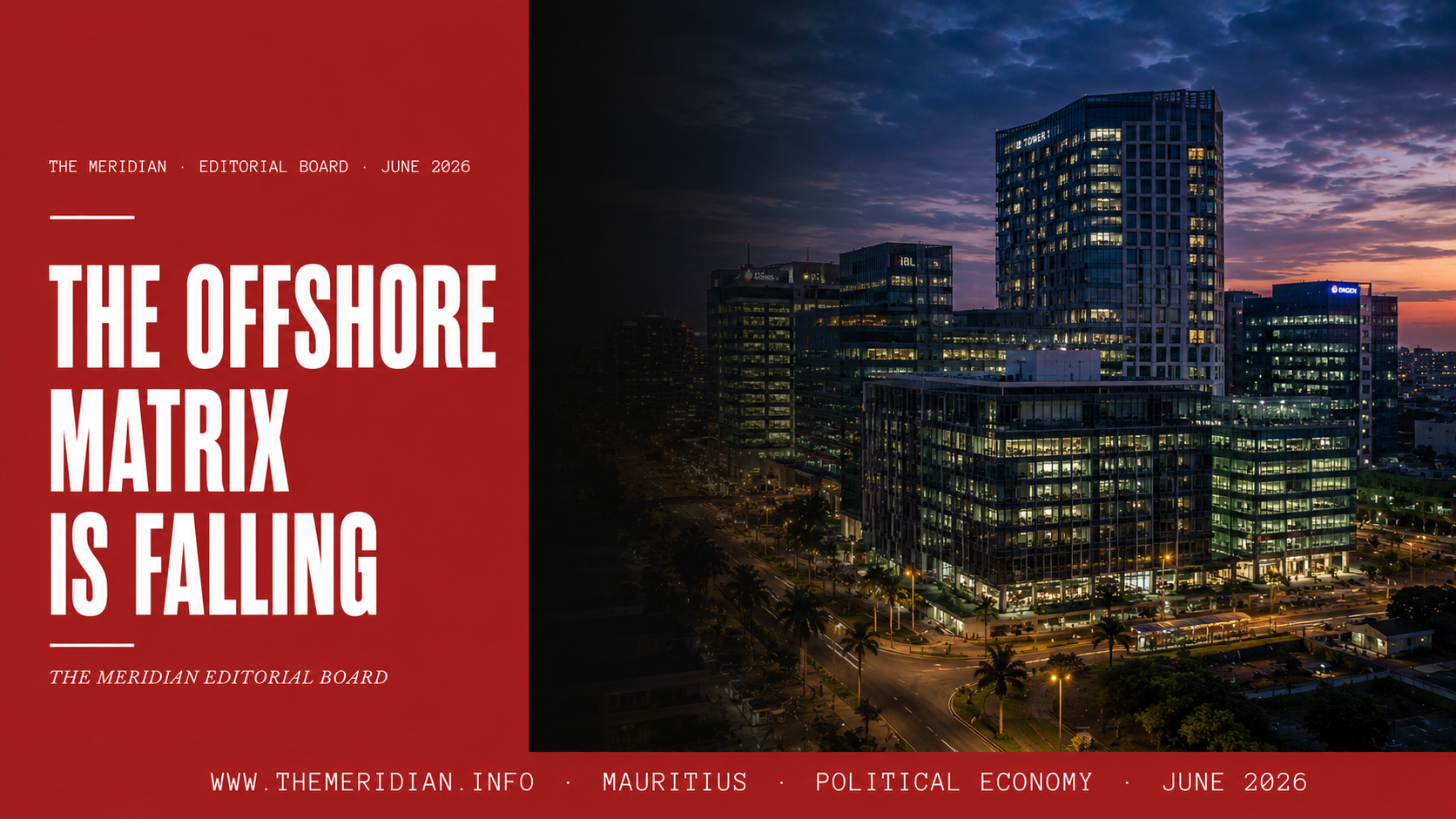
For decades, the Mauritian Global Business sector has operated on a carefully maintained illusion. We were told this island was a critical financial hub, a sophisticated gateway for global capital flowing between the developed world and emerging markets. Strip away the polished corporate facades in Ebène, and the reality is considerably simpler. The money was never actually here. And the workforce that managed it is about to discover that the skills it spent decades acquiring are being automated out of existence.
The Mauritian offshore industry produces no physical goods and invents no new technologies. The wealth it manages is digital data sitting on foreign servers, routed through Port Louis purely to exploit tax treaties and regulatory frameworks. The entire product of the Global Business sector is not finance in any meaningful sense of the word. It is bureaucratic friction. For years, that friction was extraordinarily lucrative. An army of compliance officers, auditors, and management company directors built careers and sustained a middle class on the premise that manually processing paperwork, performing KYC checks, and ticking regulatory boxes was indispensable work. Then came Artificial Intelligence. And the matrix began to break.
To understand what is happening to Mauritius's offshore sector, it helps to remember what happened to a previous generation of Mauritian workers. Through the 1990s and 2000s, institutions built entire industries out of training people to use Microsoft Word, Excel, and PowerPoint. The ICDL -- the International Computer Driving Licence -- became the gatekeeping mechanism of its era. Careers were jeopardised if you lacked the right certificate. Expensive training institutes charged substantial fees to teach people to perform basic document formatting. This was dressed up as high-tech literacy. What it actually was, in retrospect, was administrative compliance training -- the mastery of proprietary corporate tools that were already obsolete by the time most students had qualified.
The irony was invisible at the time because the gatekeeping was so effective. While Mauritians were being charged to learn how to build macros in Excel, financial institutions like BlackRock were running algorithmic risk analysis across global portfolios using systems like the early iterations of Aladdin. The elite financial sector has been operating on automated, predictive data frameworks since the late 1980s. The gap between what the public was being told constituted technical sophistication and what was actually being deployed in global capital markets was enormous. Generative AI has now collapsed that gap, publicly, and permanently. The poker face of the training institute sector is justified. Their model is over.
Institutions charged workers for certificates to perform administrative tasks that global financial institutions had already automated. The "tech literacy" being sold was proprietary software compliance. Wall Street was running Aladdin. Mauritius was teaching table formatting.
The offshore sector charges global capital for manual KYC checks, audit processing, and regulatory compliance that AI RegTech systems execute in seconds. The "financial sophistication" being sold is bureaucratic friction. The technology to eliminate it entirely already exists and is being deployed.
Generative AI and automated RegTech systems do not merely make compliance officers faster. They make the role structurally redundant. An AI system can cross-reference global financial databases, trace the source of offshore funds across complex corporate structures, and execute a flawless audit in seconds. It does this without human error. Without fatigue. And without the vulnerability to political influence, social pressure, or financial inducement that has historically been the most significant risk factor in any compliance system relying on human judgment.
AI offers something the current system desperately lacks: compliance without corruption. Algorithms do not take bribes. They do not look the other way for a wealthy, politically connected client. And they cannot be intimidated.
This is not a distant prospect. Global capital markets are not sentimental. They will not continue paying Mauritian management companies substantial retainer fees for manual compliance processes when an AI platform can deliver total legal transparency and regulatory adherence at a fraction of the cost. The economic logic is straightforward. When the cost differential between human compliance and automated compliance becomes large enough, capital migrates to the cheaper jurisdiction. Mauritius, as a jurisdiction whose primary competitive advantage is the availability of a human compliance workforce, is directly in the path of that migration.
Faced with the potential vaporisation of its primary economic moat, the Mauritian regulatory establishment has responded in the only way an institution defending obsolete infrastructure can respond: it has attempted to regulate the disruptive technology into irrelevance. The Financial Services Commission and the government's April 2026 National AI Strategy are instructive in this regard. Neither document bans AI. Banning AI would be too obviously backward. What they do instead is far more sophisticated: they mandate the continued employment of the human workforce that AI was built to replace.
The FSC's guidelines for the "Responsible Use of AI" place heavy emphasis on "human-in-the-loop" oversight and board accountability. In practice, this means that companies wishing to deploy automated compliance systems in Mauritius are legally required to maintain human supervision of those systems. Furthermore, any firm seeking the FSC's "Robotic and Artificial Intelligence-Enabled Advisory Services Licence" must establish a physical office in Mauritius, hire local resident directors, and employ what the regulations describe as an adequate number of officers. The technology can be deployed -- but only if it brings along the human workforce it was specifically designed to make unnecessary.
Let us call this what it is. The government is not regulating AI to protect the integrity of the financial system. It is regulating AI to protect obsolete white-collar jobs. It is forcing global technology and finance firms to subsidise a class of Mauritian administrative workers by hiring them as mandatory supervisors of algorithms that operate more reliably, more cheaply, and more transparently without them. This is dressed up in the language of ethics, governance, and the government's FAIR framework. The substance beneath that language is institutional self-preservation.
The regulatory strategy has a structural flaw that cannot be resolved by better drafting. Capital is borderless. It moves to wherever it can operate most efficiently. If Mauritius insists on artificially inflating the cost of digital compliance by requiring companies to maintain a physical human overhead that the technology has rendered unnecessary, international investors will not comply with those requirements indefinitely. They will identify jurisdictions that offer the same legal and tax advantages with fully automated, frictionless compliance -- and they will move their capital there.
The Mauritian establishment is playing a losing game against a technology that does not negotiate and does not recognise regulatory borders. Every month that the FSC insists on human-in-the-loop mandates is a month in which the competitiveness of the jurisdiction erodes relative to every digital-first alternative. The protective wall is real today. It will not be real in five years. And the workforce it was built to protect will not have been retrained in the interim.
The fable of Mauritius as an indispensable offshore hub is not collapsing because of external hostility. It is collapsing because the technology has revealed that the product was never as valuable as the price charged for it. The compliance officer, the auditor, the management company director -- these are not professions being targeted by an indifferent algorithm. They are roles whose entire function was the management of processes that AI executes more reliably, more cheaply, and more honestly.
The path forward is not more sophisticated gatekeeping. It is not FAIR frameworks and human-in-the-loop mandates dressed up as governance. It is an honest reckoning with the fact that Mauritius built its middle class on friction, and friction is being automated away. The island has genuine assets -- geographic position, legal infrastructure, political stability relative to its region, a multilingual educated workforce. None of those assets depend on compliance paperwork. All of them can support a pivot toward genuine high-value economic activity if the political class is willing to stop protecting the model that is already obsolete.
We can embrace the technology, dismantle the bureaucracy, and build something that cannot be automated. Or we can try to regulate the future out of existence -- and watch the capital leave for jurisdictions that did not bother trying. The matrix is falling. The only remaining question is whether Mauritius falls with it or builds something new from what remains.
Add comment
Comments