Is Nigeria Still a Democracy? The Judicial Takeover of Nigerian Politics Explained
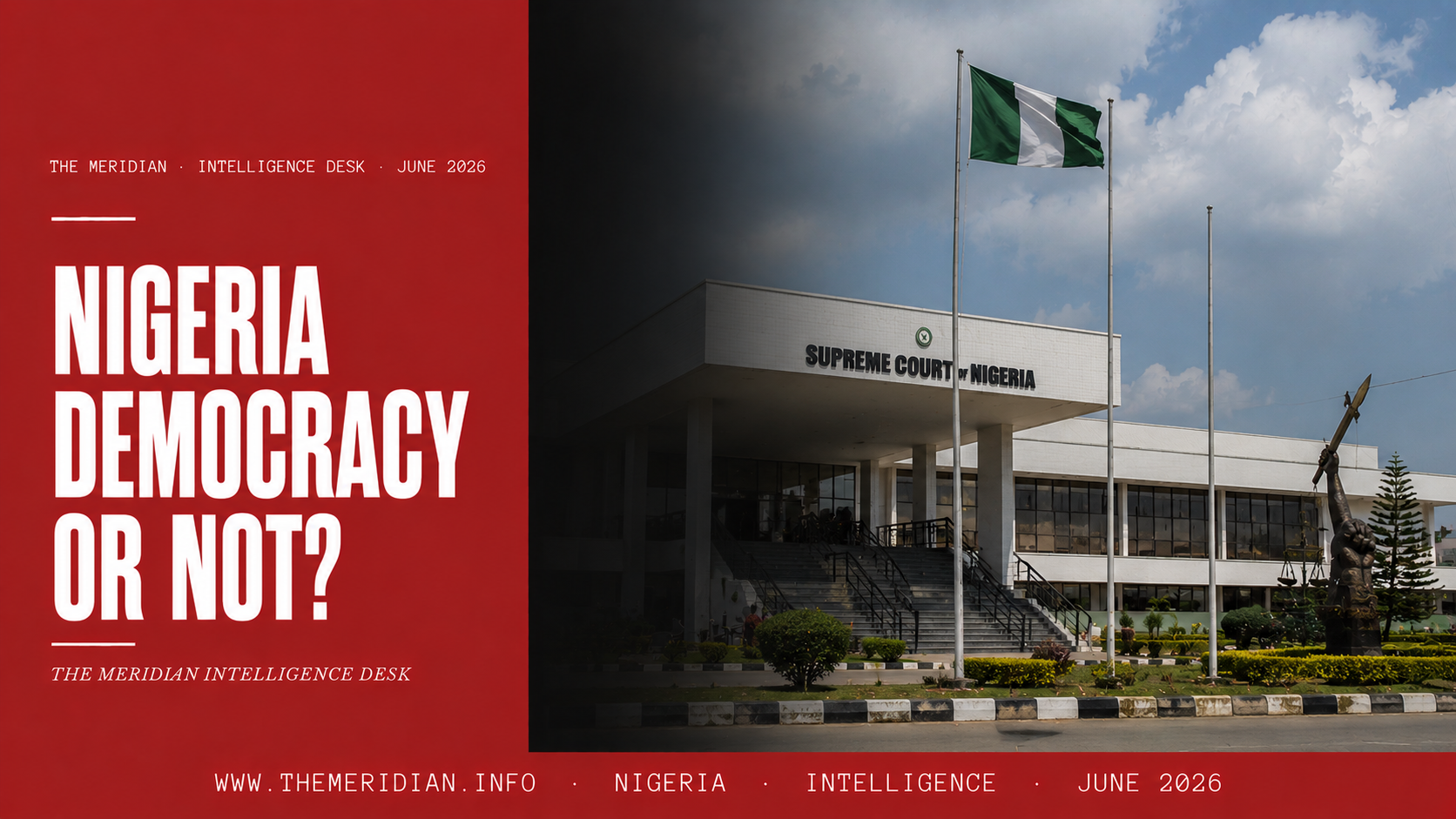
The question is spreading across Nigerian digital platforms with a velocity that tells you something important is happening: "Is Nigeria a democracy or just a civilian government?" It is not a new question. But it is being asked now with a new intensity, driven by the accumulation of court judgements that have removed elected officials, reversed electoral outcomes, and determined party leadership without a single vote being cast. The Meridian Intelligence Desk examines what the evidence shows.
Nigeria has held regular elections since 1999. It has transferred power between political parties. It has a functioning Electoral Commission, an active judiciary, and a vibrant civil society. By the formal criteria used to classify political systems, it is a democracy. But formal criteria are not the only criteria. The question being asked across Nigeria in June 2026 -- "is Nigeria a democracy or a civilian government?" -- is not asking whether elections are held. It is asking whether elections determine outcomes. And the answer to that question, measured against the evidence of the last several years, is increasingly complicated.
In a functioning democracy, courts serve as the institution of last resort for electoral disputes -- the mechanism that corrects procedural violations and protects the integrity of the electoral process. In Nigeria, courts have gradually assumed a different and more expansive role: they have become the institution through which political outcomes are contested, reversed, and determined at every level of the political system.
The pattern is consistent and documented. A party primary is held. The loser files a suit. A court issues an injunction restraining the winner from taking office. The matter proceeds through the legal system for months or years. In the interim, the governance of a state, a local government, or a party organ is in legal limbo. When the court finally rules -- sometimes years after the original election -- it may reinstate the original winner, replace them with the legal challenger, or in some cases declare the entire primary invalid and order a fresh process. The outcome of the original vote is, in all of these scenarios, secondary to the outcome of the litigation.
This is not a description of exceptional cases. It is a description of the routine operation of Nigerian politics. Governors have been removed by court order. Speakers of state houses of assembly have been replaced through injunctions. Presidential primaries have been overturned. The 2023 presidential election result, in which Bola Tinubu was declared winner by INEC, was contested through the tribunal system all the way to the Supreme Court -- a process that, regardless of its ultimate outcome, demonstrated that the formal declaration of an electoral winner is understood by all political actors to be the beginning of the process, not the end of it.
In Nigeria's current political system, the ballot determines who gets to file the stronger lawsuit. The court determines who actually governs. Whether this constitutes democracy depends entirely on your definition.
The judicialization of Nigerian politics did not happen accidentally. It emerged from specific structural features of the Nigerian political system that made courts an attractive arena for political competition.
First, the weakness of internal party democracy. Nigeria's political parties are not membership organisations with robust internal governance. They are vehicles for political competition controlled by dominant political figures -- governors, senators, wealthy businessmen -- who determine candidate selection through processes that have limited transparency and even more limited accountability. When those processes produce results that disadvantage powerful actors, those actors go to court because the courts are more reliable than the internal party process.
Second, the breadth of grounds for electoral challenge. Nigerian electoral law and party constitutions provide extensive grounds on which primaries and elections can be challenged -- non-compliance with party guidelines, unlawful exclusion of candidates, procedural irregularities. The breadth of these grounds, combined with a judiciary that has historically been willing to hear and rule on such challenges, means that almost any primary result can be made the subject of credible litigation.
Third, and most consequentially, the political utility of judicial proceedings as a delay mechanism. Even when a court ultimately rules against a challenger, the process of litigation creates months or years of uncertainty that has real political value. An incumbent whose mandate is under legal challenge has weakened political authority. A party candidate whose primary victory is being contested cannot fully campaign. The litigation itself -- regardless of outcome -- is a political weapon.
The most structurally important judicial intervention in Nigerian politics in recent years is not about elections at all. It is about money. The Supreme Court's judgement on local government financial autonomy -- ordering that federal allocations be paid directly to the 774 local government areas rather than routed through state governors -- represents a fundamental redrawing of the fiscal architecture of Nigerian federalism. State governors, who had effectively been collecting and controlling local government funds for decades, were instructed by the court to surrender that control.
The judgement is being searched extensively by citizens asking "who controls local government funds in Nigeria" and "local government autonomy Supreme Court judgement 2026." The searches reflect a genuine public interest in understanding whether the ruling has been implemented. The evidence on implementation is mixed. Some states have complied. Others have resisted. The practical effect of the ruling -- whether it actually results in local governments receiving and independently spending their constitutional allocations -- will be one of the defining governance stories of 2026 and 2027.
What the LG autonomy case illustrates is the paradox at the centre of the judicialization of Nigerian politics: the Supreme Court can deliver a landmark ruling on local government financial independence, but the enforcement of that ruling depends on the willingness of the executive branch -- governors -- to comply. When the political actors who are supposed to implement court orders are the same actors who have the most to lose from those orders, the gap between judicial decision and political reality is where Nigerian democracy actually lives.
The 2027 general elections are 18 months away, and the political machinery is already moving. INEC's timeline for voter registration, party primaries, and candidate screening will be published in the coming months. Political strategists are tracking the schedule closely -- not only to plan campaign timelines, but to identify the windows in which legal challenges can most effectively be deployed.
The question "will the Peter Obi and Kwankwaso NDC alliance work in 2027?" -- which we examine separately -- is in one sense an electoral question about coalition arithmetic. But it is also, in the Nigerian context, a legal question: whether a new political vehicle can survive the inevitable cascade of court challenges that will accompany any serious threat to the ruling party's dominance. The history of Nigerian opposition politics is partly a history of opposition movements being tied up in litigation at critical junctures of the electoral cycle.
If Nigeria's 2027 elections produce a competitive result -- and the conditions for competition are present -- the courts will be as important to the outcome as the ballot boxes. That is not a statement about judicial corruption or electoral fraud specifically. It is a statement about a political system in which the formal electoral process and the legal process are not sequential steps in a democratic outcome -- they are parallel tracks, each capable of producing a different result, and neither fully subordinate to the other.
The political science literature has a term for what Nigeria is: a competitive authoritarian system. Not a dictatorship -- elections are real, competition is real, outcomes are genuinely uncertain. But not a consolidated democracy either -- institutions designed to enforce the rules of democratic competition are used strategically by political actors to gain advantages that elections alone could not provide.
The viral question spreading across Nigerian social media -- "is Nigeria a democracy or a civilian government?" -- is a question that political scientists have been debating for years with technical language. Nigerian citizens have arrived at the same question through lived experience: they vote, their votes are counted, and then the courts decide what the votes mean. That is not what democracy was supposed to look like.
The 2027 elections will be the next major test. INEC will conduct them. The parties will contest them. The courts will adjudicate them. And the outcome will depend, as it has depended in every election cycle since 1999, not on any single institution performing its function correctly, but on whether the aggregate of imperfect institutions produces a result that enough Nigerians accept as legitimate. That is Nigeria's democratic condition in June 2026. It is fragile. It is real. And it is being tested.
Add comment
Comments