Why Is Nigeria's Poverty Rate Rising While Its Economy Is Growing?
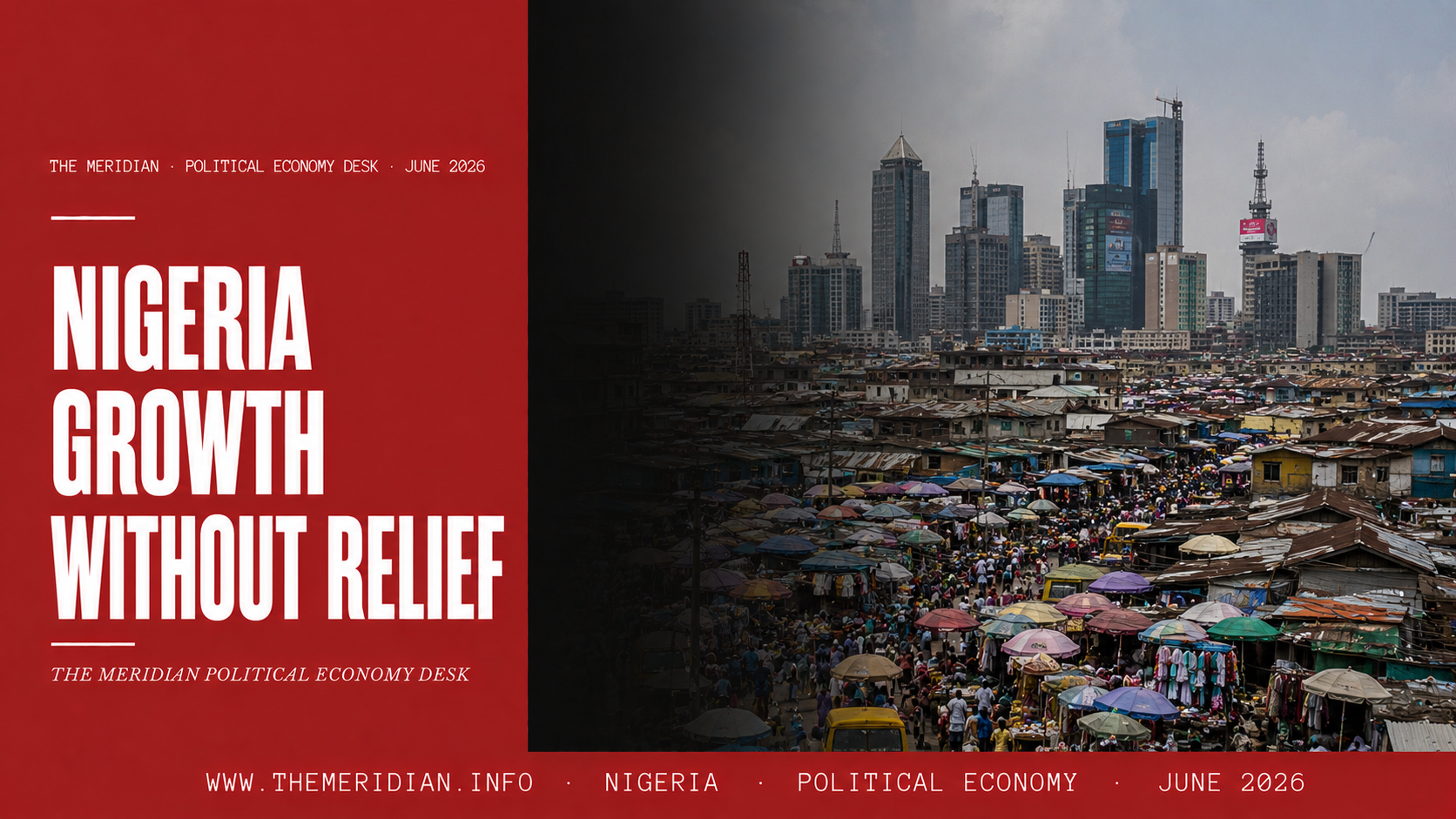
Nigeria's GDP grew at 3.8 per cent in the fourth quarter of 2024 -- the fastest rate in three years. The Tinubu administration cited this as evidence that its structural reforms were working. In the same period, Nigeria's poverty rate rose from approximately 56 per cent to an estimated 63 per cent of the population. More Nigerians living below the poverty line, in a growing economy. This is not a contradiction. It is a structural outcome of a specific set of economic policy choices whose distributional consequences were predictable from the moment they were made.
The question dominating Nigerian economic searches in June 2026 is framed as a paradox: how can the economy be growing if more people are poor? The answer requires understanding what GDP growth measures and -- more importantly -- what it does not measure. Gross Domestic Product is the total monetary value of goods and services produced in an economy. It says nothing about who captures those goods and services, nothing about how the income they generate is distributed, and nothing about whether the prices at which they are measured reflect the purchasing power of ordinary citizens. Nigeria's GDP is growing. Nigerian households are not growing wealthier at anything like the same rate. These two facts are not contradictory. They are the product of the same mechanism.
The first mechanism is the naira devaluation. On his first day in office, President Tinubu announced the removal of the fuel subsidy that had kept petrol prices artificially low for decades. Shortly thereafter, the Central Bank of Nigeria unified its multiple exchange rate windows, effectively devaluing the naira against the dollar. The naira, which had been trading at approximately N633 to the dollar at the official rate in May 2023, fell to over N1,500 by mid-2024 and has stabilised in the N1,460 to N1,465 range in 2026.
This devaluation has two simultaneous effects that work in opposite directions on the GDP-poverty relationship. For the GDP statistic: Nigeria's oil revenues, denominated in dollars, translate into vastly more naira at the devalued exchange rate. Oil is Nigeria's largest GDP component. More naira value means higher measured GDP. For Nigerian households: everything imported -- which in Nigeria includes fuel, food inputs, manufactured goods, and medicines -- now costs 55 per cent more in naira terms than it did three years ago. Purchasing power has collapsed at the household level even as GDP, measured in naira, has risen.
This is why Nigeria's dollar-denominated GDP has actually fallen dramatically -- from 77 billion in 2022 to an estimated 53 billion in 2024 -- while naira-denominated GDP growth rates look positive. The economy is not producing more real value. It is producing the same or less real value, measured in a currency that has lost more than half its external purchasing power. The GDP growth figure that the Tinubu administration cites is real in the narrow sense that naira-denominated output has increased. It is misleading in the broader sense that Nigerians' ability to buy things -- especially imported things -- has dramatically contracted.
The fuel subsidy removal was, by the consensus of international economists and institutions including the IMF and World Bank, a necessary reform. The subsidy was costing the Nigerian government over 0 billion annually, a sum that was predominantly captured by fuel importers, smugglers, and wealthy vehicle owners rather than by the poor who were ostensibly being protected. The fiscal case for removal was sound.
But the distributional case -- who bears the pain of the reform -- was not adequately addressed. When fuel prices triple overnight, the impact cascades through the entire economy: transport costs rise, food prices rise (because food is transported), generator costs rise (because Nigeria's power grid is unreliable and most businesses and households run generators), and the cost of almost every service rises. This cascading effect hits the poor disproportionately hard because they spend a higher proportion of their income on food, transport, and energy than the wealthy do.
Nigeria's GDP grew because its oil revenues, measured in a devalued currency, look larger in naira. Nigeria's poverty rate grew because the same devaluation made everything ordinary Nigerians buy more expensive. Both facts are true. They are not a paradox. They are the same policy.
The minimum wage increase to N70,000 per month -- one of the Tinubu administration's responses to the cost of living crisis -- provides some relief to formal sector workers. But Nigeria's formal sector employment is a small fraction of total employment. The majority of Nigeria's working population is in the informal economy: street traders, artisans, motorcycle taxi riders, domestic workers, subsistence farmers. None of these workers are covered by the minimum wage. None of them received any automatic compensation for the fuel subsidy removal's impact on their costs. The poverty rate rose because the policy's costs were distributed broadly and its compensation was distributed narrowly.
The African Development Bank's 2026 Economic Outlook -- one of the most-searched Nigerian economic documents in the current period -- projects Africa's continental growth at approximately 4.1 to 4.2 per cent. Nigeria's contribution to this figure is significant but complicated. Nigeria is Africa's largest economy by nominal GDP and its most populous nation. Its growth figures therefore anchor the continental average. But as the AfDB data shows, growth rates at the continental level mask enormous variation in who captures that growth.
The AfDB's framework for assessing inclusive growth -- which considers not just GDP growth but poverty rates, inequality measures, and human development indicators alongside economic output -- produces a more mixed picture of Nigeria's performance than the headline growth rate suggests. A country growing at 3.8 per cent with a poverty rate of 63 per cent is not achieving inclusive growth. It is achieving growth that is being captured predominantly by the sectors and actors who are either directly exposed to dollar revenues (oil companies, exporters, wealthy importers) or who can hedge their naira exposure through asset ownership or currency diversification. The majority of Nigeria's 220 million people are in neither category.
The search query "when will purchasing power improve in Nigeria?" reflects the most practical concern of the millions of Nigerians who are experiencing the daily reality of the poverty rate statistics. The CBN's inflation target of single digits, the projected naira stabilisation in the N1,300 to N1,465 range, and the Dangote Refinery's increasing fuel production capacity are the mechanisms through which the administration expects the cost of living to moderate. If the Dangote Refinery reaches full production capacity -- processing Nigerian crude into domestic fuel and reducing import dependence -- petrol prices could fall significantly, with cascading effects on transport, food, and energy costs.
The timeline for this is not certain. Refinery ramp-up in complex petrochemical facilities routinely takes longer than projected. Supply chain and regulatory factors can delay the cost reductions. And even if domestic fuel prices fall, the structural drivers of Nigerian poverty -- inadequate public education, underfunded healthcare, low agricultural productivity, and youth unemployment -- are not addressed by a refinery coming online. They require sustained, decades-long investment in human capital that Nigeria has not made at the required scale.
Nigeria's GDP growth and its rising poverty rate are not contradictory facts. They are the dual outputs of a specific structural condition: an economy dominated by a capital-intensive oil sector that generates national income without generating proportional employment, combined with a currency devaluation that has transferred real purchasing power from wage earners and consumers to dollar earners and asset holders.
The Tinubu reforms were necessary in the sense that the fiscal and monetary distortions they corrected were unsustainable. The question is not whether the reforms were necessary. The question is whether the distributional consequences were adequately anticipated, adequately cushioned, and adequately addressed through compensatory social spending. The evidence -- 63 per cent poverty rate in a growing economy -- suggests they were not.
Nigeria is growing. The growth is real. But growth without development, growth that does not translate into improved living standards for the majority of the population, is not a success story. It is the beginning of one. Whether it becomes the full story depends on whether the structural reforms that have corrected the fiscal distortions are followed by the investment in human capital, agricultural productivity, and manufacturing capacity that converts macroeconomic growth into household-level prosperity. That is the work that has not yet been done. And it is the work that 134 million Nigerians below the poverty line are waiting for.
Add comment
Comments