The Same Trap, Different Assets: What Bolivia Tells Mauritius About Governance and Structural Failure
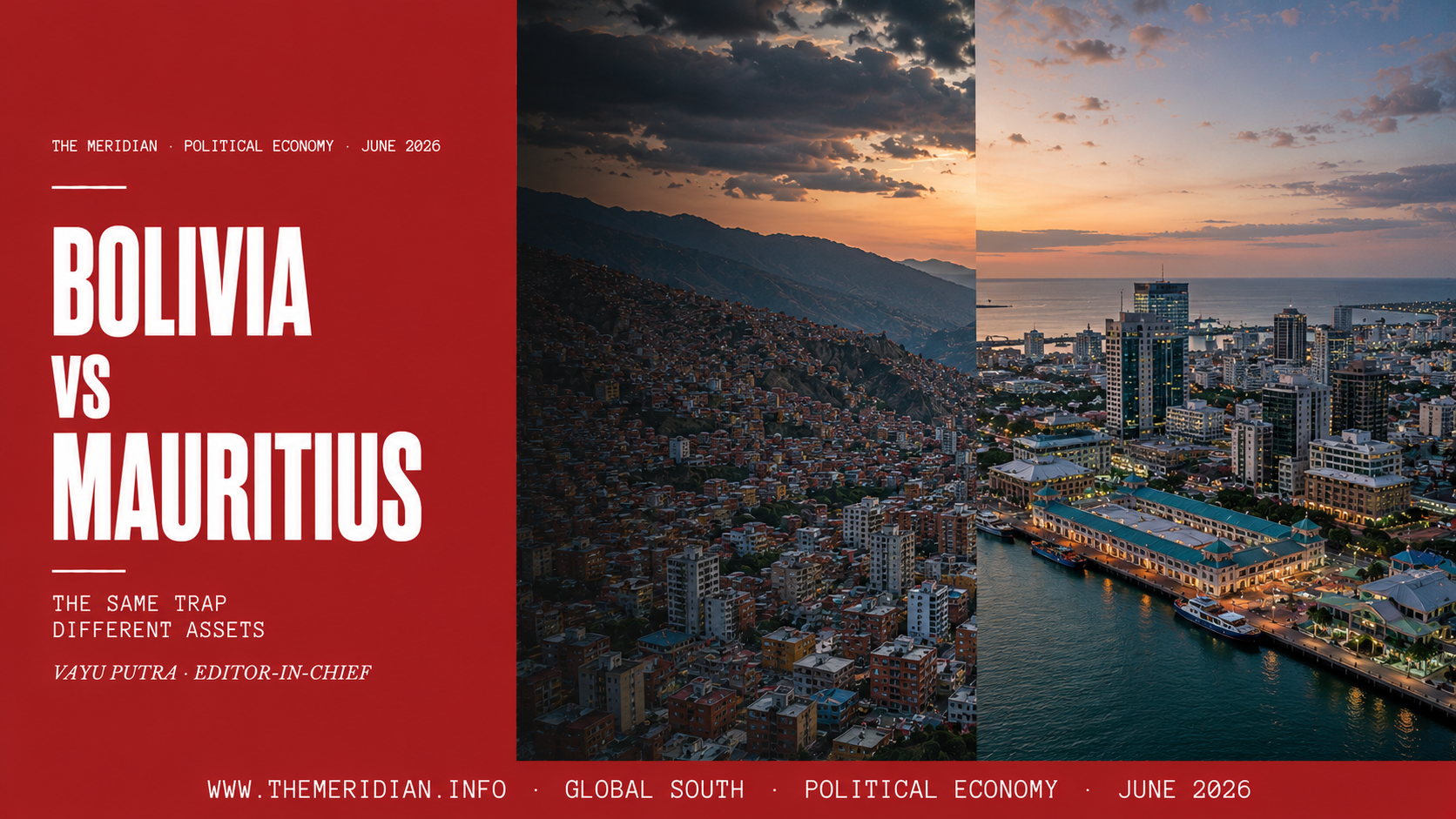
Bolivia had natural gas -- real, tangible, internationally traded hydrocarbons worth billions of dollars annually for two decades. Mauritius has offshore financial services: compliance paperwork, KYC checks, and management company fees. One is a geological gift. The other is a bureaucratic construction. Yet both economies are trapped in the same structural failure -- and the analytical frameworks developed by the Human Intelligence Unit at The State of the Mind explain precisely why. The difference in assets makes Bolivia's collapse more understandable. It makes Mauritius's trajectory more alarming.
The Meridian published the structural autopsy of Bolivia's crisis earlier today. La Paz is under indefinite siege. Hospital oxygen is measured in hours. President Rodrigo Paz has cut his own salary in a gesture that signals not austerity but the public unravelling of an administration that has lost control of the state. The immediate triggers are documented: fuel subsidy removal, dollar scarcity, contaminated gasoline imports, 20 per cent inflation. But the underlying mechanism is what connects Bolivia to an island in the Indian Ocean that most Latin Americans could not locate on a map. That mechanism has a name. The Human Intelligence Unit at The State of the Mind named it independently, derived it from field observation, and submitted it to SSRN before Bolivia's crisis made it globally visible.
In WP-2026-01: Elastic Political Hysteresis and Labour Market Persistence, the HIU introduced a concept independently derived from observation of the Mauritian labour market: elastic political hysteresis. The mechanism is precise. When external rents -- revenues from oil, gas, offshore services, tourism -- flow abundantly into a small economy, the political system is insulated from the pressure to reform. Politicians face no electoral consequence for structural inaction because the rents fund enough social stability to suppress discontent. The economy persists in its existing form not because it is efficient but because the rent income makes the cost of inefficiency invisible.
Bolivia's twenty-year gas boom is elastic political hysteresis in its most classic form. Gas revenues funded social programmes, subsidised fuel, stabilised the currency, and gave successive administrations the fiscal room to avoid the difficult structural work of diversification. Agriculture, tourism, manufacturing, lithium processing: Bolivia had assets in all of these sectors and did not develop them seriously, because the gas made it unnecessary. When the gas fields depleted and Argentina and Brazil found their own supply, the hysteresis snapped. The political system had no adaptive capacity because it had never needed to develop any.
Mauritius is the same mechanism at a smaller scale and with a softer timeline. The offshore sector -- compliance fees, management company retainers, KYC processing -- has funded enough middle-class stability to insulate successive Mauritian governments from serious reform pressure. The manufacturing base that existed in the 1990s was allowed to hollow out. The agricultural sector was never diversified. The high-value technology and industrial capacity that would make Mauritius genuinely competitive was never built. Because the offshore revenues made it unnecessary -- until now.
Natural gas: a geological gift worth billions annually. Abundant enough to fund social programmes, stabilise the currency, and suppress reform pressure for twenty years. Depleted physically when the fields ran dry. Buyers found alternatives. The rent collapsed and took the political system with it. Bolivia still has lithium, agriculture, and tourism -- undeveloped.
Offshore compliance: a bureaucratic construction worth billions annually. Abundant enough to fund middle-class stability and suppress reform pressure for three decades. Depleting not physically but technologically -- AI RegTech executes in seconds what compliance officers spend careers doing. The rent is collapsing and the political system has no more adaptive capacity than Bolivia's did.
In WP-2026-02: Fifty Years of Rentier Theory -- One Variable It Never Tested, the HIU formally ranked external rent types by crisis durability. Oil and gas rents are market-fragile when buyers find alternatives -- exactly Bolivia's situation. Offshore financial services rents are regulation-fragile and technology-fragile: they disappear when either the regulatory framework changes or the technology makes human intermediaries redundant. The AI disruption of the offshore sector, which The Meridian documented this week in the Offshore Matrix article, is the technology-fragile collapse in real time.
The taxonomy produces a stark comparative verdict. Bolivia's gas rents were depleted over decades -- the collapse was slow enough that a competent government could theoretically have managed the transition. Mauritius's offshore rents are vulnerable to a technological disruption that can operate at the speed of software deployment. The window for managed transition is narrower. The political system has, if anything, less adaptive capacity, because the offshore revenues have been flowing longer and the hysteresis is deeper.
Bolivia had a real asset and still could not escape the governance trap. Mauritius built its economy on something that can be automated in seconds. If the trap caught Bolivia, it has already caught Mauritius. The only remaining question is when the political class notices.
The HIU's essay The Abundance Trap argues that surplus without structure becomes weakness rather than strength. Surplus delays reform. It distorts incentives. It protects failing structures and encourages elites to consume stability rather than build resilience. Bolivia's gas surplus is the essay's central case in material form. The gas revenues were consumed: as subsidies, as patronage, as currency stabilisation. They were not invested in the structural transformation that would have made Bolivia resilient when the surplus ran out.
Mauritius has run the same consumption model with offshore revenues. The signal that the abundance is ending is visible in the fiscal data. The Price Stabilisation Account, the mechanism designed to cushion Mauritian households from imported price shocks, is now in deficit. This is precisely the dynamic identified in the HIU's VAT Buffer Policy Paper, which introduced the concept of Fiscal Amplification of Imported Inflation: when a government depletes its buffer mechanism, the next external price shock hits households with no institutional protection. Bolivia's contaminated gasoline crisis is what Fiscal Amplification looks like when the buffer is removed by force. Mauritius's depleted Price Stabilisation Account is what it looks like when the buffer is eroded by policy neglect.
Bolivia had natural gas. It had a real, internationally traded commodity that funded a state for twenty years. And it still could not escape the governance trap because the revenues were consumed rather than invested, the political system was insulated from reform pressure by the very abundance that should have funded reform, and when the abundance ended there was nothing structural beneath it.
Mauritius built its equivalent on compliance paperwork and KYC fees. It had no geological gift. It constructed its rent from regulatory arbitrage and treaty networks. That construction was ingenious. It was also more fragile than gas, because it depended not on physical depletion but on two variables no government controls: regulatory change and technological disruption. Both are now operating simultaneously.
The question Bolivia's collapse puts to Mauritius is precise. If a country with real gas, real reserves, and a real commodity cannot escape the extraction trap through governance failure, what is the trajectory of a country that built its economy on something that can be replaced by an algorithm? The HIU frameworks provide the analytical answer. The Mauritius government has not yet read them. The budget on 19 June will tell us whether they need to.
Add comment
Comments