The Siege of La Paz: Bolivia's Structural Collapse Explained
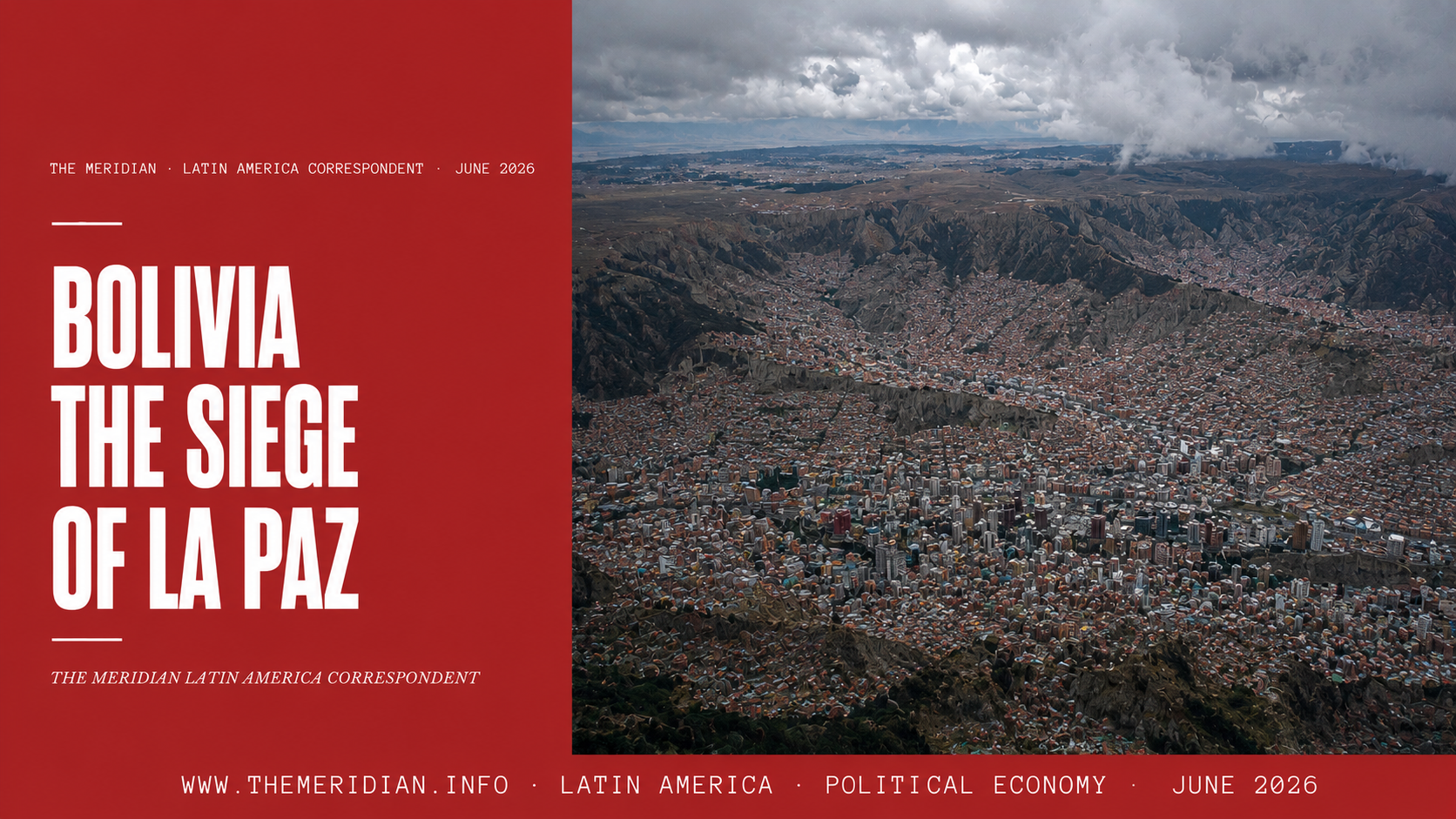
The administrative capital of Bolivia is under indefinite siege. For over a month, thousands of coordinated roadblocks have paralysed the country's primary transport arteries, severing supply lines for food, fuel, and medical supplies. At the Clinicas de La Paz public hospital, emergency physicians report that remaining oxygen reserves are now measured in hours. When President Rodrigo Paz announced a last-minute 50 per cent cut to his own salary, it signalled the public unravelling of an administration that has lost control of the state. The Meridian Latin America Correspondent publishes the structural autopsy.
The immediate triggers of Bolivia's crisis are being widely documented: unpopular land reform bills, inflation hovering around 20 per cent, and acute shortages of both physical fuel and US dollars. Focusing solely on these triggers, however, misses the systemic rot beneath them. What is unfolding in La Paz is a textbook structural collapse, the terminal failure of a state-dependent extraction model crashing into a deceptive political transition, leaving a highly mobilised population stranded in an economic vacuum. It is a story The Meridian has told before, in Venezuela. The mechanism is the same. The geography is different.
The roots of the political crisis lie in a calculated act of electoral deception. Running on a centrist ticket, Rodrigo Paz deliberately positioned himself as a generational break from the polarising, left-wing Movimiento al Socialismo administrations that dominated the previous two decades. To capture the vital working-class, rural, and indigenous vote, he selected Edmundo Lara as his vice-presidential running mate. Lara, a former police officer who rose to national prominence through an anti-corruption campaign, provided an organic and credible link to Bolivia's popular classes. The strategy worked. The centrist ticket consolidated a massive portion of the traditional indigenous and rural vote that had historically belonged to the left.
The betrayal was instantaneous. Upon assuming office, President Paz abandoned his campaign rhetoric and systematically cut ties with Vice President Lara, signalling a radical reorientation towards the country's traditional business elite. Latin American political economy specialist Dr Enrique Castanon Bivvian notes that while Paz marketed himself as a fresh voice, he is fundamentally a product of the traditional political oligarchy: his father served as president during Bolivia's previous, highly controversial neoliberal era. The speed with which Paz reverted to his family's ideological lineage blindsided even seasoned regional analysts.
The political whiplash arrived against the backdrop of a terminal macroeconomic crisis that no administration, left or right, could easily have resolved. For nearly twenty years, the Bolivian state was sustained by a natural gas boom. Hydrocarbon revenues funded extensive social programmes, stabilised the national currency through an artificial peg, and subsidised domestic energy. It was presented as an economic miracle. It was an illusion built on finite resource extraction rather than structural diversification or advanced industrial strategy.
Today that model is entirely exhausted. Bolivia's four mega gas fields have depleted their reserves far faster than anticipated. Simultaneously, the country's primary regional buyers, Argentina and Brazil, discovered large-scale domestic hydrocarbon deposits of their own, permanently destroying Bolivia's export leverage. The disappearance of gas revenues triggered a catastrophic drain on foreign exchange reserves. The resulting dollar scarcity forced the emergence of a rampant black-market exchange rate, driving up the cost of imported goods and plunging the nation into a punishing inflationary spiral.
Bolivia's gas boom was an illusion built on finite resource extraction. When the fields ran dry and the buyers found their own supply, the entire state model built on top of them collapsed simultaneously.
In a desperate bid to manage the widening fiscal deficit, the Paz administration attempted a blunt implementation of shock therapy. The government abruptly terminated long-standing national fuel subsidies, causing the cost of living and transport to surge overnight. Compounding the disaster, the state petroleum enterprise YPFB imported a cheap, highly contaminated batch of gasoline that severely damaged thousands of commercial and civilian engines, transforming economic anxiety into absolute fury among the country's highly unionised transport sectors. The roadblocks are the direct consequence. The drivers whose vehicles were destroyed are among those manning them.
Isolated domestically, the Paz administration sought salvation through a rapid reorientation of foreign policy. The government moved aggressively to align itself with the regional far right, explicitly modelling its rhetoric after figures like Argentina's Javier Milei. In a transparent signal to Washington and international conservative networks, Paz swiftly re-established diplomatic relations with Israel, a move entirely at odds with the political sentiments of the majority of the Bolivian population.
According to regional analysts, this geopolitical pivot was designed to rebrand Bolivia as a hyper-deregulated frontier, openly inviting foreign corporate consortia to exploit the country's remaining natural resources, particularly its vast untapped lithium reserves. Bolivia sits atop one of the world's largest lithium deposits, a resource of enormous strategic value in the global energy transition. The administration's calculation was that foreign investment in lithium could replace the revenue lost from gas. The calculation fundamentally miscalculated the depth of resource nationalism embedded in the Bolivian national consciousness. For decades, Bolivian social movements have consistently mobilised to overthrow administrations that attempted to lease sovereign wealth to foreign corporate interests. The roadblocks are, in part, the latest instalment of that historical pattern.
More ominously, independent observers in La Paz have flagged the arrival of unverified cargo flights from neighbouring right-wing administrations in Argentina and Chile. With Congress recently granting the executive expanded powers to declare a national state of emergency, analysts fear that a coordinated regional security apparatus is being quietly deployed to back a domestic crackdown. The traditional elite and the landed oligarchy have openly dominated the media landscape, demanding a militarised response to dissent and declaring that civilian casualties are an acceptable price for restoring order.
The core tragedy of Bolivia's impasse is a deep disconnect between the rulers and the ruled. The modern political establishment is attempting to govern a country it fundamentally does not comprehend. The elite design macroeconomic structural adjustments from isolated boardrooms, entirely detached from the survival mechanics of the popular classes who bear the brunt of subsidy removals and currency devaluations. The same pattern produced Venezuela's $83 billion GDP collapse, which The Meridian documented earlier this month. The mechanism differs in detail but not in structure: an extractive model exhausted, a political class reverting to a discredited playbook, and a population bearing costs it did not choose.
A key miscalculation of the Paz administration was the belief that defeating the traditional left allowed it to dismantle the Plurinational State, the constitutional framework that legally recognises Bolivia's diverse indigenous nations, and revert to an exclusionary republican model. This ideological erasure has reignited deep-seated class and racial tensions, exemplified by instances of indigenous symbols and flags being publicly desecrated by right-wing counter-protesters. The blockades are not merely economic. They are a reassertion of constitutional identity against an administration that sought to erase it.
Yet within the resistance itself, a dangerous vulnerability has emerged. Bolivia's indigenous groups, transport unions, and miners possess an extraordinary, historically proven capacity to organise, paralyse the country, and threaten the survival of regimes. What they currently lack is a mature, viable alternative macroeconomic project. They are capable of bringing an incapacitated government to its knees. They do not yet possess a concrete blueprint to replace the dead hydrocarbon model or stabilise a collapsing monetary system.
Bolivia is trapped in a perilous equilibrium. A government that has lost the mandate to govern. An oligarchy turning towards militarism as its only remaining instrument. A mobilised populace capable of stopping the economy but not yet equipped to structurally rebuild it.
The oxygen running out at the Clinicas de La Paz is the most visceral symbol of where this equilibrium leads if it is not broken. Medical emergencies do not wait for political negotiations. Neither does a population that has been deprived of fuel, food, and foreign currency simultaneously.
Until a comprehensive economic alternative is forged from within Bolivian civil society, the siege of La Paz remains a stark warning of what happens when the illusion of resource extraction runs dry and the political class that sustained it has nothing left to offer except repression. The gas is gone. The mandate is gone. What comes next will define Bolivia's decade.
Add comment
Comments