Asian Currency Crisis: How the Strait of Hormuz Is Breaking Asia’s Money -- and Pushing Mauritius Into a Corner
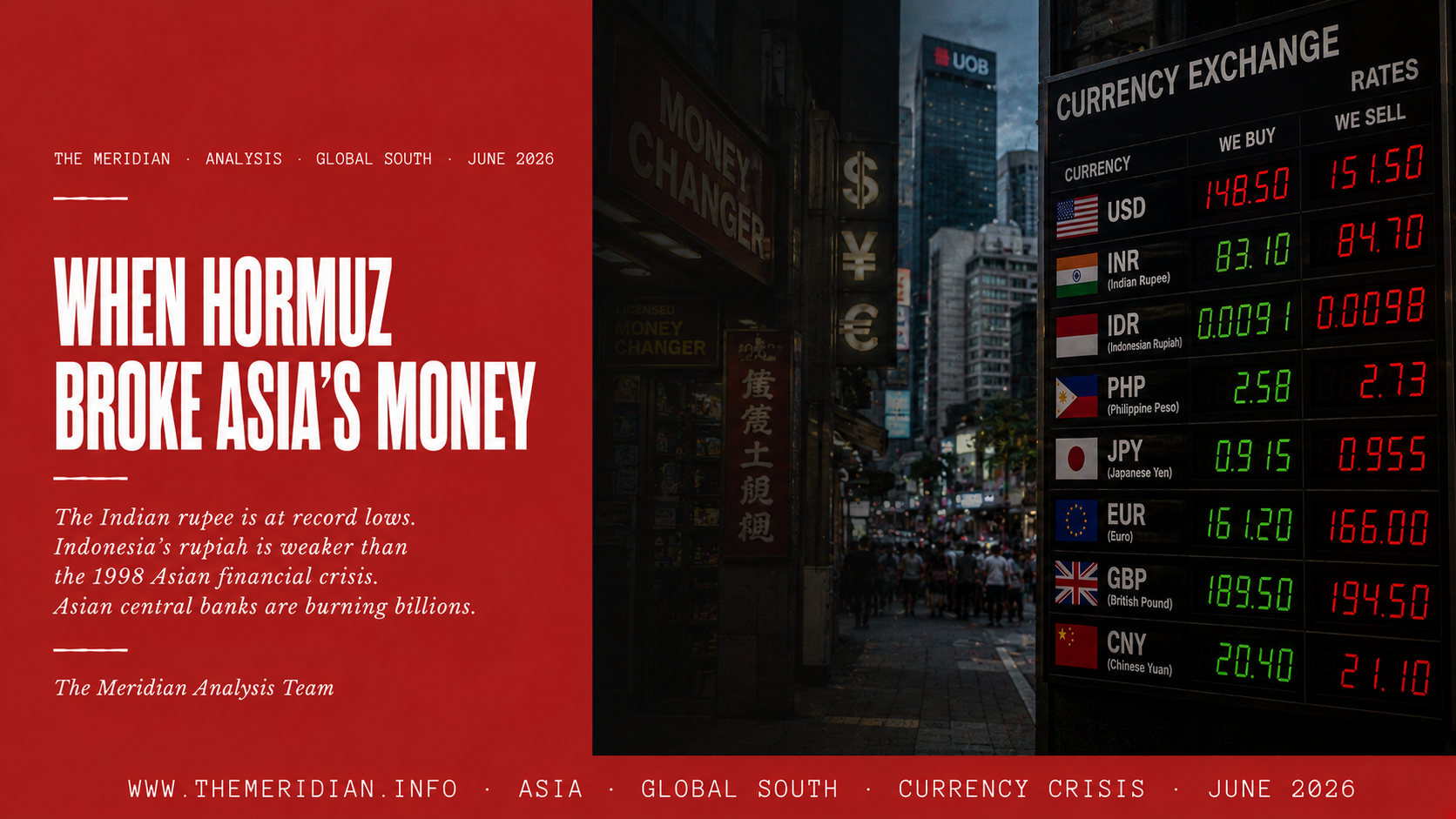
The Indian rupee is at record lows. Indonesia’s rupiah is weaker than it was at the depths of the 1998 Asian financial crisis. Asian central banks are burning billions of dollars trying to slow the tide. The Meridian Analysis Team maps the contagion -- and the eight channels through which it is squeezing Mauritius from every direction simultaneously.
In February 2026, it took approximately 90 Indian rupees to buy one US dollar. By June, that figure had reached 95. In Indonesia, the rupiah has fallen below the levels recorded at the depths of the 1998 Asian financial crisis -- a benchmark that economists use to measure genuine systemic distress. The Philippine peso has hit record lows. Japan and South Korea, two of the world's most advanced economies, have watched their currencies weaken despite spending billions of dollars in reserve intervention. The cause sits in the Strait of Hormuz, 6,000 kilometres away. The consequences arrive in Port Louis, Plaine Magnien, and Grand Baie.
The Strait of Hormuz disruption that began in late February 2026 cut approximately 20 per cent of global oil and gas flows. For Asian economies that import the overwhelming majority of their energy -- India sources nearly 90 per cent of its crude oil externally, Indonesia was already a net oil importer before the crisis -- the price shock was immediate. But the currency effect has been compounding. Oil and gas are priced in US dollars. Economies that import energy are now buying more dollars to pay for that energy, putting sustained downward pressure on their own currencies.
Alicia Garcia Herrero, Chief Economist for Asia Pacific and the Middle East at Natixis, noted in analysis published this week that several of these currencies were already weakening before the Hormuz disruption, partly because Asian central banks had front-loaded interest rate cuts in 2025 in anticipation of US Federal Reserve easing that did not materialise at the expected scale. The Iran shock accelerated a slide that was already under way. Her assessment: the situation has not yet reached crisis levels, but it could -- and that risk is the operative concern.
India's response has been revealing. Prime Minister Narendra Modi has made an appeal for voluntary national austerity -- asking citizens to use less fuel, stop buying gold, and avoid travelling abroad. The government simultaneously raised import duties on gold and silver to 15 per cent. The scale of the problem that prompted this appeal is evident in a single figure: India spent more than $72 billion importing gold in the year preceding the crisis alone. Gold is not merely a financial asset in India. It is a cultural institution, a store of generational wealth, and a form of savings that the working and middle classes have used for decades precisely because it hedges against rupee depreciation. Asking Indians to stop buying gold during a period of rupee weakness is asking them to abandon the hedge at the moment they need it most.
Professor Biswajit Dar, economist and retired professor from Jawaharlal Nehru University, assessed the voluntary austerity call as unlikely to succeed. Indians have become accustomed to international travel during the economic expansion of the past decade. The middle class that benefited from that expansion will not abandon its summer travel plans on a government appeal. The Make in India strategy, which was meant to reduce import dependency in electronics and manufacturing components, has also not delivered the structural shift that would make India less vulnerable to this kind of dollar pressure.
Indonesia has taken a sharper approach. The government has established a state-run agency as the sole buyer and exporter of Indonesian commodities -- initially covering coal, palm oil, and nickel products, all of which Indonesia leads globally in production. All foreign currency earned from these exports must be deposited in state-owned banks. The stated objective is to prop up the rupiah by ensuring export earnings remain in the Indonesian financial system rather than being held offshore by corporate treasury operations. Bimma Udhira, Executive Director of the Center of Economic and Law Studies in Jakarta, described this policy as likely to weaken the rupiah further by reducing investor confidence and driving capital out of commodity-related stocks. The markets have responded accordingly.
China already oversees the majority of Indonesia's nickel mining infrastructure. When Indonesia mandates that all export proceeds flow through state-owned banks, it does not reduce Chinese influence. It routes that influence through a government bureaucracy that Beijing is better positioned to navigate than any other actor.
Indonesia's resource nationalism cannot be understood without its Chinese dimension. Chinese firms control significant portions of Indonesia's nickel mining operations -- the same nickel that Indonesia is now attempting to route through a state export agency. In practice, much of this trade will settle in renminbi rather than dollars, as Chinese counterparties have both the incentive and the established infrastructure to use RMB settlement. Garcia Herrero noted that the RMB has already surpassed the euro as the second most widely used trade settlement currency globally. Indonesia's capital controls push it further into that orbit.
For Mauritius, the China dimension creates a second-order effect. If Chinese industrial capital is being deployed inward -- absorbing Indonesian commodities, managing supply chains, building fuel resilience -- it is not flowing outward as discretionary tourism spending. Chinese tourist arrivals to Mauritius, which were recovering through 2025, face a renewed headwind as Chinese consumers and corporates alike prioritise domestic economic stability over international leisure travel.
Channel One: Indian tourists. India is Mauritius's largest tourism source market. The rupee at 95 per dollar reduces Indian purchasing power for a holiday priced in euros or Mauritian rupees. Modi's explicit call for Indians not to travel abroad directly addresses the demographic that books long-haul leisure flights to Mauritius. The Vostro account arrangement between India and Mauritius -- which allows bilateral trade and some financial settlement in Indian rupees without USD conversion -- partially buffers trade flows. It does not prevent Indian families from cancelling their Mauritius holiday when the rupee makes it feel too expensive.
Channel Two: Aviation fuel. This is the most acute structural vulnerability Mauritius faces. The island imports 100 per cent of its aviation fuel. Every litre that powers an Air Mauritius departure is priced in US dollars and purchased on international spot markets that have risen sharply since the Hormuz disruption began. Air Mauritius faces a choice between absorbing the cost increase -- compressing already thin margins -- and passing it through to ticket prices. Higher fares reduce demand. Lower margins threaten operations. There is no third option available to an island nation with no domestic fuel production and no pipeline alternative.
Channel Three: Chinese tourists. Chinese capital is being deployed to manage domestic industrial and energy challenges rather than outward as tourism. Arrivals from China to Mauritius, which showed recovery momentum through 2025, will slow as Chinese consumers reassess discretionary international spending.
Channel Four: European tourists spending less. European source markets -- France, the United Kingdom, Germany -- are Mauritius's premium tourism segment. The cost of living squeeze across these economies has reduced discretionary spending. European tourists who do travel to Mauritius in 2026 are spending more conservatively per stay. Revenue per available room falls even when occupancy holds.
Channel Five: World Cup. A major international football tournament keeps European audiences at home. They watch matches, spend on domestic hospitality, and do not book long-haul flights during tournament weeks. Mauritius historically sees a measurable dip in European arrivals during World Cup cycles. In winter 2026, this compounds every other pressure point simultaneously.
Channel Six: Winter season. June to August is Mauritius's winter -- already the lower season for arrivals compared to the European summer peak. Seasonal weakness is a known variable. But in 2026 it arrives layered under currency pressure, fuel cost spikes, and reduced disposable income across every major source market.
Channel Seven: World Cup merchandise and the rupee. Mauritius produces no sports merchandise. Every World Cup jersey, every piece of branded fan equipment purchased on the island is an imported product priced in dollars or euros. In a period of rupee weakness, this consumer behaviour is a direct dollar outflow from an already pressured currency. The advice not to purchase World Cup merchandise in a weak rupee environment is economically sound -- and culturally difficult to enforce.
Channel Eight: India's $1 billion fuel reserve signal. India deploying a billion dollars to build strategic fuel resilience is not a sign that the Hormuz disruption is about to resolve. It is a signal that New Delhi believes the disruption will be prolonged and is taking structural precautions. A prolonged Hormuz crisis means prolonged aviation fuel pressure, prolonged rupee weakness, and prolonged suppression of outbound Indian tourism. Every week the disruption continues is another week that Mauritius's eight-channel squeeze tightens.
The bilateral Vostro account arrangement between India and Mauritius allows certain trade and financial transactions to settle in Indian rupees without requiring USD conversion. This provides a genuine buffer for goods trade and some service transactions between the two economies.
What it does not protect: Aviation fuel purchases, which are settled in USD on international markets. Tourism demand, which falls when Indian consumers feel financially constrained regardless of settlement currency. The Mauritian rupee's exchange rate against the dollar, which is driven by the island's overall current account position and reserve dynamics, not bilateral settlement arrangements with a single partner.
A small island economy with no energy production, near-total import dependency for fuel, and a tourism sector that draws from three simultaneously pressured source markets -- India, China, and Europe -- has no structural buffer against a shock of this scale and duration. The Hormuz disruption did not create Mauritius's vulnerabilities. It activated them simultaneously.
The aviation fuel trap is the most immediate. Air connectivity is not a luxury for Mauritius. It is the physical infrastructure on which the entire tourism economy rests. When jet fuel costs rise, connectivity shrinks, fares rise, demand falls, and revenue per tourist declines. There is no road alternative. There is no domestic fuel substitute. The island's economy sits at the end of a global fuel supply chain that is currently under the most severe disruption in decades.
The policy response available to Mauritius is narrow. Accelerate bilateral currency arrangements with India beyond the existing Vostro framework. Hedge aviation fuel costs where contracts permit. Diversify tourist source markets toward economies less exposed to the current dollar-denominated energy shock. And resist the temptation to paper over the structural vulnerability with short-term subsidy measures that defer the adjustment cost onto future public finances that are already carrying 83 per cent of GDP in debt.
The Strait of Hormuz will eventually reopen. When it does, some of these pressures will ease. But the eight-channel squeeze that Mauritius faces in June 2026 is a diagnostic, not just a crisis. It reveals the structural exposure that has been building for years. The question is whether the island uses this moment to address it, or waits for the next shock to activate the same vulnerabilities again.
Add comment
Comments