Cradle-to-Grave Monopoly: How IBL, ENL, Rogers and CIEL Own Mauritius from Birth to Death
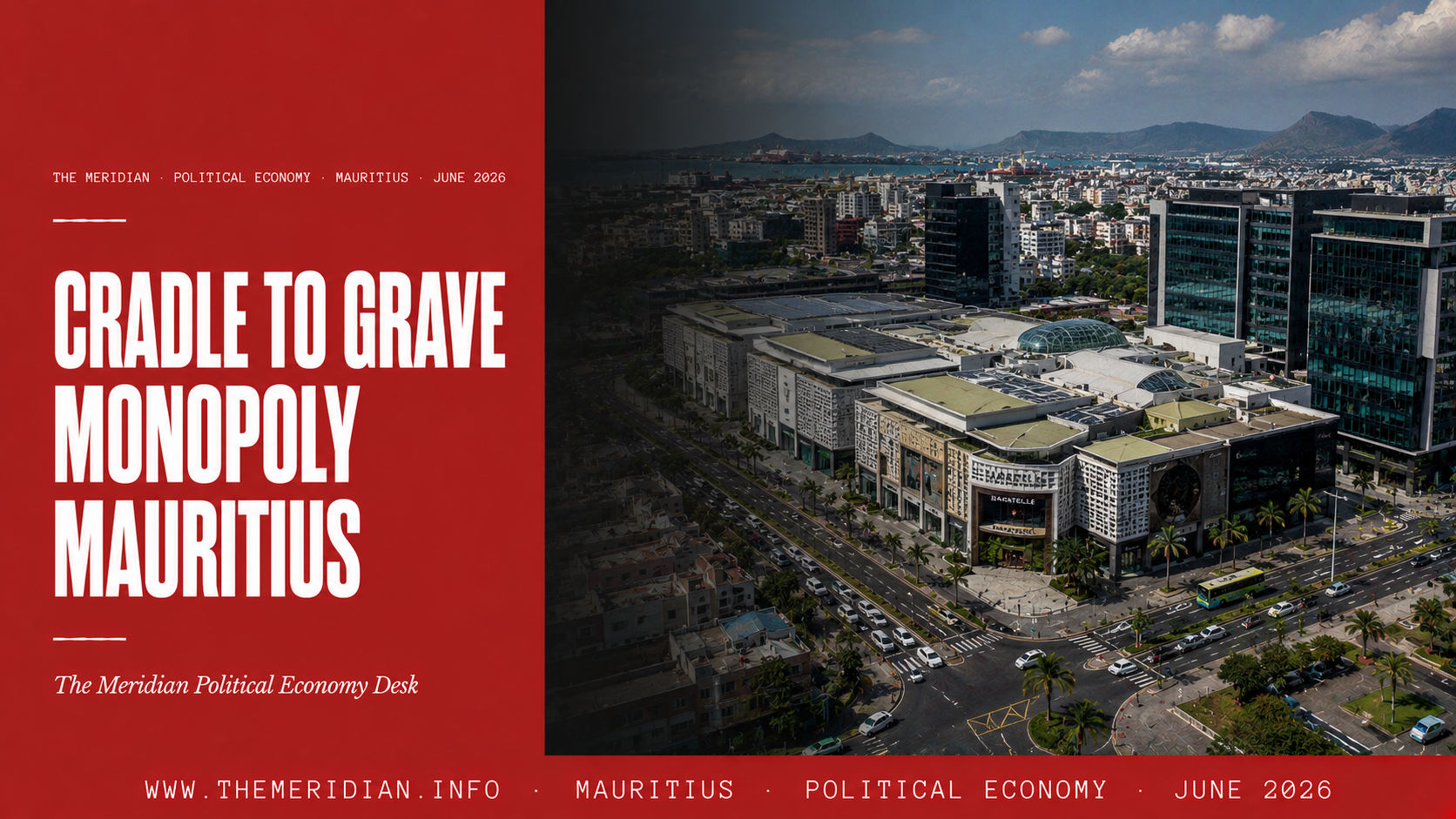
Four conglomerates. Every sector of the Mauritian economy. From the private clinic where you are born to the land your home sits on, the supermarket where you buy food, the hotel where you work, the bank where you save, and the insurance policy that covers your death. IBL, ENL, Rogers and CIEL do not compete with each other in any meaningful sense. They divide Mauritius between them. The Meridian Political Economy Desk maps the architecture of total market control.
In a genuinely competitive market economy, the hospital where a Mauritian child is born, the school where they are educated, the employer who hires them, the bank where they save, the supermarket where they shop, and the land on which their home sits would belong to different owners competing for their custom. In Mauritius in 2026, the overwhelming likelihood is that several of these -- and in some cases all of them -- trace back to one of four conglomerate groups that have divided the island's economy between them across multiple generations. This is not a conspiracy. It is a documented structure. And understanding it is essential to understanding why the constitutional reform The Meridian has been investigating this week is not abstract political theory. It is the legal architecture being built to protect what already exists.
IBL Group -- Ireland Blyth Limited -- is one of Mauritius's most diversified conglomerates, operating across healthcare, food distribution, financial services, retail, and manufacturing. Its healthcare arm includes hospitals and clinics serving the private health market. Its food and beverage operations reach into wholesale and distribution. Its financial services subsidiaries operate in insurance, leasing, and wealth management. IBL is present at the point of entry into the Mauritian private healthcare system -- and through its financial services, at the point of managing wealth accumulated over a lifetime.
ENL Group -- Espitalier-Noël Limited -- is the island's dominant property and land conglomerate. Its origins lie in the colonial-era sugar estates that covered the island's interior. Those estates, accumulated over generations and never meaningfully redistributed, have been progressively converted under the Smart City Scheme into some of the most valuable commercial and residential real estate on the island. The Moka region -- now marketed as a Smart City -- sits on former ENL sugar estate land. The families who could not afford to purchase within ENL's developed zones now rent or purchase at prices set by a land market that ENL's historic holdings have shaped. Land in Mauritius is not scarce. It is controlled.
Rogers Group -- founded in 1899, making it one of the oldest commercial enterprises in Mauritius -- operates across tourism, aviation ground handling, logistics, financial services, and property. Rogers Aviation manages ground services at Sir Seewoosagur Ramgoolam International Airport, positioning the group at the gateway through which Mauritius's entire tourism economy passes. Beachcomber Hotels, historically associated with the Rogers ecosystem, is among the island's largest luxury hotel chains. The traveller who lands at SSR, transfers to a Beachcomber property, and banks with a Rogers-affiliated financial institution has spent their Mauritius experience largely within one corporate orbit without ever being told so.
CIEL Group operates across textiles, agri-business, financial services, and healthcare. Its healthcare arm -- C-Care -- operates hospitals and clinics across the island. Its textile operations employ thousands of workers in the export garment sector. Its financial services include banking and insurance operations extending across the Indian Ocean region. CIEL is present at birth through its healthcare facilities, through employment in its textile factories, and through the financial products that manage the savings and risks of Mauritian households across their working lives.
The most consequential dimension of the cradle-to-grave monopoly is land. The four conglomerates, along with a small number of related family-owned entities, control the majority of the island's developable private land. This land was not accumulated through market competition. It was inherited from the colonial plantation economy, where vast tracts of the island's interior were given over to sugar cultivation by a small number of Franco-Mauritian and Indo-Mauritian elite families. Independence did not redistribute this land. The post-independence governments -- dominated by the same political families The Meridian has documented in its coverage of state capture -- did not challenge the land structure. They accommodated it.
The Smart City Scheme, administered by the Economic Development Board, has provided the mechanism through which this inherited agricultural land is converted into the highest-value real estate on the island. ENL's Moka development is the flagship example. Former sugar cane fields that carried no significant commercial value two decades ago are now the site of office parks, retail complexes, educational institutions, and residential developments priced well beyond the reach of the median Mauritian household. The family that owned the cane field owns the Smart City. The Mauritian worker who might have worked that field now rents or purchases within the development at a price the field's owner has set.
The land was not bought from the Mauritian people. It was inherited from the colonial economy. The Smart City Scheme did not transfer it. It monetised it -- at public expense, through tax exemptions, and with the legal protection of the EDB.
The four conglomerates and their subsidiaries are collectively among the largest formal private sector employers in Mauritius. CIEL's textile operations alone employ thousands of workers. Rogers's tourism and logistics operations employ thousands more. IBL's food, healthcare, and financial services arms account for a significant portion of the island's formal sector employment. This is not incidental. It is structural. When four groups control the dominant employers in healthcare, hospitality, logistics, textiles, and financial services simultaneously, the labour market ceases to function as a competitive market for workers. It functions as a managed allocation system in which the major employers set the terms and workers accept or exit into the informal economy.
The minimum wage in Mauritius provides a legal floor. But the floor is set by a state whose regulatory bodies -- as The Meridian has documented in its analysis of the constitutional reform -- are increasingly insulated from the kind of independent oversight that would allow them to enforce labour standards against the interests of the same conglomerates that employ a substantial portion of the island's workforce. The Fair Wage Hotel Index published by The Meridian's Human Intelligence Unit has documented the gap between the room rate a tourist pays and the daily wage of the worker who services that room. The gap is not a market outcome. It is a structural consequence of concentrated employer power.
IBL, CIEL, and Rogers all operate financial services subsidiaries -- insurance companies, leasing operations, and in CIEL's case banking operations extending across the Indian Ocean region. A Mauritian worker employed by one of these groups may find that their employer-linked pension scheme, their health insurance, and their savings product are all administered by entities within the same corporate ecosystem. This is not illegal. In many jurisdictions it would trigger conflict of interest scrutiny. In Mauritius, where the regulatory framework for financial services is administered by the FSC -- whose director is appointed on the Prime Minister's advice -- the scrutiny depends on the independence of the regulator. The independence of the regulator depends on the independence of the appointment. And the independence of the appointment, as The Meridian has documented in its coverage of the Constitutional Review Commission Bill, is precisely what the current constitutional reform is designed to constitutionally insulate from challenge.
The Meridian's investigation into the Constitutional Review Commission Bill No. VI of 2026 -- published earlier this week -- identified the constitutionalisation of EDB powers and FSC regulatory immunity as the two most consequential hidden mechanisms of the bill.
Now read that analysis against the cradle-to-grave monopoly map above. The EDB administers the Smart City Scheme through which ENL and CIEL convert sugar estate land into tax-exempt developments. The FSC regulates the financial services subsidiaries of IBL, CIEL, and Rogers. If both bodies are constitutionally insulated from judicial review under a three-quarters majority provision, the conglomerates that benefit from their decisions gain permanent legal immunity. The constitutional reform is not being designed in a vacuum. It is being designed to protect a specific, documented architecture of market control.
One of the structural features of the cradle-to-grave monopoly that most distinguishes it from normal market concentration is the interlocking directorate. The boards of IBL, ENL, Rogers, CIEL, and their major subsidiaries share members. Individuals who sit on the board of one conglomerate frequently sit on the advisory boards, subsidiary boards, or governance committees of another. This is not unusual in small economies where the pool of experienced corporate directors is limited. But in Mauritius, where these four groups collectively dominate every major sector, the interlocking directorate means that competitive intelligence, pricing strategy, and regulatory positioning are effectively shared across the entire oligarchic ecosystem through common board membership. Four separate companies. One conversation.
The test of a monopoly is not whether alternatives exist in theory. It is whether the ordinary citizen can meaningfully choose an alternative in practice. In Mauritius in 2026, a citizen who needs private healthcare has a very limited set of providers outside the IBL and CIEL networks. A citizen who wants to buy or rent in a modern residential development in the Moka corridor has essentially one landowner to negotiate with: ENL. A citizen who works in the formal tourism sector works in a hotel ecosystem dominated by Rogers and CIEL. A citizen who banks or insures through a major private institution is likely dealing with a subsidiary of one of these four groups.
Choice exists at the margins. The informal economy provides alternatives outside the conglomerate structure. Small businesses compete in spaces the conglomerates have not yet entered or have found too small to be worth controlling. But the formal economy -- the economy of stable employment, bank credit, private healthcare, and quality housing -- is substantially a conglomerate economy. And the citizen who cannot access or afford the alternatives that exist on the margins is not exercising free market choice. They are navigating a managed allocation system in which the terms were set before they were born.
The cradle-to-grave monopoly in Mauritius is not the result of superior competition. It is the result of inherited land, political accommodation, regulatory capture, and a constitutional reform process now under way that is designed to make the existing structure permanently unchallengeable in law.
IBL, ENL, Rogers, and CIEL are not villains in the way that fictional corporate antagonists are villains. They employ people. They build hospitals and hotels and housing developments. They generate tax revenue and foreign exchange. But they do all of this within a structure of market control that prevents the emergence of meaningful competition, suppresses the bargaining power of workers, prices ordinary Mauritians out of the land their ancestors worked, and uses its accumulated political influence to shape the regulatory environment in its own interest.
A genuine Second Republic -- if one were actually being built -- would address the land structure, the interlocking directorate, the regulatory capture, and the labour market concentration that the cradle-to-grave monopoly represents. The Constitutional Review Commission Bill No. VI of 2026 does the opposite. It constitutionalises the protection of exactly those structures. The Second Republic being promised to Mauritians is the First Corporate Administrative Zone wearing a new flag.
Add comment
Comments