The Tuna Shock: How the UK Tariff Suspension Threatens Mauritius’s Rs 14 Billion Export Advantage
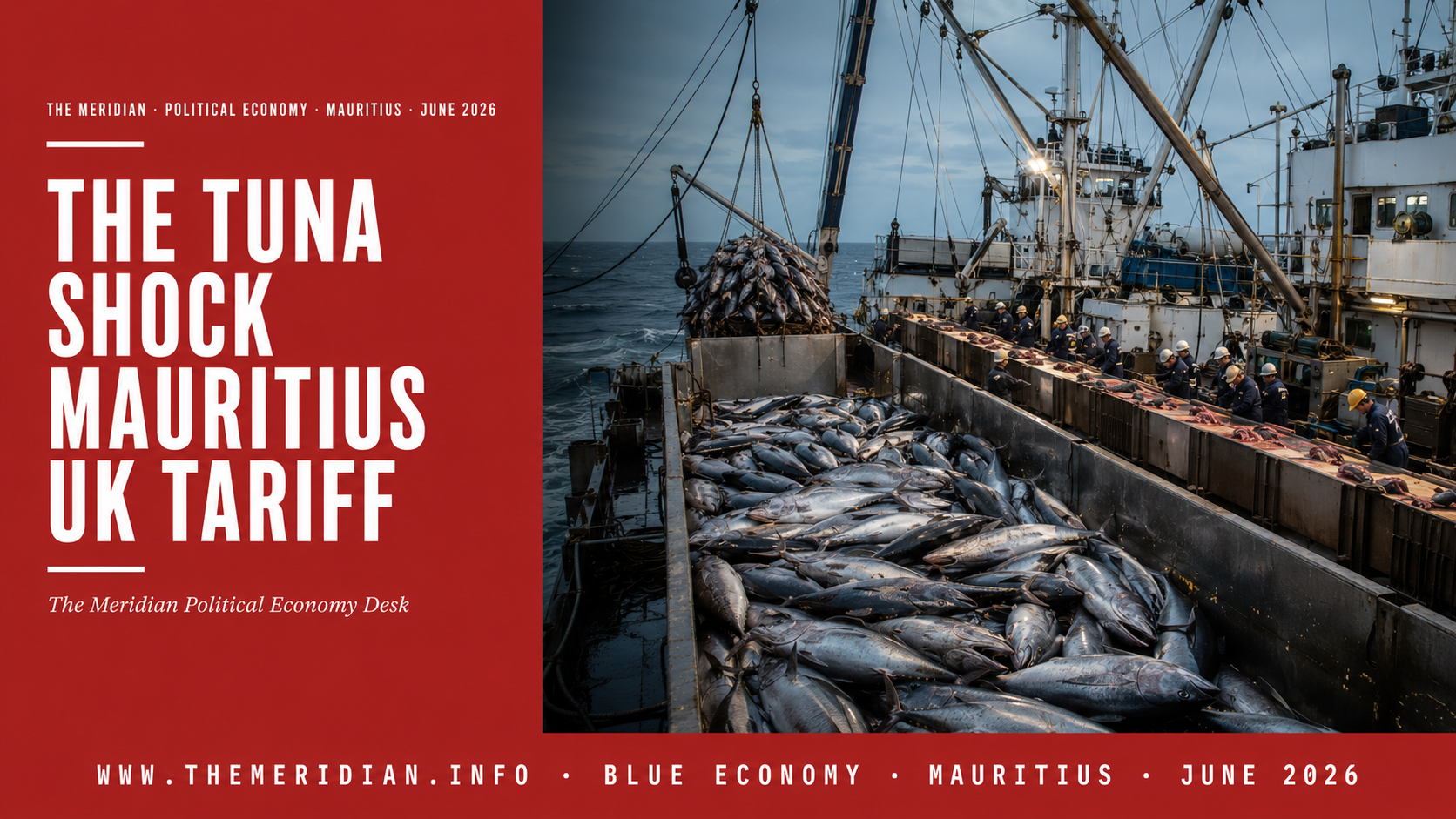
On 20 May 2026, the United Kingdom suspended its 20 per cent tariff on all tuna imports until 31 December 2028 -- with no prior consultation with Mauritius. For a sector generating Rs 14 billion annually and anchoring the livelihoods of thousands of processing workers, this is not a trade footnote. It is a structural competitive shock that will be paid for, in ways the official response has not yet named, by Mauritian workers and Mauritian consumers.
A tin of tuna is not simply food. It is the compressed form of a fishing quota, a maritime boundary, a processing wage, a trade preference, a carbon footprint, and a retail price point -- all in 170 grams. When the United Kingdom decided, effective 20 May 2026, to suspend the 20 per cent tariff it had previously applied to tuna imports from most of the world, it moved one variable in that compression. But in a system as tightly integrated as the Mauritian tuna export chain, moving one variable moves all the others. The question is who absorbs the movement.
The UK's Developing Countries Trading Scheme already granted Mauritius duty-free access to the British tuna market. What changed on 20 May 2026 is that every other tuna-exporting country -- the Maldives, Thailand, Sri Lanka, India, Oman, Indonesia -- now has the same access. A 20 per cent tariff that had applied to these competitors is suspended until 31 December 2028. The UK government's own guidance describes this as part of a package of food tariff suspensions intended to deliver more than £150 million per year in consumer savings, directly addressing cost-of-living pressure on British households.
The stated rationale is transparent and domestically coherent. What the UK did not do was consult the exporting nations whose competitive positions it altered. Minister of Blue Economy Arvin Boolell has confirmed that Mauritius received no prior notification. The matter has been referred to the Ministry of Foreign Affairs. Discussions with British authorities are described as forthcoming.
Mauritius's advantage in the UK tuna market was built over decades of trade architecture. The duty-free access that Mauritius already enjoyed was a structural competitive edge -- not a product of superior quality alone, but of preferential terms that meant Mauritian canned tuna could undercut or match competitors who were simultaneously paying a 20 per cent entry cost. That edge is now erased. The Maldives, whose president Mohamed Muizzu publicly welcomed the suspension as opening new market opportunities, previously faced exactly this 20 per cent disadvantage. From 20 May 2026, they face none.
Thailand is the world's largest canned tuna producer, with processing scale that Mauritius cannot approach. Sri Lanka and India have lower labour costs across the supply chain. The Maldives has a premium positioning argument -- pole-and-line, Marine Stewardship Council certified, eco-friendly -- that appeals specifically to the UK retail segment that pays more for sustainability credentials. Each of these competitors brings something to a newly level playing field that Mauritius is not positioned to match on price alone.
The advantage was not just that Mauritius paid no tariff. It was that everyone else did. The suspension does not improve Mauritius's position. It eliminates everyone else's disadvantage.
The Meridian's Tin Tuna Index measures how many minutes of minimum-wage labour are required to purchase a standard 170g tin of canned tuna in a given economy. It is not a price index. It is a labour-time-to-affordability index -- which means it captures wage adequacy, purchasing power, and food cost simultaneously in a single intuitive metric.
The UK tariff suspension creates a significant interpretive challenge for the index and an important methodological update. In the United Kingdom, if the suspension flows through to retail prices, a minimum-wage worker will need fewer minutes of labour to buy the same tin. The UK TTI score improves. That improvement is real but its cause is trade policy, not wage growth. A reader who sees the UK TTI score improve in 2026-2028 and attributes it to rising living standards would be wrong.
Where a tariff suspension directly affects retail tuna pricing, the Index should record the pre-suspension and post-suspension price separately. Affordability gains caused by trade policy should be distinguished from affordability gains caused by wage growth or productivity improvement. The UK TTI score will be recorded with a Tariff Adjustment Note for all observations from June 2026 to December 2028.
Track 2 — Mauritius Producer (TTI Pressure Indirect)The Index does not directly measure factory-level conditions, but the TTI is built on the premise that the tin is a system. If export margins compress and the adjustment mechanism is wage suppression or domestic price inflation, the Mauritius TTI score will deteriorate. This deterioration will be recorded and its cause -- competitive equalisation in the UK market -- will be noted.
Track 3 — The Interpretation Gap (The Index’s Core Value)The 2026 UK Tuna Tariff Shock is a real-world demonstration of the Index's purpose. The same policy that reduces the minutes a British worker needs to buy a tin may increase the minutes a Mauritius processing worker needs to buy the same product. One tin. One policy. Two opposite effects on two populations connected by the same supply chain. The Index makes that gap visible.
The key analytical question is not whether Mauritius's tuna sector faces pressure. It is who absorbs the pressure and how. There are three transmission mechanisms, and each of them distributes the cost differently.
Wage suppression. If processing plants face squeezed UK margins, the first adjustment mechanism in labour-intensive export industries is wages. Mauritian tuna processing already relies significantly on foreign workers from Bangladesh, Madagascar, and India employed at costs below what equivalent Mauritian workers would command. If margin pressure deepens, the incentive to expand this substitution increases. The result is that Mauritius's own maritime resource -- its exclusive economic zone, its fish stocks, its Blue Economy -- generates an industry whose wages are set by the labour cost floor of economies entirely outside the island. Mauritians who live beside the sea and whose state owns the fishing rights see the value of that resource captured by processing conglomerates and distributed to foreign workers at rates that could not sustain a Mauritian household.
Domestic price inflation. The second adjustment mechanism is the domestic market. If export margins compress, processors have an incentive to charge the captive domestic consumer more for locally sold tuna products. The Mauritian consumer, who cannot buy from Thailand or the Maldives at the retail level with the same ease a British consumer can, absorbs a cross-subsidy. The Tin Tuna Index score for Mauritius worsens not because wages fell but because the domestic price of the product they produce increased to compensate for the loss of export margin. The worker and the consumer are the same person. They are taxed twice.
Capital contraction. The third mechanism is the most structurally significant. If the UK margin compression is deep enough and persistent enough -- the suspension runs to December 2028 with no guarantee of reversal -- capital that was committed to the Mauritius tuna sector will reassess its allocation. This does not necessarily mean immediate disinvestment. It means that reinvestment, capacity expansion, and upgrading of processing infrastructure become less attractive relative to alternative uses of the same capital. In an investment environment already carrying the governance concerns The Meridian has documented this week, the marginal capital does not renew its commitment. It searches for the exit.
The Mauritius tuna sector is not a dispersed cottage industry. It is concentrated in large vertically integrated operations that hold the fishing licences, operate or contract the vessels, own the processing plants, and control the export relationships. These conglomerates have the scale and the institutional relationships to absorb short-term pressure that smaller operators cannot. They can diversify, hedge, reprice, and if necessary reduce the labour cost base. In the short term, the tariff shock may in fact accelerate a consolidation that was already under way -- smaller processors unable to sustain UK margin compression exit, and the large players absorb market share.
But the deeper question is one of resource sovereignty. The maritime territory from which Mauritius's tuna is sourced belongs to the Mauritian state and its citizens. The value extracted from that territory flows primarily through the conglomerate structure -- in export revenues that attract the concession, in processing margins that employ predominantly foreign labour, and in retained earnings that may or may not reinvest in the domestic economy. The Mauritian citizen who lives on an island surrounded by fishing grounds that generate Rs 14 billion in annual export revenue is not necessarily a beneficiary of that revenue in any meaningful sense. The tuna shock does not create this structural problem. It makes it visible.
The UK tariff suspension raises a legitimate question about the responsibilities of market access. When a large importing economy grants preferential access to an exporting sector, it implicitly enables the labour and environmental practices of that sector. The UK's own DCTS framework includes provisions relating to labour standards and good governance.
The EU-Mauritius Economic Partnership Agreement contains similar provisions. The question of whether these standards are being enforced -- whether foreign workers employed in Mauritius tuna processing are paid and treated to the standards those agreements require -- is a legitimate subject of bilateral accountability. The Meridian will examine this question in a dedicated analysis of trade standard enforcement mechanisms and their application to the Mauritius Blue Economy sector.
The UK suspended a tariff. A British family pays less for lunch. The Maldivian president welcomes new market opportunities. The Mauritian minister expresses concern. These are the visible surfaces of a structural adjustment that will be absorbed, invisibly and disproportionately, by the least powerful actors in the supply chain: the processing worker who will see their wage pressured, the domestic consumer who will see prices rise, and the Mauritian citizen whose state owns the maritime resource but captures almost none of its rent.
The Tin Tuna Index exists precisely to track the gap between what trade policy looks like from London and what it feels like in Port Louis. The UK tariff suspension is the index's most instructive real-world case study to date.
The UK tariff suspension may reduce the number of minutes a British worker needs to buy a tin of tuna. It may also intensify the pressure on the very island economies and factory workers whose labour makes that tin possible. One tin. One policy. Two opposite effects. That gap is the story.
Add comment
Comments