The Price of Access: Why UK and EU Trade Agreements Must Enforce Labour Standards in the Mauritius Tuna Supply Chain
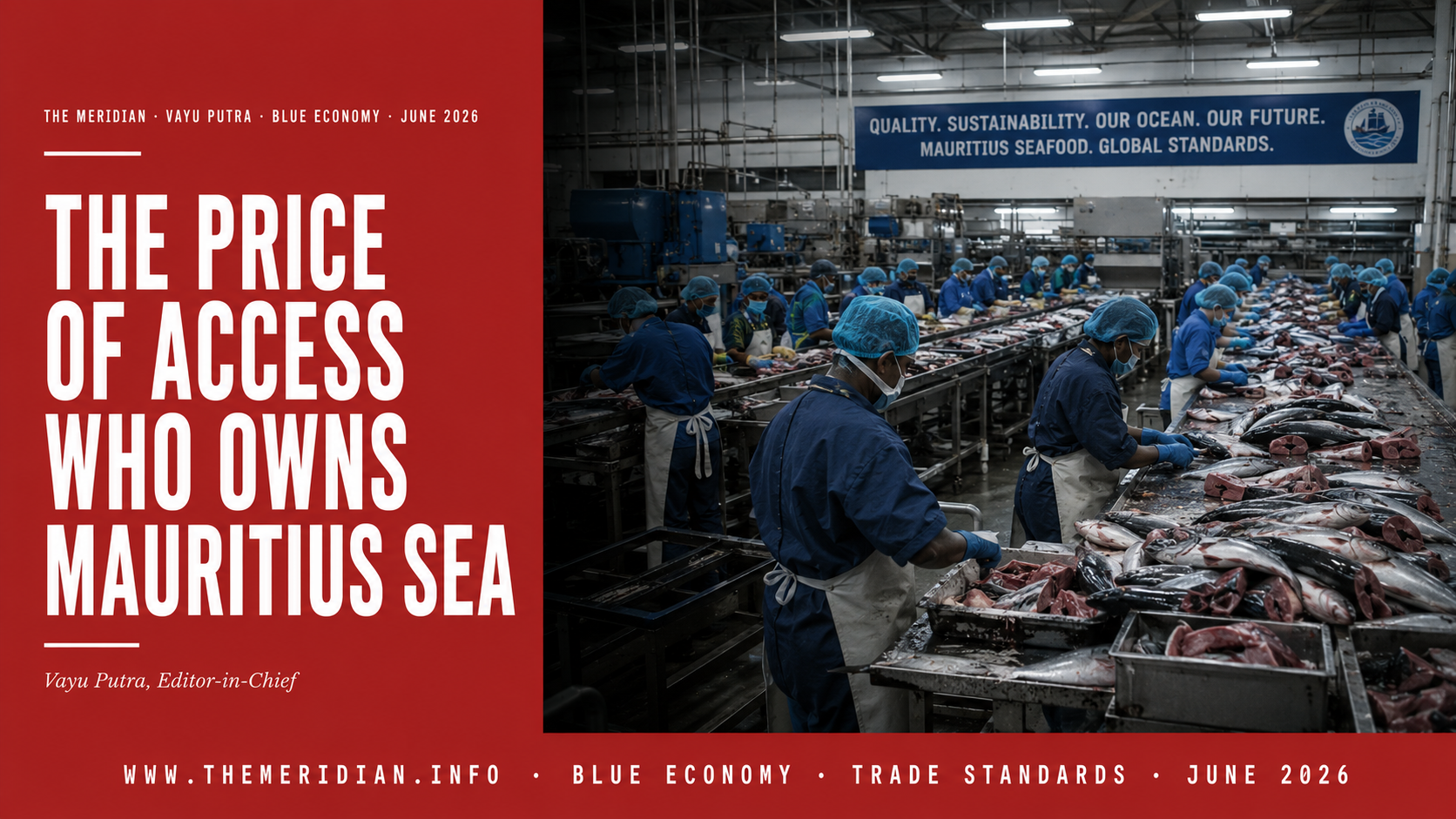
Trade access is not a gift. It is an agreement. When the United Kingdom and the European Union grant Mauritius preferential access to their tuna markets, they do so under frameworks that include explicit commitments to labour standards, sustainable development, and human rights. The Meridian asks a direct question: are those commitments being monitored, and are they being enforced?
The United Kingdom suspended its 20 per cent tuna tariff on 20 May 2026, equalising access for all exporting nations and eliminating the competitive advantage Mauritius had previously held in the British market. The stated rationale was consumer cost relief. The consultation with affected exporting nations was, according to Mauritius's Minister of Blue Economy Arvin Boolell, non-existent. These two facts together reveal something about how trade relationships between large importing economies and small island developing states are structured in practice: as instruments of the importing economy's domestic policy, not as bilateral arrangements in which the exporting partner's interests are part of the calculation.
This editorial is not about the tariff suspension. My colleague published that analysis in an accompanying piece. This editorial is about what the tariff suspension makes urgent -- the question that has been present in the Mauritius tuna supply chain for years and that the new competitive pressure makes impossible to defer any further. The question is this: the access Mauritius has to British and European tuna markets was granted under agreements that include labour standard provisions. Are those provisions being applied? And if they are not, what does that mean for the workers whose labour -- often at wages set by economies far removed from Mauritius -- fills the tins that British and European consumers buy at their supermarkets?
It is important to be precise about the institutional architecture, because confusing two separate agreements leads to two separate accountability failures.
The UK Developing Countries Trading Scheme, which came into force in June 2023 following Brexit, is the instrument through which Britain grants preferential market access to developing nations including Mauritius. The DCTS operates across three tiers. Enhanced Preferences -- the tier most relevant to Mauritius -- requires that beneficiary countries have ratified core international labour and environmental conventions and that the UK can take appropriate action where those commitments are not being honoured. The framework explicitly links market access to governance and rights standards.
The EU-Mauritius Economic Partnership Agreement, negotiated under the SADC EPA framework, is an entirely separate instrument governing Mauritius's preferential access to the European Union's 450-million-consumer market. EPA agreements contain sustainable development chapters that reference core International Labour Organisation conventions -- covering freedom of association, collective bargaining, the elimination of forced and child labour, and non-discrimination in employment. These are not aspirational clauses. They are binding commitments attached to the preferential access the agreement provides.
Both agreements exist. Both contain labour provisions. Both grant Mauritius preferential access to markets that together represent the dominant destination for Mauritius's tuna exports. The question is not whether these provisions exist. It is whether anyone is checking.
The Mauritius tuna processing industry is a significant employer. It is also an industry that has, over an extended period, built its labour model around the recruitment of foreign workers -- primarily from Bangladesh, Madagascar, Sri Lanka, and India -- at wage and employment terms that reflect the labour markets of those countries rather than the living costs of Mauritius. This is not a secret. It is a structural feature of the sector that has been documented in international labour and migration research, acknowledged in policy discussions about the Mauritian labour market, and visible to anyone who visits the processing facilities around Port Louis.
The consequences are layered. For the foreign worker, the arrangement may represent an income improvement relative to their country of origin, but one purchased at the cost of working in conditions and at wages that would not sustain them as residents of Mauritius. For the Mauritian worker, the arrangement represents a labour market in which an entire industrial sector -- built on Mauritius's own maritime resources, within Mauritius's own exclusive economic zone -- is staffed primarily by people brought from elsewhere, at rates that Mauritian workers would not accept and that the Mauritian minimum wage does not adequately protect against.
Mauritius's sea is a public resource. Its fish are caught under licences issued by the Mauritian state. Its canning plants export under trade preferences negotiated by the Mauritian government. But the workers who make the industry function are recruited from economies whose wage structures are a fraction of what a Mauritian household requires. The resource belongs to the island. The labour cost is set by Bangladesh and Madagascar.
The UK tariff suspension changes the competitive calculus for Mauritius's tuna processors in a specific and measurable way. Where Mauritius previously had a 20 per cent price advantage over competitors like the Maldives, Thailand, and Sri Lanka in the British market, it now has parity. Thailand is the world's largest canned tuna producer. Sri Lanka has lower baseline labour costs. The Maldives carries a premium eco-certification that commands margin in the segment of British retail that pays for sustainability credentials.
In this newly competitive environment, the pressure to maintain or improve margins will be felt acutely. There are limited levers available to processors who cannot compete on scale with Thailand or on certification with the Maldives. The lever that remains is labour cost. And the risk -- not a certainty, but a structural risk that deserves to be named clearly -- is that the response to tightened UK market margins is a further deepening of the foreign labour substitution model, at terms that compress wages, extend working hours, and erode the conditions that the ILO conventions both the UK and EU frameworks require Mauritius to uphold.
Beneficiary countries must have ratified core international labour and environmental conventions. The UK retains the ability to take action, including the suspension of preferences, where it determines that a beneficiary country is failing to implement those commitments. This is not a passive arrangement. It requires active monitoring by the UK government of conditions in the supply chains that benefit from the preferences.
EU-Mauritius Economic Partnership AgreementThe sustainable development chapter of the EPA references core ILO conventions covering freedom of association, the right to collective bargaining, the elimination of forced labour, the abolition of child labour, and non-discrimination in employment. Both parties commit to not using labour standards as disguised trade barriers while simultaneously committing to uphold those standards. The EU has a dedicated mechanism for monitoring and dialogue on sustainable development chapters in its trade agreements.
Both frameworks create an obligation on the importing party -- the UK and the EU -- to monitor whether the exporting country is meeting its labour commitments as a condition of continued preferential access. The question is not whether these mechanisms exist. They do. The question is whether they are being actively applied to the Mauritius tuna sector.
There is a question that sits beneath the trade standards argument and that I want to state plainly, because it is the question that the trade statistics and the tariff schedules and the sustainability chapters do not address.
The tuna in the tins that are sold in British and European supermarkets was caught in the Indian Ocean, within and adjacent to Mauritius's exclusive economic zone. The fishing rights to those waters belong to the Mauritian state. They are granted by the Mauritian government to operators -- primarily large conglomerates -- who hold the licences, contract the vessels, and run the processing operations. The Mauritian citizen who lives on an island surrounded by fishing grounds that generate Rs 14 billion in annual export revenue is not, in any meaningful sense, a beneficiary of that revenue at scale.
The conglomerates that hold the licences and run the processing plants benefit. The foreign workers who staff those plants at below-Mauritian-living-wage rates benefit modestly relative to their countries of origin. The British and European consumers who buy the product benefit from competitive retail prices. The institution that granted the fishing rights and the trade preferences -- the Mauritian state -- collects tax revenue and employment statistics. But the Mauritian fishing community, the coastal resident, the worker who might have staffed those plants at a wage that allowed them to participate in the economy the tuna industry claims to represent -- these people are largely absent from the distribution of the rent.
This is not exclusively a trade standards issue. It is a resource governance issue, a wage policy issue, and a question about who the Blue Economy actually serves when it is owned by four conglomerates, staffed by imported labour, and exported under preferences negotiated in Brussels and London. But trade standards enforcement is one of the few external mechanisms with enough leverage to change the incentive structure. When market access is conditional on labour standards, and when those conditions are enforced rather than checked off at accession and forgotten, the calculus for the processor changes.
The Meridian is not asking the UK or the EU to withdraw Mauritius's trade preferences. That would harm the Mauritian workers whose livelihoods depend on the sector, however inadequate the terms of those livelihoods currently are. What this publication is asking is specific and achievable.
First: Both the UK government and the European Commission should conduct or commission independent assessments of labour conditions in the Mauritius tuna processing sector -- including conditions for foreign workers, wage levels relative to the Mauritius minimum wage and living wage benchmarks, working hours, freedom of association, and recruitment practices.
Second: The findings of those assessments should be published, and the Mauritius government should be given a defined period to respond with documented remediation where shortfalls are identified.
Third: Future tariff decisions -- including any extension of the UK suspension beyond December 2028, or any renegotiation of the EU EPA -- should incorporate the findings of those assessments as a condition of continued preferential terms.
These are not radical demands. They are the minimum that the labour standard provisions in both existing agreements already contemplate. The mechanism exists. The question is the political will to use it.
The UK suspended its tuna tariff to help British consumers. That is a legitimate domestic policy objective. But the cost of cheaper tuna in British supermarkets should not be silently transferred to the workers who process it -- workers who are often not Mauritian, who did not consent to subsidise British cost-of-living relief, and whose terms of employment are structured to ensure they receive as small a share as possible of the value they create.
The EU's EPA with Mauritius contains the language of rights and the architecture of accountability. So does the UK's DCTS. These are not decorative commitments. They are the price that was agreed for preferential access to some of the world's largest consumer markets. Both institutions should begin collecting what is owed to them.
The sea around Mauritius belongs to Mauritius. The labour that processes its catch should be treated with the dignity that the trade agreements both the UK and EU signed -- and both have the mechanisms to enforce -- explicitly require. The Meridian will continue to report on whether they do.
Add comment
Comments