The Great Mauritian Bluetooth Circus
When the car is smarter than the law, and the statistics are on silent mode
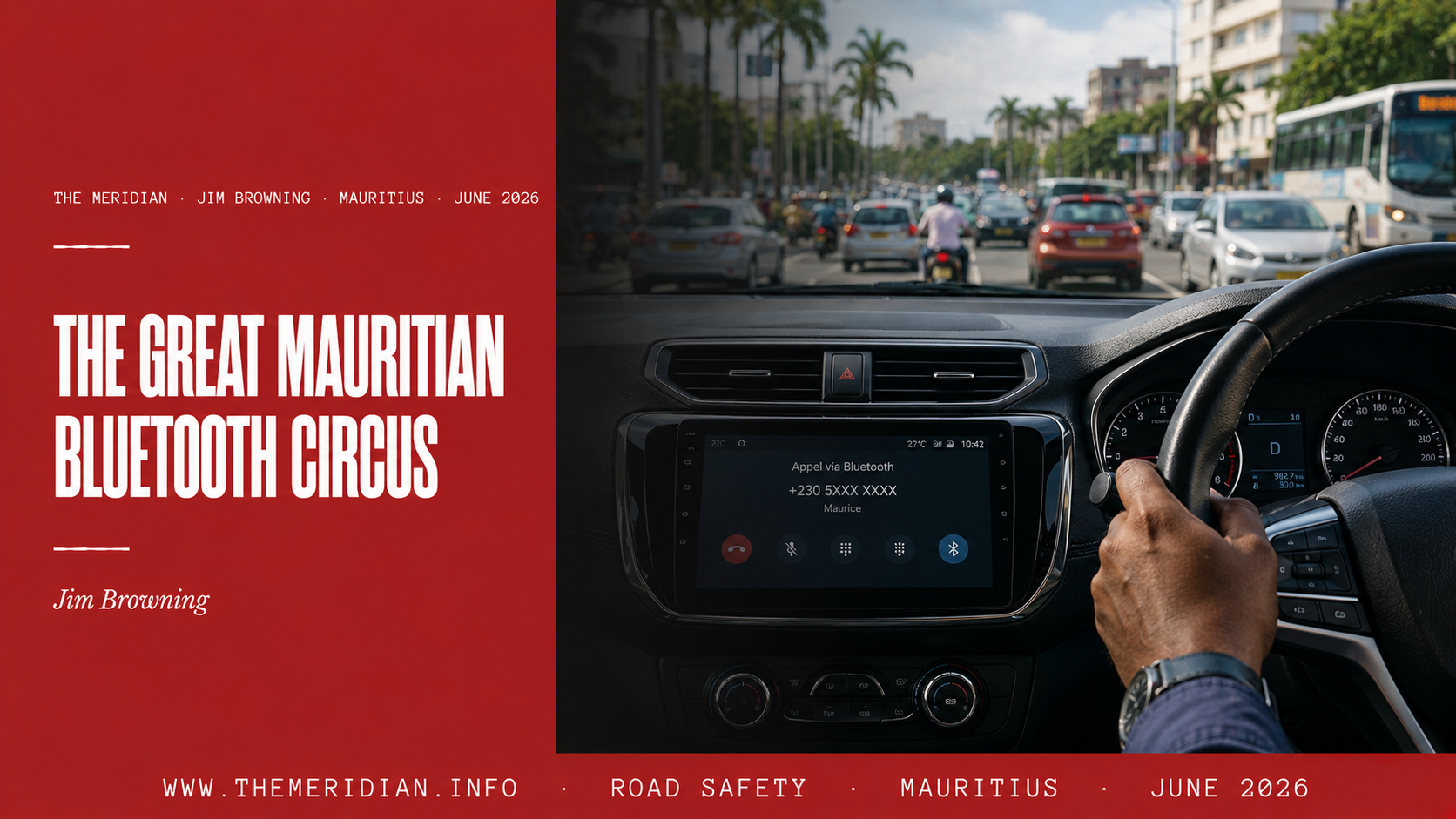
Mauritius has finally discovered the great enemy of road safety. Not potholes deep enough to qualify as Municipality swimming pools. Not drivers who treat roundabouts as philosophical suggestions. No. The villain of the national road drama is now the mobile phone. And the law written to address it has created a circus worthy of the name.
Mauritius has finally discovered the great enemy of road safety. Not potholes deep enough to qualify as Municipality swimming pools. Not drivers who treat roundabouts as philosophical suggestions. Not buses that stop wherever divine inspiration strikes and poison you with their constant carbon monoxide emissions. Not motorcycles zigzagging between lanes like mosquitoes with registration plates.
No. The villain of the national road drama is now the mobile phone.
And, to be fair, using a phone while driving is indeed dangerous. Texting behind the wheel is madness with a screen protector. WhatsApping while driving is not multitasking. It is auditioning for a police report. Nobody sensible should defend it.
But Mauritius, being Mauritius, has managed to turn a serious road safety issue into a wonderful legal and administrative comedy, complete with penalty points, Bluetooth confusion, statistical fog and the usual political charades where every government takes turns holding the steering wheel before pretending the car drove itself.
The law first entered the scene in 2003, when the Road Traffic Act was amended to say that a driver must not use a hand held microphone or telephone handset while driving. Simple enough. If you are driving, do not hold the phone. That law arrived during the MSM MMM period, when politics itself was already operating through a complicated hands-free arrangement of its own.
Then came 2010, and the Road Traffic Construction and Use of Vehicles Regulations decided to add more spice to the curry. Regulation 90 did not only speak about hand held devices. It also referred to hand free microphones or telephone handsets used to answer or make calls while driving. In ordinary English, that means the law looked at Bluetooth and said, nice try, but sit down.
This is where the national confusion begins.
A driver buys a modern car. The car comes from the manufacturer with built-in Bluetooth. The salesman proudly makes his sales speech and describes how the driver can connect the phone, answer calls through the steering wheel, speak through the car microphone and hear everything through the speakers. Very impressive. Very modern. Very international. Very swag and very… safe?
Then the law quietly enters the showroom and says: “Congratulations on your factory-fitted feature. Please do not use it.”
Only in Mauritius can something be sold as a safety feature, advertised as convenience, installed by manufacturers, encouraged by technology and then possibly treated as an offence once the car leaves the showroom.
The driver is left wondering whether the car is equipped with Bluetooth or with legal temptation.
The logic is almost artistic. You may have the button. You may pair the phone. You may admire the microphone. You may enjoy the dashboard display. You may stare lovingly at the green call icon. But if you press it while driving, the law may suddenly develop a personality.
And of course, the usual explanation will follow: the law is the law!
Very good. But perhaps the law could also learn to speak like a normal person.
Because the ordinary driver does not sit in traffic reading section 123AE with a cup of tea. He simply sees a phone symbol on his steering wheel and assumes that, since it was placed by the manufacturer, it must be legal to use. Silly citizens. How dare they think a standard car feature is meant to be used in a car?
The real theatre arrived with the penalty points system. In 2012, Cabinet agreed to bring in penalty points, including for mobile phone use. Because it was “classy” perhaps. Moving on… Then the system disappeared, returned, was reworked, polished, dressed up and reintroduced. In 2025, mobile phone use carried 3 to 6 penalty points. Then, in 2026, the government decided that this was not dramatic enough. The points were increased to 5 to 10, effective from 10 June 2026.
A driver can now collect penalty points with the efficiency of someone collecting supermarket loyalty points, except these points do not give you a complimentary toaster. They give you a date with disqualification.
The fine also deserves its own round of applause. The fixed penalty is generally Rs 3,000 for using a hand held microphone or telephone handset while driving. But if the matter goes to court, the exposure can rise to Rs 10,000. So the message is clear: touching your phone may cost you money, points and possibly your licence.
Meanwhile, drink driving remains in its own category of national shame. The law is much harsher there, and rightly so. A first conviction for drunken driving can bring a fine of Rs 20,000 to Rs 50,000, imprisonment of up to five years and licence disqualification for at least twelve months. That is not a slap on the wrist. That is the State arriving with a hammer and a receipt book. Unless of course you happen to be a lawyer with a certain surname from birth and then eventually you are to sit in the assembly as per your birth right, then you are exempt from breath test, blood test or simply any test and let the case run its course until it is time-barred. Or if we dive further the political brethren of the mentioned person also killed a road user while driving, the outcome you ask? Well let us put it this way; the culprit was somehow found not guilty. Surprise, surprise!
Now let us turn to the statistics, because this is where the comedy becomes even more refined.
When the authorities talk about mobile phones and road safety, the language is strong. Texting is dangerous. Manual phone operation is risky. Mobile phone use contributes to road crashes. All of that is sensible.
But when one asks a very basic question, namely, how many accidents in Mauritius were actually caused by mobile phone use while driving, the official statistics suddenly behave like a shy witness in court.
They do not answer clearly.
Mauritius has official figures for alcohol-related accidents. From 2011 to 2020, the data recorded 18,146 accidents under alcohol influence, including 123 fatal accidents, 544 serious accidents and 17,479 slight accidents. That is a mountain of evidence. Alcohol is not merely a road safety issue. It is a national funeral machine with headlights.
For drugged driving, there are also figures, although more recent and more limited. From 1 January 2024 to 30 January 2025, 13 drivers involved in road accidents tested positive for drugs, and two of those accidents were fatal. Police figures also show positive drug tests during enforcement operations. Again, this is serious. Driving under the influence of drugs is not freedom. It is recklessness with a steering wheel. Police officers were also caught in the act, albeit not caught by other police officers but by simpletons, civilians, and the same was recorded live on Facebook. Outcome? Have a guess? Justice? I shall let your imagination do the work…
But for mobile phones, where is the neat official table? Where is the clean figure saying, X number of accidents were caused by mobile phone use? It seems to be missing from the public stage.
Instead, we get combined categories. We are told that 22,653 drivers or riders were contravened during operations for speeding, mobile phone use, drink driving or drug driving. All together. In one statistical basket. Like a fruit salad of offences.
Speeding, phone use, alcohol and drugs are thrown into the same pot, stirred politely and served as road safety soup. Useful, perhaps, for a speech. Less useful if one wants to know exactly how many people crashed because they were checking TikTok, replying “ok”, or sending a voice note that could have waited ten minutes.
So the government has enough confidence to increase penalty points, but not enough publicly separated data to show how many accidents are actually caused by mobile phones as a distinct category. This is the Mauritian policy style: punish first, explain later, publish vaguely.
And before anyone misunderstands the point, this is not a defence of phone use while driving. It is dangerous. It should be punished. A driver looking at a screen instead of the road is not driving. He is browsing his way into a collision.
The problem is not the principle. The problem is the mess.
If Bluetooth is illegal for calls, say so clearly in public. If factory-fitted hands-free systems are not allowed while driving, tell car dealers to stop selling them like gifts from a newly discovered civilisation. If the offence is about hand-held use only for penalty points, say that. If hands-free use is also punishable under regulation 90, say that too. If mobile phone use is causing accidents, publish the numbers separately. If there are no separate numbers, admit that the data system is not yet good enough.
But no! We prefer the national method: keep the law complicated, keep the statistics blurred, keep the public guessing, and then act surprised when everyone is confused. And make it a point to introduce Kréole in Parliament so that only the parliamentarians know the ins and outs of the laws and the layman knows nothing. Therefore, the citizens must now become legal scholars before answering a call from his wife.
Citizens must understand the Road Traffic Act, the Construction and Use Regulations, penalty points, fixed penalties, court fines, Cabinet decisions, commencement dates and the sacred difference between hand held and hand free.
All this while sitting in a car that says, with great confidence, phone connected.
The phone says connected. The car says connected. The law says careful. The police says stop. The driver says, but it came with the car. The State replies, so did the accelerator. That does not mean you may fly.
And there lies the absurdity.
Mauritius wants modern cars, modern technology and modern enforcement, but often with laws written as though the national vehicle fleet consists mainly of ox carts and Nokia handsets. We have dashboards that can connect to satellites, but legal explanations that still need a torchlight. This goes to show how the concerned minister’s logic works. Eventually he will say that pressing on the air-con button is dangerous, so drive naked for fresh air. Thereafter make an addendum to the law to say that displaying nudity is also illegal and while the minister sleeps he can hear £££€€€$$$¥¥¥ RsRsRs.
Politically, the story is even richer. The initial offence came under one political arrangement. Later regulations were shaped under another. The penalty points system came, went and came back through different governments. The fine was updated under another administration. The points were sharpened again under the current one.
So nobody can pretend to be entirely innocent. This is a multi-party relay race of road safety. MSM, MMM, Labour-led arrangements and parasitic coalitions of different colours have all had their hands somewhere near the wheel. The mobile phone law is not the child of one party. It is a political foster child raised by several governments, each adding a rule, a fine, a schedule, a regulation or a speech.
And now the driver is left with the finished product: a law that says do not touch the phone, regulations that appear to say do not even use hands-free to make or answer calls while driving, a car that invites him to do exactly that, and official statistics that scold mobile phone use without clearly separating its accident count from other offences.
This is not road safety communication. This is a treasure hunt.
The simple public message should be this: do not hold your phone while driving. Do not text while driving. Do not WhatsApp while driving. Do not scroll while driving. Do not answer calls while driving, even by Bluetooth, unless the law is properly clarified otherwise. Set your navigation before you move. Pull over safely if the call is important. And if you are drunk or drugged, do not drive at all, unless your ambition is to become a statistic and ruin several lives in the process.
That is the message. Simple. Clear. Human.
But instead, we have created the grand Mauritian Bluetooth Circus, where the car comes ready to connect, the driver connects, the law disconnects, the statistics buffer and the authorities announce another reform.
In the end, perhaps the safest thing is to treat the mobile phone like a small poisonous animal in the car. Do not touch it. Do not answer it. Do not negotiate with it. Let it ring. Let the WhatsApp message wait. Let the voice note die of loneliness.
Because on Mauritian roads, the phone may not only distract you.
It may also cost you Rs 3,000, expose you to Rs 10,000, add up to 10 penalty points, and possibly make you the latest unwilling performer in the national theatre of, “I thought Bluetooth was allowed.”
And that, ladies and gentlemen, is where we are.
A country where the car is smart, the phone is smarter, the driver is confused, and the law is sitting in the passenger seat just as would your mother-in-law be saying: “I told you so, but only if you read the regulation properly!”
| Source or Legal Item | Relevant Point |
|---|---|
| Road Traffic Act, section 123AE | Bans the use of a hand held microphone or telephone handset while driving. The provision was inserted by Act 9 of 2003 and came into force on 1 September 2003. |
| Road Traffic Construction and Use of Vehicles Regulations 2010, regulation 90 | Refers to hand held or hand free microphone or telephone handset use to answer or make calls while driving. This is the provision creating the Bluetooth and hands-free confusion. |
| Road Traffic Amendment Act 2018 | Increased the statutory maximum fine for the mobile phone offence from Rs 3,000 to Rs 10,000, while the fixed penalty schedule lists Rs 3,000. |
| Road Traffic Amendment Act 2025 | Reintroduced the penalty points system. The mobile phone offence was initially listed at 3 to 6 points. |
| Road Traffic Amendment of Schedule No. 2 Regulations 2026 | Increased the mobile phone penalty points from 3–6 to 5–10 points, effective from 10 June 2026. |
| Police Annual Report 2024–2025 | Reported 22,653 contraventions for speeding, mobile phone use, drink driving or drug driving together, without separating the mobile phone figure. |
| Road Safety Observatory data 2011–2020 | Recorded 18,146 accidents under alcohol influence, including 123 fatal accidents, 544 serious accidents and 17,479 slight accidents. |
| Parliamentary answer, 4 February 2025 | Stated that from 1 January 2024 to 30 January 2025, 13 drivers involved in road accidents tested positive for drugs, including two fatal accidents. |
Add comment
Comments