Mauritius Should Deprioritise Cannabis Enforcement
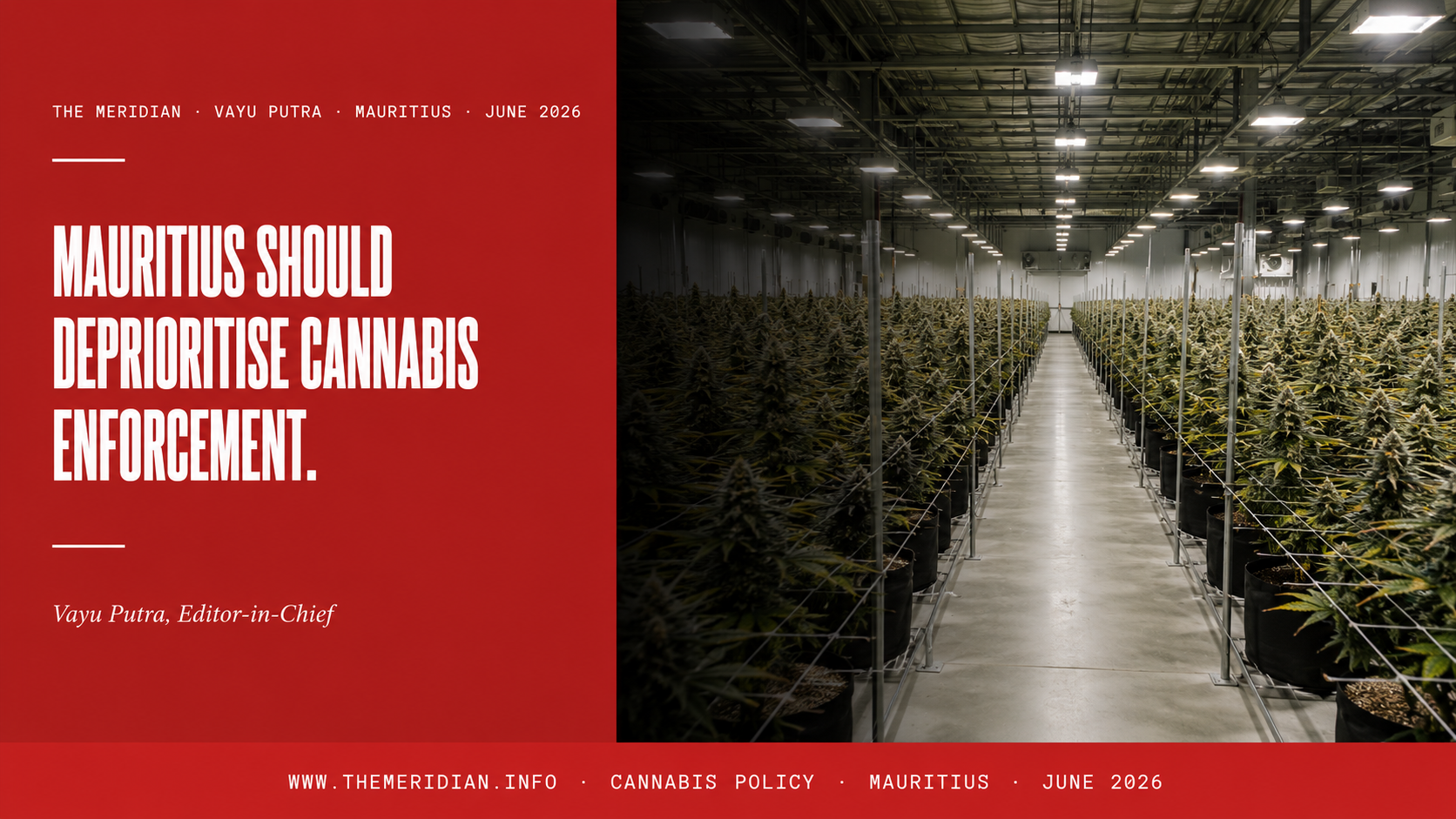
This article is written in simple English. Every difficult word is explained the moment it appears, in brackets. Because the question this article asks affects ordinary people -- young people, mostly -- and they deserve to understand it without a law degree. America just changed how it treats cannabis. The Meridian explains what happened, what it means, and why Mauritius should act now -- before any new law is even written.
In June 2026, the United States government moved cannabis [the plant also called marijuana, weed, ganja, or in Mauritius, gandia] from one legal category to a less serious one. Before, cannabis was officially treated the same as heroin -- a drug considered to have no medical use and a very high risk of abuse. Now, under an executive order [an instruction signed directly by the President, which does not need a vote in Parliament first] from President Trump, cannabis used for medical purposes is treated more like ketamine -- a drug that is accepted to have real medical benefits, with a lower risk of dependence.
This is a big deal. But the most important part of this story is not what just happened in 2026. It is what the United States was doing for years before this change -- and that is the part Mauritius should pay attention to.
To deprioritise [to make something less important, less urgent, lower on the list of things to focus on] something does not mean to make it legal. It does not mean police stop doing their job. It means the police and the prosecutors [the lawyers who decide whether to bring a case to court, and who represent the State in court] are told: do not spend your limited time, your limited resources, and your limited prison space on this. Focus your energy on things that genuinely hurt people -- violent crime, serious drug trafficking, theft, fraud.
This is not a radical idea. Every police force in the world deprioritises something. No country has enough police officers to enforce every single law with equal energy. The question is always: what gets the attention, and what does not?
Here is the part of the American story that most people do not know. Cannabis has been illegal under United States federal law [the national law that applies across the whole country] since 1970. It is still illegal under federal law today, even after this 2026 change.
But starting many years ago, the US government quietly told its own federal prosecutors: do not prioritise cannabis cases, especially in states that have created their own legal cannabis systems. This guidance had names -- the Cole Memorandum [a memo, or internal instruction document, issued in 2013 under President Obama] and the Rohrabacher-Farr amendment [a rule added to a budget law by Congress, which blocked federal money from being used to interfere with state medical cannabis programmes].
The result? For more than a decade, cannabis remained illegal on paper at the national level -- but in practice, if you lived in a state that had legalised it, nobody from the federal government was coming to arrest you for it. The law on paper and the law in practice were two different things, on purpose, by design.
Think about that. Out of 50 US states, only 2 -- Kansas and Idaho -- have no legal cannabis programme of any kind. 48 states moved ahead of federal law. The federal government did not fight all of them. It deprioritised, watched, collected information, and only in 2026 did it formally change the national category.
America did not wait for a perfect new law before changing how it enforced the old one. It changed enforcement first, and let the law catch up years later. That is the lesson for Mauritius.
To be fair, not everyone in America thinks cannabis reform has gone well. There are real critics, and their concerns deserve to be heard, not dismissed.
One organisation, called Smart Approaches to Marijuana (SAM), argues that legal cannabis in America has become what they call “Big Tobacco 2.0” -- meaning, a large industry that makes most of its profit from heavy users, sells very strong products (some cannabis today is nearly 99% THC [tetrahydrocannabinol, the chemical in cannabis that makes you feel “high”], compared to much weaker cannabis in past decades), and is now attracting investment from the same tobacco and alcohol companies that built addiction-based business models before. They point out that daily cannabis use in America has grown from under 1 million people in 1992 to about 17 million people today. They also point to real evidence linking very strong cannabis to a higher risk of psychosis [a mental health condition where a person loses touch with reality] and schizophrenia [a serious, long-term mental illness], especially in young people.
These are not points to brush aside. They are exactly why the synthetic cannabinoids [chemically created substances designed to copy or exceed the effect of cannabis, often far more dangerous and unpredictable] that have been hospitalising young Mauritians -- a crisis The Meridian documented in detail in our June 2026 edition, The Colonised Plant -- are a genuinely serious problem.
But here is the key point, and it is the one that matters most for this article. Another organisation, NORML (the National Organisation for the Reform of Marijuana Laws), and SAM -- two groups that disagree about almost everything else -- actually agree on one thing: decriminalisation [removing criminal punishment, like arrest and a criminal record, for simple possession of small amounts] and commercialisation [building a large, profit-driven industry that markets and sells the product widely] are two different decisions. You do not have to do both together. You can do one without the other.
Mauritius does not have to choose between “everything stays illegal and people keep getting arrested and getting criminal records for having a small amount of cannabis in their pocket” OR “we open dispensary shops on every corner selling 90% THC products like sweets.”
There is a middle path. Stop treating simple possession as a priority for arrest. Stop ruining young people’s futures with criminal records for personal use. But do not rush into building a commercial industry until proper rules -- about potency, marketing, and who profits -- are written first.
Mauritius has its own cannabis law, the Dangerous Drugs Act 2000, which treats cannabis very harshly -- in some cases, more harshly than many countries treat far more dangerous substances. The Meridian's June 2026 edition, The Colonised Plant, documented the human cost of this: a shadow economy [an illegal economy that operates outside official records and taxes] estimated at Rs 2.5 billion, and a wave of synthetic cannabinoid poisoning hospitalising Mauritian teenagers -- often because young people, unable to access ordinary cannabis safely, turn to far more dangerous chemical substitutes that mimic its effects.
Every year, young Mauritians -- often from families without money for good lawyers -- are arrested for having a small amount of cannabis for personal use. A criminal record [an official government record showing someone has been convicted of a crime] for a simple possession case can follow a young person for the rest of their life. It can block them from certain jobs, from travelling to certain countries, from opportunities that have nothing to do with the offence itself. Meanwhile, the actual harm -- if there is any -- from one person smoking a joint privately is completely different from the harm caused by, say, drink driving, or violent crime, or the synthetic drug crisis itself.
The Meridian calls on the Government of Mauritius to deprioritise the enforcement of cannabis possession offences, starting now -- using exactly the model America used for over a decade before changing its formal law.
This means: issue clear guidance to the police and the Director of Public Prosecutions [the senior law officer who decides which criminal cases go to court] that simple possession of cannabis for personal use should not be a priority for arrest, prosecution, or imprisonment. Police time and court time should focus on trafficking [selling or moving large quantities for profit], the synthetic drug crisis, and violent crime.
This step requires no new law. It requires no vote in the National Assembly. It is an administrative decision -- exactly like the Cole Memorandum was in America. While this happens, the legislative reform -- the proper, written law, including the model bill The Meridian has already proposed based on Canadian, German, South African, and Lesotho precedent -- can be debated properly, with the safeguards against “Big Tobacco 2.0” that SAM rightly warns about.
Mistake One: Doing nothing and waiting for the “perfect law.” Perfect laws take years -- sometimes decades -- to write and pass. Meanwhile, real young people, today, this year, are getting arrested and getting criminal records for something that increasing numbers of countries no longer treat as a serious crime. Deprioritisation can happen this year. The law can follow.
Mistake Two: Copying the American commercial model without the safeguards. If Mauritius ever does build a legal cannabis economy -- whether for medical use, for export, or otherwise -- it must learn from America's mistakes, not just its reforms. That means: limits on THC potency [how strong the product is], strict rules on marketing especially to young people, and most importantly -- given everything The Meridian has documented about how Mauritius's conglomerates [the small number of very large companies that dominate the economy] operate -- real attention to who owns and profits from this industry. Will it be Mauritian farmers and small businesses, or will it become another sector captured by the same four or five large groups that already dominate everything else on this island?
The United States built the international system that made cannabis illegal almost everywhere in the world, including in Mauritius. The Dangerous Drugs Act 2000 exists, in part, because of decades of pressure from exactly this country. Now, that same country has admitted -- through its own actions, not just its words -- that the old approach was wrong. It deprioritised enforcement for over a decade before formally changing the law.
Mauritius does not need to wait for permission. Mauritius does not need a new law to start this. What Mauritius needs is a decision -- a decision that says: we will stop ruining the futures of young people for personal possession of cannabis, starting now, while we get the bigger reform right.
America took over a decade to go from quietly deprioritising cannabis enforcement to formally changing its national drug schedule. Mauritius does not need a decade. Mauritius needs a decision -- by the Commissioner of Police and the Director of Public Prosecutions, with the backing of Cabinet -- that simple possession is no longer a priority.
This is not legalisation. This is not an open door to a commercial cannabis industry controlled by the same conglomerates that already own everything else on this island. This is a simple, humane, and entirely achievable first step: stop arresting young Mauritians for personal possession, while the real reform -- with real safeguards -- is written properly.
The Meridian calls on the Government of Mauritius to deprioritise cannabis enforcement now. The evidence exists. The precedent exists. The only thing missing is the decision.
Add comment
Comments