We Said Red Zone by June. Here Is What June Looks Like.
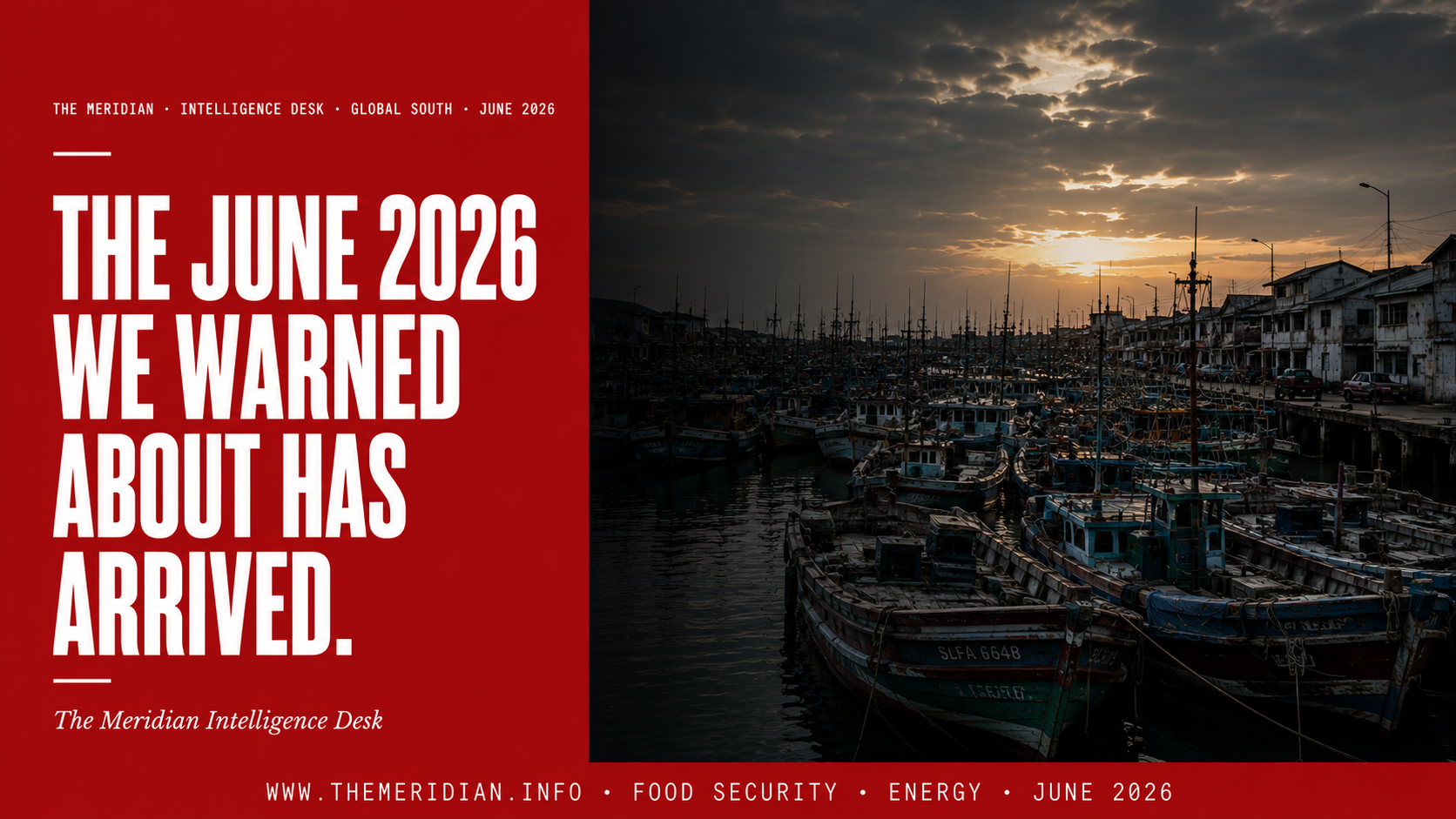
In May 2026, The Meridian published a series of warnings -- Red Zone by June, The Basket Is Getting Heavier, The Middle Class Bill, Food Systems and Conflict -- mapping how the closure of the Strait of Hormuz would move from an oil price chart into the daily lives of families across the Global South. An independent documentary investigation, filmed across the Philippines, Bangladesh and India, has now confirmed the mechanism in granular, human detail. June has arrived. So has the Red Zone.
Journalism is sometimes accused of crying wolf -- predicting crises that never quite arrive, hedging every forecast so heavily that no claim can ever be wrong. The Meridian's May 2026 series did not hedge. It named a month. It described a mechanism. It said that by June, the abstract shock of the Strait of Hormuz closure would have travelled through shipping costs, fuel prices, fertiliser markets and food baskets to land, specifically and measurably, on households that had nothing to do with the war that caused it.
A documentary investigation -- filmed across fishing communities in the Philippines, rice paddies in Bangladesh, and agricultural markets in India -- has now provided exactly that confirmation. Not in aggregate statistics released by an international body six months from now, but in the daily wage of a named fisherman, the harvest decision of a named farmer, and the inflation print of a named country, this month.
The single most important figure in the new evidence is a comparison. When Russia invaded Ukraine in February 2022, global food and energy inflation took three to four months to double, and eleven to twelve months to triple, in economies like the Philippines.
After the US and Israeli strikes on Iran beginning 28 February 2026, Philippine inflation tripled in two months. April 2026 inflation reached 7.2 per cent -- a three-year high -- before cooling slightly to 6.8 per cent in May. Economists interviewed describe this as the biggest inflationary shock to the Philippine economy in over thirty years.
The Meridian's May 2026 series made specific, falsifiable claims. Here is how each one has been tested by the evidence now available.
The Strait of Hormuz closure would not remain a contained shipping story. By June, the disruption would have propagated through energy and fertiliser markets into measurable inflation and food insecurity across Asia and the wider Global South -- a "Red Zone" of compounding crisis.
The Evidence, June 2026Rising energy costs would translate directly into a heavier household food basket -- not as an abstraction, but as a measurable increase in what families actually pay for staples.
The Evidence, June 2026The cost of this conflict would be presented to ordinary households as an invoice with no itemisation -- paid through fuel pumps, market stalls and utility bills, with no government able to fully absorb it.
The Evidence, June 2026Fertiliser markets, fishing fleets and harvest cycles -- the physical infrastructure of food production, not just its price -- would be disrupted by a conflict thousands of kilometres away, with consequences extending across multiple future harvest seasons.
The Evidence, June 2026Statistics describe populations. The documentary's strength is that it also describes individuals, and their stories illustrate the mechanism with a clarity no aggregate figure can match.
In Navotas, the fishing capital of the Philippines, a fisherman named Teodoro "Budoy" Escariel used to earn 1,000 pesos a day. He now earns 600 to 700 pesos. He had already lost a mussel farm to land reclamation; what was once a five-minute boat ride to his next nearest farm now takes thirty minutes. Since March, his boats have sat idle at the dock so often that one has begun to break apart from disuse, and he now spends his time repairing it rather than fishing.
Further south in Cavite, a fisherman named Edgar Escosia has stopped fishing altogether. The catch is no longer enough to feed his family, and the fuel cost of reaching his usual grounds is prohibitive. He now works as a driver. Reports cited in the documentary suggest that in some areas, as many as half of subsistence fishermen have stopped going to sea.
This is what "Red Zone" means in practice. Not a colour on a risk map. A fisherman repairing a boat he can no longer afford to use, and a family eating two meals instead of three.
The documentary's analysts describe this as a "long-tail crisis" -- meaning that even if the conflict ended today, the consequences would take months or years to unwind. Several mechanisms explain why.
Mine clearance. Iran's consulate in Mumbai published a map in April demarcating areas where anti-ship mines had been laid. Shipping industry associations issued hazard guidance in May. Even with an immediate ceasefire, clearing these mines and restoring shipping company confidence is estimated to take two to four months.
Infrastructure damage. Approximately one-fifth of regional LNG export capacity has been damaged by retaliatory strikes. Restoration of these facilities is estimated at a minimum of four years.
Insurance and risk premiums. War-risk insurance premiums for vessels transiting the region have risen significantly, embedding additional cost into shipping regardless of whether physical hazards remain.
Harvest cycle lag. Crops currently being harvested across Asia were planted before the conflict began in February. The disruption has not yet been fully reflected in food availability -- it will appear in the next harvest, and potentially the one after that, as fertiliser and fuel shortages compound.
The documentary also describes the beginnings of structural adaptation -- countries diversifying energy sources toward renewables, nuclear and electric vehicles; diversifying suppliers toward Latin America, West Africa, North America and Australia; and building strategic fuel and LNG buffers that many developing countries previously lacked.
ASEAN leaders met in May to advance a regional petroleum security agreement -- a mutual aid mechanism for member states facing energy crises, alongside efforts to accelerate a regional power grid. But as one analyst in the documentary noted regarding the Philippines specifically: an archipelagic nation that struggles to connect its own internal grid is unlikely to benefit quickly from a regional one.
These responses are correct in direction. They are measured in years. The crisis is measured in months, and already underway.
This evidence reinforces what The Meridian's earlier Hormuz coverage argued: the Strait will not simply return to its pre-February 2026 state, even if a ceasefire holds. Tanker traffic at under 20 per day, against a pre-war baseline of approximately 250, represents a 90% reduction that persists weeks into any ceasefire period -- because the damage is not only physical, but reputational and actuarial. Shipping companies, insurers and buyers have all recalibrated their assessment of this route's risk, and that recalibration does not reverse on the signing of a piece of paper.
In May, The Meridian described a mechanism: a conflict over the Strait of Hormuz would not stay contained to oil price charts. It would travel -- through shipping costs, fuel prices, fertiliser markets, and harvest cycles -- into the daily lives of fishermen in the Philippines, farmers in Bangladesh, and households across India and the wider Global South. We named the timeframe. We said June.
The documentary evidence now available does not merely corroborate this forecast in broad strokes. It corroborates it in the specific, falsifiable terms the original series used: the speed of inflation transmission, the scale of the household food basket increase, the inadequacy of government fiscal response relative to the population affected, and the multi-season disruption to food production.
This is not a story about being right. It is a story about what happens next -- because every mechanism described above is still operating, the fertiliser shortfall will not clear until 2027 at the earliest, and the next harvest cycle has not yet been tested. The Meridian will continue to track the Red Zone as it evolves.
Add comment
Comments