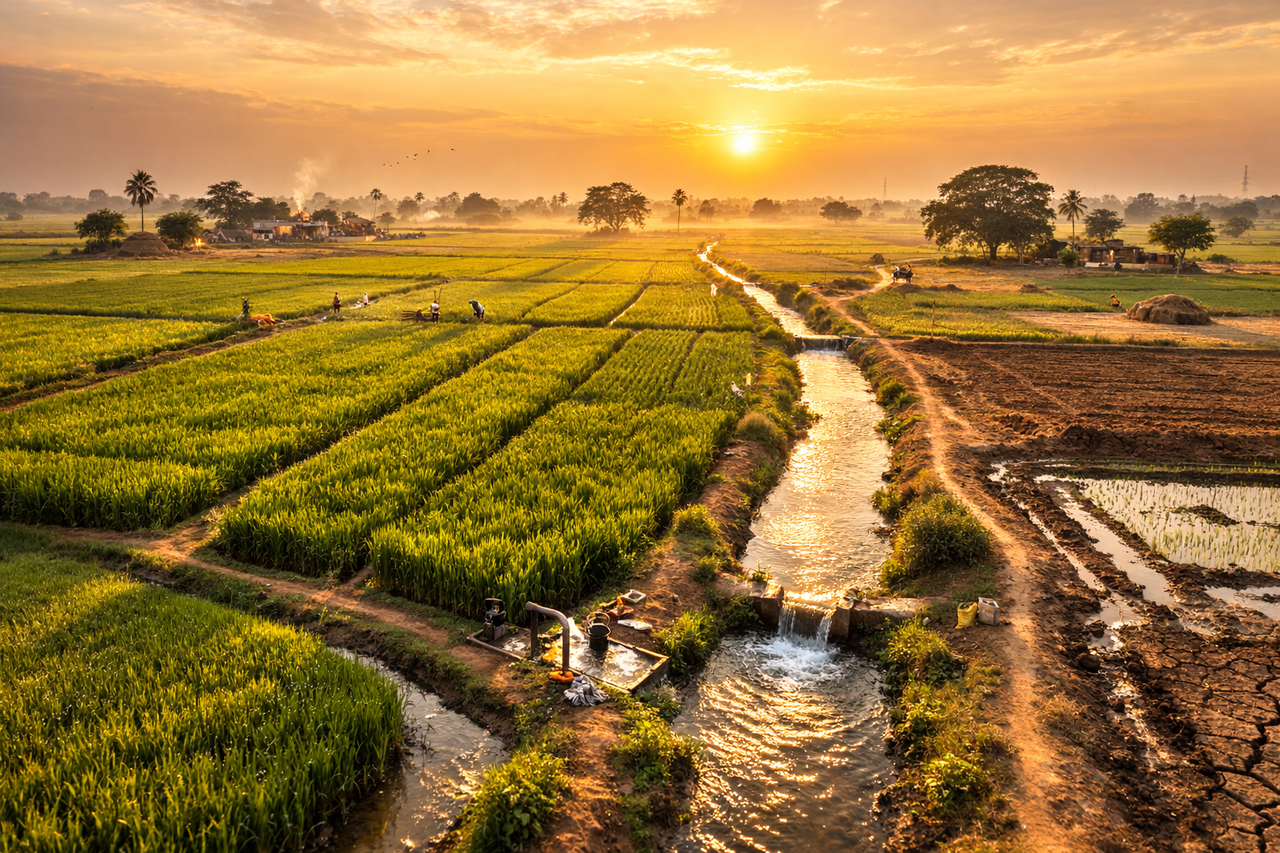
India's agricultural production data for 2022‑23, drawn from FAOSTAT and the Ministry of Agriculture's Final Estimates, places the country at or near the top of global rankings in almost every major food category. Rice output reached 135.75 million tonnes, making India the world's second largest producer behind China. Wheat production stood at 110.55 million tonnes, again second globally. India is the world's largest producer of milk, at approximately 221 million tonnes representing roughly 24 percent of global output, and the world's largest producer of pulses at 26.06 million tonnes. Sugarcane output reached 490.53 million tonnes, placing India second behind Brazil in a crop that is simultaneously a major source of rural income and one of the most water-intensive agricultural activities in the country's repertoire.
These figures are not in dispute. They represent genuine productive capacity accumulated over decades of investment in irrigation, seed technology, fertiliser access and procurement infrastructure. The Green Revolution, for all its ecological consequences, delivered a food security outcome that has insulated India from the kind of systemic scarcity that constrained its development in earlier decades. What the production rankings do not capture is the ecological cost structure underlying them: the groundwater accounts being drawn down to support rice and sugarcane cultivation in semi-arid regions, the fertiliser dependency that converts global energy price shocks into domestic subsidy obligations, and the farm income structure that makes a bad monsoon or a price collapse a household crisis rather than a sector-level adjustment.
The most precise and least discussed dimension of India's agricultural vulnerability is the groundwater account. The Central Ground Water Board's Dynamic Ground Water Resources of India report for 2023 provides specific extraction-to-resource ratios for the country's most agriculturally productive states, and the numbers are severe. Punjab extracts 27.8 billion cubic metres of groundwater annually against an extractable resource of 16.98 billion cubic metres, giving it a stage of extraction of 163.76 percent. In practical terms, Punjab is withdrawing water from underground at a rate more than 60 percent above what nature replenishes. Haryana extracts 11.8 billion cubic metres against an extractable resource of 8.69 billion cubic metres, a stage of extraction of 135.74 percent. Rajasthan extracts 16.74 billion cubic metres against a resource of 11.25 billion cubic metres, a stage of extraction of 148.77 percent.
These three states are not peripheral to Indian agriculture. Punjab and Haryana are the heartland of the wheat and rice procurement system that supplies the Public Distribution System and the strategic grain reserve. The food security of hundreds of millions of people depends on production systems that are drawing down their own physical foundations. When water tables fall below the reach of existing tube wells, farmers invest in deeper pumps. When those fail, the investment is lost. The households most exposed to groundwater depletion are precisely those with the smallest landholdings and the least access to alternative income sources: the category the data consistently shows to be most vulnerable to the income volatility that drives indebtedness and financial distress.
The connection between water depletion and crop choice is a political economy problem as much as an agronomic one. Punjab's rice cultivation is driven in significant part by the minimum support price procurement system, which makes rice a reliable income source in a way that less water-intensive crops are not. Reforming the procurement system to create comparable income certainty for crops like maize, millets and oilseeds would reduce groundwater pressure, but it requires simultaneously changing the procurement infrastructure, the subsidy architecture and the farming community's income expectations in a state with a long history of political mobilisation around agricultural support prices. The 2020‑21 farm law protests, which ultimately forced the withdrawal of legislation that included elements of procurement reform, are the most recent demonstration of how politically constrained this space is.
The NCRB's Accidental Deaths and Suicides in India report for 2023 records 10,786 suicides in the farming sector: 4,690 among farmers and cultivators, and 6,096 among agricultural labourers. The agricultural labourer figure is consistently higher than the farmer figure, which reflects a distribution of distress that runs deepest at the bottom of the rural income hierarchy. Agricultural labourers have no land asset, no MSP entitlement and no access to crop insurance. Their income is entirely dependent on the availability of work and the wage it commands, both of which are sensitive to weather, mechanisation and the financial condition of the farmers who employ them. When a monsoon fails or input costs spike, the labourer's income disappears before the farmer's does.
The pattern in the NCRB data is persistent rather than episodic. Farming sector suicides have appeared in every annual report for as long as the category has been tracked. They are concentrated in Maharashtra, Karnataka, Andhra Pradesh and Telangana, states with significant dryland farming exposure, high dependence on informal credit and limited access to institutional agricultural finance. The structural features driving the pattern are not difficult to identify: average landholdings of approximately 1.1 hectares nationally that are too small to support a diversified risk management strategy, high dependence on informal credit at usurious rates in regions where cooperative and bank credit penetration is inadequate, and an income exposure to weather events that has no parallel in any other occupational category of comparable scale in the Indian economy. The subsidy architecture around food and fertiliser addresses some of these pressures through price support and input cost insulation, but it does not eliminate the underlying volatility that makes agricultural income structurally precarious for the households at the bottom of the distribution.
"The NCRB records 10,786 farming sector suicides in 2023: 4,690 farmers and 6,096 agricultural labourers. The labourer figure consistently exceeds the farmer figure — distress runs deepest where there is no land, no MSP entitlement and no crop insurance."
The Union Budget 2026‑27 allocates approximately ₹2.27 lakh crore (~US$27bn) to the food subsidy and approximately ₹1.70 lakh crore (~US$20.2bn) to fertiliser subsidies. Together these two items represent a fiscal commitment of nearly ₹4 lakh crore (~US$47.6bn), making them among the largest single expenditure categories in the central budget. The food subsidy sustains the Public Distribution System, which provides subsidised grain to a beneficiary population of several hundred million people under the National Food Security Act. The fertiliser subsidy insulates farmers from the global urea and DAP price volatility that would otherwise translate directly into input cost shocks at the farm level.
The fertiliser subsidy has a specific geopolitical exposure that the budget line does not make visible. India imports 100 percent of its potash (MOP) consumption, with no meaningful domestic production capacity, according to Ministry of Chemicals and Fertilisers data submitted to the Lok Sabha in 2026. For phosphate (DAP), India imports approximately 54.7 percent of consumption requirements, having sourced 45.69 lakh metric tonnes against domestic production of 37.69 lakh metric tonnes in the most recent year for which data is available. Global potash supply is geographically concentrated in Canada, Russia and Belarus, the latter two of which have been subject to sanctions regimes that have disrupted supply chains and elevated prices over the past several years. A sustained disruption to potash supply would either require a large expansion of the fertiliser subsidy to absorb elevated import prices or force a reduction in fertiliser application rates that would reduce yields in the medium term. Neither outcome is compatible with either the fiscal consolidation targets or the food security objectives that Indian agricultural policy is simultaneously trying to achieve.
India's rice export position changed dramatically between 2022 and 2024, and the episode illustrates a tension in Indian food policy that has direct consequences for its credibility as a global food supplier. In 2022, India accounted for approximately 40 percent of global rice trade by volume, according to USDA Foreign Agricultural Service data, making it the single most important supplier in the global rice market. Following the 2023 export restrictions, introduced in response to domestic price pressures, India's share of global rice exports by value fell to 30.3 percent in 2024‑25, with total export value at $11.83 billion according to USDA and TradeImeX data.
The export restrictions were, from a domestic policy perspective, defensible. India faces a political economy in which food price inflation carries electoral consequences, and the government's primary obligation is to the domestic consumer. But from the perspective of international buyers, particularly the lower-income importing countries in Africa and Asia that depend on Indian rice as a price-anchor in their own food markets, the 2023 restrictions were a demonstration that India's supply commitment is conditional and can be withdrawn at short notice when domestic considerations require it. That perception has a cost that does not appear in any budget line. Countries that experienced supply disruption have begun diversifying their sourcing, building longer-term supply relationships with Vietnam, Thailand and Pakistan. India's market share may recover, but the 10-percentage-point decline in its export share represents lost positioning that will not automatically return when the restrictions are lifted.
Institutional agricultural credit disbursement reached ₹19.28 lakh crore (~US$229.5bn) as of 31 December 2024, against a full-year target of ₹27.5 lakh crore (~US$327.4bn), according to PIB and Ministry of Finance data. These figures represent the formal credit system's engagement with the agricultural sector across banks, cooperative institutions and regional rural banks. They are large in absolute terms and reflect genuine progress in credit penetration relative to a decade ago. The PM-KISAN direct income transfer programme reached 10.07 crore beneficiaries in its 19th instalment, disbursing ₹66,138.90 crore (~US$7.9bn) in FY2024‑25, providing a direct fiscal transfer of ₹6,000 per year per beneficiary household.
The credit data needs to be read alongside the distress data rather than instead of it. Formal credit disbursement at scale does not mean that all farm households have adequate, affordable access to credit for their specific needs at the time they need it. The households most exposed to distress, marginal farmers and agricultural labourers in dryland regions with limited asset collateral, are precisely those for whom the formal credit system has historically been least accessible. NABARD's own surveys consistently document the continued importance of informal credit, including moneylenders charging rates that bear no relationship to the formal system, in precisely the districts where farming sector suicide rates are highest. The existence of a large formal credit system is a necessary but not sufficient condition for the elimination of the credit stress that contributes to rural distress. What matters is whether the right households can access credit on terms that do not themselves become a debt trap when a bad year arrives.
The articles in this series have documented India's ambitions in semiconductor manufacturing, defence industrialisation and biopharma development. Each of those programmes makes demands on the same resource base that agriculture depends on. Semiconductor fabrication consumes millions of gallons of water per day, competing directly with irrigation requirements in the water-stressed regions where industrial corridors are being developed. Defence manufacturing corridors and industrial estates occupy land, draw on electricity grids and attract migrant workers from rural areas, accelerating the labour reallocation that agricultural policy has not yet designed a transition pathway for. Industrial growth raises energy demand, which raises natural gas prices, which expands the fiscal cost of the urea subsidy that keeps fertiliser affordable for farmers. These interactions are not incidental. They are structural, and they mean that agricultural policy cannot be designed in isolation from the industrial strategy it is supposed to support.
The productivity gap that sits at the heart of India's agricultural economics, where the sector contributes 15 to 17 percent of GDP while employing more than 40 percent of the workforce, will not close through subsidy maintenance alone. It requires yield enhancement beyond the Green Revolution baseline, crop diversification toward less water-intensive and higher-value produce, mechanisation appropriate to the 1.1-hectare average holding rather than designed for large farms, and the development of agro-processing capacity that captures value addition domestically rather than exporting raw commodities for processing abroad. Each of these transitions requires investment, policy design and institutional capacity that is currently distributed across departments with limited coordination. The National Agricultural Market, the PM Fasal Bima Yojana crop insurance scheme and the Pradhan Mantri Krishi Sinchai Yojana irrigation programme are all designed to address components of this challenge. What they have not yet produced is the integrated transition at scale that the arithmetic of India 2.0 eventually demands.
Climate variability does not create India's agricultural vulnerabilities. It multiplies them. The groundwater depletion in Punjab and Haryana is not caused by climate change, but erratic monsoons that reduce recharge rates while maintaining crop water demand will accelerate it. Farmer indebtedness is not caused by heat stress, but a crop failure from an unseasonal heatwave in a household already carrying informal debt at high interest rates can be the event that makes the debt irreversible. Export policy volatility is not caused by climate-driven yield shocks, but the 2022 wheat export ban was triggered precisely by a heat event that reduced the crop below procurement expectations, demonstrating how climate variability can force domestic policy reversals that damage international credibility.
India's wheat crop is increasingly exposed to late-season heat stress during the March grain-filling period, when temperatures above 35 degrees Celsius for as little as five days can reduce yields by 20 to 40 percent at the field level. The 2022 season provided a live demonstration of this vulnerability at national scale. The rice crop faces a different but complementary set of climate risks: irregular monsoon onset and distribution, which affects transplanting schedules and therefore the timing of the entire cropping season in rain-fed areas, and increasing frequency of flooding events that can inundate standing crops. Sugarcane and cotton, both major cash crops in rain-shadow regions, face increasing drought stress as monsoon reliability declines in the Deccan and central India. The cumulative climate exposure of Indian agriculture is not a distant scenario. It is already present in the yield variability data of the past five years, and it will intensify under every credible emissions trajectory for the period through which India 2.0 is intended to unfold.
India's agricultural scale is a genuine strategic asset. The production data from FAOSTAT, the procurement infrastructure of the PDS and the fiscal commitment embedded in ₹3.97 lakh crore (~US$47.3bn) of combined food and fertiliser subsidy represent a system that has delivered food security at a scale and cost that no other country of comparable income has managed. This should not be understated.
What it should also not obscure is the ecological debt on which part of that security rests. Punjab is overdrawing its groundwater at 163 percent of sustainable yield. The farm households most exposed to that depletion are the same households that appear in the NCRB's distress data. The fertiliser system that supports yields is 100 percent import-dependent for potash and more than half import-dependent for phosphate. The export credibility that gives India food leverage in global markets took a decade to build and lost 10 percentage points of share in a single policy reversal.
Food sovereignty in the coming decade will not be determined by harvest totals. It will be determined by whether India can transition the production systems that generate those totals onto a foundation that does not require drawing down aquifers, subsidising imports from geopolitically volatile sources, and exposing tens of millions of farming households to income volatility that a bad monsoon or a late frost can render catastrophic. That transition is technically feasible. It is politically difficult. And it is necessary, because the industrial century India is trying to build requires a food system durable enough to support it.