The relationship between physical infrastructure and industrial competitiveness is mechanistic, not merely correlational. A semiconductor plant that cannot move its inputs and outputs reliably cannot compete with one that can, regardless of the quality of the fabrication process inside the building. A defence manufacturer whose components sit in customs processing for three days longer than its South Korean equivalent absorbs that delay as cost and schedule risk. A food processor whose cold chain depends on a road network subject to monsoon disruption builds inventory buffer into its cost structure that its competitors do not need to carry. Infrastructure is a continuous input into the cost function of every manufacturing operation, and its quality determines the competitive floor on which Indian industry operates.
India’s capital expenditure expansion over the past five years has been substantive and historically significant. Public infrastructure capex exceeds ₹12 lakh crore in FY2026–27, supporting roads, rail, ports and logistics corridors. The PM GatiShakti programme has mapped 434 projects worth ₹11.17 lakh crore, providing a GIS-based coordination framework that reduces the project-by-project siloing that historically left logistics networks incomplete. These are real improvements. The structural question — whether aggregate efficiency statistics are being sustained at the level of the individual factory gate, the urban freight corridor and the industrial water supply — is the subject of this article.
The most significant data point in this article requires care in its interpretation. A 2025 assessment by DPIIT and NCAER, using a hybrid framework that captures diverse transport modes, firm sizes and national accounts, placed India’s logistics cost at 7.97 percent of GDP for FY2023–24. This is below the sub-9 percent target of the National Logistics Policy 2022 and represents a dramatic revision from the 13–14 percent figure cited in policy discourse since at least 2017. India ranks 38th in the World Bank Logistics Performance Index (2023 edition), reflecting improved customs efficiency, infrastructure quality and timeliness. The LEADS 2024 Index identifies Gujarat, Karnataka, Maharashtra, Odisha and Tamil Nadu as coastal achievers, with Haryana, Telangana, Uttar Pradesh and Uttarakhand among the landlocked achievers.
The 7.97 percent figure demands analytical scrutiny rather than uncritical celebration. Logistics cost measurement is methodologically contested: different frameworks that weight inventory holding costs, informal charges and last-mile differently produce substantially different results, which is why a decade of academic and government estimates clustered around 13–14 percent while the DPIIT-NCAER hybrid framework arrives at a significantly lower number. The World Bank LPI sub-index scores, which are independently collected through shipper surveys, continue to place India below China, South Korea and Germany on infrastructure quality and timeliness. The JNPA container dwell time of 6.5 days, the urban freight speed of 18–22 km/h against a 30 km/h target, and the 2.5 percent of GDP estimated by the SMILE programme to be lost to indirect costs — idling, paperwork delays and sub-optimal routing — are operational realities that sit alongside the headline figure. A logistics cost of 7.97 percent that co-exists with a 6.5-day port dwell time suggests that the measurement framework may not be fully capturing the frictions that advanced manufacturing exporters experience.
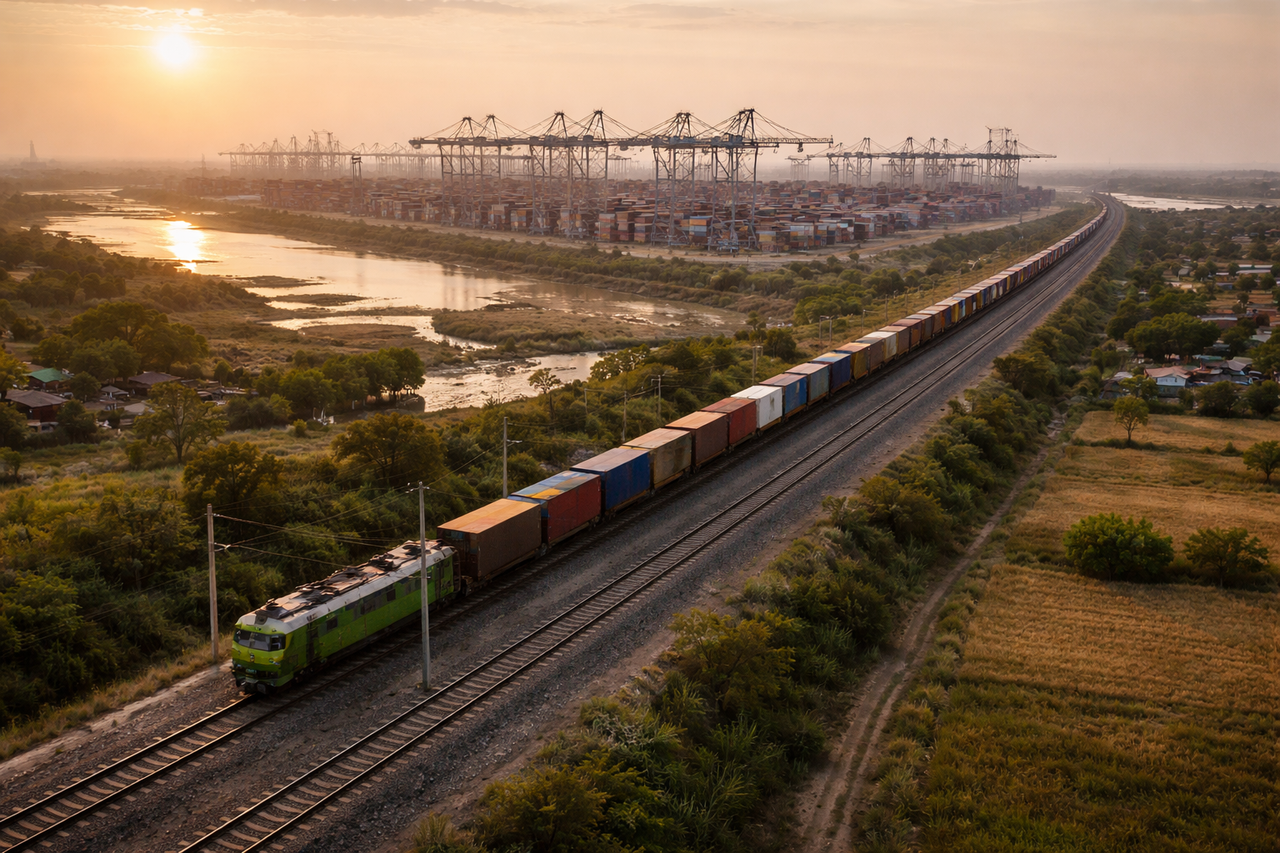
The Eastern Dedicated Freight Corridor, running from Ludhiana in Punjab to Dankuni near Kolkata, is fully operational at 1,337 kilometres. The Western Dedicated Freight Corridor, connecting Dadri in Uttar Pradesh to Jawaharlal Nehru Port in Mumbai, stands at 1,506 kilometres total with 93.2 percent operational as of late 2025, with full commissioning expected by March to May 2026. Together the two corridors cover 2,741 kilometres — 96.4 percent of the planned 2,843-kilometre network. The operational performance data confirms the corridors are delivering on their core promise: average freight train speeds of 50 to 60 kilometres per hour on operational sections, against the pre-DFC mixed-traffic baseline of 20 to 25 kilometres per hour. That improvement — a doubling to tripling of operational speed — is the most significant structural reform in Indian freight transport since the original railway network, and it translates directly into reduced transit time, more predictable scheduling and lower inventory carrying requirements for manufacturers dependent on trunk-route freight.
What the corridor metrics do not capture is the system performance at the interfaces. The corridors are designed to move freight efficiently between major origination and destination nodes. The efficiency gain at the node depends on last-mile rail connectivity to industrial parks, road connections between corridor stations and factory gates, and the performance of port inland container depots at the western terminal where Western DFC cargo meets JNPA. A freight corridor that delivers containers from Dadri to the port in significantly less time than the pre-DFC baseline, and then holds those containers for 6.5 days in port before loading, has improved one segment of the supply chain while another segment remains a bottleneck. The SMILE programme’s Ahmedabad master plan explicitly addresses this gap through the operationalisation of the Sanand Multimodal Logistics Park with zero-touch customs clearance for electronics components — the kind of interface completion that transforms corridor speed into export competitiveness.
India’s port performance rankings have improved materially. JNPA ranked 23rd in the World Bank Container Port Performance Index 2024, and nine Indian ports now rank in the global top 100. Container throughput capacity has expanded substantially under the Sagarmala programme. The scale of the gap that remains in global throughput terms is instructive: Shanghai handled 51.5 million TEUs in 2024, projected to exceed 55 million in 2025, and Singapore 41.1 million TEUs in 2024, rising to 44.66 million in 2025. The CPPI ranking reflects vessel turnaround and berth productivity improvements that are genuine, and the improvement should not be dismissed.
Container dwell time — the period a container spends in port between arrival and departure — is a different measurement from the metrics that drive CPPI ranking, and it tells a different story. The JNPA dwell time of 6.5 days, cited in the SMILE Mumbai master plan, is more than double the 2 to 3 days that Singapore, Busan and Shanghai deliver as standard. For the high-value manufacturing exports that India is trying to grow — electronics, defence components, precision engineering — dwell time is not merely a cost issue. It is a supply chain reliability issue. A buyer who requires a just-in-time delivery window cannot absorb 6.5 days of port residence regardless of how efficiently the vessel itself was handled. The Mumbai SMILE master plan’s focus on integrating Vadhavan Port to bypass JNPA congestion and digitally mapping 4,000-plus last-mile warehouses to ULIP acknowledges the gap explicitly. The scale of the solution proposed — underground urban freight tunnels connecting the port to Navi Mumbai industrial zones — signals that this is understood as a structural problem, not an operational one.
“JNPA ranks 23rd globally on vessel handling. Its containers sit for 6.5 days before departure. Rankings measure what ships experience. Competitiveness is determined by what exporters experience. The gap between these two measures is the gap between India’s port statistics and India’s port reality.”
India’s national highway network has reached 1,46,195 kilometres, and the construction pace has been sustained at approximately 18 kilometres per day in the period April to December 2025, with 4,938 kilometres completed in that period against 10,660 kilometres in the full FY2024–25. The PM GatiShakti national master plan has identified 434 projects worth ₹11.17 lakh crore and uses GIS-based network planning tools to ensure, in principle, that no new factory is built without an immediate last-mile connection to a railhead or highway. The integration of ULIP with 1,600-plus private APIs represents a meaningful step toward the digital logistics visibility that multimodal coordination requires.
Road freight carries the significant majority of India’s surface freight by value, and the highway network quality directly determines the reliability of the road segment that connects every factory to the wider logistics system regardless of how efficient the DFC trunk routes or port operations become. The construction pace of 18 kilometres per day is substantial in absolute terms. The challenge is that the network at 1,46,195 kilometres is large enough that the average quality of the road surface, the proportion with four-lane or higher capacity, and the maintenance budget relative to network size determine operational performance as much as new construction. A network expanding rapidly in length while maintenance investment lags behind will see average quality decline even as total kilometres increase. The GatiShakti GIS planning tool helps address the connectivity logic of new investment. It does not automatically address the maintenance economics of the existing network.
The inland waterways programme has delivered measurable progress. Cargo moved across India’s operational waterways reached 145.5 million tonnes in FY2024–25, across 29 operational waterways — a network that stood at just 5 operational waterways in 2014. The Vision 2030 target of 200-plus million tonnes is within a plausible range if the pace of capacity development is maintained. Waterway transport’s cost and carbon advantages over road freight are real: per-tonne-kilometre costs are substantially lower, and carbon intensity is a fraction of road transport. These advantages are the reason that China, Europe and the United States have invested heavily in inland waterway infrastructure as part of their logistics systems.
The gap between the 111 waterways notified as national waterways under the 2016 Act and the 29 currently operational is an accurate measure of where navigability, terminal infrastructure and scheduling integration stand relative to the statutory ambition. Operationalisation requires consistent navigable depth maintained by regular dredging, terminal infrastructure with road and rail connectivity at both ends, and booking and customs systems integrated with the road and rail networks that waterway cargo connects to. The NW-1 Jal Vikas Marg project on the Ganga-Bhagirathi-Hooghly system is the most developed corridor, and its performance data — actual cargo moved against the targets set when the project was designed — is the best available evidence of whether the programme is translating statutory designation into operational freight movement. The remaining gap of 54.5 million tonnes to the 2030 target is achievable, but it requires terminal completion and system integration at a pace that has not yet been demonstrated across the full waterway network.
The Services Monitoring, Integrated Logistics and Ecosystem programme — SMILE — has moved from conceptual framework to city-specific logistics master plans for eight pilot cities, including Mumbai, Delhi-NCR, Bengaluru and Ahmedabad. The plans identify specific logistics friction points and infrastructure solutions in a degree of operational detail that the national logistics policy framework previously lacked. The aggregate estimate embedded in the SMILE framework is that 2.5 percent of GDP is lost to indirect logistics costs — idling, paperwork delays and sub-optimal routing — that do not appear in headline logistics cost measurements. If that estimate is accurate, it implies that the 7.97 percent headline figure and the 2.5 percent indirect leakage figure should be read together as a combined logistics burden closer to 10.5 percent — still below the old 13–14 percent estimate, but materially above the headline number alone.
The city plans carry specific verified commitments. Ahmedabad is operationalising the Sanand Multimodal Logistics Park with zero-touch customs clearance for containerised electronics components destined for or departing from the Dholera semiconductor corridor, and dedicating freight-only lanes on the SG Highway during non-peak hours. Mumbai is pursuing Vadhavan Port integration to address JNPA congestion, digitally mapping 4,000-plus last-mile warehouses to ULIP, and planning underground urban freight tunnels connecting the port to Navi Mumbai industrial zones. Delhi-NCR is mandating 100 percent conversion of light commercial vehicles to electric vehicles for e-commerce deliveries by 2027 and establishing 30 micro-fulfilment centres in high-density zones including Okhla and Bawana. Bengaluru is running a drone-corridor pilot for critical-path components between Kempegowda International Airport and the Devanahalli Aerospace Park. The operational ambition is significant. The gap between the 35 MMLPs approved and the 4 currently operational — 11 percent implementation against approvals — is a reasonable indicator of the pace at which announced solutions translate into operating infrastructure.
Industrial corridors require water as reliably as they require electricity, and the governance of industrial water supply has received less systematic attention in India’s industrial policy framework than either energy or logistics. Water requirements vary significantly by sector. A large-scale advanced semiconductor fabrication facility requires 11 to 19 million litres of ultra-pure water per day — water processed to parts-per-billion purity levels — according to industry benchmark data. The Tata–PSMC fab under construction in Dholera requires water supply infrastructure that draws directly on Gujarat’s Narmada canal system, and the adequacy of that supply over the facility’s 25-year operational life is a direct variable in the investment case. Steel, chemical and pharmaceutical clusters have similarly large and quality-sensitive water requirements.
India is one of the world’s largest extractors of groundwater. As documented in the agricultural article of this series, Punjab is withdrawing groundwater at 163 percent of sustainable yield, Rajasthan at 148 percent and Haryana at 135 percent, according to CGWB 2023 data. These are the states where several industrial corridors are being developed, and where the competition between agricultural, urban and industrial water demand is most acute. Industrial clusters that depend on groundwater sources in these regions are building on a resource base that is being depleted by the agricultural system operating alongside them. The industrial water security question is therefore not merely a planning consideration for new facilities. It is a long-term operational risk for facilities that are already in production or under construction. No equivalent of the CEA’s generation capacity monitoring or DFCCIL’s operational reporting exists for industrial water allocation and security. This governance gap is the most underweighted structural risk in the India 2.0 industrial programme.
A significant portion of India’s logistics cost is not embedded in concrete but in procedures. The SMILE programme’s estimate that 2.5 percent of GDP is lost to indirect costs — idling, paperwork delays and sub-optimal routing — is consistent with qualitative evidence from shipper surveys and the World Bank LPI sub-component scores, which continue to place India below leading comparators on customs efficiency and timeliness despite the improvement in the overall ranking. The E-way Bill system introduced under GST recorded 112 crore bills in FY2025, demonstrating the scale of digital logistics integration achieved. The ULIP platform has linked 1,600-plus private APIs. These are genuine reductions in procedural friction.
The implementation rate of the multimodal logistics park programme — 35 approved, 4 operational — is a structural indicator that the policy framework for addressing procedural and last-mile leakage is more developed than its execution. Administrative harmonisation requires coordination across dozens of ministries, departments and state governments with different legacy systems and different political economies. The LEADS 2024 index identifies eight states as achievers, which implies by construction that a majority of states are not yet at that level. For manufacturing investors evaluating sites across Indian states, the variation in logistics ease across the LEADS rankings is a real competitiveness variable. A factory in a LEADS achiever state has a measurably different logistics cost structure from one in a lagging state, regardless of what the national average figure shows.
Public capital expenditure exceeding ₹12 lakh crore in FY2026–27 represents a historic commitment to infrastructure investment. The risk is not the current-year allocation but continuity across the multi-year investment horizon that large infrastructure projects require. An incomplete network delivers a fraction of the benefit of a complete one, because the value of infrastructure lies in the connections it enables. The 35-approved-4-operational gap in MMLPs is precisely this problem: the approval decisions have been made, the capex is notionally committed, but the translation into operating infrastructure is proceeding at a pace that leaves the connection from DFC trunk corridor to factory gate incomplete. An operational MMLP with zero-touch customs clearance at the DFC terminal is worth far more to a semiconductor exporter than a planned one that exists on a GIS map.
Infrastructure investment also competes within the fiscal envelope against the defence capital outlay of ₹2.19 lakh crore, subsidy commitments including the ₹3.97 lakh crore combined food and fertiliser subsidy, RDSS distribution sector reform, and semiconductor incentives. The case for treating infrastructure as enabling capital — as the physical precondition of every other industrial investment’s return — is analytically strong. The PM GatiShakti framework, by identifying projects and their connectivity logic in advance of budget cycles, is designed to make that case operational rather than rhetorical. Whether the implementation pace of the MMLP programme, the SMILE city logistics plans and the remaining 3.6 percent of DFC network converges toward project timelines will be a meaningful indicator of whether enabling capital is being treated as a priority or as a residual.
Climate variability introduces a risk dimension to physical infrastructure that industrial policy frameworks have not fully internalised. Extreme precipitation events have flooded rail corridors in Assam, Kerala and Maharashtra. Cyclonic storms of increasing intensity have damaged port infrastructure on the eastern coast. Heat stress above 50 degrees Celsius, recorded in Rajasthan and parts of the Indo-Gangetic plain during 2024, affects track integrity on conventional rail lines, reduces road surface durability and creates occupational health constraints that affect port and warehouse labour productivity. The Dedicated Freight Corridors were designed to current civil engineering standards incorporating some climate resilience requirements. The older port infrastructure, road network and warehouse estate that connects to the new corridors was designed to earlier climate standards and represents a vulnerability that new corridor investment does not automatically remediate.
An industrial supply chain is only as resilient as its least resilient component. A state-of-the-art freight corridor connecting to a coastal port regularly disrupted by increasingly intense cyclones does not deliver the supply chain reliability that advanced manufacturing investment requires. Climate adaptation in infrastructure is a direct protection of the capital invested in the India 2.0 industrial programme, not a peripheral environmental policy consideration. The 434 GatiShakti projects worth ₹11.17 lakh crore that are currently being planned and executed should carry climate resilience requirements as a standard design specification. Evidence that this is systematically applied across the full project pipeline, rather than selectively at new corridor infrastructure, would represent meaningful governance progress.
India’s infrastructure data for February 2026 presents a more encouraging picture than the narrative of structural underdevelopment that has dominated policy discourse for a decade. Logistics cost at 7.97 percent of GDP already meets the National Logistics Policy target. The Dedicated Freight Corridors are delivering 50 to 60 km/h operational freight speeds at 96.4 percent of planned network length. Nine Indian ports rank in the global top 100. Inland waterway cargo has reached 145.5 million tonnes across 29 operational waterways. These represent genuine progress at scale and should be recognised as such.
The structural leakage that persists beneath these headlines is the more difficult challenge precisely because it resists capital expenditure as a solution. A 6.5-day container dwell time at JNPA is not resolved by a faster freight corridor; it requires customs process reform, Vadhavan Port development and urban freight infrastructure simultaneously. An urban freight speed of 18 to 22 km/h against a 30 km/h target is not resolved by more highway construction; it requires SMILE master plan implementation, MMLP operationalisation and urban freight management at a city level that is more complex to coordinate than national infrastructure procurement. Industrial water security in corridors built on overdrawn aquifers is not resolved by any logistics programme; it requires a governance framework that does not yet exist.
Industrial ambition depends on physical coherence. The headline infrastructure statistics now warrant qualified optimism. The 35-approved-4-operational gap in MMLPs, the 6.5-day JNPA dwell time against a 2–3 day East Asian benchmark, the 2.5 percent of GDP estimated to be lost to indirect leakage, and the absence of industrial water governance in the country’s most water-stressed manufacturing corridors are not problems that a larger capex number will automatically resolve. Durable manufacturing strength is measured in transit time, water security and network reliability. On transit time, India is improving. On water security and last-mile reliability, the work is only beginning.