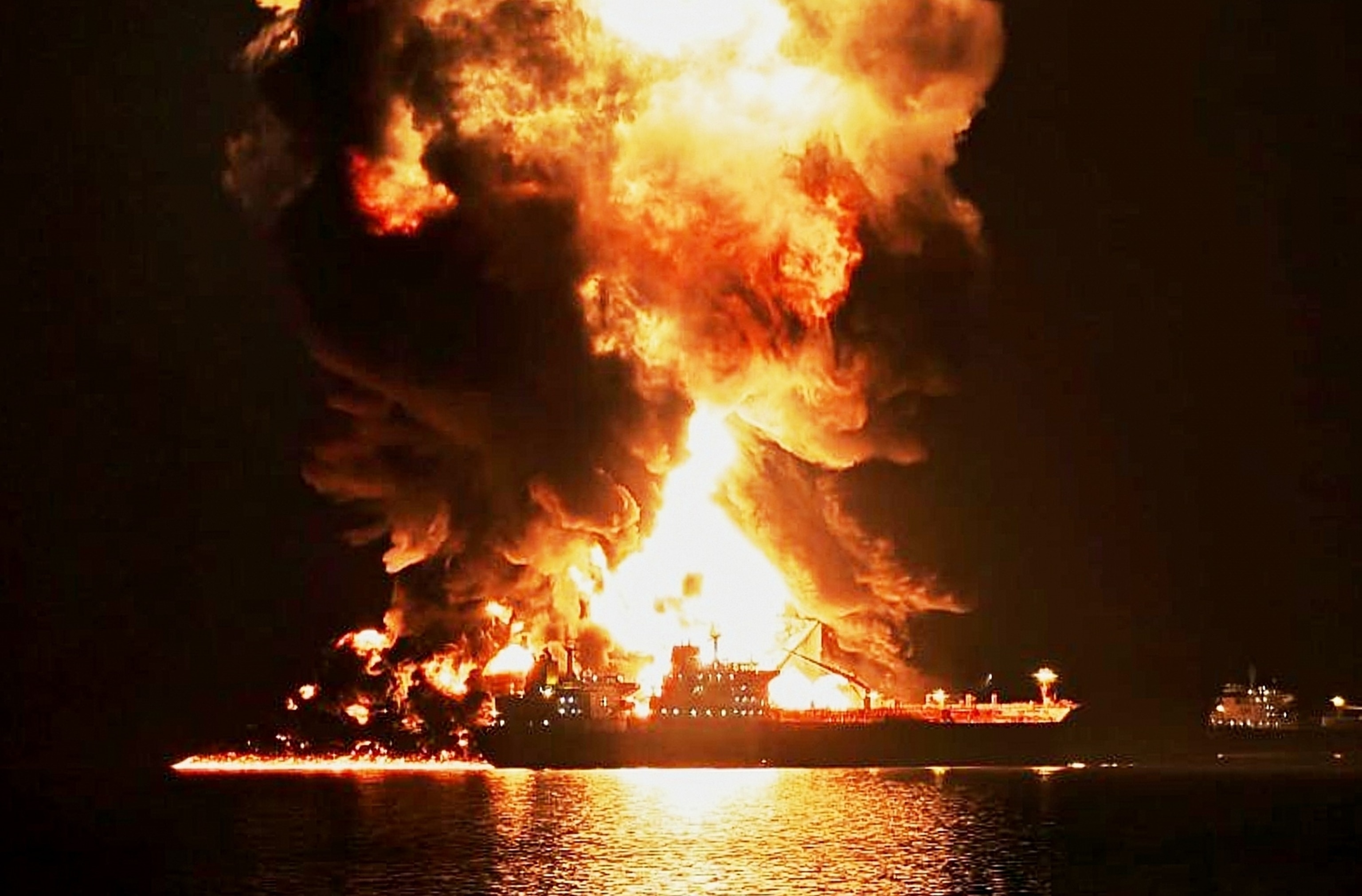
There is a concept in strategic studies known as the Samson Option. It refers to a last-resort doctrine in which a state, facing existential defeat, deploys its most destructive capabilities with full knowledge that it cannot survive the consequences. The name derives from the biblical account of Samson pulling down the temple columns, choosing to die in the rubble rather than submit to captivity. It is a doctrine not of victory but of irreversible damage.
Iran has adopted this doctrine. Not with nuclear weapons, not yet, but with something arguably more immediately disruptive: the systematic weaponisation of the Strait of Hormuz and the strategic targeting of global energy infrastructure. The results are reshaping the economics of the Indian Ocean, fragmenting the post-war energy pricing architecture, and producing a divergence in economic outcomes between the Atlantic and Indo-Pacific worlds that may prove impossible to reverse.
Understanding why requires looking not at the battlefield but at the spreadsheet.
I. The Benchmark Split
For most of the past four decades, the world operated on a single integrated energy pricing system. Brent crude, the North Sea benchmark, served as the global reference price. Murban, the Abu Dhabi grade, tracked it closely. Differentials existed but were narrow — the product of quality adjustments, logistics costs, and seasonal demand variations. They were, in the language of commodity markets, manageable.
That era is over.
Brent currently trades at $103 per barrel. Murban physical delivery commands $166. The $62 gap between them represents what this publication is calling the Hormuz Gap: the price the East pays for the geographic reality that 20 to 21 per cent of global petroleum liquids transit a waterway that Iran can, and currently does, disrupt at will.
To the West, the Iranian crisis registers primarily as an inflationary nuisance. North American shale production, North Sea reserves, and the coordinated release of Strategic Petroleum Reserves have insulated the Atlantic economy from the worst of the physical supply disruption. Brent reflects a market in which the paper architecture of futures contracts, financial hedging, and reserve drawdowns has partially decoupled price from physical scarcity. It is, in a precise sense, a paper price.
Murban is the physical price. It reflects what buyers in Japan, India, South Korea, China, and the smaller import-dependent economies of the Indian Ocean actually pay for barrels that must transit the Strait or source from the Gulf. It reflects geography. And geography, as Iran has correctly calculated, cannot be hedged.
II. The Samson Calculus
Iran's strategic logic is coherent, if catastrophic. Tehran's internal economy was already under severe structural stress before the current escalation. Sanctions had compressed oil export revenues, inflation had eroded household purchasing power, and the institutional capacity of the Iranian state had been weakened by decades of isolation. The regime faced a version of the classic authoritarian dilemma: reform risked destabilising the political order, while continued stagnation risked the same outcome more slowly.
What the Samson doctrine offers is a third option: controlled collapse on Iran's own terms, with maximum damage to the external system that Iran holds responsible for its predicament.
Iran is not trying to win a war. It is trying to break the dollar. By making Middle Eastern physical oil too expensive to settle in USD, Tehran is attempting to force the East to create a parallel settlement economy — in yuan, in rupees, in anything that is not the currency of the system Iran is trying to destroy.
By maintaining the Hormuz disruption and striking strategic regional infrastructure, Tehran is pursuing two objectives simultaneously. The first is purely coercive: to raise the cost of Western power projection in the Gulf to a level that makes sustained military engagement politically unsustainable in Washington and London. The second is structural: to break, or at least crack, the dollar's monopoly over global oil settlement.
The mechanism is straightforward. If Middle Eastern physical oil becomes too expensive to settle in dollars, buyers in the East will seek alternative payment arrangements. Yuan-denominated contracts already exist. Rupee settlement frameworks are under negotiation. If the Hormuz Gap widens further, the economic logic of currency diversification in energy trade becomes compelling not as an ideological choice but as a financial necessity.
This is Iran's real target. Not a fleet. Not an airbase. The dollar.
Whether Tehran survives the attempt is, from the regime's perspective, a secondary consideration. The Samson Option, by definition, does not require the protagonist to walk out of the rubble.
III. The East's Double Bind
The most consequential and least discussed dimension of this crisis is the position in which it places the major economies of Asia and the Indian Ocean.
Japan imports approximately 90 per cent of its energy. South Korea imports roughly 93 per cent. India, despite its domestic production, depends on Gulf imports for the majority of its crude oil requirements. China, the world's largest oil importer, sources a significant share of its supply from the very geography that Iran is disrupting. These are not marginal dependencies. They are structural features of Asian industrialisation that took decades to construct and cannot be unwound in months.
At the same time, the wealth of these economies remains embedded in Western financial architecture. Their sovereign reserves are largely held in dollar-denominated instruments. Their merchant fleets are insured by Western underwriters. Their export revenues flow primarily from sales to the United States and the European Union. The financial infrastructure of Asian prosperity is, in the most literal sense, Western.
The East cannot walk away from Iranian energy geography because Iran controls the gas nozzle. It cannot walk away from Western financial architecture because the West is the bank. Every diplomatic move risks antagonising one master or the other. Every economic calculation produces a contradiction.
Japan and India are attempting to navigate this bind through studied ambiguity, maintaining formal alignment with Western sanctions regimes while quietly seeking accommodations that preserve energy access. China is pursuing a more explicit hedging strategy, deepening its engagement with Gulf producers while maintaining its dollar reserves. None of these approaches resolves the underlying structural tension. They manage it, at increasing cost, until the next disruption raises the price again.
The casualties of this bind are not, in the first instance, the major powers. They are the smaller, structurally exposed economies of the Indian Ocean whose import dependency is total and whose capacity to absorb price shocks is minimal.
Mauritius provides the starkest illustration. An island economy with no domestic energy production, heavily dependent on imported petroleum, and too small to negotiate preferential supply arrangements, Mauritius faces the Hormuz Gap as a pure pass-through. The $166 Murban price does not represent a risk to be hedged. It represents a reality to be financed. The result is a fiscal squeeze, power supply disruptions, and inflationary pressure that the island's monetary authorities have limited tools to address. The Maldives, Seychelles, Comoros, Madagascar, and the smaller economies of South and Southeast Asia face variants of the same exposure. They did not create the Hormuz Gap. They cannot close it. They simply pay it.
IV. The Fragmentation Matrix
| Sector | The West (Atlantic) | The East (Indian Ocean) | Iran's Role |
|---|---|---|---|
| Oil Price | $103 — Brent / Paper | $166 — Murban / Physical | The friction creator |
| Economic State | High inflation / Stable supply | Energy stress / Blackout risk | The bifurcation wedge |
| Strategy | Decoupling and isolation | Panic and accommodation | The chaos catalyst |
| Vulnerability | Digital and financial supply | Physical and hard-asset supply | The sovereign saboteur |
| Dollar Exposure | Issuer — insulated | User — trapped | The target of the strategy |
| First Casualties | Modest inflation, political cost | Mauritius, Maldives, SIDS — triage zone | Isolation deepens regardless of outcome |
V. The Death of the Paper Sanctuary
The deeper significance of the benchmark split lies not in the current price differential but in what it reveals about the fragility of the globalised energy architecture that has governed commodity markets since the early 1970s.
That architecture rested on two assumptions: that physical supply chains were sufficiently diversified to prevent any single chokepoint from generating sustained pricing bifurcation, and that financial instruments were sophisticated enough to absorb and redistribute the risk associated with geopolitical disruptions. Both assumptions have now been empirically tested, and both have failed.
The Strait of Hormuz has demonstrated that a single actor, willing to absorb the costs of its own isolation, can impose a sustained and structurally significant premium on physical delivery to an entire hemisphere. Financial hedging instruments have demonstrated that they can protect buyers with access to alternative supply sources but are powerless to reduce the cost of physical scarcity for those without such access.
The Hormuz Gap is not, in this reading, a temporary aberration that will close when the crisis resolves. It is a signal that the paper sanctuary of globalised energy pricing has limits. Geography has reasserted itself. The era in which a buyer in Osaka and a buyer in Rotterdam faced essentially equivalent energy costs, adjusted only for logistics, is over. The era in which they face structurally different costs, determined by their physical proximity to disrupted supply routes, has begun.
Globalisation was, in the energy market, a thin layer of financial engineering painted over the hard rock of geography. The Hormuz crisis has stripped the paint. What remains is the rock.
The fragmentation matrix this crisis has produced does not resolve cleanly into winners and losers. The West's relative insulation is real but partial — sustained high energy costs in Asia reduce the purchasing power of the world's largest manufacturing base, which ultimately compresses demand for Western exports and financial services. The paper sanctuary has walls, but they are not airtight. For the East, the immediate costs are severe, but the strategic pressure to accelerate decoupling from both Iranian supply dependency and Western financial architecture will intensify. The Hormuz Gap is, paradoxically, the most powerful subsidy for renewable investment that any carbon tax could replicate. For Iran, the Samson strategy may be achieving its proximate objectives, but the structural isolation it accelerates will ultimately leave Tehran with less leverage, not more. Destroying the temple does not rebuild it. The rubble belongs to everyone. And for the smallest economies of the Indian Ocean, the message is bleak and structural. In a world fragmenting into triage zones, small states without energy sovereignty and without the financial scale to absorb exogenous shocks are not bystanders to this conflict. They are its first and most enduring casualties. The globalisation that was supposed to protect them turns out, under stress, to have exposed them. The $62 Hormuz Gap is the price of that exposure. It will not close quickly. And for Mauritius, the Maldives, and their peers, it may not close at all.