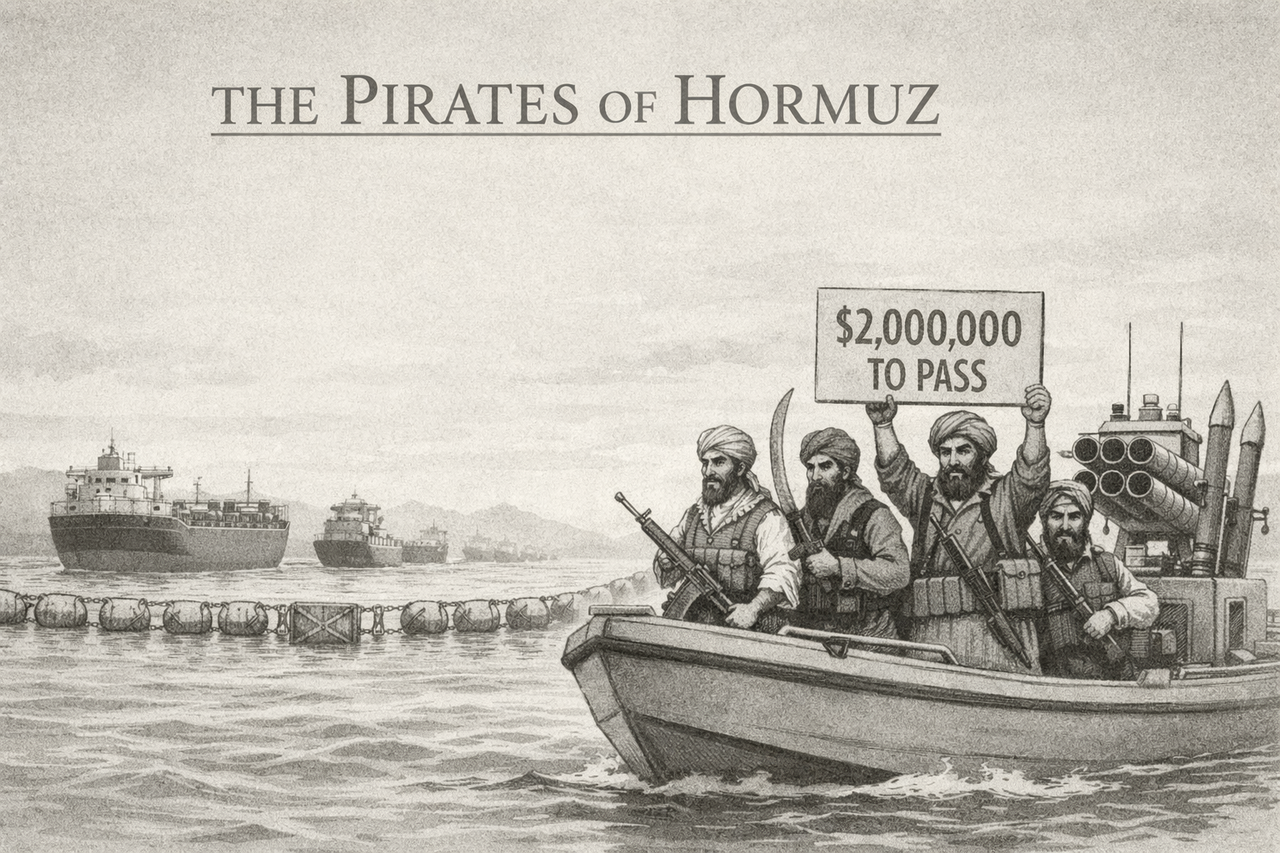
Let us begin with a definition.
Piracy, under Article 101 of the United Nations Convention on the Law of the Sea, is defined as any illegal act of violence, detention, or depredation committed for private ends on the high seas. The key phrase is "the high seas." International waters. Waters that belong, in law and in principle, to no state, no sovereign, and no regime in Tehran.
The Strait of Hormuz is international waters.
Iran is charging $2 million per vessel for safe passage through it.
The Meridian has consulted its legal dictionary, its moral compass, and the collected wisdom of maritime law stretching back to the Peace of Westphalia. What Iran is doing has a name. It has always had a name. The name is not a transit fee. It is not a security surcharge. It is ransom. And the people collecting it are, by any reasonable application of the English language and four centuries of admiralty law, pirates.
They do not wear tricorn hats. They do not carry cutlasses. They operate from a landmass with a functioning foreign ministry and a seat at the United Nations. But a pirate who wears a suit and issues an invoice is still a pirate. He is simply a better-dressed one.
I. What UNCLOS Actually Says
UNCLOS Article 38 — Right of Transit Passage
Ships and aircraft of all states enjoy the right of transit passage through straits used for international navigation. This right shall not be impeded, suspended or conditioned by the bordering state.
UNCLOS Article 101 — Definition of Piracy
Piracy consists of any illegal act of violence, detention or depredation committed for private ends by the crew or passengers of a private ship on the high seas against another ship, persons or property.
Convention on the High Seas, Article 2 — Freedom of the Seas
No state may validly purport to subject any part of the high seas to its sovereignty.
Iran's UNCLOS Status
Iran is a signatory to the United Nations Convention on the Law of the Sea — the very treaty it is currently treating as a suggestion.
The United Nations Convention on the Law of the Sea is admirably clear on the question of straits. Article 38 establishes the right of transit passage through straits used for international navigation. This right is not a courtesy. It is not a privilege extended by the goodwill of the bordering state. It is a legal entitlement held by all ships and aircraft of all states. It cannot be suspended. It cannot be conditioned. And it most certainly cannot be invoiced.
The Strait of Hormuz qualifies as a strait used for international navigation under UNCLOS. It connects the Persian Gulf to the Gulf of Oman and the Arabian Sea. Approximately 20 to 21 per cent of global petroleum liquids pass through it. The bordering states have no legal authority under international law to impose conditions on that passage, levy charges for it, or demand payment for the right to exercise it.
What Iran is doing — demanding $2 million per vessel for the right to pass through a waterway it does not own, cannot legally close, and has no right to toll — is, in the precise language of international maritime law, an act of extortion committed against the international community on a body of water that belongs to everyone and therefore to no one.
If a man stands on a public road and demands payment from every passing car, we arrest him. We charge him with highway robbery. We do not convene an emergency session of the United Nations Security Council and debate the geopolitical sensitivities of his toll booth. We remove him from the road. The international community has not removed Iran from the road. It is, instead, paying the toll and scheduling diplomatic consultations.
II. The East as Hostage
Let us be precise about what paying the toll actually means for the economies of Asia and the Indian Ocean.
Japan, which imports approximately 90 per cent of its energy, has no meaningful alternative to Gulf supply in the short or medium term. South Korea, at 93 per cent import dependency, is in a structurally identical position. India, the world's third-largest oil importer, sources the majority of its crude from the very geography Iran is currently monetising. China, the world's largest oil importer, is in the extraordinary position of buying Iranian oil at a discount while simultaneously being subject to the infrastructure disruption that Iran is using to extract premiums from everyone else. The Chinese discount and the regional premium exist simultaneously. China has apparently concluded this arrangement is, on balance, acceptable. It is not acceptable for everyone else.
The $2 million toll per vessel is not an abstraction. It is a direct operating cost that moves through the supply chain with the inevitability of gravity. The shipping company pays it, or it does not ship. If it pays, the cost passes to the cargo owner. The cargo owner passes it to the importer. The importer passes it to the refinery. The refinery passes it to the petrol station. The petrol station passes it to the motorist. The motorist in Colombo, in Dhaka, in Port Louis, in Male, who had no vote on Iran's strategic doctrine and no representation in any of the negotiations that failed to prevent this situation, pays for a toll on international waters because a regime in Tehran decided the global economic order owed it a debt and that the most efficient collection mechanism was a waterway.
This is not geopolitics. This is a mugging. It is a mugging conducted at civilisational scale, with an invoice attached, and the victims are not the governments of Japan or India or South Korea. The victims are the 800 million people at the end of the supply chain who cannot absorb the cost, hedge the risk, or vote in Iranian elections.
III. The Parasites Who Arrived With the Pirates
Every pirate story requires, beyond the pirates themselves, a cast of supporting characters who profit from the piracy without technically committing it. In the golden age of Atlantic piracy, these were the merchants of Port Royal and Nassau who bought stolen cargo at discount prices and asked no questions. In the 2026 Hormuz crisis, they go by more respectable names.
| The Actor | The Historical Analogy | What They Do | Legal Status | Who Pays |
|---|---|---|---|---|
| Iran | The Pirate Captain | Charges $2m toll on international waters. Issues invoices where previous pirates issued threats. | Illegal under UNCLOS Art.38 & Art.101 | Everyone transiting the Strait |
| War Risk Insurers | Merchant of Port Royal | Charge war risk premiums that rise the worse the crisis becomes. Structurally short on regional peace. | Entirely legal | Shipping companies, then consumers |
| Arms Manufacturers | The Armourer | Report "sustained demand environment" on earnings calls. Sell to governments on all sides of the conflict. | Entirely legal | Taxpayers of every nation buying weapons |
| Shadow Fleet Operators | The Longboats | Move sanctioned Iranian oil in ageing tankers. Arbitrage the gap between the legal and the sanctioned market. | Sanctions evasion in Western law | Crews sailing without adequate cover |
| Diplomatic Community | The Governor Who Takes a Cut | Issue statements of concern. Schedule consultations. Quietly continue purchasing discounted supply. | Entirely legal | The 800 million at the end of the chain |
The war risk insurance market has, since the escalation of Hormuz disruptions, applied war risk premiums to Gulf transits that have in some cases increased the cost of insuring a single voyage by several hundred per cent. This is not illegal. It is not immoral by the standards of the insurance industry. It is, however, an arrangement in which the insurers profit more the worse the crisis becomes. A Lloyd's syndicate writing war risk cover on Gulf tanker transits has, in the most clinical financial sense, a short position on regional peace. The worse things get, the more the premiums rise, the more the syndicate collects. Lloyd's does not cause the piracy. But Lloyd's does, structurally, benefit from it.
The global arms industry requires even less introduction. Those defence contractors whose quarterly earnings calls have, since the start of the Gulf escalation, featured the phrase "sustained demand environment" with the regularity of a metronome are experiencing what the financial press calls a constructive pricing environment. They are not firing the missiles that are keeping the Strait in a state of perpetual threat. They are merely manufacturing them, selling them to governments on both sides of the relevant geopolitical divide, booking the revenue, and reporting it to shareholders as evidence of operational excellence. The arms manufacturer, like the insurer, does not cause the piracy. It simply ensures the piracy is well-equipped, thoroughly insured, and reliably profitable for everyone in the supply chain except the person at the end of it buying diesel.
IV. The Law, the Satire, and the Verdict
Let us return, for a moment, to the law.
UNCLOS Article 38 guarantees transit passage. Article 101 defines piracy. The Convention on the High Seas confirms that no state may validly purport to subject any part of the high seas to its sovereignty. The International Maritime Organization has issued guidance on the inviolability of internationally recognised sea lanes. The entire architecture of post-war maritime law rests on the foundational principle that the sea belongs to everyone, which means that charging admission to it is a crime.
Iran is committing that crime at scale. The international community is paying the charge, calling it a transit levy, and scheduling diplomatic consultations.
The Meridian would like to propose an alternative framing. If a government in any other context demanded $2 million from foreign nationals as a condition of passing through a public space it had no legal right to close, the Security Council would convene within 48 hours and the word piracy would appear in the resolution. The reason the Security Council has not convened, and the reason the word piracy does not appear in the diplomatic communiques, is not that Iran's conduct is legally distinguishable from piracy. It is that Iran has made itself too expensive to confront. The toll is not merely an act of extortion. It is proof of concept. If you make the cost of resistance high enough, the international community will call your crime a policy and schedule a meeting about it.
The East is the hostage. The arms industry is the dealer who sold the weapon to the kidnapper. The insurance market is charging the family a premium to cover the ransom. The diplomatic community is issuing statements expressing concern while the invoice arrives. This is not a maritime dispute. It is a protection racket. The distinction between a pirate and a sovereign, it turns out, is largely a question of budget, address, and the quality of one's legal team.