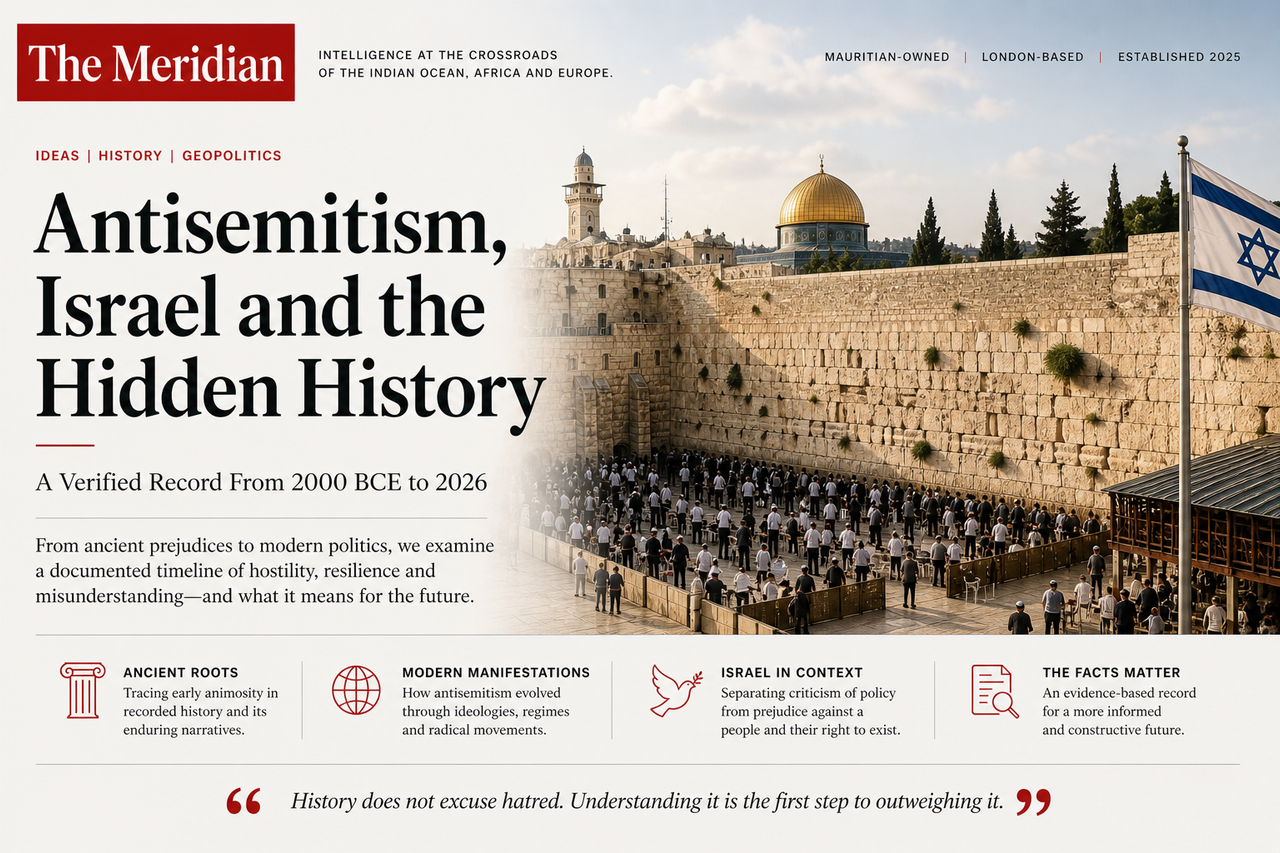
This article is editorial analysis, not advocacy. It presents the verified historical and empirical record on antisemitism, Jewish history and the Israeli-Palestinian conflict and asks questions that the current public conversation is not asking. It draws a clear distinction between criticism of Israeli government policy, which is legitimate and which this publication has published and will continue to publish, and antisemitism, which is the targeting of Jewish people for being Jewish regardless of what any government does. The sources cited throughout are primary institutions: the United States Holocaust Memorial Museum, Yad Vashem, Amnesty International, Human Rights Watch, the Community Security Trust, the Nobel Foundation, the United Nations, and the official German diplomatic record. The editorial team presents this record for the reader's consideration and invites engagement with the questions it raises. Readers who disagree with any factual claim are encouraged to consult the primary sources cited and to engage with the evidence directly.
This editorial does not take a side in the conflict between Israel and Hamas. It does not adjudicate the war in Gaza, the question of Palestinian statehood, or the policy decisions of any government. Those are legitimate and serious debates to which this publication will return. What this editorial does is something different and, in our assessment, more necessary at this moment. It asks fourteen questions that the current public conversation is not asking. It presents the verified historical and empirical record. And it asks the reader, wherever they stand on the politics of the Middle East, to sit with what the data actually shows before reaching for a conclusion.
The reason this editorial is necessary is that the data has become too clear to ignore. In the United Kingdom alone, the Community Security Trust recorded 3,700 antisemitic incidents in 2025, the second highest annual total ever documented, representing a 4 percent rise from the 3,556 incidents recorded in 2024. In the same year, a man drove a car into worshippers and stabbed congregants outside the Heaton Park Hebrew Congregation in Manchester on Yom Kippur, the holiest day of the Jewish year, killing two people. In April 2026, two Jewish men aged 76 and 34 were stabbed in Golders Green in North London, in an attack linked to a group believed to have connections to the Iranian regime. In Germany, antisemitic incidents numbered 5,729 in 2025, against 2,811 in 2022, more than doubling in three years. These are not incidents at the margins of society. They are a documented, measurable, accelerating trend in some of the world's most liberal democracies. The fourteen questions below are addressed to that trend.
The most common framing of the Arab-Jewish conflict places its origin in 1948, the year the State of Israel was established. The historical record does not support this framing. On April 4, 1920, twenty-eight years before Israeli independence, Arab mobs attacked Jewish residents in the Old City of Jerusalem during the Nebi Musa festival. Five Jews were killed and more than 200 were wounded. Rioters chanted slogans that have been documented by multiple historical sources, among them the phrase "Palestine is our land and the Jews are our dogs." The violence was incited by speeches from Arab nationalist leaders including Haj Amin al-Husseini, who would become the Grand Mufti of Jerusalem. The British military administration was criticised in the subsequent Palin Report for withdrawing troops from inside Jerusalem before the riots began and being slow to restore order.
In May 1921, Arab rioters attacked Jewish communities in Jaffa and surrounding areas. Twenty-seven Jews were killed and 150 were wounded. In August 1929, organised violence against Jewish communities in Hebron resulted in the massacre of 67 Jews, with hundreds wounded. These attacks preceded the existence of the State of Israel by nearly three decades. They preceded the displacement of Palestinians that accompanied the 1948 war. They preceded any Israeli military occupation. They preceded, by many years, every grievance that is today cited as justification for violence against Jewish people. The question this history raises is simple: if the violence against Jews in Palestine predated Israel by nearly thirty years, what was it a response to? The record suggests the answer is Jewish presence itself, which is a categorically different claim than resistance to a specific political condition.
| Event | Date | Documented Facts |
|---|---|---|
Nebi Musa Riots, Jerusalem |
April 1920 | 5 Jews killed, 211 wounded. Incited by Haj Amin al-Husseini with anti-Jewish speeches during the Nebi Musa festival. 28 years before Israeli independence. Source: Wikipedia citing British Palin Commission Report, 1920; multiple academic histories. |
Jaffa Riots |
May 1921 | 27 Jews killed, 150 wounded. Arab rioters attacked Jewish communities in Jaffa and surrounding areas. 27 years before Israeli independence. Source: CAMERA, "Anti-Jewish Violence in Pre-State Palestine," citing League of Nations Interim Report, June 1921. |
Hebron Massacre |
August 1929 | 67 Jews killed in Hebron. Hundreds wounded across Palestine. Organised violence against Jewish civilians by Arab mobs, incited by Husseini's warnings of Jewish threats to Muslim holy sites, which were false. 19 years before Israeli independence. Source: Jewish Virtual Library; multiple academic histories. |
State of Israel Founded |
May 14, 1948 | Israel declares independence. The violence documented above precedes this date by 19 to 28 years. The argument that violence against Jews is a response to Israeli statehood does not account for this documented historical record. |
The phrase "from the river to the sea, Palestine will be free" has become among the most visible slogans at pro-Palestinian demonstrations across Europe, North America and Australia. It is presented by its users as an expression of solidarity with the Palestinian people and an aspiration for their freedom and dignity. That aspiration is legitimate. The geographic content of the phrase, however, is not ambiguous. The river in question is the Jordan River, which forms the eastern boundary of present-day Israel and the West Bank. The sea is the Mediterranean. The territory between them is the entirety of present-day Israel, the West Bank and Gaza, the land in which approximately 7 million Jewish Israelis currently live as citizens of an established state.
The phrase does not specify what happens to those 7 million people in a Palestine that is "free" from the river to the sea. It does not propose their relocation. It does not propose coexistence. It proposes a Palestinian state across the entirety of the territory, which by mathematical and geographic necessity eliminates the State of Israel and the nationality of every person currently living in it. Those who use the phrase and intend it only as a call for Palestinian rights and dignity are entitled to that interpretation. But they are also required to account for its literal content, which does not distinguish between the Israeli government whose policies they oppose and the Israeli citizens whose existence occupies the same land. When a slogan's literal meaning calls for the elimination of a state in which 7 million people live, and those people are predominantly Jewish, the question of whether it constitutes an antisemitic statement rather than a political one is not a rhetorical question. It is a serious one that requires a serious answer.
The territory between the Jordan River and the Mediterranean Sea is the entirety of present-day Israel. The phrase does not propose what happens to the 7 million people who live there. That silence is the question.
On October 7, 2023, Hamas and several other Palestinian armed groups launched a coordinated attack on southern Israel by land, sea and air. At least 4,300 rockets were fired into Israeli territory in the opening hours. Approximately 6,000 militants breached the Gaza-Israel barrier at 119 locations. The attack killed 1,195 people. Of those, 828 were civilians, including 36 children and 71 foreign nationals. 364 civilians were killed at the Nova music festival, a youth event in an open field, where they were shot while dancing, hiding or trying to flee. 251 people were taken hostage to Gaza, including infants, elderly people and foreign nationals from more than a dozen countries. As of October 2025, 48 hostages remained in captivity. Amnesty International, which has been consistently critical of Israeli military conduct in Gaza, investigated the October 7 attack and concluded that Hamas and other Palestinian armed groups committed crimes against humanity, including murder, torture, enforced disappearance and sexual violence. Human Rights Watch reached the same conclusion. Both organisations also documented serious violations of international law by Israeli forces in Gaza.
October 7 was the deadliest day for Jewish people since the Holocaust. That sentence appears in no major protest banner. It is not chanted at demonstrations. It is rarely read from podiums at universities. The same campuses that declared themselves in solidarity with Palestine within days of the attack did not, in most cases, hold vigils for the 1,195 people killed that morning, or for the 364 young people shot at a music festival, or for the 251 people taken underground into tunnels in Gaza. The question is not whether Palestinian suffering deserves attention. It does, and it is documented and serious. The question is why the documented suffering of Jewish victims on October 7 was, in so much of the public discourse, treated as context for Israeli behaviour rather than as an event of primary moral significance in itself.
Amnesty International (December 2025): After interviewing 70 people including 17 survivors, reviewing over 350 videos and photographs, and visiting attack sites, Amnesty International concluded that Hamas and other Palestinian armed groups committed crimes against humanity. The specific crimes against humanity identified were murder, extermination, imprisonment or other severe deprivation of physical liberty in violation of fundamental rules of international law, enforced disappearance, torture, rape and other forms of sexual violence, and other inhumane acts. Source: Amnesty International, "Targeting Civilians: Murder, Hostage-Taking and Other Violations by Palestinian Armed Groups in Israel and Gaza," December 2025.
Human Rights Watch (July 2024): After interviewing 144 people and verifying over 280 photographs and videos, Human Rights Watch found that the Hamas-led assault on October 7 was designed to kill civilians and take as many people as possible hostage. The report documented summary killings, hostage-taking and other war crimes, and the crimes against humanity of murder and wrongful imprisonment. Source: Human Rights Watch, "October 7: Crimes Against Humanity, War Crimes by Hamas-Led Groups," July 2024.
United States Department of State: Confirmed 1,200 killed including 44 Americans. Described as the most Americans killed in a terrorist attack since September 11, 2001. 12 Americans taken hostage. Source: US State Department, Country Reports on Terrorism 2023.
Between 1901 and 2025, 220 of the 965 individual Nobel Prize recipients have been Jewish or of Jewish descent. That is 22 percent of all Nobel Prize winners in history. Jews represent 0.2 percent of the world's population, meaning their share of Nobel laureates is 110 times their proportion of humanity. In the sciences alone: 25 percent of Nobel prizes in medicine, 27 percent in physics, 19 percent in chemistry. In economics, 40 percent of all Nobel Memorial Prize winners have been Jewish. Since the year 2000, 24 percent of all Nobel Prizes have been awarded to Jewish recipients. The State of Israel, founded in 1948 by Holocaust survivors, refugees and a diaspora gathered from across the world into a territory the size of Wales, ranks 11th globally in Nobel Prizes per capita. It has more Nobel laureates in total than India, China and Spain. A country of 9 million people, which has been in a continuous state of conflict since its founding, has contributed more to human knowledge per head of population than the United States, Germany and France.
Beyond the Nobel record, the contribution of Jewish scientists, writers, thinkers and physicians to modern civilisation is documented across every field. Albert Einstein's theory of relativity. Sigmund Freud's founding of psychoanalysis. Jonas Salk's polio vaccine. Paul Ehrlich's chemotherapy. Karl Marx's political philosophy. Franz Kafka's literature. Gustav Mahler's music. Emile Durkheim's sociology. Milton Friedman's economics. The list does not prove that Jewish people are superior. No group is. What it demonstrates is the scale of what systematic persecution has consistently tried to eliminate from the world, and what the world has consistently lost when it succeeded. The question the editorial poses is not about gratitude. It is about proportion. When a population of 15 million people, scattered across the world without a state for nearly two thousand years, produces this record under conditions of persistent hostility, the question of what drives the hostility toward them is not answered by pointing to their record. It is made more urgent by it.
| Field | Jewish Nobel Share | Jewish Share of World Population |
|---|---|---|
All Nobel Prizes 1901-2025 |
22% (220 of 965) | 0.2% of world population. Nobel share is 110 times the population share. Source: Wikipedia, "List of Jewish Nobel laureates," citing Nobel Foundation data. |
Economics (Nobel Memorial Prize) |
40% | 40 of 86 economics laureates. 197.5 times the Jewish share of the world population. Source: JINFO.ORG, "Jewish Nobel Prize Winners," 2025 update. |
Medicine and Physiology |
25% | 56 of 222 medicine laureates. Source: JINFO.ORG, 2025 update. |
Physics |
27% | 59 of 216 physics laureates. 136.5 times population share. Source: American Enterprise Institute analysis of Nobel Foundation data. |
Israel Nobel Prizes Per Capita Rank |
11th globally | More Nobel laureates per capita than Germany, the United States and France. More total laureates than India, China and Spain. Founded in 1948. Population: approximately 9 million. Source: Wikipedia, "List of Israeli Nobel laureates." |
Since 2000 (21st Century) |
24% | 24 percent of all Nobel Prizes since the year 2000 awarded to Jewish recipients. The share is rising, not falling. Source: JINFO.ORG, "Jewish Nobel Prize Winners," 2025. |
There are approximately 15.3 million Jewish people in the world today. The global Jewish population before the Second World War was approximately 16.6 million. The Holocaust killed 6 million, reducing that number by more than a third. That the Jewish population has recovered only to approximately its pre-war level, nearly eighty years after the Holocaust ended, tells a precise statistical story about what sustained persecution does to a people over centuries. For comparison, the global population has grown from approximately 2.3 billion in 1940 to 8.2 billion today, a more than threefold increase. The Jewish population, starting from a lower base after the Holocaust, has grown back to roughly where it was. The mathematical implication is that without the expulsions, pogroms, inquisitions, forced conversions, ghetto confinements and industrial extermination of the preceding millennium, the Jewish population might today number in the hundreds of millions.
The relevant history includes: the expulsion of Jews from England in 1290, from France repeatedly between 1182 and 1394, from Spain in 1492, from Portugal in 1497, from cities across the Holy Roman Empire throughout the medieval period, from Russia through repeated waves of pogroms in the nineteenth and early twentieth centuries, from Arab and Muslim majority countries in the mid-twentieth century, where approximately 850,000 Jews were expelled or fled after Israeli independence. When Hitler began the systematic murder of European Jews in the early 1940s, the world knew within years. The Allied governments received detailed reports of the extermination camps from 1942 onward. The response was, with exceptions, silence and inaction. The question this history poses in 2026, when Jewish people in the liberal democracies of Europe are hiding their Stars of David, changing their names on ride-sharing apps, and being stabbed outside synagogues, is whether the pattern of the world's silence has genuinely ended or simply paused between its most visible expressions.
The world population has tripled since 1940. The Jewish population has returned only to approximately its pre-war level. The arithmetic of what persecution does to a people across centuries is contained in that gap.
Israel is not above criticism. No state is. Its military operations in Gaza have caused enormous civilian suffering that is documented, serious and deserving of scrutiny. The International Court of Justice and International Criminal Court have both initiated proceedings relevant to the conflict. Amnesty International and Human Rights Watch have documented serious violations of international humanitarian law by Israeli forces. This editorial does not dispute those findings. It stands by them.
The question this section asks is different. It is whether the standard applied to Israel, and by extension to Jewish people globally, is the same standard applied to other actors in comparable situations. Hamas has governed the Gaza Strip since 2007. Under its governance, it has diverted international aid, including concrete intended for civilian infrastructure, to construct tunnels used for military operations. It has executed political opponents within Gaza. It has fired rockets from within civilian areas, using the civilian population as a tactical shield in a manner that international law explicitly prohibits. It has held civilian hostages, including children and elderly people, for more than two years in conditions that Amnesty International described as including torture and sexual violence. The protests across European and American cities that followed October 7 have largely focused on Israeli military operations in Gaza. The same cities have not, to any comparable degree, produced demonstrations demanding Hamas release its hostages, condemning Hamas's documented crimes against humanity, or calling for accountability from the Iranian government that has financed and armed Hamas for decades. This editorial does not suggest that protesting Israeli operations is wrong. It asks whether the asymmetry of attention is itself a form of the double standard that antisemitism has historically involved.
In 2025, the United Kingdom recorded 3,700 antisemitic incidents, double the rate of 2022, in years when Israel was not conducting military operations in Gaza. Two Jewish men were stabbed in London in April 2026. A synagogue in Manchester was attacked on Yom Kippur. A Jewish couple were shot dead outside a museum in Washington. A flamethrower was used to attack a hostage vigil in Colorado. These attacks are not responses to Israeli government policy. They are attacks on Jewish people for being Jewish. The Community Security Trust notes that many of the perpetrators of antisemitic incidents in the United Kingdom hold radical Islamist ideology. Christopher Browning, a leading American Holocaust historian, wrote in 2025 that when conspiracy theory, racism and authoritarianism combine, the result is almost always antisemitism. The question is not whether that pattern is recognisable to anyone who has read twentieth-century history. It is whether enough people are willing to say so.
Scale: The CST recorded 3,700 antisemitic incidents in the United Kingdom in 2025, the second highest annual total ever recorded. This is more than double the 1,662 incidents recorded in 2022, before the Gaza war began. Source: CST Antisemitic Incidents Report 2025, February 2026.
The Manchester Yom Kippur attack (October 2, 2025): Jihad al-Shamie, a 35-year-old British citizen who had immigrated from Syria, drove a car into pedestrians and stabbed worshippers outside the Heaton Park Hebrew Congregation during Yom Kippur services. Two people were killed. Source: CST Antisemitic Incidents Report 2025; Wikipedia, "Antisemitism in the United Kingdom."
The Golders Green stabbings (April 29, 2026): Two Jewish men aged 76 and 34 were stabbed in North London. A group believed to have connections to the Iranian regime claimed responsibility. The Metropolitan Police Commissioner noted a rise in antisemitic incidents. Source: Wikipedia, "Antisemitism in the United Kingdom," citing police and media reports, April 2026.
The ideology: CST recorded 156 antisemitic incidents in 2024 that contained discourse relating to Islam, Muslims and Islamist groups, while 65 evidenced radical Islamist ideology. Holocaust historian Christopher Browning, cited in the ADL J7 Task Force Report 2025: "Historically, when you mix conspiracy theory, racism, and authoritarianism, you almost always get to antisemitism." Source: CST Antisemitic Incidents Report 2024; ADL J7 Task Force Report, cited in CNN, April 2026.
The survey finding: According to a survey conducted by the Campaign Against Antisemitism in June 2024, 84 percent of British Jews believe that authorities are not doing enough to address antisemitic incidents and penalise those responsible. Many Jews across Europe are hiding their Stars of David and changing their names on ride-sharing apps to appear less identifiably Jewish. Source: ADL J7 Task Force Report, cited in Euronews, May 2025.
When someone picks up their phone to search Google, they are using a platform co-founded by Sergey Brin, born in Moscow to Russian-Jewish parents who fled Soviet antisemitism in 1979, and Larry Page, whose maternal grandfather made aliyah and settled in Israel. When they open Facebook or Instagram, they are using platforms built by Mark Zuckerberg, who grew up in a Jewish family in New York. When they send a message on WhatsApp, they are using an application co-founded by Jan Koum, who grew up Jewish in Kyiv. When they store a file on Dropbox, the company was built by Drew Houston, who grew up in a Jewish family. When they book a flight on Expedia or search for a job on LinkedIn, they are using platforms co-founded by Jewish entrepreneurs. Sam Altman, the CEO of OpenAI whose technology has become one of the most discussed tools of 2024 and 2025, has Jewish heritage. These are not marginal contributions to the digital world. They are the digital world.
The medical record is older and deeper. Jonas Salk, the son of Ashkenazi Jewish immigrants from Poland, developed the polio vaccine in 1955 and chose not to patent it, estimating that doing so would have cost him approximately 7 billion dollars. His decision made the vaccine freely available and has saved an estimated 650,000 lives annually in the decades since. Paul Ehrlich, a German Jewish physician, founded chemotherapy. Selman Waksman, a Ukrainian Jewish biochemist, discovered streptomycin, the first antibiotic effective against tuberculosis, and coined the word antibiotic. Gertrude Elion, a Jewish American biochemist, developed acyclovir, still the most effective treatment against herpes viruses, as well as drugs for leukaemia and drugs that made organ transplants possible by preventing rejection. Karl Landsteiner, an Austrian Jewish physician, discovered the ABO blood groups, without which blood transfusion would be impossible. Paul Zoll, a Jewish American cardiologist, developed the cardiac pacemaker and the defibrillator. Baruch Blumberg, a Jewish American physician, discovered the hepatitis B antigen and developed the first hepatitis B vaccine.
Beyond medicine and technology: Albert Einstein's theory of relativity underpins GPS navigation, used daily by billions. Emile Durkheim founded modern sociology. Sigmund Freud founded psychoanalysis, which shaped the entire field of mental health. Franz Kafka, Marcel Proust and Primo Levi reshaped what literature could do. Gustav Mahler and Leonard Bernstein shaped classical and popular music. Claude Levi-Strauss founded structural anthropology. Milton Friedman shaped modern economic policy. The laser was developed with foundational contributions from Jewish physicists. Optical fibre cable, which carries the internet itself, was developed with key contributions by Jewish scientists. The microprocessing chip that runs every computer, phone and digital device draws on mathematical and engineering advances in which Jewish scientists played central roles.
The question this section poses is not designed to produce gratitude. It is designed to produce proportionality. The same civilisation that uses these tools, that calls Google to find information, that receives the hepatitis B vaccine, that has GPS in its car, that reads Kafka and listens to Mahler, that lives longer because of penicillin era antibiotics pioneered by Jewish scientists, has in various forms and at various moments decided that the people who contributed these things to humanity should be expelled, murdered or silenced. The editorial does not say this to produce guilt. It says it to produce a question that the reader may not have asked: what exactly does the world think it is protecting when it tolerates or ignores the persecution of the people responsible for so much of what makes modern life liveable?
| Contribution | Person | Impact |
|---|---|---|
Google Search Engine |
Sergey Brin (Jewish, born Moscow) and Larry Page (Jewish heritage, maternal grandfather settled in Israel). Founded 1998. | Used by approximately 8.5 billion searches per day worldwide as of 2025. The primary way most of the world accesses information. |
Facebook / Meta / Instagram / WhatsApp |
Mark Zuckerberg (Jewish, raised in New York). Jan Koum, WhatsApp co-founder (Jewish, born Kyiv). | Meta platforms used by approximately 3.3 billion people daily as of 2025. WhatsApp used by 2 billion people in over 180 countries. |
Polio Vaccine |
Jonas Salk (Jewish, son of Polish immigrants). Developed 1955. Did not patent it. | Polio has been eliminated in most of the world. Estimated 650,000 lives saved annually in peak vaccination decades. Salk's decision not to patent cost him an estimated 7 billion dollars but made the vaccine universally accessible. |
Chemotherapy |
Paul Ehrlich (Jewish, Germany). Nobel Prize in Physiology or Medicine, 1908. | Founded the field of chemotherapy. His development of Salvarsan in 1909 was the first modern pharmaceutical drug. Used by millions of cancer patients annually. |
Blood Groups (ABO System) |
Karl Landsteiner (Jewish, Austria). Nobel Prize in Physiology or Medicine, 1930. | Without the ABO blood group system, blood transfusion would be impossible. Every blood transfusion performed in the world today depends on Landsteiner's discovery. |
Cardiac Pacemaker and Defibrillator |
Paul Zoll (Jewish, USA). Developed functional cardiac pacemaker 1952. | Approximately 1.2 million pacemakers are implanted worldwide annually. Defibrillators are standard in hospitals and public spaces globally. |
Organ Transplant Drugs and Leukaemia Treatment |
Gertrude Elion (Jewish, USA). Nobel Prize in Physiology or Medicine, 1988. | Developed the immunosuppressant azathioprine which made organ transplants possible, the leukaemia drug 6-mercaptopurine, and acyclovir, still the most effective antiviral against herpes viruses. |
Streptomycin and the Word "Antibiotic" |
Selman Waksman (Jewish, born Ukraine). Nobel Prize in Physiology or Medicine, 1952. | First antibiotic effective against tuberculosis, which was killing millions annually. Also coined the term antibiotic. His work launched the modern antibiotic era. |
Theory of Relativity / GPS |
Albert Einstein (Jewish, Germany). Nobel Prize in Physics, 1921. | Einstein's general theory of relativity must be accounted for in GPS satellite calculations or the system would drift by approximately 10 kilometres per day. Every GPS device in the world depends on a correction derived from his work. |
Hepatitis B Vaccine |
Baruch Blumberg (Jewish, USA). Nobel Prize in Physiology or Medicine, 1976. | Discovered the hepatitis B antigen and developed the first vaccine against hepatitis B, which causes liver cancer and kills approximately 820,000 people annually. Over 1 billion doses have been administered globally. |
Understanding where antisemitism comes from is not the same as justifying it. The editorial makes this distinction explicitly. There are no legitimate reasons to hate Jewish people. There are, however, documented historical mechanisms that explain how that hatred was manufactured, sustained and transmitted across centuries and continents. Naming those mechanisms is the necessary precondition for recognising them when they reappear, which the data in this article suggests they are doing.
Mechanism One: The visible minority that refused religious assimilation. In medieval Europe, where religious uniformity was the social and political glue of entire civilisations, Jews were the one community that refused baptism. This made them structurally distinct in a way that invited legal exclusion, social suspicion and scapegoating. They were not hated primarily for what they did. They were hated for what they refused to become. This mechanism preceded and survived the Reformation, the Enlightenment and modernity, because the underlying dynamic, that a persistent minority refuses to dissolve into the majority identity, recurs in different forms across different historical periods.
Mechanism Two: Forced into the roles that made them targets. Medieval Christian law prohibited Christians from lending money at interest, which it defined as usury. Jews were legally excluded from land ownership, most craft guilds and most professions. Moneylending was one of the few economic roles available to them. When kingdoms went into debt or peasants could not repay loans, the visible face of the economic pressure was the Jewish lender. The structural cause was the feudal economic system and its contradictions. The visible target was the Jewish community that the same system had confined to that role. This pattern, of forcing a group into a specific economic position and then hating them for occupying it, is one of the most consistently documented mechanisms of group persecution in the historical and sociological literature. Hannah Arendt, one of the twentieth century's foremost political philosophers and herself a Jewish refugee from Nazi Germany, documented this mechanism extensively in The Origins of Totalitarianism, 1951.
Mechanism Three: Made the explanation for things that had no explanation. When the Black Death killed between a third and half of Europe's population between 1347 and 1351, an explanation was required. Jews were accused of poisoning wells. There was no evidence. The accusation spread rapidly because it provided a human, actionable explanation for an incomprehensible catastrophe. The same pattern repeated across subsequent centuries: military defeats, crop failures, economic depressions, pandemics. The community that was already marked as different and legally separated from the majority became the available explanation. This is the mechanism that historians of prejudice identify as the structural function of the scapegoat: a group that carries the social weight of events that the majority cannot otherwise explain or control.
Mechanism Four: Religious narratives were weaponised. The accusation that Jewish people bore collective responsibility for the death of Jesus Christ was not officially repudiated by the Catholic Church until the Second Vatican Council issued Nostra Aetate in 1965. For nearly two thousand years, this theological position provided a foundation for social exclusion, forced conversion and organised violence. The Protocols of the Elders of Zion, a fabricated text produced by the Tsarist secret police of Russia around 1903 and claiming evidence of a Jewish conspiracy to dominate the world, was thoroughly exposed as a forgery by The Times of London in 1921. It remains in active circulation today, used in antisemitic movements across the political spectrum from far-right nationalism to radical Islamism. Conspiracy theories do not require evidence. They require a pre-existing target, a pre-existing suspicion, and a human need for a simple explanation of complex problems.
Mechanism Five: Success was reframed as evidence of the conspiracy. This is the most structurally vicious of the mechanisms because it makes itself immune to counter-evidence. When Jewish people overcame centuries of legal barriers and achieved success in science, commerce, law, medicine and the arts, that success was not treated as evidence of resilience. It was cited as evidence of the conspiracy. If Jewish people were poor, they were a social burden. If they were successful, they were manipulating the system. The argument is circular and unfalsifiable by design. The Nobel Prize record documented in this article has been used not as evidence of human achievement but as evidence, in antisemitic propaganda, of Jewish dominance. This mechanism is still visible in 2026 in the way that the prominence of Jewish people in technology, media and finance is discussed in certain online communities as confirmation of a coordinated agenda rather than as the outcome of historical circumstance, individual achievement and structural resilience.
Mechanism Six: Statelessness made them permanently vulnerable. For nearly two thousand years, from the destruction of the Second Temple in 70 CE to the founding of Israel in 1948, the Jewish people had no state, no army and no government to represent them in the international order. A people without a state can be expelled without diplomatic consequence. They can be taxed discriminatorily without parliamentary accountability. They can be massacred without military reprisal. They could rely on no sovereign power but the tolerance, often revocable, of the host society. The founding of Israel in 1948 was a direct institutional response to this structural vulnerability, which the Holocaust had made undeniable to the international community. The deepest irony in the current moment, which the historian Christopher Browning identified in the ADL report of 2025, is that having a state and defending it has become in certain quarters a new source of the oldest hatred.
The argument that Israel must return to its pre-1967 borders to enable Palestinian statehood contains a historical problem that is rarely examined in public debate. Those borders existed for nineteen years before 1967. During that entire period, the territories now described as the future Palestinian state were in Arab hands. Egypt administered the Gaza Strip from 1948 until Israel captured it in the Six-Day War of June 1967. Jordan annexed the West Bank in 1950 and governed it until the same war. Neither Egypt nor Jordan used those nineteen years to establish a Palestinian state. The question of why they did not is the most important question in the entire conflict that almost no one is asking.
The verified record, confirmed by the United Nations itself, is unambiguous. According to UNCTAD, the official UN body: "While the State of Israel was established on May 15, 1948 and admitted to the United Nations, a Palestinian State was not established. The remaining territories of pre-1948 Palestine, the West Bank including East Jerusalem and the Gaza Strip, were administered from 1948 until 1967 by Jordan and Egypt respectively." Egypt never annexed the Gaza Strip. It treated it as a controlled territory administered through a military governor. Palestinians in Gaza were not given Egyptian citizenship. Egypt dissolved the nominal All-Palestine Government in 1959 and merged the territory into the United Arab Republic, a political union with Syria. It was governed as an Egyptian military zone, not as a Palestinian homeland in development.
Jordan's treatment of the West Bank was different in form but equally revealing. Jordan formally annexed the West Bank in 1950 and extended Jordanian citizenship to Palestinian Arabs there. Palestinians in the West Bank received Jordanian passports, Jordanian identity documents and seats in the Jordanian parliament. Jordan's annexation was not recognised internationally, with the exception of the United Kingdom and Iraq. Critically, Jordan's annexation of the West Bank was opposed not only by Israel but by the Arab League itself and by Palestinian Arab political leaders including Haj Amin al-Husseini. Jordan held the West Bank not as a trustee preparing Palestinian sovereignty but as an annexing power incorporating the territory into its own state.
The political question this record raises is precise. If the Palestinian cause is defined by the demand for a state in the West Bank and Gaza, and if those territories were under Arab governance for nineteen years between 1948 and 1967, why was no such state established? The answer that the historical record supports is that the Palestinian cause as it existed before 1967 was not primarily a demand for a state in the West Bank and Gaza. The PLO was founded in 1964, three years before the Israeli occupation of those territories began. Its founding charter called for the liberation of all of historic Palestine, meaning the elimination of the State of Israel entirely, not for a Palestinian state in the West Bank and Gaza alongside Israel. The pre-1967 Arab political consensus, as expressed in the Khartoum Resolution of September 1967 adopted by eight Arab heads of state after Israel captured the territories, was the three nos: no peace with Israel, no recognition of Israel, no negotiation with Israel.
This historical record does not resolve the question of Palestinian rights, which are real and require a political solution. It does resolve a specific question. The argument that the Palestinian cause is exclusively a response to the 1967 occupation, and that Israel simply returning to the 1967 lines would end the conflict, is not supported by the pre-1967 record. During the nineteen years when Gaza was Egyptian and the West Bank was Jordanian, the Palestinian cause was the elimination of Israel, not the establishment of a state in those territories. The 1967 occupation changed the territorial frame of the conflict. It did not create the conflict. The conflict preceded the occupation by nineteen years. And the pre-1967 record of what Arab states did with the territories they controlled provides no evidence that Palestinian statehood was the operational objective of anyone holding those lands.
Gaza under Egypt (1948 to 1967): Egypt occupied the Gaza Strip following the 1948 Arab-Israeli War. Palestinians in Gaza were not given Egyptian citizenship. Egypt did not establish a Palestinian state in Gaza. Egypt dissolved the All-Palestine Government in 1959 and merged the territory into the United Arab Republic. Gaza was administered through an Egyptian military governor for nineteen years. Source: Wikipedia, "Gaza Strip" and "Occupation of the Gaza Strip by the United Arab Republic," citing Egyptian administration records.
West Bank under Jordan (1948 to 1967): Jordan occupied and annexed the West Bank following the 1948 war. In 1950, Jordan formally annexed the territory and extended Jordanian citizenship to Palestinian Arabs there. Jordan did not establish a Palestinian state. Jordan's annexation was recognised internationally only by the United Kingdom and Iraq. The Arab League condemned the annexation. Jordan ruled the West Bank as part of Jordan for nineteen years. Source: Wikipedia, "West Bank" and "Three-state solution," citing Jordanian annexation records and Wikipedia, Three-state solution, citing international recognition records.
The PLO founding charter (1964): The Palestine Liberation Organisation was founded in 1964, three years before the Israeli occupation of the West Bank and Gaza. Its founding charter called for the liberation of all of historic Palestine. It did not call for a Palestinian state in the West Bank and Gaza alongside Israel. The charter was not amended until the Oslo process of the 1990s. Source: PLO founding charter, 1964, publicly available.
The Khartoum Resolution (September 1967): Following Israel's capture of the West Bank and Gaza in the Six-Day War, eight Arab heads of state adopted the Khartoum Resolution: no peace with Israel, no recognition of Israel, no negotiation with Israel. This was the Arab political consensus three months after the 1967 occupation began. Source: Wikipedia, "Khartoum Resolution," 1967, citing League of Arab States official documents.
The UN confirmation: "While the State of Israel was established on May 15, 1948 and admitted to the United Nations, a Palestinian State was not established. The remaining territories of pre-1948 Palestine, the West Bank including East Jerusalem and the Gaza Strip, were administered from 1948 until 1967 by Jordan and Egypt respectively." Source: UNCTAD, "Background: The question of Palestine," official UN document.
On November 28, 1941, Haj Amin al-Husseini, the Grand Mufti of Jerusalem and the most prominent Palestinian Arab political leader of his era, was officially received by Adolf Hitler at the Reich Chancellery in Berlin. The meeting is documented in the official German diplomatic record, published in Documents on German Foreign Policy 1918 to 1945, Series D, Volume XIII, London, 1964, and is extensively documented by the United States Holocaust Memorial Museum, Yad Vashem and every serious Holocaust research institution. It is not contested by any credible historian. The question this section asks is not whether the meeting happened. It happened. The question is why it is almost entirely absent from the public conversation about the Israeli-Palestinian conflict.
The context requires understanding. Al-Husseini was the same man who incited the 1920 Nebi Musa riots in Jerusalem in which five Jews were killed, and who organised the 1936 to 1939 Arab revolt in Palestine. Facing a British arrest warrant in 1937, he fled Palestine, took refuge first in Lebanon, then in Iraq where he participated in a pro-Axis coup in April 1941, and then escaped to Fascist Italy, where he met Mussolini and secured an Axis declaration supporting the elimination of the Jewish national home in Palestine. He arrived in Berlin in November 1941. He had previously written to Hitler in January 1941 requesting German recognition of Arab independence and the right of independent Arab authorities in Palestine to eliminate the proposed Jewish homeland there. Germany financed him and began paying him to foment an uprising in Palestine in May 1941.
At the November 28 meeting, the official German record shows that al-Husseini opened by declaring that the Arabs were Germany's natural friends because they had the same enemies, specifically the English, the Jews and the Communists. He offered to raise an Arab Legion to fight alongside Germany. He assured Hitler that the Arabs would wait patiently for the right moment and only strike upon an order from Berlin. Hitler replied that Germany stood for uncompromising war against the Jews and that this naturally included active opposition to the Jewish national home in Palestine. He promised that once German forces reached the southern exit of Caucasia, the only German objective would be the destruction of the Jews living in the Arab sphere. The Fuehrer confirmed that the struggle against a Jewish homeland in Palestine would be part of the wider struggle against the Jews globally.
Following the meeting, al-Husseini's collaboration with Nazi Germany continued and deepened across every dimension available to him. He broadcast anti-Jewish and anti-Allied propaganda by radio to the Arab world and to Muslim communities under German influence. On March 1, 1944, speaking on Radio Berlin, he declared: "Arabs, rise as one man and fight for your sacred rights. Kill the Jews wherever you find them." The USHMM classifies this broadcast as incitement to genocide. He was paid 50,000 Reichsmarks per month by the Nazi regime, more than twice the annual salary of a German Field Marshal, equivalent to approximately 12 million dollars a year in today's money.
Between March and April 1943, the SS sent al-Husseini personally to Zagreb, Sarajevo and Banja Luka to recruit Bosnian Muslims into the Waffen-SS. The largest unit he helped recruit was the 13th Waffen Mountain Division of the SS Handschar, composed primarily of Bosnian Muslims. The SS general Gottlob Berger reported on April 29, 1943 that 24,000 to 27,000 recruits had signed up, noting that the visit of the Grand Mufti of Jerusalem had had an extraordinarily successful impact. Sir Martin Gilbert, one of Britain's foremost historians of the Second World War and the Holocaust, documented in his Routledge Atlas of the Second World War that al-Husseini helped recruit 28,000 Bosnian Muslims into the Handschar Division. Total enlistments into the division reached approximately 20,000 to 21,000 by mid-1944. The Handschar Division was declared a criminal organisation at the Nuremberg Trials due to its involvement in war crimes and crimes against humanity. Al-Husseini met Heinrich Himmler in July 1943 to advocate for Muslim SS interests, by which point the extermination of European Jews was well advanced. Photographic evidence documented by Tablet Magazine shows al-Husseini visiting a Nazi concentration camp. He performed the Nazi salute in documented photographs from his time in Berlin.
The record goes further. In May 1943, al-Husseini wrote to the Bulgarian, German, Italian, Hungarian and Romanian governments demanding they not transfer Jewish children from Hungary, Romania and Bulgaria to Palestine. He suggested those children be sent to Poland, which meant sending them to the extermination camps. Sir Martin Gilbert documented that al-Husseini successfully intervened with Hitler on May 12, 1943 to prevent the rescue of 6,700 Jewish children and 800 accompanying adults from Bulgaria, Romania and Hungary. He also sent five parachutists to Palestine with containers of a toxin intended to poison Tel Aviv's water supply, sufficient according to the Jericho district police commander to kill 250,000 people. They were caught near Jericho. He was never tried for any of this. He was never held accountable. General Charles de Gaulle personally intervened to prevent his indictment at Nuremberg. He fled to Cairo in 1946, was welcomed as a hero, and died in 1974.
Two important scholarly distinctions must be made. First, Yad Vashem, the world's leading Holocaust research institution, concludes that al-Husseini did not convince Hitler to undertake the Final Solution. The mass murder of European Jews had already begun before their November 1941 meeting, with the Einsatzgruppen shooting Jews by the thousands in the Soviet Union from June 1941, and the first extermination camp at Chelmno beginning operations in December 1941, days after the meeting. Al-Husseini arrived in the middle of the play. Second, not all Palestinian Arabs supported al-Husseini or the Axis. Some Palestinian Arabs actively worked against the Axis powers during the war. The editorial does not hold the Palestinian people collectively responsible for the actions of their most prominent political leader of that era.
What the editorial does note is this. Al-Husseini was the founding figure of Palestinian Arab nationalism in its modern form. He is the man who incited the violence against Jews in Palestine in 1920, who organised the 1936 revolt, who fled to Berlin and offered an Arab Legion to Hitler, who recruited Muslims for the SS, who visited a concentration camp, and who returned after the war to lead opposition to the 1947 UN partition plan that would have established both a Jewish and a Palestinian Arab state. He died in 1974. He was never tried for war crimes. He was never held accountable by the international community. This man, whose record is documented in the archives of the United States Holocaust Memorial Museum, is the same man who appears as a historical progenitor of the Palestinian nationalist movement. That fact is in the historical record. It is not in the public conversation. The editorial simply asks why.
The meeting (November 28, 1941): Al-Husseini was officially received by Hitler at the Reich Chancellery. The official German diplomatic record published in Documents on German Foreign Policy 1918-1945 records al-Husseini declaring the Arabs were Germany's natural friends because they shared the same enemies: the English, the Jews and the Communists. He offered to raise an Arab Legion. Hitler replied that Germany stood for uncompromising war against the Jews and that once German forces reached the southern exit of Caucasia, their objective would be the destruction of the Jews in the Arab sphere. Source: Documents on German Foreign Policy 1918-1945, Series D, Vol XIII, London 1964, as published in full by The Times of Israel.
Prior collaboration: Germany began financing al-Husseini and paying him to foment an uprising in Palestine in May 1941, six months before the Hitler meeting. He met Mussolini on October 27, 1941 and secured Axis support for eliminating the Jewish national home. He met Foreign Minister Ribbentrop on November 20, 1941, eight days before seeing Hitler. Source: USHMM, "Hajj Amin al-Husayni: Key Dates," encyclopedia.ushmm.org.
SS recruitment (verified figures): Al-Husseini personally visited Zagreb, Sarajevo and Banja Luka in March and April 1943 to recruit Bosnian Muslims into the Waffen-SS. SS General Berger reported on April 29, 1943 that 24,000 to 27,000 recruits had signed up and that the Grand Mufti's visit had had an "extraordinarily successful impact" (USHMM). Sir Martin Gilbert's Routledge Atlas of the Second World War records the figure as 28,000 Bosnian Muslims recruited into the Handschar Division. Total division enlistment reached approximately 20,000 to 21,000 by mid-1944. The division was declared a criminal organisation at Nuremberg. He met Himmler in July 1943. He was paid 50,000 Reichsmarks per month, more than twice the annual salary of a German Field Marshal. Source: USHMM, "Hajj Amin al-Husayni: Wartime Propagandist" · Sir Martin Gilbert, Routledge Atlas of the Second World War · Wikipedia, "13th Waffen Mountain Division of the SS Handschar."
Concentration camp visit: Photographic evidence published by Tablet Magazine shows al-Husseini visiting a Nazi concentration camp during the war. Al-Husseini later denied the visit in his Damascus memoirs, calling it a Zionist smear, while acknowledging in the same memoirs that the Nazis had killed more than thirty percent of all Jews. Source: Tablet Magazine, "Photographic Evidence Shows Palestinian Leader Amin al-Husseini at a Nazi Concentration Camp," April 2021.
What the Handschar Division actually did and did not do (the full verified record): The division earned a documented reputation for brutality and committed atrocities against Serb and Jewish civilians in northeastern Bosnia. Post-war investigations found at least 2,000 civilians killed. 38 Handschar soldiers were tried for war crimes at Nuremberg. Seven were executed and the others received prison sentences. The Encyclopedia of the Holocaust documents their involvement in some of the worst atrocities of the war and their role hunting Jews in Croatia. At the same time the USHMM states the division did not participate in the organised deportation of Jews in Bosnia or Hungary. By the time it was deployed in February 1944, most of Bosnia's Jews were already dead, murdered by the Ustasha regime and Nazi forces before the division arrived. The documented massacre of 22 Hungarian Jews in Tuzla is confirmed. The wider claim that the division slaughtered 90 percent of Bosnia's Jews conflates Ustasha atrocities with Handschar operations and is not supported by the USHMM's own assessment. Two facts must be held simultaneously: the division committed real and documented war crimes, and it arrived after the majority of Bosnia's Jewish population had already been murdered. Sources: USHMM, Wikipedia "13th Waffen Mountain Division of the SS Handschar," ProtoThema historical analysis, Times of Israel, Encyclopedia of the Holocaust.
The broader Bosnian Muslim record: The Handschar division was a minority within a minority. The overwhelming majority of Bosnian Muslims, approximately 98 percent, joined Tito's Partisans and fought against the Nazis and the Chetniks. The Bosnian Muslim community was itself a victim of genocide during the same war, with over 150,000 killed, primarily by the Chetnik Serbian nationalist forces. In late 1941, Muslim community leaders across Bosnia issued declarations condemning Ustasha atrocities against Serbs and Jews. Over 100 documented cases of Bosnian Muslims rescuing Jews have been collected, including the rescue of the Sarajevo Haggadah by Imam Dervis Korkut. The editorial distinguishes absolutely between a minority collaborationist formation recruited by al-Husseini and the Bosnian Muslim community as a whole. Sources: Times of Israel, "Bosnian Holocaust Historiography: A corrective note," February 2026; Dzvada Garic (ed.), rescue testimonies, published 2025.
The scholarly consensus on the Final Solution: Yad Vashem and leading Holocaust historians including Dina Porat confirm that the decision to murder all European Jews was taken before the November 1941 meeting. Al-Husseini did not cause the Holocaust. The mass shootings had begun in June 1941 and the first death camp opened in December 1941. He arrived, in the words of TIME magazine's historian, "in the middle of the play." His collaboration was real and documented. His causal role in the Final Solution is not supported by the historical record. Source: Yad Vashem, "Setting the Record Straight," Prof. Dina Porat, yadvashem.org.
There has not been a free election in the Gaza Strip since January 2006. Hamas won the Palestinian legislative elections that year, formed a government, then seized full military control of Gaza in June 2007 by defeating Fatah in violent clashes in which approximately 500 Fatah members were killed or thrown from buildings. Since that day, Hamas has governed Gaza as a single-party authoritarian administration with no electoral mandate renewed by the population it governs. Freedom House rates Gaza as Not Free, the lowest possible classification, in every annual report since 2007. The US State Department's annual Country Reports on Human Rights Practices document the following for Hamas governance in Gaza: unlawful or arbitrary killings, systematic torture, arbitrary detention, political prisoners, restrictions on free expression and the press, violence against journalists, censorship, interference with freedom of assembly, restrictions on political participation, acts of corruption, violence against LGBT persons, criminalisation of consensual same-sex conduct, and forced child labour. These are not Israeli government allegations. They are the findings of Freedom House, Human Rights Watch, Amnesty International and the United States Department of State, the same institutions whose findings on Israeli military conduct are accepted without question in the public conversation.
Human Rights Watch's landmark 2018 report, based on 147 interviews, concluded that the systematic and routine use of torture in Hamas detention facilities in Gaza constitutes governmental policy. The report documents practices including forcing detainees to hold painful stress positions for long periods, beating, punching and flogging. Hamas security forces have carried out summary executions of Palestinians accused of collaboration with Israel without any judicial process meeting minimum fair trial standards. Amnesty International documented in its 2024 annual report that Hamas-run forces executed at least 39 civilians accused of collaboration, abducted, tortured and killed 12 Palestinians accused of working with a US-Israeli humanitarian organisation, and beat and detained protesters at peaceful demonstrations. These are executions without court process, of the organisation's own civilian population, during a war in which the civilian population is already suffering enormously.
The tunnel network beneath Gaza, described by Israel as a military infrastructure, represents one of the most significant documented cases of deliberate resource diversion in modern history. UN reporting and independent journalism have documented that Hamas diverted cement, steel and other construction materials intended for civilian infrastructure, including housing and schools, into tunnel construction. The tunnel network, estimated at approximately 500 kilometres in total length by Israeli military assessments, required billions of dollars of investment over years of construction. That investment was made while Gaza's civilian population had among the highest youth unemployment rates in the world, among the lowest caloric intake levels in the region, and among the highest population densities on earth. Not a single one of the tunnels contained a civilian shelter. When Israeli airstrikes began, Hamas leadership retreated underground. The civilian population retreated to UNRWA schools and tent camps. The tunnels were not built for the people of Gaza. They were built for Hamas.
Hamas's founding charter of 1988 is explicit about its ideology. Article 7 cites a hadith, a classical Islamic tradition text, invoking an apocalyptic scenario in which Muslims are called to fight and kill Jews as a precondition for the Day of Judgement. The USHMM and multiple academic sources classify this citation as a call to genocidal violence against Jews embedded in a founding political document. Article 22 claims that Jews were behind the French Revolution, the Communist revolution in Russia and both World Wars. The charter was amended in 2017 to drop the explicit denial of Israel's right to exist, while maintaining the call for a Palestinian state from the river to the sea and refusing to recognise Israel. The 2017 document accepted the 1967 borders as a frame for a Palestinian state but explicitly stated this did not constitute recognition of Israel. Hamas's founding ideology is not anti-Zionist. It is antisemitic by the definition applied to any other movement that calls for the killing of Jews on religious grounds and attributes to them conspiratorial control of world history.
The question this section poses is the same question that runs through this entire editorial. The world holds demonstrations demanding accountability for Israeli military operations in Gaza. Those demonstrations are a legitimate exercise of political expression. The same world has not, to any comparable degree, held demonstrations demanding that Hamas release its hostages, hold elections, stop torturing its own civilian population, account for the diversion of aid into tunnel construction, or acknowledge that its founding document calls for the killing of Jews. The asymmetry of attention is not explained by the relative severity of the documented abuses. It is explained by something else. The editorial invites the reader to name what that something else is.
| Hamas Governance Record | Verified Finding | Source |
|---|---|---|
Last Free Election in Gaza |
January 2006 | No election has been held since January 2006. Hamas has governed for 19 years without a renewed electoral mandate. Freedom House, "Gaza Strip: Freedom in the World," annual reports 2007-2025. |
Overall Freedom Rating |
Not Free (0/100 in 2024) | Freedom House assigns Gaza its lowest possible classification in every report since Hamas seized power. Political rights score: 0/40. Civil liberties score: 7/60. Freedom House 2024. |
Torture Classification |
Systematic government policy | Human Rights Watch 2018 report based on 147 interviews: "The habitual, deliberate, widely known use of torture using similar tactics over years with no action taken by senior officials makes these practices systematic. They also indicate that torture is governmental policy." HRW, "Two Authorities, One Way, Zero Dissent," October 2018. |
Executions Without Trial |
At least 39 in 2024 alone | Amnesty International 2024 Annual Report: Hamas-run forces executed at least 39 civilians accused of collaboration without due process. On June 11 gunmen abducted, tortured and killed 12 Palestinians accused of working with a humanitarian organisation. Amnesty International, Palestine Annual Report, 2024. |
Press Freedom |
Severely restricted | Hamas security forces beat journalist Rewaa Mershid with a tree branch for not wearing a headscarf. Journalists face arrest, interrogation, beatings and torture. Freedom House 2022; HRW 2018. |
Tunnel Network |
~500km, no civilian shelters | Israeli military assessment: approximately 500 kilometres of tunnels beneath Gaza, built using diverted construction materials. UN documented diversion of cement and steel from civilian reconstruction. No tunnel was designed as a civilian shelter. The civilian population had no underground protection during airstrikes. |
Hamas Founding Charter 1988 |
Calls for killing of Jews | Article 7 cites a hadith invoking an apocalyptic scenario calling for Muslims to fight and kill Jews as a precondition for the Day of Judgement. Classified by the USHMM as genocidal incitement. Article 22 attributes the French Revolution, Communist revolution and both World Wars to Jews. The 2017 revised charter dropped the explicit denial of Israel's right to exist but maintained the river-to-the-sea formulation and refused recognition of Israel. Hamas founding charter 1988; Hamas Political Document 2017. |
US State Dept Human Rights Findings |
Comprehensive violations | US State Department Country Reports document: unlawful killings, systematic torture, arbitrary detention, political prisoners, press censorship, interference with assembly, corruption, violence against LGBT persons, criminalisation of same-sex conduct, and forced child labour. US State Department, Country Reports on Human Rights Practices, multiple years. |
The argument most commonly made in Western public discourse about the Israeli-Palestinian conflict is that Israel must return to the pre-1967 borders to achieve peace. It is a reasonable argument on its face. UN Resolution 242, adopted after the 1967 Six-Day War, calls for the withdrawal of Israeli forces from occupied territories. The international consensus broadly supports a two-state solution based on the 1967 lines. The editorial does not dispute any of this. What it does is ask a question that the pre-1967 borders argument does not answer: if those borders were the objective, why did Egypt and Syria go to war in 1973 to recover them rather than negotiate for them? And why do Hamas and the Iranian government refuse to accept those same borders as the basis for a Palestinian state today?
On October 6, 1973, Egypt and Syria launched a coordinated surprise attack on Israel during Yom Kippur, the holiest day of the Jewish calendar, crossing their respective ceasefire lines and advancing into the Sinai Peninsula and the Golan Heights. The attack was chosen deliberately for Yom Kippur, when Israeli soldiers were at prayer and the country was at its most vulnerable. It was not a defensive act. It was an offensive war launched against a country at prayer on its holiest day, by states that had spent the previous six years refusing to recognise that country's existence under the Khartoum Resolution of no peace, no recognition and no negotiation.
What happened after 1973 is the most instructive part of the entire story. Anwar Sadat, who led Egypt into the 1973 war, made a decision that no Arab leader had made before him. In 1977 he travelled to Jerusalem, spoke at the Knesset, and recognised Israel's right to exist. He negotiated. The Camp David Accords of 1978 and the Egypt-Israel Peace Treaty of 1979 followed. Egypt recovered the entire Sinai Peninsula, every square kilometre of the territory it had lost in 1967. The peace treaty has held for 46 years and counting. Jordan made peace with Israel in 1994 and recovered its land. The Abraham Accords of 2020 brought the UAE, Bahrain, Sudan and Morocco into normalisation with Israel. Every Arab government that chose recognition and negotiation recovered its territory and kept it. The pattern is not ambiguous.
The contrast with Hamas and Iran could not be more complete. Hamas's founding charter of 1988 calls for the destruction of Israel and the killing of Jews on religious grounds. Its 2017 revised document accepts the 1967 borders as a frame for a Palestinian state but explicitly refuses to recognise Israel's right to exist, making negotiation on those terms impossible. On October 7, 2023, Hamas did not attack Israeli settlements in the West Bank, which are the specific territories whose status is disputed under the 1967 borders argument. It attacked Israeli civilians inside Israel's pre-1967 borders, at a music festival in the Negev and in kibbutzim that have existed since before 1967. The attack was not about the 1967 borders. It was about the existence of Israel within any borders. Yahya Sinwar's own documents, recovered after his death in October 2024, showed he calculated that a massive attack would produce enormous civilian suffering in Gaza and that this suffering would generate international pressure on Israel. He used the population of Gaza as strategic material in a calculation whose objective was not Palestinian statehood. It was Israeli elimination.
Iran's position is stated without ambiguity by its Supreme Leader, who has called for the elimination of Israel repeatedly and publicly. Iran finances Hamas with an estimated one billion dollars annually, finances Hezbollah in Lebanon, and finances the Houthi movement in Yemen, all of which have attacked Israel or Israeli interests since October 7. Iran does not want a Palestinian state alongside Israel. It wants the elimination of Israel, and it is willing to fund the deaths of Palestinians and the destruction of Gaza as the price of that objective. The Palestinian civilians of Gaza are not Iran's concern. They are Iran's instrument.
The answer to the question this section poses is this. The 1967 borders were never the actual objective of the rejectionist movements. They were a frame that some leaders, Sadat, King Hussein of Jordan, the Gulf states of the Abraham Accords, used to achieve peace and recover their territory. They were rejected by others, Hamas, Hezbollah, Iran, because for those actors the objective was never a border adjustment. It was the elimination of a state. The evidence for this is not Israeli government propaganda. It is the founding charter of Hamas, the stated position of the Iranian Supreme Leader, and the geographic target of the October 7 attack, which struck inside Israel's pre-1967 borders. A movement whose founding document calls for killing Jews, whose political objective is the elimination of Israel within any borders, and whose military action targets civilians inside pre-1967 Israel, is not a movement pursuing the 1967 borders. It is a movement pursuing what al-Husseini pursued in 1920, in 1929, and in Berlin in 1941. The borders have changed across a century of this conflict. The underlying objective of the rejectionist position has not.
Egypt (1973 to 1979): Launched the Yom Kippur War in 1973 to recover the Sinai. Chose negotiation over continued war after 1973. President Sadat travelled to Jerusalem in 1977, recognised Israel, negotiated the Camp David Accords and the 1979 Peace Treaty. Egypt recovered 100 percent of the Sinai Peninsula. The peace has held 46 years. Source: Britannica, "Yom Kippur War"; World Jewish Congress, historical record.
Jordan (1994): Signed the Wadi Araba Treaty with Israel in October 1994. Recovered territorial adjustments under the treaty. Maintained peaceful relations with Israel for 31 years. Source: Wikipedia, "Israel-Jordan peace treaty."
UAE, Bahrain, Sudan, Morocco (2020): Normalised relations with Israel under the Abraham Accords without a war. Achieved economic, diplomatic and security cooperation agreements. Source: US Department of State, Abraham Accords documentation, September 2020.
Hamas (2007 to present): Refused to recognise Israel, renounce violence or accept previous agreements, as demanded by the international Quartet. Launched October 7 attack inside Israel's pre-1967 borders targeting civilians. Has not recovered any territory. The civilian population of Gaza has borne the cost of this strategy. Source: Hamas founding charter 1988, Hamas Political Document 2017, Wikipedia "Gaza Strip under Hamas."
Iran (1979 to present): Has financed Hamas, Hezbollah and the Houthis to attack Israel. Supreme Leader has called publicly for Israel's elimination. Has not recovered any territory on behalf of Palestinians. Has sustained enormous economic damage through sanctions. Has used Palestinian suffering as a geopolitical instrument. Source: US Department of State, Iran designations; Israeli government documentation of Iranian financing.
The conclusion the data produces: Sadat said in 1977 that no more war, no more bloodshed. He got his land back and his country has been at peace for 46 years. Hamas said in its founding charter that it would fight until Israel is destroyed. It has not gotten its land back. The civilian population it governs has experienced three major wars, a blockade, an internal authoritarian government, no elections for 19 years, and the destruction of most of its built environment. The comparison is not between Israeli and Palestinian moral worth, which are equal. It is between strategies and their outcomes. Negotiation with recognition produced land and peace. Permanent war produced permanent loss and permanent suffering.
The Arab Republic of Egypt shares a border with the Gaza Strip. Egypt and Gaza share language, religion, history and geography. Egypt administered Gaza for nineteen years between 1948 and 1967. Egypt has a population of 105 million people. Egypt has, since 2020, been building a system of walls, electronic fences, a 20-metre-wide moat and a miles-wide military buffer zone along its border with Gaza to ensure that no significant number of Palestinian civilians crosses into Egyptian territory. This is the verified record and it is almost entirely absent from the public conversation about Gaza.
In February 2020, Egypt began building a new concrete wall along its border with Gaza, 7 metres high, equipped with electronic sensors, positioned no more than 8 metres from the existing wall. Both walls are within Egyptian territory. In June 2015, Egypt completed a ditch at the Rafah crossing point, 20 metres wide and 10 metres deep. In September 2015, the Egyptian army began pumping water from the Mediterranean Sea into the smuggling tunnels beneath the border. The flooding collapsed homes in Gaza near the border, contaminated agricultural soil with salt water, and according to Palestinian sources caused tunnels to collapse on nearly a daily basis killing operators. In February 2024, satellite images from Maxar Technologies confirmed Egypt was constructing an additional miles-wide buffer zone stretching from the end of the Gaza border to the Mediterranean Sea, with multiple cranes laying new sections of wall and bulldozers clearing Egyptian territory. The Rafah border crossing, the only crossing between Egypt and Gaza, has been completely closed to Palestinian civilians since May 2024. Egypt has taken no significant number of Palestinian refugees.
Egypt's stated justification is national security. Egypt has its own history with the Muslim Brotherhood, from which Hamas emerged. President Sisi has argued that mass Palestinian displacement into Sinai would destabilise the region, bring Hamas into Egyptian territory and potentially threaten the Egyptian state. These are not frivolous arguments. They are the same arguments that every sovereign state makes when deciding who crosses its borders. They are the arguments that, when made by Israel, produce mass demonstrations in European capitals. When made by Egypt, they produce silence.
Jordan administered the West Bank for nineteen years between 1948 and 1967 and did not establish a Palestinian state. Jordan made peace with Israel in 1994 and has maintained that peace for 31 years. Jordan has taken Palestinian refugees over decades and currently hosts approximately 2.4 million registered Palestinian refugees, the largest Palestinian refugee population outside Gaza and the West Bank. Jordan has also, since 2023, declined to accept mass new Palestinian displacement from Gaza, citing the same destabilisation concerns as Egypt. Saudi Arabia, the UAE, Qatar, Kuwait, all majority Arab Muslim states with significant financial capacity, have not offered to permanently resettle Palestinian civilians from Gaza in any significant number. The Gulf states have funded Hamas, directly or through intermediary channels, while building their own gleaming cities and refusing resettlement.
In London, two Jewish men were stabbed outside a synagogue in April 2026 in the name of Palestinian solidarity. In Paris, Jewish-owned businesses have been attacked. In Berlin, antisemitic incidents doubled in three years. In Amsterdam, Israeli football supporters were hunted through the streets by mobs. These acts are committed in the name of a Palestinian people whose Arab neighbours, who share everything with them except a wall, have collectively declined to take them in. The states that demand Israel's elimination as the solution to the Palestinian question are the same states that have built walls to ensure the Palestinian question does not arrive at their own borders.
The editorial does not argue that Palestinian civilians deserve less international concern because Arab states have failed them. They deserve more. The humanitarian crisis in Gaza is real, documented and requires urgent political resolution. What the editorial argues is that the distribution of moral responsibility in this conflict is radically different from the distribution of moral attention in the public conversation. Egypt built walls and flooded tunnels. The world protested in front of Israeli embassies. Jordan declined resettlement. The world held vigils outside synagogues in the other direction. The Gulf states funded Hamas for decades. The world stabbed Jewish men in London. The question is not only what Israel should do differently. The question is why the entirety of the moral demand in this conflict falls on the one party that the rejectionist movements have been trying to eliminate since 1920, while the parties that share language, religion, culture and geography with the civilian population they claim to support have built walls, flooded tunnels and declined to open their borders. That question is not being asked. This editorial asks it.
| Country | Relationship to Palestinian Cause | Action Taken on Palestinian Civilians |
|---|---|---|
Egypt |
Arab Muslim majority. Shares border with Gaza. Administered Gaza 1948 to 1967. Has signed peace with Israel since 1979. | Built multiple concrete walls on Gaza border. Dug 20m-wide, 10m-deep moat. Flooded tunnels with Mediterranean seawater in 2015. Built miles-wide military buffer zone in 2024. Kept Rafah crossing completely closed to Palestinian civilians since May 2024. Has not accepted mass Palestinian refugee resettlement. Sources: Wikipedia, Egypt-Gaza border; CNN satellite imagery, February 2024. |
Jordan |
Arab Muslim majority. Administered West Bank 1948 to 1967. Did not create Palestinian state. Made peace with Israel 1994. | Hosts approximately 2.4 million registered Palestinian refugees, the largest population outside Gaza and West Bank. Has declined mass new resettlement from Gaza since 2023, citing destabilisation concerns. Source: UNHCR Jordan country data 2024. |
Gulf States (Saudi Arabia, UAE, Qatar, Kuwait) |
Arab Muslim majority. Wealthy states with significant capacity. Some have financed Hamas directly or through intermediaries. | Have not offered mass resettlement of Palestinian civilians from Gaza. Qatar hosts Hamas political leadership in Doha. UAE and Saudi Arabia have normalised or are normalising relations with Israel. Source: US Department of State, Hamas financing designations; Abraham Accords documentation. |
Iran |
Non-Arab Muslim majority. Finances Hamas with estimated 1 billion dollars annually. Calls for elimination of Israel. | Has not offered resettlement to Palestinian civilians. Has financed Hamas, Hezbollah and the Houthis. Used Palestinian suffering as geopolitical instrument in proxy war against Israel. Source: US Department of State, Iran terrorism designations; Israeli government documentation. |
European Protesters |
No geographic, linguistic or historical connection to Palestine. Demonstrating in the name of Palestinian solidarity. | 3,700 antisemitic incidents in UK in 2025. Two Jewish men stabbed in London, April 2026. Jewish businesses attacked in Paris. Israeli football supporters hunted in Amsterdam. Synagogue attacked on Yom Kippur in Manchester. None of these actions transferred a single kilogram of food to Gaza or opened a single border crossing. Sources: CST Report 2025; Wikipedia, "Antisemitism in the United Kingdom." |
The narrative most commonly presented in the public conversation about Israel frames its founding as a consequence of the Holocaust: European Jews, traumatised by the Second World War, displaced by genocide, arrived in Palestine and displaced the Arab population that was living there. This narrative contains elements of historical truth. It omits three things that the complete record requires. First, the international legal foundation for a Jewish homeland in Palestine was established in 1917, thirty-one years before the Holocaust ended and thirty-one years before the State of Israel was founded. Second, the Jewish historical, religious and continuous presence in the land of Israel spans more than three thousand years, predating Islam by approximately two thousand years and predating Arab settlement of the region by a similar period. Third, Jews never fully left. A continuous Jewish presence in Jerusalem, Hebron, Safed, Tiberias and other historic sites persisted through the Roman diaspora, through the Byzantine period, through the Islamic conquests, through the Crusades, through the Ottoman Empire, and into the modern era. The people who founded Israel in 1948 were not arriving for the first time. Many of them were returning. Some of them had never left.
On November 2, 1917, British Foreign Secretary Arthur James Balfour sent a letter of 67 words to Lord Walter Rothschild, a leader of the British Jewish community and president of the Zionist Federation. The letter stated that His Majesty's Government viewed with favour the establishment in Palestine of a national home for the Jewish people, and would use their best endeavours to facilitate the achievement of this object. It stipulated that nothing should be done to prejudice the civil and religious rights of existing non-Jewish communities in Palestine. This was not a secret document. It was published in the press on November 9, 1917. It was endorsed by the principal Allied powers. It was incorporated into the British Mandate over Palestine, formally approved by the League of Nations on July 24, 1922. The League of Nations mandate preamble specifically recognised the historical connection of the Jewish people with Palestine as the basis for reconstituting their national home there. This is the foundation of the international legal framework for the State of Israel. It precedes the Holocaust by twenty-five years. It precedes the Second World War by twenty-two years. It was not created in response to the Holocaust. The Holocaust was the final, catastrophic demonstration of what the absence of that state meant for the Jewish people. But the international legal and political foundation was already established.
Why did the international community in 1917 recognise the historical connection of the Jewish people with Palestine? Because the historical record is unambiguous. The Jewish people's connection to the land of Israel, then called Canaan, begins approximately four thousand years ago with the biblical patriarchs Abraham, Isaac and Jacob. By approximately 1000 BCE, King David established Jerusalem as the capital of a united Israelite monarchy. His son Solomon built the First Temple in Jerusalem around 960 BCE. The Babylonian exile began in 586 BCE when Nebuchadnezzar destroyed the First Temple and deported the Jewish population to Babylon. The majority returned when Cyrus the Great of Persia permitted it in 538 BCE. The Second Temple was built and the Jewish presence in the land continued through the Persian, Greek and Hasmonean periods. When Rome destroyed Jerusalem and the Second Temple in 70 CE and expelled much of the Jewish population into exile, dispersed communities spread across the Mediterranean, North Africa, Europe and the Middle East. But Jews never entirely left. A continuous, documented Jewish presence in Jerusalem, Hebron, Safed and Tiberias persisted through every subsequent century. The Ottoman census records of the 16th and 17th centuries document Jewish communities in Jerusalem and other historic cities. By 1914, before the Balfour Declaration, before the Holocaust, before the Zionist immigration waves of the late 19th and early 20th centuries had reached their peak, approximately 60,000 Jews, representing about 8 percent of the population, were already living in Palestine.
The Zionist movement that produced the Balfour Declaration was not created in response to the Holocaust. It was created in response to the nineteenth century's wave of pogroms and antisemitism in Eastern Europe, particularly in Tsarist Russia. Theodor Herzl founded political Zionism in 1896, forty-nine years before the Holocaust ended, publishing Der Judenstaat, the Jewish State, in which he argued that the only solution to centuries of persecution was a state of their own. Herzl's argument was not that Jewish people had no connection to the land of Palestine. It was that this ancient historical connection, combined with the documented impossibility of permanent safety in Europe, made Palestine the only viable national home. He was right about the danger, as the Holocaust demonstrated. The first Zionist Congress was held in Basel in 1897. The Balfour Declaration followed twenty years later. The Holocaust followed twenty-five years after that. The State of Israel was founded three years after the Holocaust ended.
The argument that Israel is a colonial project imposed on Palestine by European Jews in response to the Holocaust is incomplete on its own historical terms. The international legal foundation was established in 1917. The historical connection spans three thousand years. The continuous presence was never broken. The Jewish immigration that preceded the state began in the 1880s with people fleeing Russian pogroms, not European colonialism. And the Holocaust, which the narrative uses as its primary causal explanation, was not the cause of the Jewish claim to the land. It was the catastrophic proof of what happens to a people without a state, a proof that had already been made in 1920, in 1929, in 1938, across two thousand years of exile, expulsion and massacre, before the full scale of the Final Solution was revealed to the world. The State of Israel was not created by the Holocaust. It was created by a three-thousand-year historical connection, a century of political organisation, an international legal framework established in 1917, and the final catastrophic demonstration of what the absence of that state costs. The Holocaust emphasised the necessity. It did not create the right. The right had been in the historical record for three thousand years.
c. 2000 to 1500 BCE: The Hebrew patriarchs Abraham, Isaac and Jacob in Canaan. The formation of the Twelve Tribes. The foundation of the Jewish historical and religious connection to the land of Israel. Source: Encyclopaedia Britannica, "History of Israel"; Hebrew Bible; academic archaeological and historical scholarship.
c. 1000 BCE: King David establishes Jerusalem as the capital of the united Israelite monarchy. Solomon builds the First Temple around 960 BCE. The city of Jerusalem becomes the centre of Jewish religious and political life, a status it has held in Jewish prayer, tradition and identity for three thousand years without interruption. Source: Encyclopaedia Britannica, "Solomon"; archaeological record.
586 BCE: Babylon destroys the First Temple and exiles the Jewish population. Return from Babylon begins in 538 BCE when Cyrus the Great permits it. The Second Temple is built. Jewish sovereignty and presence in the land continues through the Persian, Greek and Hasmonean periods. Source: Encyclopaedia Britannica, "Babylonian captivity."
70 CE: Rome destroys Jerusalem and the Second Temple. Much of the Jewish population is exiled or killed. A continuous Jewish presence nevertheless remains in Jerusalem, Hebron, Safed and Tiberias through every subsequent century of Byzantine, Islamic, Crusader and Ottoman rule. The diaspora begins but never replaces the continuous presence in the land. Source: Josephus, The Jewish War; academic historical scholarship; Ottoman census records 16th to 17th century.
1880s to 1914: Jewish immigration to Palestine driven primarily by Russian pogroms increases the Jewish population. By 1914, approximately 60,000 Jews, roughly 8 percent of the total population, are living in Palestine before the Balfour Declaration and before the Holocaust. Source: Imperial War Museums, "Why did Britain promise Palestine to Arabs and Zionists?" (60,000 Jews, 8 percent of population, 1914).
1896: Theodor Herzl publishes Der Judenstaat, founding political Zionism. Forty-nine years before the Holocaust ends. The argument is that Jewish people require a state to escape centuries of persecution. The First Zionist Congress is held in Basel in 1897. Source: EBSCO Research Starters, "Balfour Declaration."
November 2, 1917: The Balfour Declaration. British Foreign Secretary Arthur Balfour writes 67 words to Lord Rothschild supporting the establishment of a national home for the Jewish people in Palestine. Endorsed by the Allied powers, incorporated into the League of Nations Mandate for Palestine in 1922. The mandate preamble explicitly recognises the historical connection of the Jewish people with Palestine. This is the international legal foundation of Israel. It precedes the Holocaust by 25 years. Source: Yale Avalon Project, "Balfour Declaration, November 2, 1917" (full text); Wikipedia, "Balfour Declaration"; League of Nations Mandate for Palestine, July 24, 1922.
1939 to 1945: The Holocaust. Six million Jews murdered. The most catastrophic demonstration of what the absence of a Jewish state means. The Holocaust does not create the Jewish claim to a homeland. It proves, catastrophically and finally, why that claim was necessary. Source: USHMM, "Holocaust Encyclopedia."
May 14, 1948: The State of Israel declares independence. It is admitted to the United Nations. It is the realisation of the Balfour Declaration of 1917, the League of Nations Mandate of 1922, the Zionist movement founded in 1897, and the three-thousand-year historical connection of the Jewish people with the land. It is not created by the Holocaust. It is the implementation of an international legal framework that predates the Holocaust by a generation. Source: United Nations, "Question of Palestine," official historical record.
The fourteen questions in this article draw on a historical record that spans four thousand years. The timeline below presents that record in sequence so the reader can follow it as a single unbroken story rather than a collection of isolated events. Each entry is verified and sourced. The reader is invited to read it from beginning to end and then to consider whether the framing of the conflict that dominates public debate, which typically begins in 1947 or 1967, reflects the complete historical record or a selected portion of it.
This editorial does not argue that criticism of Israeli government policy is antisemitic. It is not. Governments are accountable to criticism and Israel's government is no exception. The documented suffering of Palestinian civilians in Gaza is real, serious and requires urgent political and humanitarian attention.
This editorial does argue that the data presented above raises questions that cannot be answered by pointing only at Israeli government policy. The violence against Jews in 1920 had no Israeli government to point at. The Holocaust had no Israeli occupation to cite. The stabbing of two Jewish men in London in April 2026 was not a response to a specific Israeli military operation. The pattern the data describes is older and wider than any particular conflict. It predates the State of Israel. It has outlasted every regime that has acted on it.
This editorial asks the reader to hold two things simultaneously. Palestinian civilians in Gaza are suffering and their suffering demands a political response. Jewish people across the world are being attacked for being Jewish, at a rate not seen since the Second World War, and that reality also demands a response. These are not contradictory positions. They are both true. The capacity to hold both as true simultaneously, without using one to cancel the other, is the precise moral and intellectual requirement of this moment.
The question the title of this editorial poses is whether the silence the world maintained when Jewish people were being persecuted across centuries, and most catastrophically in the 1940s, has genuinely ended. The data from 2025 and 2026 suggests it has not. That is not a political conclusion. It is a measurable one. The reader is invited to consider what follows from it.
For Readers Who Want to Examine the Primary Record Directly
Primary Institutions: United States Holocaust Memorial Museum (encyclopedia.ushmm.org) · Yad Vashem (yadvashem.org) · Community Security Trust (cst.org.uk) · Freedom House Gaza reports (freedomhouse.org) · Human Rights Watch Palestine reporting (hrw.org) · Amnesty International Palestine (amnesty.org)
Key Documents: Hamas founding charter, 1988 (publicly available) · Hamas Political Document, 2017 · Khartoum Resolution, September 1967 · PLO founding charter, 1964 · Amnesty International, "Targeting Civilians: October 7," December 2025 · HRW, "October 7: Crimes Against Humanity," July 2024 · CST Antisemitic Incidents Reports 2024 and 2025
Recommended Books: Hannah Arendt, The Origins of Totalitarianism (1951) · Sir Martin Gilbert, Routledge Atlas of the Holocaust (1982) · Benny Morris, 1948: A History of the First Arab-Israeli War (2008) · Dan Senor and Saul Singer, Start-Up Nation (2009) · Gad Saad, The Parasitic Mind (2020) · Dara Horn, People Love Dead Jews (2021) · Douglas Murray, The War on the West (2022)
Recommended Viewing: Gad Saad, "The Next Stage of Islam's Takeover Will Be More Deadly Than You Think" (YouTube, January 2026) · Gad Saad Live in Tel Aviv (YouTube, January 2026) · USHMM documentary archive on the Holocaust (encyclopedia.ushmm.org) · "Screams Before Silence" by Sheryl Sandberg, October 7 survivor testimonies (YouTube, 2024)
Add comment
Comments