What Will Mauritius Look Like in 2048?
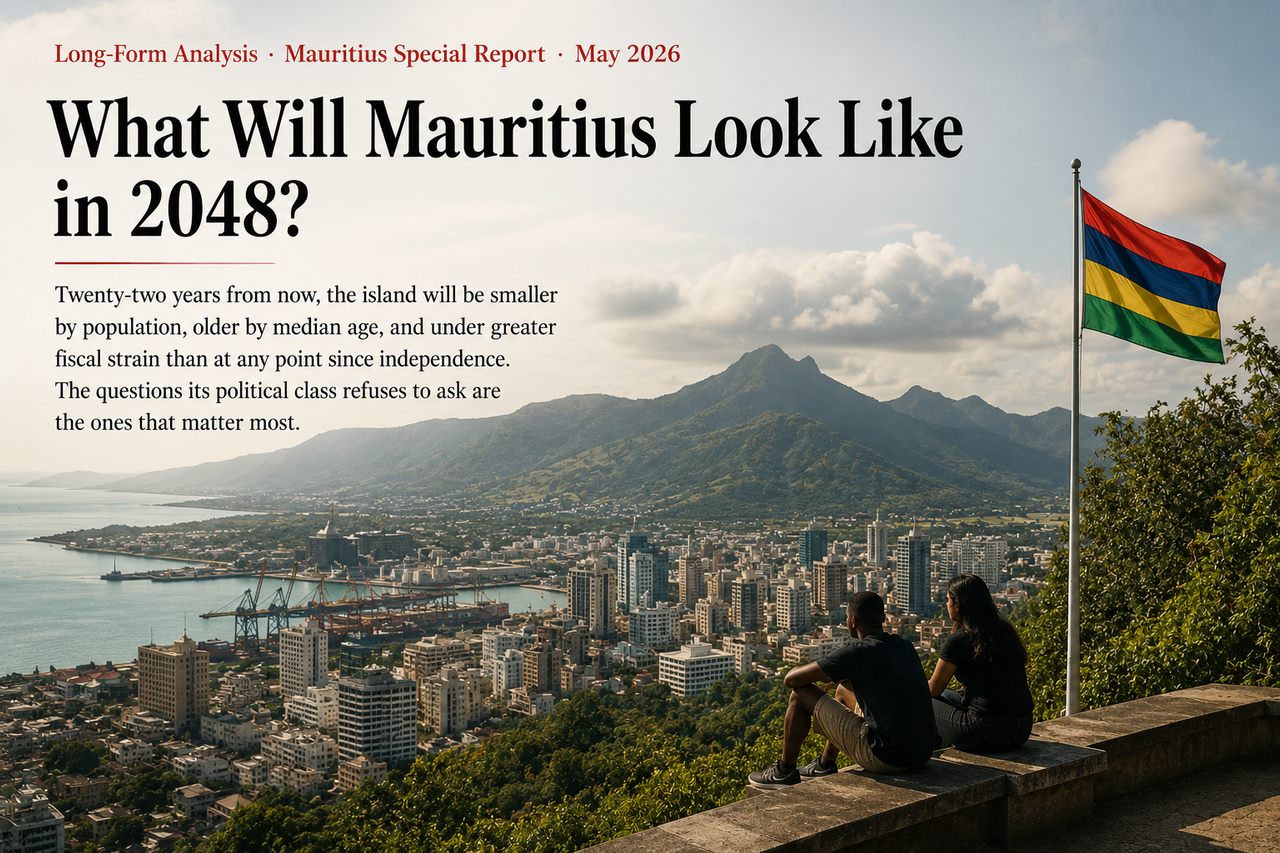
An island at a crossroads: Mauritius faces simultaneous demographic contraction, fiscal stress and climate risk by 2048.
Twenty-two years from now, the island will be smaller by population, older by median age and under greater fiscal strain than at any point since independence. The questions its political class refuses to ask are the ones that matter most.
Every generation or so, a country must ask itself an honest question: what are we actually becoming? Not what the government promises, not what the tourism brochures project, but what the data, demography, fiscal accounts, climate science, labour economics, is quietly and insistently describing. For Mauritius in 2026, that question is long overdue. And the answers, drawn from verifiable data rather than ministerial optimism, are more uncomfortable than the political establishment will admit.
This is not a polemic. It is an attempt to read the data honestly. Mauritius in 2048 will not be the confident upper-middle-income success story its tourism brochures project. It will be a smaller, significantly older, fiscally stressed society trying to fund a welfare state designed for growth on a tax base shaped by contraction. The questions are not whether these pressures will arrive. They are already in motion. The question is whether the island's institutions are capable of responding in time.
UN / Statistics Mauritius, 2025
UN World Population Prospects 2024
Worldometer / UN data, 2026
UN World Population Prospects 2024
Demographic contraction in a welfare state built for growth
The single most consequential and least discussed fact about Mauritius's future is that the island will have fewer people in 2048 than it does today. The UN's medium-fertility projection, the standard benchmark used by governments and international institutions, places Mauritius's 2050 population at approximately 1.09 million, a decline of roughly 12.5 per cent from the current 1.27 million.
This is not a forecast of catastrophic collapse. It is a forecast of managed contraction, and managed contraction is precisely what Mauritius is not preparing for. The country's pension architecture, social transfer system, and infrastructure planning were all designed in an era of population growth. None have been fundamentally restructured for the demographic reality now baked into the data.
The driver is fertility. According to World Bank data compiled through 2023 and corroborated by multiple sources, Mauritius's total fertility rate stands at 1.39 children per woman, well below the replacement threshold of 2.1. The fertility rate has been below replacement since 1997. In 1960, it was 5.9. The decline of nearly 76 per cent over six decades represents one of the most rapid demographic transitions in the Indian Ocean region, and it is not recovering. The 2022 figure of 1.32 was the lowest recorded in recent history. Even the most optimistic UN projections do not foresee a return to replacement fertility within the century.
The fertility rate has been below replacement since 1997. The decline over six decades represents one of the most rapid demographic transitions in the Indian Ocean region, and it is not recovering.
What compounds the raw population decline is its age structure. The population is not merely shrinking; it is inverting. The share of Mauritians aged 60 and older was 13 per cent in 2013. According to IMF projections, it will reach 30 per cent by 2050. The median age, currently 38.3 years, is projected to reach 50.1 years by the same date, making Mauritius one of the oldest societies on the African continent, a distinction it shares with no comparable small island developing state in the Indian Ocean.
The fiscal mathematics of this transition are well-documented and largely uncontested. An IMF working paper on Mauritius pension sustainability projects public pension spending rising from 3.7 per cent of GDP in 2013 to exceed 11 per cent of GDP by 2060, absent major reform. The National Pension Fund is projected to be sound until approximately 2050, then begin drawing down assets. The Basic Retirement Pension, a universal non-contributory scheme paid to all residents over 60, remains the unreformed core of the system and the largest source of future fiscal pressure.
IMF Working Paper WP/15/126
IMF Working Paper WP/15/126
IMF / UN projections
IMF Working Paper WP/15/126
Debt, deficits, and a credit warning the political class is not treating as urgent
Mauritius enters the 2048 horizon with its public finances in a condition that would have been unthinkable a decade ago. Government debt-to-GDP stood at 82.1 per cent at the end of 2024, according to the Bank of Mauritius, up from a historical average of 63.15 per cent since 1998. The fiscal deficit for 2024 was 5.7 per cent of GDP, nearly three times the pre-COVID norm. The new Ramgoolam administration, elected in November 2024, has publicly acknowledged what was increasingly evident: that the previous government misrepresented key fiscal indicators for years. The former finance minister and former central bank governor have been charged with fraud, and are currently out on bail having denied wrongdoing.
The international response has been measured but clear. In January 2025, Moody's maintained Mauritius's Baa3 sovereign rating, the lowest investment-grade tier and one notch above speculative, but revised the outlook from stable to negative, citing uncertainty about the government's ability to reverse recent fiscal deterioration. By January 2026, Moody's acknowledged some progress but estimated the 2025-26 deficit at 6.4 per cent of GDP, still substantially above the government's own target of 4.9 per cent. Moody's projected government debt stabilising at around 82 per cent of GDP through June 2027.
Moody's has explicitly warned that delays in fiscal consolidation that lead to persistently high deficits, causing debt to at best stabilise at high levels, would be likely to result in a rating downgrade. A downgrade from Baa3 would strip Mauritius of investment-grade status entirely, with potentially severe consequences for borrowing costs, financial sector positioning, and international confidence in the jurisdiction. The FATF review scheduled for 2027 adds a second, parallel reputational pressure point. Morocco has already overtaken Mauritius in the Global Financial Services Index to become Africa's leading financial centre, a competitive displacement that reflects structural rather than merely cyclical challenges.
The deeper issue is structural. Government expenditure runs at approximately one-third of GDP, well above the historical level of one-quarter. Debt service alone consumed 43.7 per cent of total government expenditure in fiscal year 2022-23, up from 41.2 per cent in 2018-19. These are not ratios that stabilise naturally; they require deliberate, politically costly action. The window for that action, before demographic pressures begin to compound fiscal ones, is closing.
What comes after tourism and offshore finance when both face structural headwinds?
The Mauritian economic miracle was built on sequential reinvention. Sugar dominated the colonial and early post-independence economy. Export processing zones and textiles provided the first diversification in the 1970s and 1980s. Tourism became a primary foreign exchange earner from the 1980s onward. Offshore financial services, built deliberately against the advice of multilateral donors, gave the economy its third major pillar from the 1990s through the 2010s. GDP per capita in 2024 stood at approximately $11,872, according to World Bank data updated December 2025, making Mauritius one of the two wealthiest countries in sub-Saharan Africa on a per capita basis.
But both active pillars are under pressure simultaneously, and no credible fourth pillar has yet been constructed.
Tourism contributed approximately 20 per cent of GDP and employed around 22 per cent of the workforce as of the most recent data. In 2025, the sector welcomed 1.44 million visitors and generated $2.16 billion in revenue, respectable figures that nonetheless mask structural vulnerability. More than 37 kilometres of Mauritius's coastline have already been affected by erosion, threatening the beach product that underpins the entire luxury tourism offer. Beach erosion is projected to cost up to $50 million in lost revenue annually by 2050. The Stimson Center's 2024 climate risk assessment found that the tourism sector faces compounding threats from sea level rise, coral reef degradation, marine heatwaves, and intensifying cyclone activity.
The financial services sector faces a different but equally serious challenge. As the University of Manchester's political economy research group has documented, Mauritius's offshore sector has not evolved beyond basic fund administration and related services. Unlike Singapore, which diversified into capital markets, foreign exchange, commodity trading and corporate banking, Mauritius remained narrowly positioned. With foreign firms now acquiring some of the island's largest offshore management companies, the risk is that Mauritius becomes a processing node for larger financial centres rather than a centre in its own right. Morocco's displacement of Mauritius at the top of the African financial services rankings is a symptom, not an anomaly.
GDP per capita stands at $11,872, yet both active economic pillars face structural headwinds simultaneously and no credible fourth pillar has yet been constructed.
The government's Vision 2050 framework, and the CEPA agreement with the UAE that entered into force on 1 April 2025, the UAE's first such agreement with an African country, which eliminates tariffs on over 97 per cent of traded goods, represent genuine strategic moves. But a trade agreement and a vision document are not a growth engine. The blue economy, digital services, and green transition are identified as candidate pillars in multiple government communications. Whether any of them achieves the structural weight of the previous three diversification waves remains, as of 2026, entirely unproven.
The World Bank's climate and development report places the climate adaptation investment gap at $5.6 billion by 2050, equivalent to approximately 2.2 per cent of GDP annually until 2030. Without that investment, climate change alone could reduce GDP by up to 4 per cent by 2050, with tourism revenues falling as much as 11 per cent. An economy trying simultaneously to service elevated debt, fund an ageing population's pensions and healthcare, and close a multi-billion dollar climate adaptation gap is an economy operating without margin for error.
Who will do the work, and where will the educated young have gone?
The demographic contraction is not simply a matter of births falling below deaths. It is being actively accelerated by emigration of exactly the cohort the economy most needs. A 2025 report by AXYS, titled "The Hands That Build Mauritius," documented that the labour shortfall is already severe enough to require the urgent recruitment of at least 25,000 Indian workers to meet demand in hospitality, retail, and food services. The island is simultaneously exporting its educated professionals and importing lower-skilled labour to fill the operational gaps they leave behind.
This dynamic, which development economists term human capital displacement, is not unique to Mauritius, but it operates with particular force in small island states where the educated population has near-frictionless access to metropolitan labour markets in France, the United Kingdom, Canada, and Australia. The AXYS report recommended competitive salary reform to incentivise skilled Mauritians abroad to return, automation of key sectors to offset demographic shortfalls, and restructured vocational training to reduce secondary school dropout rates. These are sound recommendations. They also require fiscal space and institutional capacity that the current situation does not guarantee.
By 2048, Mauritius will require a workforce strategy that is fundamentally different from any it has previously implemented. With smaller youth cohorts entering the labour market and a growing dependent elderly population drawing on public transfers, the ratio of productive workers to dependents will have shifted to a degree that conventional policy responses, including minor adjustments to retirement age and incremental pension reform, cannot adequately address. The IMF working paper on Mauritius pension reform suggested indexing the retirement age to life expectancy, potentially reaching 68 by 2050 and 72 by 2100. Even that, the paper conceded, would contain rather than eliminate the fiscal pressure.
What happens to ethnic peace when fiscal space disappears?
Mauritius's most celebrated achievement is not its economic transformation. It is the management of a profoundly diverse plural society, comprising Indo-Mauritians (approximately 68 per cent of the population), Creoles (approximately 27 per cent), Sino-Mauritians (approximately 3 per cent) and Franco-Mauritians (approximately 2 per cent), without serious interethnic violence since 1969. The 1999 riots that followed the death of singer Kaya in police custody represented a moment of rupture, but the long arc of Mauritian communal relations has been one of managed coexistence underwritten by broad-based economic development.
That coexistence rests on a specific, if informal, compact: Hindu Indo-Mauritian political dominance is tolerated by other communities in exchange for genuinely inclusive economic growth. The Bertelsmann Transformation Index 2026 report on Mauritius confirms that extreme poverty has been eradicated and relative poverty has fallen from 16.5 per cent in 2020 to an estimated 9 per cent by 2025. On a per capita basis, Mauritius received a Human Development Index score of 0.796 in 2022, ranking 72nd globally.
But structural inequality persists beneath these headline figures. The long-documented phenomenon of malaise créole, the systemic socioeconomic marginalisation of the Creole community, has not been resolved by aggregate growth. The BTI 2026 report notes that structural inequality remains a challenge, linked to skills gaps as the economy shifts toward knowledge-intensive services. Women earned an average of 77.6 per cent of male wages according to the same report. Political parties continue to mobilise along ethnic lines. These are not new findings; they are persistent features of Mauritian society that successive governments have managed without resolving.
The 2048 question is whether managed coexistence can survive the transition from growth to contraction. An ageing state under fiscal austerity cannot sustain the distributional generosity that has historically cushioned communal resentment. When governments must choose between increasing pension contributions, maintaining social transfers for the working poor, investing in climate adaptation, and servicing elevated debt, the distributional tradeoffs become politically explosive in ways they never were during the growth decades. The Creole social question, deferred for more than half a century, does not dissolve under austerity. Historical evidence suggests it intensifies.
Sea level rise, cyclone intensity, and the physical limits of a small island state
The physical territory of Mauritius is under measurable, documented threat. Mean sea level around the island has been rising at approximately 3.8 millimetres per year since 1988, with the rate accelerating sharply after 2003, when a drop of 0.7mm per year reversed to a rise of 5.0mm per year. Mauritius's Second National Communication to the UNFCCC forecasts a total sea level rise of 16 centimetres by 2050, 35 centimetres by 2080, and 49 centimetres by 2100.
These are not abstract projections. Cyclone Belal struck Mauritius in January 2024 during high tide, causing extensive infrastructure damage to coastal zones, a concrete demonstration of what storm surge compounded by sea level rise means for a densely populated island with a coastal tourism economy. The villages of Grand Sable and Quatre Soeurs on the south-east coast, and Rivière des Galets on the south coast, are already experiencing recurrent flooding, property damage, and community displacement pressure. These communities have inhabited their coastal locations for generations; relocation is not a technocratic recommendation they will accept readily.
The compounding effect on the tourism economy is direct and quantified. The Stimson Center's 2024 climate risk assessment identified the loss of coral reefs, which provide natural wave attenuation, as a critical amplifier of coastal vulnerability. Once reefs lose the race with sea level rise, the protective function must be replaced by engineered interventions at significant cost. Beach erosion alone is projected to cost up to $50 million in annual revenue by 2050. The government has allocated 3.2 billion rupees to a new climate fund to rehabilitate 26 kilometres of shoreline and 30 degraded sites, a meaningful commitment, though one that addresses symptom rather than cause.
By 2048, the functional economic geography of Mauritius will be measurably different from today's. Some coastal communities will have undergone managed retreat. Some infrastructure that currently sits at sea level will have been damaged or rebuilt inland. The exclusive economic zone, now formally enlarged to include the Chagos Archipelago following the bilateral agreement signed with the United Kingdom in May 2025, provides a theoretical sovereign resource base, but developing that resource base requires the fiscal and institutional capacity that the island is currently straining to maintain.
What the data actually tells us about 2048
These are the five core questions Mauritius must answer, questions its political class has largely preferred to defer:
Fewer than today. The UN projects approximately 1.09 million by 2050, a decline of 12.5 per cent from the current 1.27 million. The population will be older: a median age of 50.1 years, compared to 38.3 today. Thirty per cent of residents will be over 60, drawing on a pension system the working population cannot sustain at current configurations.
That is the central unanswered question of the next generation of Mauritian governance. Tourism will persist but under climate-induced structural erosion. Financial services will shrink unless genuine diversification beyond fund administration occurs, and Morocco's ascent as Africa's leading financial centre suggests the competitive window is narrowing. The blue economy, digital services, and green transition are the stated candidates for a fourth pillar. None has yet achieved critical mass.
Not in their current form. With government debt at 82.1 per cent of GDP, a structural deficit above 5 per cent, Moody's outlook on negative watch, and pension spending projected to triple as a share of GDP by 2060, the arithmetic is unambiguous. The reforms needed, including retirement age indexation, means-testing of universal benefits and revenue mobilisation, are all politically costly. The window for implementing them at manageable cost is closing with each passing budget cycle.
Mauritius's inter-ethnic compact has proven durable across six decades of democratic governance, a genuine achievement. But it was constructed under conditions of expanding prosperity and fiscal generosity. Austerity, distributional tradeoffs, and the structural persistence of Creole socioeconomic exclusion create conditions in which that compact faces its most serious long-term test since the 1999 riots. The political class has no established framework for managing ethnic politics under resource scarcity.
Less of it. By 2048, some coastal communities will have undergone managed or forced retreat. The beach-resort economy that generates $2.16 billion annually faces measurable erosion, literally and financially. The national climate adaptation investment gap stands at $5.6 billion through 2050. Without it, climate-related GDP losses of up to 4 per cent are projected. With a foreign reserve buffer of $8.5 billion covering 13 months of imports, Mauritius retains significant resilience. Whether that resilience is deployed proactively or consumed reactively is the governance question that will define 2048.
Mauritius Is Not Doomed. But It Is Drifting.
James Meade, the Nobel laureate economist, predicted in 1961 that Mauritius faced a tragic future: sugar dependence, population density, ethnic division and no natural resources. He was comprehensively wrong. The island confounded every pessimistic projection through political will, institutional quality, and strategic timing across four decades of reinvention.
The data assembled here does not argue that Mauritius will fail. It argues that the conditions which enabled past success, namely a growing population, expanding fiscal space, sequential opportunities for economic reinvention and a communal compact supported by rising living standards, are all simultaneously under pressure. The island that reaches its 80th independence anniversary in 2048 will need a quality of governance it has not yet demonstrated: the ability to make hard distributional choices, restructure institutions built for growth, manage ethnic politics without the lubricant of prosperity and invest ahead of climate threats rather than behind them.
That is a harder brief than any the island has faced before. Whether it is met will determine not whether Mauritius survives, for it will survive, but what kind of country it becomes for the next generation of its citizens.
All demographic projections are drawn from the United Nations World Population Prospects 2024 revision (medium-fertility variant). Fiscal data sourced from the Bank of Mauritius, Trading Economics, CEIC Data, and the IMF eLibrary (WP/15/126). Credit rating information from Moody's public press releases (January 2025, January 2026) and InsuranceNewsNet analysis, April 2026. Economic structural data from World Bank Development Indicators (December 2025 update), Worldometers, and the Bertelsmann Transformation Index 2026 Country Report for Mauritius. Climate projections from the World Bank Country Climate and Development Report for Mauritius (March 2026), the Stimson Center CORVI assessment (November 2025), and Mauritius's Second National Communication to the UNFCCC. Labour market data from the AXYS "Hands That Build Mauritius" report, March 2025. No data has been modelled, extrapolated or generated by the author. All figures are drawn from cited primary and secondary institutional sources. Where projections are used, the source and variant are stated explicitly. This article was produced by the Human Intelligence Unit of The State of the Mind and published in The Meridian. © 2026 The Meridian. All rights reserved.
Add comment
Comments