Africa Forward Summit 2026: A New Partnership or a New Label?
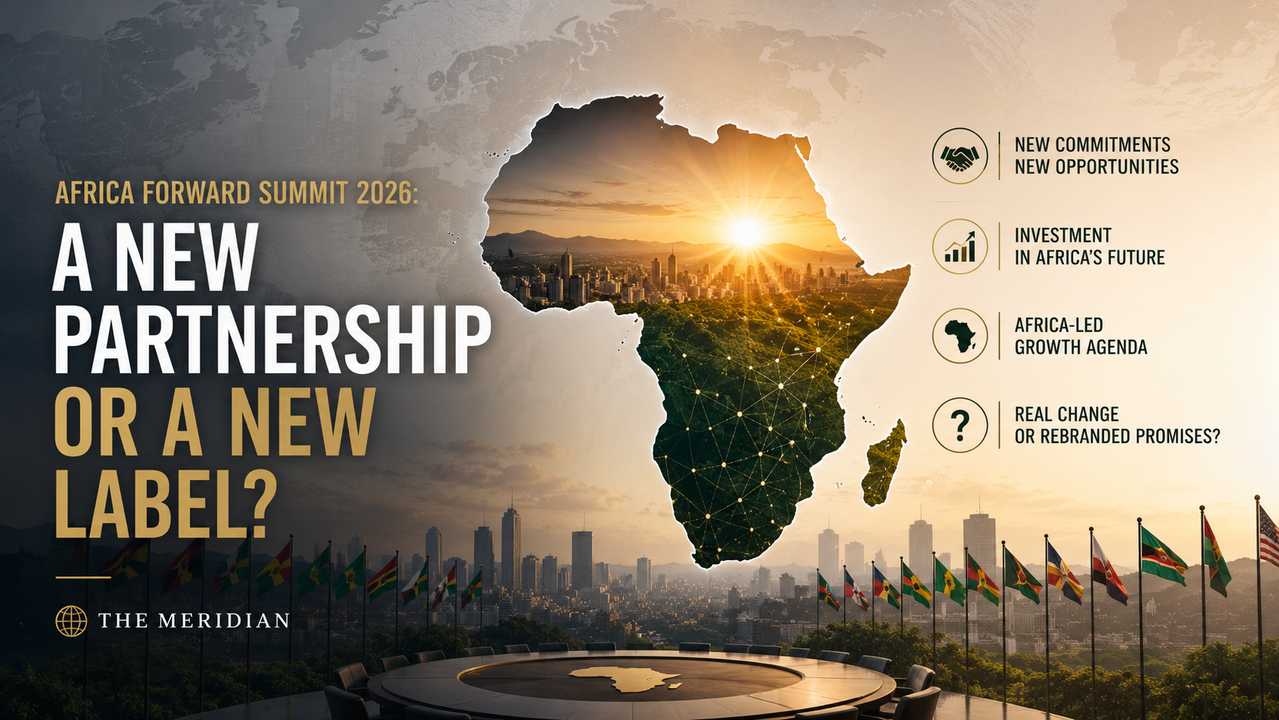
The Africa Forward Summit opens in Nairobi today, co-hosted by Presidents Ruto and Macron. Thirty heads of state. Fifteen hundred business leaders. A Nairobi Declaration and a direct feed into the G7 in Evian next month. It is the most significant Africa-France gathering in a generation, and the first ever held on Anglophone African soil. The Meridian asks the question the summit programme does not answer: is this a genuine structural reset or a rebranding of a relationship that has consistently failed to deliver on African terms?
The Africa Forward Summit 2026 is, by any reasonable measure, a significant diplomatic event. It opens today at the Kenyatta International Convention Centre in Nairobi, co-hosted by President William Ruto of Kenya and President Emmanuel Macron of France, and it carries a weight of symbolism that its organisers have been careful to emphasise. Kenya is the first non-Francophone African country to host the Africa-France summit in the 53 years since the format was established in 1973. The summit will close tomorrow with the adoption of the Nairobi Declaration. Its conclusions will be carried directly into the G7 Summit in Evian in June, where France holds the presidency. For Africa, the argument runs, this is the moment when the continent's voice reaches the highest table of global governance not as a supplicant but as a co-author of the agenda.
The Meridian does not dispute the significance of the occasion. What it disputes is whether significance and transformation are the same thing. The history of Africa-France summitry is a history of elegant communiqués, announced partnerships and reoriented frameworks that have, over five decades, left the structural realities of the relationship largely intact. France remains the dominant actor. African nations remain, in aggregate, price-takers in the financial architecture that France helps to govern. The question that the summit programme is not designed to answer is whether this time is genuinely different, and if so, what specifically has changed to make it so.
KICC, Nairobi, 11-12 May 2026
University of Nairobi, 11 May 2026
First time hosted outside Francophone Africa
Nairobi outcomes feed directly into G7 agenda
Why the Africa Forward Summit 2026 in Nairobi is historically significant
The choice of Nairobi as the host city is not incidental. It is the clearest signal available within the diplomatic vocabulary of summit hosting that France intends a departure from the Francophone-centric architecture that has governed its Africa policy since decolonisation. The Africa-France summit has been held in Paris, Cannes, Nice, La Baule, Dakar, Bamako and Libreville. It has never been held in Nairobi, Lagos, Accra or Johannesburg. The English-speaking African economies that have driven the continent's most dynamic growth stories have been peripheral to the formal France-Africa relationship, engaged bilaterally when commercially convenient but not structurally integrated into the summit framework. Moving the summit to Nairobi acknowledges, at the level of symbolic politics, that France's Africa policy cannot be credibly reformatted without including the Anglophone half of the continent.
The timing is equally deliberate. France has suffered a series of significant diplomatic reversals in its traditional African sphere of influence. Military presences have been expelled from Mali, Burkina Faso and Niger. The CFA franc architecture that tied Francophone African monetary policy to Paris has faced sustained political criticism across the region. Public sentiment in parts of Francophone Africa has shifted sharply against French presence, driven by accumulated grievances about security partnerships that served French interests, economic arrangements that extracted value, and political alignments that prioritised stability over democratic legitimacy. The Africa Forward Summit is, among other things, France's attempt to demonstrate that it has heard these grievances and is prepared to operate differently.
France has moved the summit to Nairobi. That is significant. What it has not yet demonstrated is that moving the venue changes the terms of the relationship rather than the optics of it.
Africa Forward Summit agenda development finance digital transformation food sovereignty
The summit's two-day structure is revealing. Day one, themed "Inspire and Connect," is built around the Business Forum at the University of Nairobi, showcasing investment opportunities, France-Africa collaborations and private sector partnerships. Day two is devoted to development finance and global governance, with roundtables on food sovereignty, the blue economy, digital transformation and peace and security. The closing ceremony will adopt the Nairobi Declaration and will be addressed jointly by both presidents.
The thematic agenda is well-constructed and reflects genuine areas of continental priority. The blue economy track is directly relevant to Indian Ocean states including Mauritius, which has both a stake in maritime governance and a historic relationship with France through the French Indian Ocean territories. The digital transformation track reflects the genuine competitive urgency that African economies face in positioning for the artificial intelligence transition. The development finance track, which addresses reform of the international financial architecture and mobilisation of private capital, addresses the structural constraint that every African economy identifies as its primary development bottleneck: the cost and availability of capital on terms compatible with long-run growth.
What the agenda does not address directly is the harder political economy of the relationship. The CFA franc question, which remains structurally unresolved despite nominal reforms in the WAEMU zone, is not on the programme. The question of France's defence agreements with African governments, which have in some cases underwritten regimes that lacked democratic legitimacy in exchange for access and influence, is framed within the summit's peace and security track but not confronted as a structural issue requiring reform. The question of intellectual property and technology transfer, which determines whether African economies can build productive capacity or remain dependent on imported solutions, is addressed within the digital track but not with the specificity that would allow it to produce bankable outcomes.
Africa Forward Summit G7 Evian France June 2026 Africa global governance reform
The most consequential element of the Africa Forward Summit for the Global South is the explicit linkage to the G7 in Evian next month. France holds the G7 presidency in 2026, and the Élysée has stated clearly that certain conclusions of the Nairobi summit will provide substance for G7 preparations. This is not a marginal diplomatic connection. It means that African positions on debt restructuring, reform of the IMF and World Bank, climate finance architecture and equitable trade rules have a direct pathway from Nairobi into the room where seven of the world's wealthiest economies make decisions that shape the financial environment for the rest of the world.
The potential value of this linkage is real. African economies collectively carry debt at interest rates that reflect a perceived risk premium entirely disproportionate to their actual default histories. The cost of capital for a Kenyan infrastructure project is multiples of the equivalent cost for a comparable European project, not because Kenya is less creditworthy but because the rating agencies and financial institutions that set these rates operate within a framework calibrated to Northern hemisphere risk assumptions. If the Nairobi Declaration produces a credible African common position on concessional finance reform and France uses its G7 presidency to advance it, the outcome for African development financing could be material and lasting.
Whether that is what happens depends entirely on whether the summit produces the specific, costed, time-bound commitments that its organisers have insisted it is designed to generate, rather than the aspirational language that has characterised previous summits. The Élysée communiqué specifically states that the summit's mandate is concrete commitments, not declarations, and that every roundtable is designed to produce bankable, scalable, implementable outcomes. These are the right words. They have been used before. The test will be in the Nairobi Declaration text and in the G7 communiqué in Evian.
The G7 feed-in is the most important structural feature of this summit. If African positions on debt, capital costs and financial architecture reform reach Evian as a co-authored French agenda item rather than as a lobbying position, something has genuinely changed. If they arrive as background notes, the Nairobi symbolism will have been exactly that.
What Africa Global South needs from Africa Forward Summit debt reform capital costs AfCFTA
For The Meridian's analytical framework, the Africa Forward Summit matters most not as a France-Africa bilateral event but as a test of whether the Global South can convert diplomatic visibility into structural economic advantage. The answer requires three things that the summit programme addresses in varying degrees.
The first is concrete progress on the cost of capital. African economies pay between 400 and 800 basis points more than equivalent Northern economies for international financing. This premium is not justified by fundamentals and is not self-correcting through market mechanisms. It requires institutional reform, specifically changes to the way credit rating agencies assess sovereign risk in developing economies and changes to the way multilateral development banks price their lending. France, as G7 president, has the platform to advance this agenda if it chooses to. Whether Nairobi produces a commitment specific enough to move this needle is the most important question the declaration must answer.
The second is meaningful progress on technology transfer. Africa's digital transformation track at the summit correctly identifies artificial intelligence, digital infrastructure and the tech sector as priority areas. What converts digital aspiration into structural advantage is not investment in connectivity but investment in the capacity to develop, own and export technology rather than import it. This requires intellectual property frameworks that allow African economies to benefit from their own innovations, educational investment in technical capacity and industrial policy that supports domestic tech ecosystems. These are harder asks than fibre optic cables, and their presence or absence in the Nairobi Declaration will indicate whether this summit represents genuine co-creation or elegant extraction dressed in innovation language.
The third is alignment with the African Continental Free Trade Area. The AfCFTA represents the most significant structural shift in African economic architecture since independence, and it provides the framework within which genuine industrialisation can occur at continental scale. France's engagement with AfCFTA, both as a partner and through its influence in European Union trade policy, will determine whether European and French capital accelerates African continental integration or continues to engage primarily with individual African economies in ways that reproduce dependency rather than build interconnection.
Africa Forward Summit Mauritius Indian Ocean small island developing states
Mauritius sits in a distinctive position relative to the Africa Forward Summit. It is an African state by geography and by continental membership, an Indian Ocean economy by commercial orientation, a Francophone society by history and culture, and an Anglophone professional economy by institutional design. It has historic and present ties to France through the French Indian Ocean territories of Réunion and Mayotte. It is a member of the African Union and the Southern African Development Community. It has an offshore financial sector that competes with French-influenced jurisdictions in Luxembourg and Switzerland for African capital management mandates.
The blue economy track is the most directly relevant summit component for Mauritius. Maritime governance in the Indian Ocean, the management of exclusive economic zones, the decarbonisation of maritime transport and the creation of blue economy jobs are all areas where Mauritius has both a national interest and a potential comparative advantage. If the Nairobi Declaration produces a blue economy framework with Indian Ocean specificity, Mauritius needs to be positioned to participate in its implementation rather than watching from the sidelines.
More broadly, the summit's G7 feed-in matters for Mauritius because the cost of capital question is as acute for a small island developing state as it is for a continental African economy. Mauritius borrows internationally at a sovereign risk premium that constrains its fiscal space. A genuine reform of international financial institution pricing frameworks would benefit Port Louis as directly as it would benefit Nairobi or Accra. The question is whether Mauritius has made itself part of the African common position on this question or whether it continues to pursue its financial sector interests in ways that occasionally diverge from the collective African interest.
The Africa Forward Summit 2026 is happening now. The declarations will be adopted tomorrow. The G7 in Evian is five weeks away. The Meridian will return to this analysis when the Nairobi Declaration text is available and when the G7 communiqué in Evian can be assessed against the commitments made today. The measure of success is not the eloquence of the language. It is whether the cost of capital for African governments falls, whether technology ownership shifts toward African economies, and whether the AfCFTA receives the institutional and financial support that would make it function at the scale its architects intended. On those measures, the summit will be judged.
Add comment
Comments