The BRICS Currency Question Is Back: From Rhetoric to Infrastructure
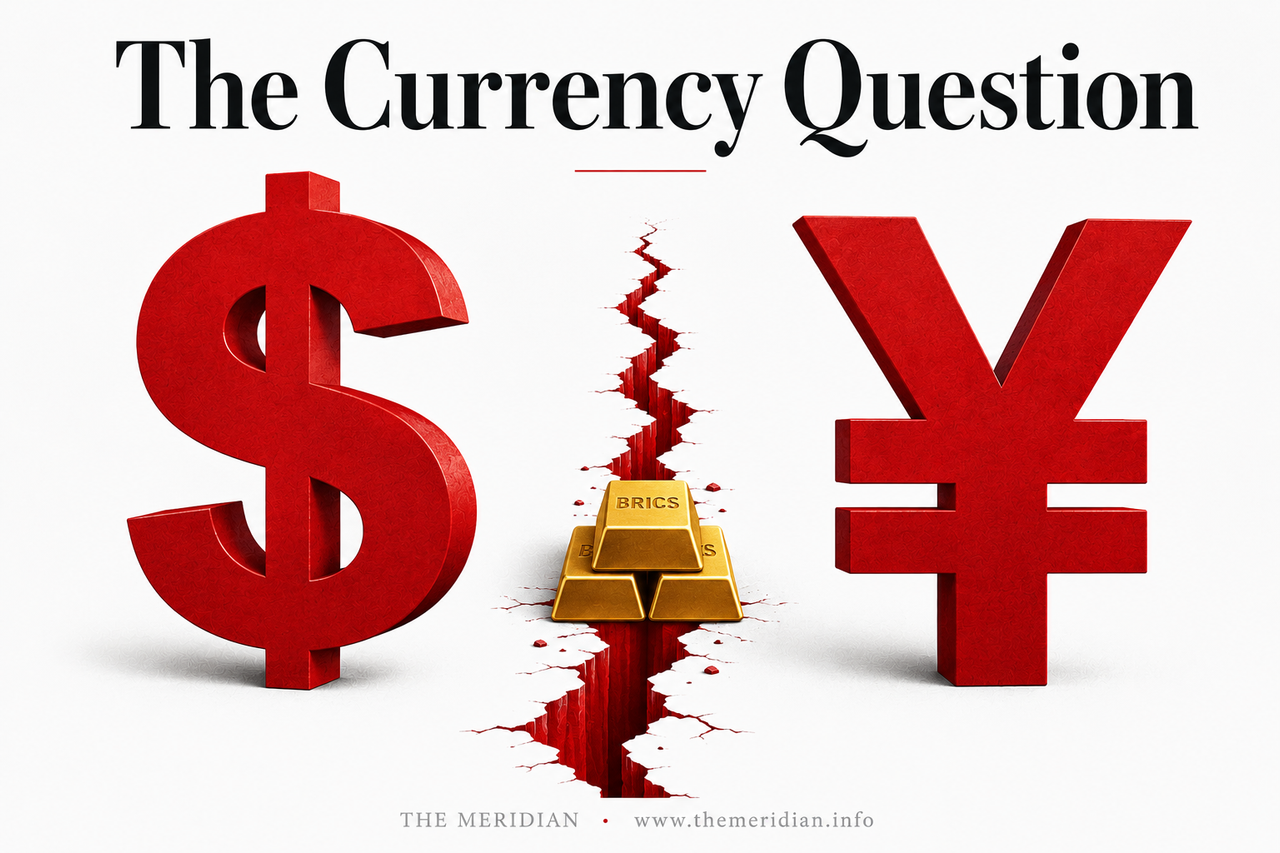
The dollar's share of global reserves has fallen from 72 per cent in 2000 to 58 per cent in 2026. BRICS piloted the Unit — 40 per cent gold, 60 per cent currencies — in October 2025. mBridge processed $55 billion with 95 per cent in digital yuan. Iran is conditioning Hormuz passage on yuan settlement. Copper hit an all-time high of $14,700 per tonne this week. The Meridian Intelligence Desk asks the question precisely: what is real, what is rhetoric, and what does the commodity market know that the currency debate does not?
Every few years the BRICS currency question returns to prominence, usually attached to a summit communiqué, a dramatic geopolitical event or a provocative speech by Vladimir Putin about weaponised dollars. Each time, Western commentators dismiss it as posturing. Each time, the dismissal is partly correct and partly mistaken. It is correct that BRICS has not produced a common currency, has no confirmed timeline for doing so, and that the yuan accounts for less than 5 per cent of global reserves compared with 58 per cent for the dollar. It is mistaken in its complacency about what is actually being built beneath the headline currency debate — the payment infrastructure, the settlement systems, the CBDC interoperability frameworks and the commodity market dynamics that are collectively shifting the ground under the dollar system without producing the dramatic single event that would make the shift undeniable. The Hormuz crisis of 2026 has accelerated all of these processes simultaneously. The Meridian Intelligence Desk does not predict the dollar's collapse. It documents what is verifiably changing and asks what it means for the Global South.
Down from 72% in 2000. IMF COFER data
95% in digital yuan. Ledger Insights 2026
WION April 2026
LME 13 May 2026. Up 40.86% year-on-year
BRICS de-dollarisation 2026 what changed infrastructure CIPS mBridge Unit gold settlement
The BRICS currency debate is best understood not as a question about whether a single new currency will replace the dollar — it will not, at least not soon — but as a question about whether the infrastructure for non-dollar settlement has crossed a threshold of operational viability that makes it qualitatively different from anything that existed five years ago. Three developments suggest it has.
The first is CIPS. China's Cross-Border Interbank Payment System now has 1,467 indirect participants across 119 countries, linking approximately 4,800 banks in 185 countries, according to CIPS data from January 2025. Five years ago CIPS was a marginal alternative to SWIFT used primarily for China's domestic settlement of yuan-denominated trade. Today it processes approximately $134 billion in daily transactions, a figure that surged from $85 to $105 billion to over $130 billion coinciding with the start of the Iran war in February 2026, as The Meridian documented in its analysis of the China-Iran financing loop. CIPS is not SWIFT. It does not match SWIFT's global reach. But it has passed the threshold of being used under genuine pressure — not just as a convenience but as a functional alternative when the dollar system is unavailable.
The second is mBridge. The cross-border central bank digital currency platform originally developed under the BIS Innovation Hub processed approximately RMB 387.2 billion — equivalent to $55 billion — in payments, with 95 per cent of transactions denominated in digital yuan, according to Ledger Insights. The BIS withdrew from the project in late 2024, citing concerns that sanctioned countries including Russia and Iran could gain access. The BIS withdrawal is itself significant: it confirms that the platform is operationally capable of providing sanction-evasion infrastructure, which is precisely why Russia and Iran want to use it and precisely why the BIS exited. mBridge continued operating after the BIS exit. It is now a Chinese-led, China-aligned payments infrastructure operating independently of the BIS framework.
The third is the Unit. On 31 October 2025, BRICS quietly piloted a new digital trade settlement token — 100 Units backed 40 per cent by gold and 60 per cent by a basket of BRICS currencies. NDB President Dilma Rousseff confirmed agreement in principle to use the Unit as a settlement currency. The Unit is not a common currency. It is a neutral settlement instrument — closer in concept to Keynes's bancor than to a rival dollar. Its gold backing connects it to the ongoing accumulation of gold by BRICS central banks, which have been collectively purchasing gold at record pace while reducing dollar holdings. The New Development Bank approved approximately $42.9 billion in cumulative project financing, with a third of its loans now in domestic currencies.
The question is not whether the dollar will be replaced. It is whether the infrastructure for not using the dollar has crossed the threshold of operational viability. In 2026 it has. The question now is who benefits from that infrastructure — and the answer is not automatically the Global South.
Iran Hormuz yuan settlement dollar bypass BRICS de-dollarisation accelerant 2026
The Hormuz crisis of 2026 has done more to advance the operational case for non-dollar settlement than any BRICS summit communiqué in the past decade. The mechanism is precise. An Iranian government official told CNN that tankers can receive permission to transit the Strait of Hormuz if they agree to sell oil in China's currency — the renminbi — rather than US dollars. This is not a preference or an incentive. It is a condition on access to a chokepoint through which 20 per cent of global oil supply must pass. Countries that need their tankers through the strait are being compelled to hold and transact in yuan. The operational infrastructure to do so — CIPS, mBridge, bilateral yuan swap lines covering more than 40 countries — is available. The coercion to use it has arrived.
Harvard economist Kenneth Rogoff warned that if Iran and China prevail in establishing yuan-denominated Hormuz passage as a norm, it will encourage countries to diversify away from the dollar financial system to protect themselves from being held hostage to US financial sanctions. As Brad Setser of the Council on Foreign Relations has noted, coercing countries to use the dollar through tariff threats could actually accelerate de-dollarisation — a paradox Washington has not resolved. Trump's executive order threatening 100 per cent tariffs on any BRICS nation pursuing dollar alternatives has not deterred the infrastructure development. If anything, the threat has reinforced the strategic logic of building alternatives.
The dollar's reserve share decline from 72 per cent in 2000 to 58 per cent in 2026 represents 14 percentage points of erosion over a quarter century. That is not collapse. The British pound's transition from world reserve currency to secondary player took approximately 30 years, from the 1920s to the 1950s. The current trajectory, if it continues at the pace of the past 25 years, suggests the dollar's reserve share could reach approximately 44 per cent by 2051. Whether that constitutes loss of reserve currency status depends on what the alternatives look like by then — and the infrastructure being built today will determine what those alternatives are.
Copper price record high 2026 $14700 tonne AI data centres Iran war sulphuric acid China
While the currency debate focuses on dollar share percentages, the commodity markets are registering a different signal about where real economic power is shifting. Copper hit an all-time high of $14,700 per tonne on the London Metal Exchange on 13 May 2026, up 40.86 per cent year-on-year. COMEX copper futures surged above $6.4 per pound, also the highest on record. The week preceding 13 May saw the LME's combined base metals price gauge close at an all-time high — meaning the copper surge is not a single-commodity anomaly but a confirmation of tightness across the entire industrial metals complex.
Three simultaneous drivers are responsible, and all three connect to the themes this edition of The Meridian has been tracking. The first is Chinese industrial demand. China's April 2026 manufacturing PMI came in at 52.2 from private surveys — above expectations — confirming resilient industrial activity despite geopolitical headwinds. China consumes approximately 60 per cent of global copper demand. When Chinese manufacturing activity is strong, copper is tight. When copper is tight, the countries that control copper deposits — Chile, the Democratic Republic of Congo, Peru — have structural leverage that no financial sanctions regime can easily neutralise.
The second driver is AI and digital infrastructure. Major technology companies are signing agreements exponentially increasing data centre construction, supporting copper demand through its utility in electrification and grid technology. Data centres can require up to ten times the electrical load of traditional office facilities. Every GPU cluster, every fibre backbone, every power distribution system requires copper at a scale that the green energy transition — which itself requires massive copper for solar panels, wind turbines and electric vehicle charging infrastructure — compounds further. S&P Global estimates global copper demand could rise from approximately 28 million tonnes in 2025 to over 42 million tonnes by 2040. Supply cannot grow that fast. The mines do not exist yet and take decades to develop.
The third driver connects directly to the Iran war. The ongoing conflict between the US and Iran in the Middle East has suspended exports of sulphur and sulphuric acid from the key region since March 2026. Sulphuric acid is a critical input for heap leaching — the process used to refine copper from lower-grade ores. The supply squeeze for this input, which is used by refiners throughout Chile and Peru, forced China to suspend its own sulphuric acid exports to protect domestic supply. The shortage in Chile's top copper producers forced major refiners to cut capacity. The Iran war, through this indirect channel, has tightened the global copper market in a way that raises costs for every economy dependent on copper for its industrial and digital infrastructure — which is every economy in the world.
Copper at $14,700 per tonne is not primarily a financial story. It is a physical story. The real economy — the infrastructure of the digital transition, the energy transition, the AI transition — requires copper that the world is struggling to produce fast enough. Whoever controls the copper controls the transition. That is a different kind of reserve currency question from the one being debated at BRICS summits.
BRICS internal divisions India China yuan rupee Brazil de-dollarisation 2026 summit
The BRICS currency agenda is complicated by a fundamental internal contradiction that has not been resolved and is unlikely to be resolved at the New Delhi summit in September 2026. China actively promotes yuan internationalisation and views mBridge and CIPS as instruments of that agenda. India, as the 2026 BRICS chair, has placed the linking of BRICS central bank digital currencies on the summit agenda — but India's External Affairs Minister Jaishankar stated clearly in March 2025 that there is no policy on India's part to replace the dollar. India's participation in BRICS de-dollarisation infrastructure is driven by practical economic efficiency and protection from external policy shocks, not by a desire to substitute Chinese monetary dominance for American monetary dominance.
Brazil under Lula has sought to use BRICS as leverage in its relationship with Washington, not as an instrument of Chinese power. Brazil's record agricultural exports in 2025 exceeded $165 billion — most of which was traded in dollars or local currencies, not yuan. Russia and Iran, whose survival depends on circumventing dollar sanctions, strongly support de-dollarisation. But Russia confirmed in January 2026 that talks on a unified BRICS currency have not taken place and are not taking place. The bloc has explicitly stated it is not pursuing a common currency to replace national currencies. What it is pursuing is a multipolar settlement system — which is a substantially different and more achievable objective.
The internal contradiction matters for the Global South because it determines what kind of alternative monetary architecture actually emerges from the BRICS process. A system designed primarily to advance yuan internationalisation — the Chinese preferred outcome — would substitute Chinese monetary leverage for American monetary leverage. A system designed to provide genuine multilateral settlement infrastructure — the Indian preferred outcome, closer to Keynes's bancor concept — would offer the Global South more genuine monetary sovereignty. The difference between these two outcomes is the most important unresolved question in the BRICS currency agenda, and it will not be answered by any single summit communiqué.
BRICS currency Global South developing economies dollar yuan monetary sovereignty
The Global South's interest in the BRICS currency question is not primarily ideological. It is practical. Dollar dominance creates three specific vulnerabilities for developing economies that a multipolar monetary system could reduce. The first is the dollar funding cycle — when the US Federal Reserve tightens monetary policy, dollar-denominated debt becomes more expensive globally, triggering capital outflows from emerging markets that have nothing to do with their own economic policies. The second is sanctions vulnerability — the ability of the United States to exclude any country from dollar-clearing systems gives Washington extraordinary coercive leverage over any economy with dollar-denominated trade, debt or reserves. The third is seigniorage extraction — the US earns an ongoing return from the dollar's reserve status that is effectively a tax on every country that holds dollars in reserve, reducing their domestic monetary policy autonomy.
A multipolar settlement system that reduced dollar dependence without replacing it with yuan dependence would address all three vulnerabilities simultaneously. Whether the BRICS process is building such a system or building Chinese monetary infrastructure in multilateral clothing is the question that the Global South cannot yet answer definitively. The evidence is mixed. The Unit's gold backing and multilateral currency basket design points toward genuine multipolarity. mBridge's 95 per cent yuan denomination points toward Chinese centrality. India's cautious, sovereignty-preserving approach to the 2026 summit agenda points toward genuine multilateral intent. China's simultaneous construction of bilateral yuan swap lines, CIPS expansion and Hormuz-linked yuan coercion points toward strategic yuan internationalisation using multilateral cover.
The Global South's task is to engage with BRICS currency infrastructure on its own terms — demanding the governance structures, transparency mechanisms and convertibility conditions that would make a multipolar settlement system genuinely neutral rather than Chinese-dominated. The copper market is meanwhile telling it that the real monetary question of the next twenty years is not yuan versus dollar. It is who controls the physical commodities — copper, lithium, cobalt, rare earths — that the digital and energy transitions require. Those commodities are disproportionately located in the Global South. That is leverage the BRICS currency debate has not yet adequately incorporated. The countries that control copper at $14,700 per tonne have a stronger negotiating position in the monetary architecture discussion than their current reserve currency holdings would suggest.
Add comment
Comments