The Dollar Trap: How Small States Cannot Escape the Currency That Controls Their Fate
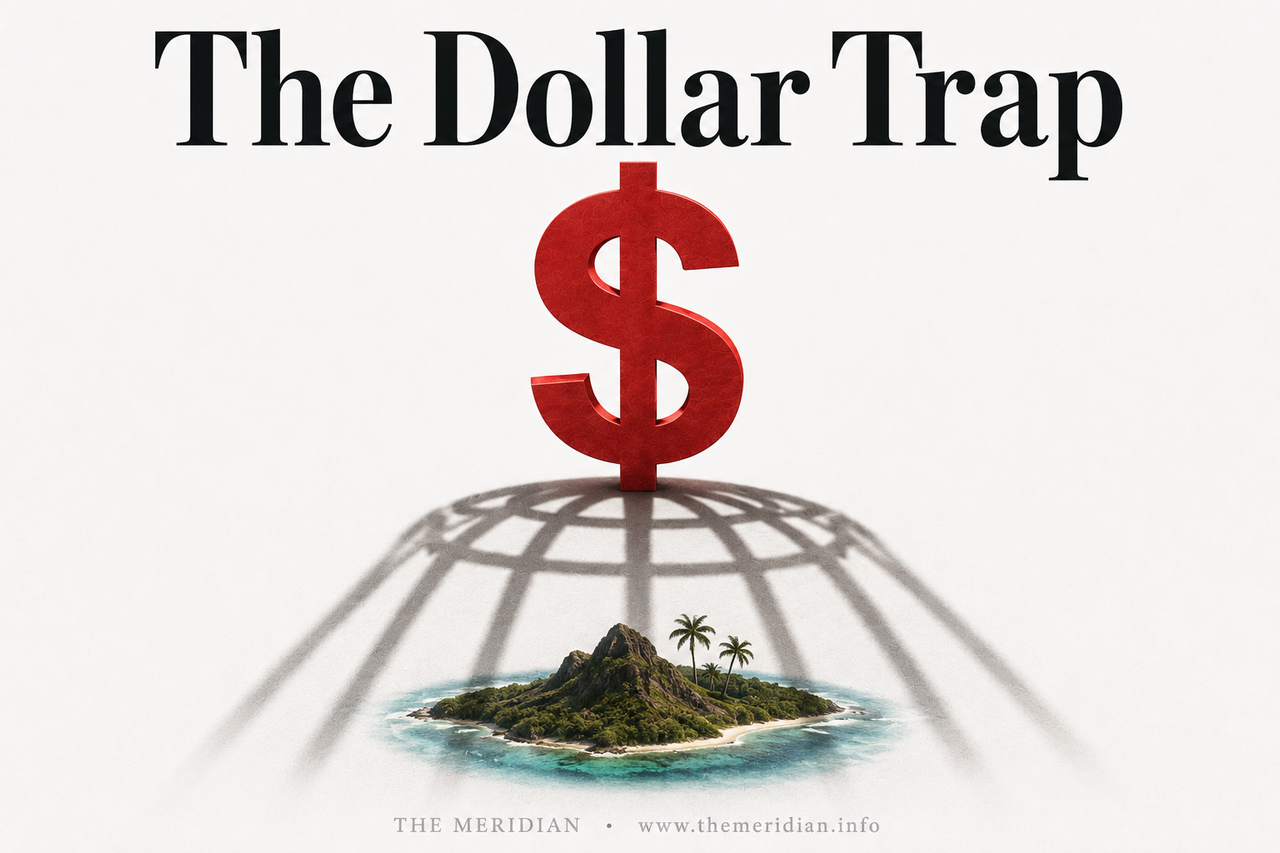
The BRICS currency debate focuses on reserve share percentages and settlement infrastructure. It is conducted primarily by large economies about large economies. What it consistently fails to incorporate is the experience of small states — island nations, landlocked economies, commodity exporters — for whom dollar dependency is not an abstract monetary policy question but the daily operational reality that determines whether the lights stay on, whether the shelves stay stocked and whether the government can pay its bills. Sri Lanka defaulted. Pakistan owes forty years of debt service to China alone. Zambia restructured under creditor pressure. Cuba is blockaded. Mauritius pays a Rs211 billion trade deficit in dollars every year from earnings that structurally cannot cover it. The Meridian Intelligence Desk documents the dollar trap from the inside.
The dollar trap has a precise definition. It is the condition in which a small or developing economy must earn, borrow, service debt and purchase its most essential imports — oil, food, medicines — in a currency it does not issue, cannot control and cannot devalue away from without triggering the very crisis it is trying to avoid. The trap has three jaws. The first jaw is the trade jaw: small states import more in dollar terms than they export, requiring a constant supply of dollars from external sources — tourism, remittances, foreign investment — that are structurally insufficient, volatile and subject to external shocks beyond the country's control. The second jaw is the debt jaw: dollar-denominated sovereign debt must be serviced regardless of what happens to the domestic currency, meaning that any rupee, peso or kwacha depreciation automatically raises the real cost of debt service in local currency terms, compressing fiscal space and forcing cuts to social spending to protect the debt service line. The third jaw is the leverage jaw: Washington can exclude any country from the dollar-clearing system at will, and has demonstrated the willingness to do so against adversaries, near-adversaries and countries it wishes to coerce. The trap has no obvious exit. And it is tightening.
April 2022. First default in history
$30bn CPEC loans. Expert estimate
BOM Monthly Statistical Bulletin Feb 2026
Feb to Nov 2022. LKR 200 to LKR 368
Sri Lanka dollar debt default 2022 rupee depreciation IMF bailout Hambantota
Sri Lanka is the textbook dollar trap case study. A decade of fiscal mismanagement built up $52 billion of external dollar-denominated debt while tourism and tea exports — the primary foreign exchange earners — proved structurally insufficient to service it. When Covid eliminated tourism revenues entirely in 2020 and 2021, the trap closed. The Sri Lankan rupee depreciated approximately 555 per cent on an annualised basis from February to November 2022, dropping from LKR 200.92 per dollar to LKR 368.50 at its lowest. The country struggled to pay for fuel and food in dollars. Shelves emptied. Queues formed at petrol stations. Hospitals rationed medicines. The President fled. The IMF provided $2.9 billion in September 2022 and a further $3 billion in March 2023 under conditions of severe austerity. The Hambantota Port, built with a Chinese loan, had already been handed to a Chinese state company on a 99-year lease when an earlier debt crisis made repayment impossible. Sri Lanka did not fall into the dollar trap suddenly. It walked into it slowly, over a decade, borrowing in the currency it could not control.
Pakistan dollar debt China CPEC IMF bailout 40 years repayment crisis
Pakistan occupies a distinctive position in the dollar trap because it is simultaneously caught in the Western dollar system and the Chinese debt architecture that was supposed to offer an alternative. Its debt to China reached approximately $30 billion by 2020, primarily through China-Pakistan Economic Corridor loans, and experts estimated Pakistan would require nearly 40 years to repay it. Pakistan has received $42.7 billion in World Bank assistance since 1980, of which $33.4 billion are loans. Its external debt increased by 38 per cent as soaring inflation, dwindling foreign reserves and a falling currency produced a severe balance of payments crisis. The IMF has provided multiple bailout programmes with stringent conditions. Pakistan is the clearest example of a country that sought to escape the dollar trap through Chinese bilateral financing and found itself in a different trap — Chinese debt on opaque terms, denominated in dollars, with repayment periods that span generations of citizens who had no say in the original borrowing decision.
Zambia debt default restructuring China creditor IMF 2020 2026
Zambia became the first African country to default during the Covid era, in 2020, after years of borrowing in dollar-denominated bonds on international capital markets at rates that reflected Zambia's perceived risk premium rather than its actual development needs. Private lenders accounted for approximately 46 per cent of Zambia's external debt. Chinese creditors held over 30 per cent. When restructuring became necessary, China — a non-Paris Club member — refused to share loan terms with other creditors, making Zambia's debt restructuring more complicated by preventing transparent coordination among lenders. China even prevented Zambia from sharing the terms of Chinese loans with other lenders, according to documented reports of the restructuring negotiations. Zambia's IMF programme was delayed by China's insistence on bilateral rather than multilateral negotiation. The country's citizens bore the cost of the creditor disagreement in the form of delayed relief and extended austerity. This is the geopolitics of the dollar trap in its rawest form: small states default, large creditors disagree, and the population in between pays the price of a financial architecture they did not design.
Cuba dollar blockade oil 2026 Trump sanctions energy crisis dollar weaponisation
Cuba is the most extreme case of dollar weaponisation as a geopolitical instrument in the modern world. Excluded from dollar-clearing systems since the US embargo of 1962, Cuba has spent over six decades attempting to construct an economy that functions without access to the world's primary reserve currency. The result is an economy permanently constrained by the inability to participate in dollar-denominated international trade on normal terms. On 29 January 2026, President Trump signed an executive order imposing an oil blockade on Cuba, threatening tariffs on any country that provides oil to the island. Oil imports dropped to effectively zero in January 2026. The country's Soviet-era power grid, dependent on oil it could no longer obtain, began collapsing. As The Meridian documented in its Cuba at the Breaking Point analysis, the result was fifteen-hour daily blackouts in parts of Havana, hospitals unable to operate safely, water pumps failing and petrol at $10 per litre on the black market. Cuba is not in the dollar trap in the same way as Sri Lanka or Pakistan. It has been forcibly ejected from the dollar system and left to survive outside it — which is the trap's most brutal expression. Exclusion from the dollar is not freedom from dollar dependency. It is the most punishing form of it.
Mauritius dollar trap trade deficit BOM FX intervention SIDS small island developing states
Mauritius has not defaulted. It has not experienced a balance of payments crisis in the acute sense that Sri Lanka experienced it. It is not blockaded from the dollar system like Cuba or restructuring debt like Zambia. But it is nonetheless in the dollar trap in a structural sense that is invisible in the good years and acutely visible in the bad ones. The Bank of Mauritius's own Monthly Statistical Bulletin shows imports of approximately Rs318.9 billion per year against exports of approximately Rs107.7 billion — a structural trade deficit of Rs211 billion per year, all settled in US dollars that Mauritius must obtain from a market where its earnings structurally fall short of its needs. The rupee has lost 23.14 per cent of its value against the dollar over the past decade. The BOM must intervene regularly in the FX market to bridge the gap, selling dollar reserves to prevent disorderly depreciation. The Iran war has added approximately $35 per barrel to petroleum import costs — a shock absorbed directly by Mauritius's current account deficit and, indirectly, by every Mauritian household that pays electricity bills and buys food transported by diesel-powered vehicles.
The SIDS experience more broadly mirrors Mauritius's structural position but with less institutional resilience. Small island states in the Pacific, the Caribbean and the Indian Ocean share four common dollar trap vulnerabilities. First, 100 per cent oil import dependency means every dollar appreciation directly raises the cost of living. Second, tourism revenues are earned in dollars or euros but operational costs are in local currency, creating exchange rate volatility risk for the primary export sector. Third, climate adaptation and disaster recovery costs require dollar-denominated international financing that small states can only access at sovereign risk premiums calibrated to their size and perceived vulnerability rather than their actual creditworthiness. Fourth, SIDS have no meaningful access to dollar capital markets at fair terms. The Centre for Global Development identified the Maldives as at risk of debt distress specifically because of Chinese infrastructure lending — a small island state of 500,000 people trapped between dollar capital markets it cannot access and Chinese bilateral lending that comes with strategic strings attached.
Mauritius buys the world in dollars and sells itself in rupees. The gap between those two transactions is the dollar trap in miniature. It is the story of every small island economy in the Indian Ocean, the Pacific and the Caribbean. And it is the story that the BRICS currency debate has not yet told in their name.
Iran war oil price dollar trap small states SIDS Mauritius Pakistan oil import cost 2026
The Iran war has tightened the dollar trap for every country in this analysis simultaneously, through the mechanism of elevated oil prices and dollar funding pressure. Brent crude above $110 per barrel represents approximately $35 per barrel above pre-war levels — a transfer of wealth from oil-importing small states to oil-producing large states that is denominated entirely in dollars. Sri Lanka, already under an IMF programme, is paying more in dollars for oil it could barely afford before the war. Pakistan, already managing $30 billion of Chinese debt, is paying more in dollars for the energy that keeps its economy functioning. Zambia, already restructuring, is paying more in dollars for fuel that drives its mining and agricultural sectors. Cuba, already excluded from dollar oil markets, is paying nothing because it cannot obtain the oil at all. Mauritius, already managing a Rs211 billion trade deficit, is absorbing the oil price shock into an import bill it was already struggling to finance.
The common thread is that none of these countries had a meaningful role in creating the Hormuz crisis. None of them voted for the policies that led to the Iran war. None of them has a seat at the table in Beijing where the negotiations that could reopen the strait are taking place. And all of them are paying the dollar-denominated cost of a geopolitical conflict between powers that regard their interests, if at all, as secondary considerations. The dollar trap is not merely a structural feature of their economies. It is the mechanism through which the consequences of great power decisions flow to small states that had no part in making them.
SIDS Mauritius dollar trap solutions strategic petroleum reserve export diversification BRICS
The honest answer to what small states can do about the dollar trap is that the structural options are limited and none of them resolves the underlying vulnerability completely. But limited options are not zero options, and the states that manage the dollar trap most effectively over time do so through a combination of specific, achievable measures rather than through the transformational monetary architecture change that the BRICS currency debate promises but has not yet delivered.
The most immediately actionable measure for oil-importing small states is a strategic petroleum reserve. Mauritius has no strategic petroleum reserve of meaningful size. A 90-day reserve — the IEA standard for member countries — would cost approximately Rs28 billion at current prices. Against a government domestic debt of Rs499.9 billion, that is a 5.6 per cent addition to the debt stock that would provide insurance against exactly the kind of supply shock that the Iran war has produced. The political will to build that reserve has been absent through multiple governments and multiple administrations. The Iran war provides the most compelling possible argument for building it now.
The second measure is export diversification away from dollar-dependent tourism and financial services toward digital services, knowledge exports and blue economy products that can generate foreign exchange in multiple currencies rather than concentrating it in a single sector subject to catastrophic external shocks. Mauritius's IORA membership, its Indian Ocean position and its educated workforce are comparative advantages for exactly this kind of diversification. They have not been deployed at the scale that the dollar trap's structural pressure requires.
The third measure is collective voice in the international financial architecture reform process. The BRICS Unit, mBridge and CIPS are being built by large economies for large economies. Their governance structures will reflect the interests of their architects. Small states that want the BRICS currency infrastructure to serve their interests rather than simply substitute Chinese monetary coercion for American monetary coercion must engage actively in the design of that architecture — through the African Union, the AOSIS small island states coalition, the G77 and every other multilateral forum where their collective weight exceeds their individual size. The dollar trap will not be resolved by any single country. It will be resolved — if it is resolved — by collective institutional action that small states must shape, not merely accept.
Add comment
Comments