IORA: The Organisation in Ebène and the Crisis It Cannot Address
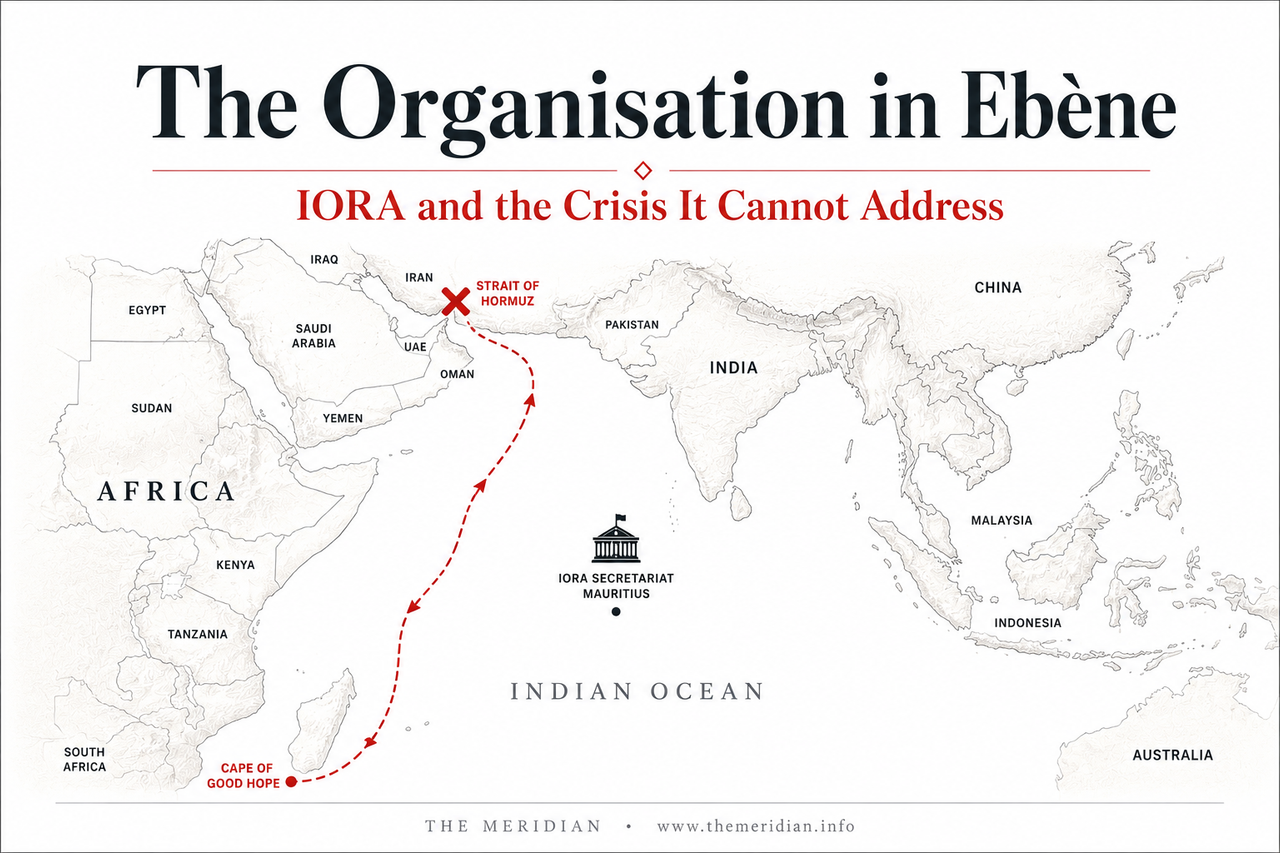
In Cyber City, Ebène, Mauritius, sits the secretariat of the Indian Ocean Rim Association. IORA brings together 23 member states representing a third of the world's population, $9 trillion in combined GDP and $800 billion in intra-regional trade. The Indian Ocean carries 80 per cent of global oil trade, 50 per cent of the world's containerised cargo and 33 per cent of its bulk cargo. Since 28 February 2026, one of IORA's 23 members has closed the world's most important energy chokepoint. Twenty thousand seafarers are stranded on 2,000 vessels. The Indian Navy is escorting ships unilaterally. China and Russia vetoed the UN Security Council resolution. And the organisation sitting in Cyber City, Ebène cannot do anything about any of it. The Meridian Intelligence Desk analyses what the Hormuz crisis has revealed about IORA and what the Indian Ocean actually needs from its only multilateral institution.
The Indian Ocean Rim Association was born in Mauritius. The Indian Ocean Rim Initiative was first convened in Port Louis in March 1995. Nelson Mandela had visited India in January of that year and, in a speech in Delhi, articulated the vision of an Indian Ocean community that would connect the emerging economies on its rim through trade, investment and dialogue. South Africa and India formed the founding nucleus. Mauritius and Australia were brought in. On 6 to 7 March 1997, the Charter of the Indian Ocean Rim Association for Regional Co-operation was concluded in Mauritius, with seven additional countries as original members. The IORA secretariat has been hosted by the Government of Mauritius in Ebène ever since. Twenty-nine years later, the Indian Ocean is in the middle of the largest maritime crisis since the Second World War, and the organisation that was built to foster cooperation among its rim states has no institutional capacity to address it. This is not a failure of IORA's staff or its Secretary-General. It is a structural reality of what IORA was designed to be. The question The Meridian is asking is whether that design is still adequate for the Indian Ocean that exists in 2026.
Founded Mauritius 1997. Secretariat Ebène
On approximately 2,000 vessels. IMO Secretary-General
One third of world population. $800bn intra-trade
50% containerised cargo. 33% bulk cargo
IORA Indian Ocean Rim Association mandate members priorities secretariat Mauritius Ebene
IORA is a consensus-based intergovernmental dialogue forum. Its 23 member states span three continents and represent economies ranging from Australia, Singapore and the UAE at the high-income end to Comoros, Somalia and Mozambique at the lower end. Its 12 dialogue partners include China, the European Union, Japan, Russia, Saudi Arabia, the United Kingdom and the United States — the full spectrum of great powers with interests in the Indian Ocean. India took over as IORA chair from Sri Lanka on 12 November 2025 and holds the chairship through 2027. The organisation addresses six priority areas: Maritime Safety and Security, Trade and Investment Facilitation, Fisheries Management, Disaster Risk Management, Tourism and Cultural Exchanges, and Academic, Science and Technology Cooperation, along with two cross-cutting themes of Blue Economy and Women's Economic Empowerment.
What IORA is not is equally important to understand. It is not a security alliance. It has no military capacity, no enforcement mechanism and no sanctions instrument. It does not have the institutional architecture of ASEAN, which at least maintains a standing security dialogue and a principle of non-interference that creates implicit norms. It does not have the binding dispute resolution mechanisms of the WTO. It does not have the financial firepower of the IMF or the World Bank. It is a platform for dialogue, information sharing and the coordination of voluntary cooperative projects among states that have chosen to participate. The Secretariat in Ebène manages, coordinates, services and monitors the implementation of policy decisions, work programmes and projects adopted by the Council of Ministers. It does not make policy. It does not enforce policy. It services the institutions that do.
Iran IORA member Hormuz closure Indian Ocean security crisis 2026 institutional contradiction
Iran is an IORA member. It has been since the organisation's founding. As one of the largest states bordering the Indian Ocean, with the longest coastline of any country bordering the Persian Gulf and a strategic position astride the Strait of Hormuz, Iran's membership has always been both an asset and a complexity for IORA. An asset because including Iran in a regional dialogue forum provides a channel of engagement that might otherwise not exist. A complexity because Iran's geopolitical posture has periodically placed it in direct conflict with the interests of other IORA members, most dramatically in the current crisis.
Since 28 February 2026, Iran has used its geographic control of the Strait of Hormuz to functionally close the most important maritime chokepoint in the Indian Ocean. The strait carries approximately 20 per cent of the world's oil supply, 20 per cent of global LNG and a significant proportion of the containerised cargo that connects the Gulf economies to global markets. The closure is, according to Professor Marc Weller, Director of the International Law Programme at Chatham House, a violation of the United Nations Convention on the Law of the Sea, which Iran has signed but not ratified. It has stranded approximately 20,000 seafarers on some 2,000 vessels in the Persian Gulf, according to IMO Secretary-General Arsenio Dominguez, who characterised the situation as ships and crews becoming leverage in geopolitical disputes. At least 18 vessels have been attacked. Multiple seafarers have been killed. The largest maritime trade disruption since the Second World War is occurring in the Indian Ocean, and it is being perpetrated by one of IORA's own founding members.
IORA has no mechanism to address this. The organisation operates by consensus. Any collective action or statement that singles out Iran as the source of the disruption would require Iran's agreement. Iran will not agree. China and Russia, both IORA dialogue partners, vetoed the Bahraini-drafted UN Security Council resolution on 7 April 2026 that called for an end to Iranian attacks on commercial shipping and for states to coordinate defensive efforts for shipping access. If the UN Security Council cannot produce a resolution — with its full institutional weight, its enforcement capacity and its Charter mandate — IORA certainly cannot. The organisation in Ebène is watching the Indian Ocean's defining crisis from the institutional sidelines, as it was always designed to do.
Iran is an IORA member. It has closed the Indian Ocean's most important strait. IORA cannot say so collectively. It cannot act on it. And the island that hosts IORA's secretariat is paying Rs71.25 per litre for diesel because of a crisis the organisation next door cannot address. This is the paradox of multilateralism when the design does not match the moment.
India Navy Operation Urga Suraksha Hormuz escort IORA chair maritime security 2026
The most instructive dimension of the current crisis for IORA's institutional future is not what the organisation has done but what its largest member has done without it. India is the current IORA chair, having assumed the chairship in November 2025. As IORA chair, India is responsible for setting the organisation's agenda, facilitating ministerial dialogue and advancing the work programmes across IORA's six priority areas. It is the highest formal role in the organisation's governance structure.
India's response to the Hormuz crisis has been conducted entirely outside the IORA framework. Under Operation Urga Suraksha, the Indian Navy deployed to the Gulf of Oman and the northern Arabian Sea to secure Indian commercial shipping in the vicinity of the Strait of Hormuz. In early May 2026, the Indian government decisively asserted maritime rights, informed Tehran that no special permission or protection fees were required for Indian vessels and that they would move under active Indian Navy guidance. Over 14 India-bound ships carrying energy cargo were escorted through the Strait of Hormuz with Indian Navy assistance. Iran summoned the Iranian envoy in New Delhi on 18 April 2026 after IRGC personnel fired on two India-linked vessels. The Indian Navy received international praise as a rapid-response security provider in the Indian Ocean Region.
None of this was coordinated through IORA. None of it could be. India's maritime assertiveness in the Gulf of Oman was a bilateral exercise of sovereign naval power, negotiated directly with Tehran and executed independently of any multilateral framework. The IORA chair acted as a great power in the Indian Ocean, not as the convenor of a regional forum. This is not a criticism of India. It is a description of the institutional reality: when the crisis arrived, the effective response came from a state exercising unilateral sovereign capacity, not from the regional institution designed to foster cooperative solutions.
Mauritius IORA host Hormuz crisis oil premium water reservoir institutional gap 2026
The most pointed illustration of IORA's institutional gap is geographic. The organisation's secretariat sits in Cyber City, Ebène, Mauritius. The island of Mauritius is simultaneously the permanent institutional home of the Indian Ocean's primary multilateral forum and one of the most acute economic victims of the crisis that forum cannot address. Mauritius imports 100 per cent of its petroleum requirements. The Iran war oil premium pushed diesel from Rs58.95 to Rs71.25 per litre in two successive increases over six weeks. The Price Stabilisation Account reached a deficit of Rs3.206 billion. The Central Electricity Board raised tariffs by 15 per cent from 1 May 2026. Government inspectors raided Tribeca Mall in Bagatelle on 6 May to turn off LED advertising screens because the state cannot absorb the cost of non-essential electricity consumption at crisis energy prices.
None of IORA's six priority areas or two cross-cutting themes provided Mauritius with any institutional buffer against the Hormuz closure. The Maritime Safety and Security priority area has no crisis response mechanism applicable to a member state closure of an international strait. The Trade and Investment Facilitation priority area cannot compensate for the supply disruption and price shock of a 20 per cent reduction in global oil transit capacity. The Disaster Risk Management priority area is designed for natural disasters, not geopolitical energy crises. Mauritius is bearing the full economic cost of a crisis generated in the Indian Ocean, hosted by a member of the organisation whose secretariat sits in Ebène, and the organisation cannot do anything about it. This is the paradox of IORA's design: ambitious enough in scope to attract membership from 23 states and 12 dialogue partners, but constrained enough in mandate and capacity that it cannot help the island that houses it when the Indian Ocean is in crisis.
IORA Blue Economy hydrogen maritime corridor Australia Indian Ocean 2030 opportunity
The institutional critique of IORA's crisis response capacity should not obscure what IORA can do and what it is uniquely positioned to do in the decade ahead. The organisation's Blue Economy cross-cutting theme is the most forward-looking element of its mandate. Sustainable marine-based economic growth encompasses fisheries, marine biotechnology, seabed resource management, ocean energy and the governance of maritime trade routes as economic infrastructure. In the current crisis context, the Blue Economy mandate connects directly to the most important structural shift in Indian Ocean energy trade on the horizon.
Australia holds some of the world's largest potential green hydrogen production capacity, with abundant solar and wind resources across its vast interior, significant land area available for hydrogen production infrastructure and a geographic position at the southern end of the Indian Ocean that connects it to Asian and potentially European hydrogen demand. Japan and Germany have already formalised a hydrogen MOU. On 11 May 2026, MB Energy, Daimler Truck AG and Kawasaki Heavy Industries signed a Joint Development Agreement for a liquefied hydrogen supply chain to Hamburg via the Port of Hamburg, targeting commercial operation in the early 2030s. The Indian Ocean is the maritime highway that will connect Australian hydrogen production capacity to Asian consumers and, through the Cape of Good Hope route, to European consumers. This is an emerging economic architecture of extraordinary significance for the Indian Ocean's member states.
IORA is positioned to play a meaningful governance role in the hydrogen maritime corridor that no other institution is currently occupying. Safety standards for liquefied hydrogen maritime transport. Port infrastructure and bunkering facility coordination. Regulatory frameworks for hydrogen trade routes. Environmental monitoring of hydrogen production sites in IORA member state territories. None of these governance functions require IORA to have enforcement capacity or security mandate. They require exactly what IORA already has: a convening platform, a cross-cutting Blue Economy mandate, membership that includes Australia as a major potential hydrogen producer, Japan and Germany as established hydrogen consumers and technology developers, and the institutional legitimacy of a 29-year-old multilateral association with the full roster of Indian Ocean rim states at the table.
IORA reform future Indian Ocean governance security hydrogen trade 2026 2030
The Hormuz crisis has made visible a structural gap in Indian Ocean governance that IORA's current design cannot fill. The gap is not unique to IORA. The Association of Southeast Asian Nations took decades to develop the institutional norms and quasi-enforcement mechanisms that give it meaningful influence over Southeast Asian security affairs, and even ASEAN cannot prevent military confrontations between its members. The African Union has a formal Peace and Security Council with a mandate that IORA lacks entirely. The Indian Ocean has no equivalent institutional architecture for security affairs, and the Hormuz crisis has demonstrated precisely why that gap matters.
The most realistic path forward for IORA is not to attempt to transform itself into a security institution for which it has neither the mandate nor the political consensus. It is to deepen its effectiveness in the economic cooperation domains where it does have a mandate, and to use the Indian Ocean's extraordinary economic significance — $800 billion in intra-regional trade, 80 per cent of global oil transit, the emerging hydrogen corridor — as the foundation for building the trust, the institutional habits and the cooperative frameworks that might, over decades, create the conditions for a more ambitious security role. The hydrogen maritime corridor is the most concrete opportunity available now. The Blue Economy mandate is the institutional vehicle. India's chairship through 2027 is the political moment.
For Mauritius, the IORA secretariat is not merely a diplomatic asset. It is the island's most significant multilateral institutional contribution to the Indian Ocean's governance architecture. The organisation's permanent home in Ebène connects Mauritius to every major economy bordering the Indian Ocean and to the great powers that engage it as dialogue partners. That connection is worth more than the modest administrative revenues of hosting the secretariat. It is the institutional expression of Mauritius's claim to be, as its motto has it, the Star and Key of the Indian Ocean. The Iran war has revealed how hollow that claim is when the Indian Ocean is in crisis and the organisation in Ebène can do nothing. The question for the next chapter is whether Mauritius will use its institutional position to push for the deeper mandate that the Indian Ocean's moment requires, or whether it will continue to host a secretariat without shaping the institution's future. The answer will determine whether the star and key metaphor describes a reality or merely a postage stamp.
Add comment
Comments