Barbados Is Doing What Mauritius Is Not: Two Islands, Same History, Different Futures
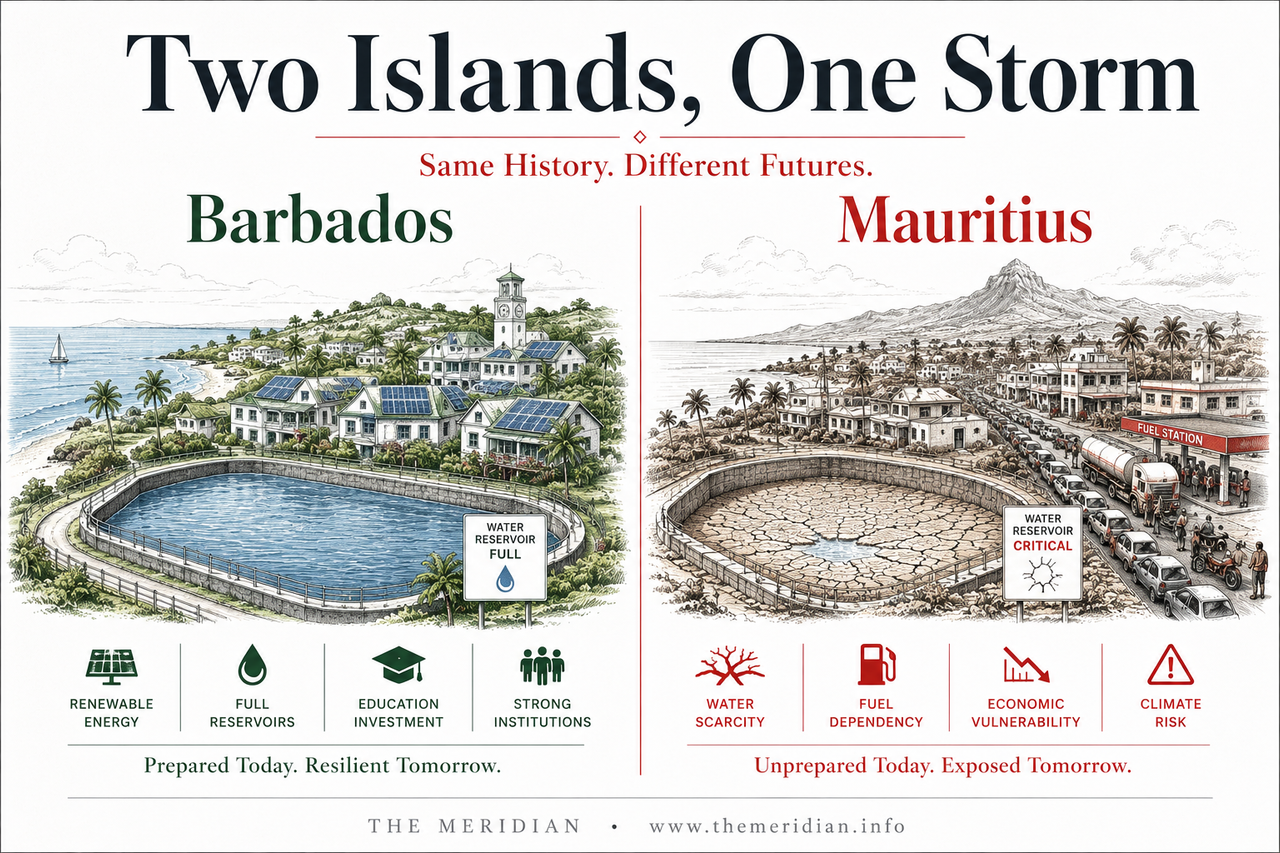
On 14 May 2026, Barbados Prime Minister Mia Mottley secured a US$260 million IMF precautionary standby facility and warned that the Iran war could trigger economic shocks for her island. She had already positioned Barbados to absorb them. A fiscal primary surplus of 4.2 per cent of GDP. Gross reserves of US$1.5 billion. An Atlantic energy supply chain with zero Hormuz exposure. Active food self-sufficiency policy. A fossil-free electricity target. A digital economy strategy. And now, a phone call away from a quarter-billion dollar emergency liquidity line. Mauritius, with twice the population, seven times the colonial inheritance in foreign aid and a government domestic debt approaching Rs500 billion, has a reservoir at 51 per cent capacity, a fuel deficit of Rs3.2 billion and no equivalent precautionary buffer. The Meridian asks why two islands that started in the same place arrived at such different ones.
The year 1627. British settlers arrive on an uninhabited island in the Caribbean and begin establishing one of the most productive sugar economies in the Western Hemisphere. They bring enslaved Africans to work the cane fields. The island becomes the starting point for English colonisation of the Americas. The sugar economy enriches the colonial metropole for three centuries. The island is left, at independence, with the structural legacy of extraction: monoculture dependency, concentrated land ownership, imported food and energy, and a population whose ancestors were never paid for the labour that built the entire productive system. The year 1638. The Dutch arrive on a small island in the Indian Ocean. Sugar follows. Enslaved Africans follow. Indentured Indians follow. The French arrive. Then the British. The same extraction model, the same structural legacy, the same point of departure at independence.
Barbados became independent in 1966. Mauritius became independent in 1968. They are, structurally, the same island: same colonial history, same monoculture legacy, same tourism dependency, same dollar trap, same climate vulnerability and same small island developing state classification. The divergence between them is not structural. It is entirely a matter of institutional choice, political leadership and the quality of governance over the past decade. And that divergence, documented in verified primary source data, is now so wide that it constitutes one of the most instructive natural experiments in small island economic management that the world has available. The Meridian assembles the evidence.
Barbados Mauritius colonial history sugar slavery IMF debt crisis governance comparison
The comparison between Barbados and Mauritius is not a comparison between a rich island and a poor island, or between a well-located island and a poorly-located island, or between an island with natural resources and one without. It is a comparison between two islands with identical structural vulnerabilities that chose, at critical moments in their recent histories, to respond to those vulnerabilities in fundamentally different ways.
Barbados's debt crisis of 2018 was severe. The debt-to-GDP ratio reached approximately 171 per cent. The country entered a structured IMF programme. It undertook a painful debt restructuring that imposed real costs on domestic creditors including the National Insurance Fund, private financial institutions and individual bondholders. Prime Minister Mottley, who came to power in the middle of this crisis with a resounding electoral mandate in 2018, committed Barbados to a home-grown economic recovery programme under the IMF framework rather than to the kind of monetary improvisation that characterises fiscal management in states that prefer to obscure the problem rather than resolve it. By end-2024, the debt-to-GDP ratio had fallen to approximately 103 per cent. The fiscal primary surplus reached 4.2 per cent of GDP in FY2025/26. Gross international reserves stood at US$1.5 billion, equivalent to approximately six months of imports, ample to support the exchange rate peg. The IMF Mission Chief Michael Perks confirmed Barbados enters the proposed precautionary standby arrangement from a position of strengthened macroeconomic credibility.
Mauritius's government domestic debt reached Rs499.9 billion in 2025, up from Rs165 billion in 2014, an increase of over 200 per cent in eleven years, growing at approximately Rs60 billion per year with no published reduction trajectory. The Broad Money Liabilities of the banking system expanded from Rs601.9 billion in 2019 to Rs1,057.7 billion in 2025, a 75.7 per cent increase in six years. During Covid, the Bank of Mauritius created money through a Special Purpose Vehicle to fund the Mauritius Investment Corporation, which provided emergency liquidity to the island's conglomerates. The public bore the inflationary cost of that monetary creation through the rupee's subsequent depreciation. The conglomerates kept the profits of the recovery. The debt grew. The Price Stabilisation Account fell into Rs3.206 billion deficit. The reservoir fell to 51 per cent capacity. No equivalent precautionary IMF facility was ever sought.
Barbados went into crisis, looked at it honestly, restructured, and built a buffer before the next one arrived. Mauritius accumulated the debt, obscured the structural problems, and waited for the next crisis to make them visible. On 14 May 2026, both approaches were on display simultaneously. One island made a phone call to the IMF from a position of strength. The other island sent inspectors to turn off shopping mall LED screens.
Barbados energy supply Atlantic USA Canada Trinidad Hormuz independent Mauritius oil exposure
The Iran war has exposed a structural difference between the two islands that no one had articulated clearly before the crisis made it visible. Barbados imports oil from the United States, Canada and Trinidad and Tobago. Not one of these supply routes passes through the Strait of Hormuz. Not one passes through the Red Sea. Barbados's entire energy supply chain is Atlantic-facing, geographically insulated from the Middle East crisis by the width of an ocean. The Iran war oil premium affects Barbados through global price mechanisms, since Brent crude above $110 per barrel raises the cost of every barrel regardless of origin, but it does not threaten Barbados's oil supply security. If US Gulf Coast refineries are exporting to Barbados at $110 Brent, the supply keeps flowing regardless of what happens at Hormuz.
Mauritius imports 100 per cent of its petroleum requirements. Its primary suppliers are in the Middle East and Asia. The supply routes pass through or adjacent to the Hormuz closure zone. In late March 2026, Mauritius was left with a terrifyingly low 21-day stock of fuel after the disruption of normal supply channels, forcing the government to purchase emergency supplies from Singapore at crisis premiums. The result was two successive 10 per cent diesel price increases in six weeks, a Price Stabilisation Account deficit of Rs3.206 billion, a 15 per cent CEB electricity tariff increase and energy inspectors raiding Tribeca Mall to turn off LED advertising screens. The difference in exposure between the two islands to the same geopolitical event is entirely the result of supply chain geography, a structural feature that Mauritius could not change overnight but which Barbados's Atlantic positioning provides as a natural hedge.
Barbados is additionally pursuing a fossil-free electricity sector as a formal government target, investing in renewable energy as both a climate strategy and an energy security strategy. Every megawatt of solar or wind capacity installed in Barbados is a megawatt that does not need to be imported from a Middle Eastern oil field through a strait controlled by Iran. Mauritius raised electricity tariffs by 15 per cent because the CEB cannot generate power cheaply enough from imported fuel at crisis prices. Barbados's renewable energy investment is the structural answer to precisely that problem. Mauritius has not yet built a comparable answer.
Barbados food self-sufficiency agriculture Agrofest Mottley arable land Mauritius import dependency
Barbados has something Mauritius increasingly does not: a government that treats food security as a national strategic priority rather than an import line on the current account. Prime Minister Mottley attends the Agrofest agricultural exhibition personally on its opening day. The Barbados Agricultural Society, established in 1845 by an act of Parliament, has been organising the national agricultural exhibition for over 150 years. The island is actively working towards self-sufficiency in tropical vegetables and domestic protein production. In 2025, correctional officers at Dodds Prison graduated from an intensive agriculture programme aimed at making the prison 80 per cent food self-sufficient. The strategic plan explicitly targets a reduction in food import dependency through expanded domestic production.
Mauritius imports the vast majority of its food. The Rs211 billion annual goods trade deficit documented by the Bank of Mauritius includes significant food imports. The import dependency extends to staples including rice, flour, cooking oil and protein. When global commodity prices rise, as they have throughout the Iran war period, Mauritius has no domestic production buffer to absorb the shock. The cost is passed directly to the consumer, to the household that is already paying more for diesel, more for electricity and more for everything transported by vehicles running on diesel at Rs71.25 per litre. Barbados's active food self-sufficiency policy does not yet make the island food independent. But it represents a strategic direction that Mauritius, with its own agricultural land and its own remaining capacity for food production, has not chosen to pursue with equivalent institutional commitment.
Barbados technology digital economy 5G BimPay AI knowledge island semiconductor positioning
In January 2026, the Barbadian government announced a strategic partnership with African AI firm Amini and articulated the goal of positioning Barbados as a sovereign tech-forward knowledge island, built on the foundational principles of local compute, local data and local talent. In 2025, Barbados launched its first 5G networks. In March 2026, it launched BimPay, the national instant payment platform developed by the Central Bank. The government launched alpha.gov.bb, a citizen-centric digital services portal. An internet penetration rate near 80 per cent and mobile connections at 120 per cent of the population give Barbados the digital adoption base that advanced technology services require.
The structural positioning argument for Barbados's technology future is more powerful than its current technology reality. The island has a maximum corporate tax rate of 5.5 per cent, not flagged as a tax haven by the European Union. It has English common law, political stability, proximity to the United States and an educated English-speaking workforce. It has an Atlantic energy supply chain that, as renewable energy investment matures, will provide green electricity for the energy-intensive operations that advanced technology industries require. The US CHIPS Act's International Technology Security and Innovation fund is explicitly extending the Americas semiconductor ecosystem through partnerships with Costa Rica and Panama. Barbados is geographically, institutionally and strategically positioned to enter that ecosystem as it extends further into the Caribbean over the coming decade. This is an analytical observation, not a verified current fact. But the preconditions that Barbados is building, namely energy security, digital infrastructure, fiscal credibility, Atlantic supply chains and a favourable tax environment, are the same preconditions that made Costa Rica and Panama attractive to the US technology supply chain extension. Mauritius, by contrast, has invested its primary technology capital in a Chinese Huawei Safe City surveillance system with a government sovereign guarantee. These are not equivalent strategic bets on the same future.
Barbados is building preconditions for a knowledge economy. Mauritius is building surveillance infrastructure for a security state. Both are small islands that needed to decide what kind of future they were building. The technology choices they made reveal the answer.
Barbados climate resilience debt-for-nature swap Mauritius coral bleaching sea level water infrastructure
Both islands face the same climate threat. Ninety per cent of Barbados's hotels are in coastal areas on or near beaches. The UNFCCC estimates Barbados could see losses of US$7.648 billion within the tourism industry by 2050, equivalent to 193 per cent of its 2010 GDP. Mauritius faces the same coral bleaching events, the same sea level rise projections, the same increasing cyclone intensity that is changing the economics of coastal resort operations. The physics of the climate crisis does not discriminate between Caribbean and Indian Ocean islands.
What discriminates between them is the response. Barbados has executed a debt-for-nature swap, converting external debt into climate investment. It is investing close to 3 per cent of GDP in climate resilience without adding to its debt stock. The IMF's Resilience and Sustainability Fund provided financing specifically for Barbados's water infrastructure replacement, with the island's water system, built by the British more than a century ago, now being upgraded with climate finance. Mottley has been the world's most prominent small island voice on climate finance reform, demanding that the international financial architecture respond to the specific vulnerability of small island states with instruments calibrated to their risk profile rather than their debt capacity.
Mauritius's water infrastructure, planned for upgrade over the past 30 years, remains largely unbuilt. The Mare-aux-Vacoas reservoir stands at 51 per cent capacity, falling toward 22 per cent by June. Fifty per cent of the water supply is lost to leaks. The government has imposed fines of up to MUR 50,000 and two years imprisonment for water waste rather than repairing the pipes that cause the waste. The IMF's Resilience and Sustainability Fund exists for exactly the kind of small island water infrastructure investment that Mauritius needs. Mauritius has received approximately $2.3 to $2.5 billion in bilateral and multilateral financing over the past decade. It has not executed a debt-for-nature swap. It has not secured an IMF resilience facility. It has not published a climate adaptation fund. It has built a surveillance system.
small island governance leadership Mottley Mauritius structural failure institutional quality comparison
The difference between Barbados and Mauritius is not a difference of geography, natural resources, colonial history or structural economic position. It is a difference of institutional quality and political leadership. Both islands had the same starting point. Both faced the same structural vulnerabilities. Both received external financing. Both depend on tourism. Both are in the dollar trap. Both face climate risk. The divergence between them is the result of choices made by governments, institutions and political leaders over the past decade.
Barbados chose to face its debt crisis honestly, restructure it transparently and build the fiscal credibility that now allows it to approach the IMF from a position of strength rather than desperation. It chose to invest in renewable energy, food security, digital infrastructure and climate resilience as strategic priorities rather than as optional extras to be funded if and when the current account allows. It chose a leader who attends the national agricultural show personally, who calls the IMF proactively and who has made Barbados the most credible small island voice in global climate finance negotiations.
Mauritius chose to grow its debt without a published reduction trajectory, to suppress fuel prices through a stabilisation account that is now Rs3.2 billion in deficit, to import cheap labour to sustain the margin of conglomerates deploying their profits to Morocco and Zanzibar, to leave the reservoirs planned 30 years ago unbuilt and the water pipes losing 50 per cent of supply unrepaired, and to invest its primary technology capital in a Chinese surveillance system with a sovereign guarantee rather than in a digital economy with a future. These are not the failures of fate. They are the failures of choice. And the comparison with Barbados, a smaller island with fewer resources and the same structural vulnerabilities, makes clear that different choices were available and were not taken.
The lesson of the Barbados-Mauritius comparison is not that small islands are helpless. It is precisely the opposite. Small islands, with the right institutional quality and the right political leadership, can build extraordinary resilience from extraordinarily limited resources. Barbados is the proof. Mauritius is the counter-example. The world has both available for study. The question is whether anyone in Port Louis is reading.
Add comment
Comments