The Sovereignty Economy: What Every Major Power Gets From Mauritius and What Mauritius Gets in Return
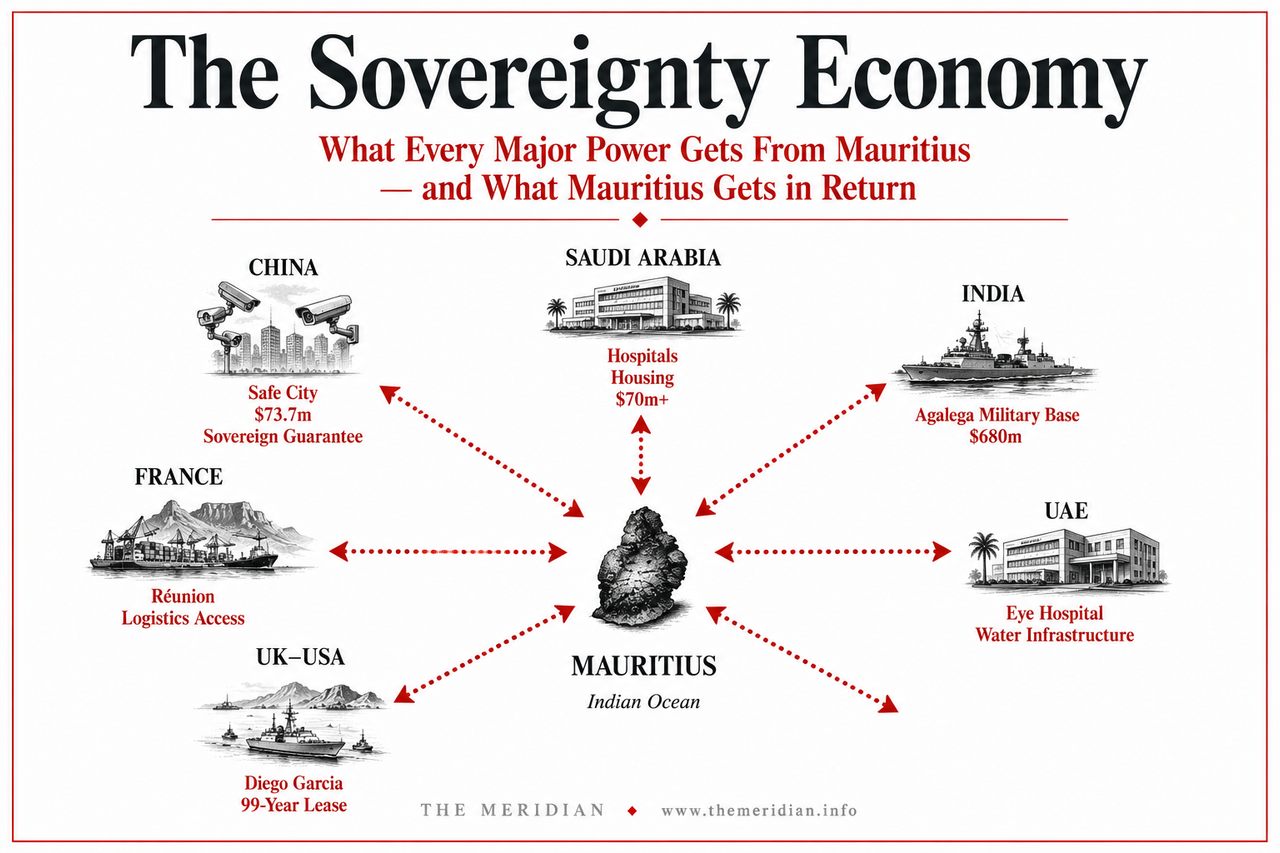
India gets a 3,000-metre military airstrip on Agalega. China gets Huawei Safe City cameras under a sovereign guarantee. The UK-USA keep Diego Garcia under a 99-year lease. France gets Indian Ocean logistics access through Réunion. Saudi Arabia and the UAE get community and institutional influence. In return, Mauritius gets billions in bilateral financing — with no governance conditions, no accountability requirements and no public cost-benefit analysis. In 1980, Mauritius absorbed only 8.3 per cent of EEC conditional development aid. The preference for bilateral over multilateral financing is not an administrative habit. It is a strategic choice with a specific and documented price: sovereignty, traded incrementally, to every major power with an interest in the Indian Ocean. The Meridian maps the exchange.
Mauritius sits in the Indian Ocean like a small island with a very large postcode. Through the waters surrounding it flows approximately 80 per cent of global oil trade, 50 per cent of the world's containerised cargo and 33 per cent of its bulk cargo. Every major power with a navy, a trading relationship with Asia, an interest in Middle Eastern energy or a strategic stake in the Indo-Pacific security architecture has a reason to want a presence in, a relationship with or influence over the island that sits at the centre of this maritime highway. India, China, France, the United Kingdom, the United States, Saudi Arabia and the UAE all have those reasons. And all of them have found, with remarkable consistency, that the most effective way to secure their interest in Mauritius is through the same instrument: bilateral financing, extended without the governance conditions that multilateral institutions impose, in exchange for something that Mauritius never publishes in its budget, never debates in Parliament and never subjects to public cost-benefit analysis. That something is sovereignty. Piece by piece, relationship by relationship, project announcement by project announcement, Mauritius has been selling what a small island in the centre of the world's most important ocean actually has to sell. The Meridian maps what each transaction looks like.
Mauritius bilateral aid preference multilateral conditionality EEC IMF World Bank governance accountability
The exchange table above is not a conspiracy. It is a rational political economy. Every actor in it is making a logical choice given its interests and its alternatives. The question The Meridian is asking is not whether the individual transactions are appropriate. It is why Mauritius has so consistently preferred this architecture of bilateral relationships over the conditional multilateral financing that international development institutions offer — and what that preference has cost over five decades.
The answer was stated plainly in 1980. When the EEC delegation chief Maurice Foley arrived in Port Louis for the Lomé II negotiations, he found that Mauritius had absorbed only 8.3 per cent of the development aid available under Lomé I — the lowest absorption rate of any of 58 ACP nations. He told Finance Minister Sir Veerasamy Ringadoo directly: I want this money, which is yours by right, to be put to work. I do not want theoretical exercises. The contrast with the Comoros, which had absorbed approximately 98 per cent of available EEC aid before the programme even expired, was stark. Mauritius was not failing to absorb the money because it lacked projects. It was absorbing it at 8.3 per cent because the conditions attached to EEC financing required transparent procurement, measurable delivery and accountable governance that the bilateral relationships with India, China, France and the Gulf states did not require.
This is the core insight of the sovereignty economy: conditional financing is financing that constrains how public money is spent and by whom. Bilateral financing attached to strategic access agreements is financing whose accountability runs to a foreign capital rather than to the Mauritian public. The IMF's Extended Fund Facility requires quarterly programme reviews, published fiscal targets and governance reforms. The Saudi Fund for Development requires that the dam be announced, the engineering be contracted, the loan agreement be signed and the project be placed in the pipeline. It does not require that the dam actually be built on schedule, that the cost not quadruple from Rs2.5 billion to Rs9.4 billion over sixteen years, or that the public be able to track what happened to the money during the intervals between announcements. The conditionality gap between these two instruments is the space in which the sovereignty economy operates.
Conditional multilateral aid requires governance that constrains political discretion. Bilateral sovereign access deals require only that the access be granted. For a political class that wishes to maintain discretion over public resource allocation, the choice between the two is not difficult.
India Agalega military base Mauritius $680 million aid package Indian Ocean strategic positioning 2025
India's relationship with Mauritius is the most historically embedded and the most strategically significant of all the bilateral relationships in the sovereignty economy. Approximately 68 per cent of Mauritius's population is of Indian origin, primarily descended from indentured labourers brought from various regions of the subcontinent during the colonial period. India has invested in this relationship through cultural institutions, the Hindi language curriculum in Mauritian schools, the Pravasi Bharatiya Divas diaspora engagement framework and a continuous programme of concessional financing that has produced the Metro Express, the Supreme Court building, the ENT Hospital, the Civil Service College and numerous smaller infrastructure projects.
In September 2025, India agreed to provide approximately $680 million in economic assistance to Mauritius for healthcare, infrastructure and maritime security projects, as New Delhi pushes for greater influence in the Indian Ocean in competition with China. The assistance also includes support for development and surveillance of the marine protected area of the Chagos archipelago, which houses the US-British air base on the island of Diego Garcia. What this financing has produced on Agalega, simultaneously with the economic package, is a 3,000-metre airstrip and deep-sea jetty capable of supporting large military aircraft including the P-8I Poseidon maritime surveillance aircraft and naval warships. Both governments have denied that India is building a permanent military base, labelling it a logistics facility. The infrastructure tells a different story. A 3,000-metre airstrip does not exist for recreational purposes. A deep-sea jetty capable of receiving naval warships is not a civilian harbour. The terminology is diplomatic. The concrete is strategic.
The Agalega arrangement illustrates the sovereignty economy in its most explicit form. Mauritius receives $680 million in economic assistance. India receives a forward operating capability in the southern Indian Ocean from which it can conduct maritime surveillance over shipping lanes carrying 80 per cent of global oil trade, monitor Chinese naval movements and project power southward toward the Mozambique Channel and eastward toward the Strait of Malacca. The transaction is rational for both parties. It is never put to a Mauritian parliamentary vote. It is never subjected to a public cost-benefit analysis that asks whether a 3,000-metre military airstrip on a remote outer island is the most productive use of the diplomatic capital represented by $680 million in Indian financing. It simply happens, announced as infrastructure development and economic cooperation, understood by every informed analyst as the extension of Indian strategic reach into the southern Indian Ocean.
China Huawei Safe City Mauritius sovereign guarantee Export Import Bank Belt Road Indian Ocean surveillance
China's relationship with Mauritius operates through a different but equally revealing mechanism. The Huawei Safe City project — approximately $73.7 million financed by a loan from the Export-Import Bank of China at a 2 per cent interest rate over 20 years, secured by a sovereign guarantee from the Government of Mauritius — installed a comprehensive network of surveillance cameras, facial recognition infrastructure and integrated command and control systems across the island. The project was described publicly as a public safety initiative. Its technical architecture is identical to the Smart City surveillance infrastructure that Huawei has deployed across more than 100 cities globally as part of China's Belt and Road digital infrastructure strategy.
The sovereign guarantee is the most significant element of the transaction from a political economy perspective. It means that if Mauritius defaults on the ExIm Bank loan, the Government of Mauritius — and by implication the Mauritian taxpayer — is personally liable for the repayment. The surveillance infrastructure that was financed by a Chinese state bank, built by a Chinese technology company and now operates on Mauritian territory is secured by a guarantee that makes the Mauritian state the ultimate guarantor of the Chinese state's investment. This is a more binding commitment than any governance condition imposed by the IMF or the World Bank, because it creates a direct financial obligation rather than a policy requirement. And it was negotiated, signed and implemented without a public debate about the terms, the technology standards, the data governance framework or the question of whose intelligence services can access the footage from cameras watching Mauritian streets, ports and public spaces.
Diego Garcia Chagos Mauritius UK USA 99 year lease sovereignty Indian Ocean military base 2025
The Chagos sovereignty arrangement concluded in 2025 is the most publicly documented element of Mauritius's sovereignty economy, and the most instructive about how the model works at its highest level. Britain ceded sovereignty of the Chagos Islands to Mauritius, resolving a decades-long dispute that had been the subject of ICJ advisory opinions and UN General Assembly resolutions. Mauritius achieved a diplomatic objective that successive governments had pursued since independence. The international legal position was vindicated. The sovereignty was transferred.
And yet Diego Garcia remains under a 99-year lease to the United Kingdom and the United States. The most strategically significant military base in the Indian Ocean — from which B-2 bombers can reach any target in Asia, from which the US Navy can project power across the Indo-Pacific, from which maritime patrol aircraft monitor every vessel transiting the central Indian Ocean — remains under American and British operational control for a century. Mauritius received the sovereignty. The UK-USA retained the base. The financial terms of the lease — the compensation payments, the development commitments and the operational arrangements — were not fully published in a form that allows independent verification of whether the price paid for 99 years of Diego Garcia access reflects the strategic value of the facility to the powers that control it. This is the sovereignty economy at its most refined: Mauritius achieves the legal principle while the practical strategic reality remains unchanged, and the financial terms of the arrangement are determined in negotiations between parties with vastly different information and bargaining power.
France UAE Saudi Arabia Mauritius community investment cultural influence bilateral aid communal electorate
France's relationship with Mauritius operates through the softest instruments of the sovereignty economy: cultural investment, Francophone institutional ties, climate financing and logistics access rather than military infrastructure or surveillance technology. The Alliance Française network, the AFD financing programme committing EUR 200 million for water sector resilience, the climate adaptation grants and the technical advisory relationships all maintain France's presence in Mauritius's institutional and cultural life in ways that reinforce the Francophone community's orientation toward Paris as a reference point for governance, culture and bilateral cooperation. France maintains logistics exchange agreements through Réunion that allow French and Indian naval assets to use each other's facilities — connecting the Mauritius relationship to the broader Indo-Pacific security architecture that France is building to sustain its role as an Indian Ocean power.
Saudi Arabia and the UAE operate through a still softer but equally deliberate community investment strategy. The Saudi Fund for Development has financed the Flacq Teaching Hospital, the Cancer Hospital, the Rivière des Anguilles dam and social housing — projects concentrated in sectors that directly affect the daily lives of Mauritius's Muslim community, which constitutes approximately 17 per cent of the electorate. The UAE's financing of the Eye Hospital and the solar rooftop programme extends this community presence into healthcare and energy infrastructure. These are not random project choices. They are calibrated investments in the welfare of a specific communal constituency that gives Saudi Arabia and the UAE diplomatic leverage within the Mauritian political system that no amount of generic bilateral financing would purchase. Each hospital built, each dam funded and each solar panel installed reinforces the relationship between the Gulf states and the Mauritian Muslim community in ways that translate into diplomatic goodwill, Islamic finance relationships and Indian Ocean positioning at a cost per unit of influence that is extraordinarily efficient.
Every external power has identified its communal constituency in Mauritius and invested in it specifically — not in Mauritius as a unified nation but in the communal segment that gives it the most political leverage within the Mauritian system. The financing deepens communal division rather than building national unity. That, too, is a strategic outcome.
Mauritius sovereignty economy price bilateral aid conditionality infrastructure failure accountability deficit
The sovereignty economy has delivered Mauritius a remarkably stable flow of external financing across six decades and across every change of government. The island has never faced the acute balance of payments crisis that has hit Sri Lanka, Pakistan, Zambia and other small states that depend on international capital markets without the bilateral safety net that Mauritius's strategic position provides. No major power wants to see Mauritius fail economically, because a failed Mauritius complicates the strategic access arrangements that each of them has built. India does not want to lose Agalega. China does not want its Safe City investment default. The UK-USA cannot afford instability near Diego Garcia. France cannot manage its Réunion logistics network without a stable Mauritius. The island's financial stability is, in a very real sense, a strategic public good for every power with an access agreement on it. This is the deepest structural protection that the sovereignty economy provides: it makes Mauritius too geopolitically useful to be allowed to fail.
The price of this protection is structural. It is paid not in a single transaction but in the accumulated opportunity cost of a political economy that was never required to develop the institutional quality, the domestic resource mobilisation capacity and the productive infrastructure that self-sufficiency demands. Because the bilateral safety net was always there, the political incentive to build the dam, replace the water pipes, train the specialist doctors and invest in renewable energy was always weaker than the political incentive to announce the project, sign the loan agreement and photograph the ribbon cutting. The financing arrived. The accountability did not. And the Mauritian citizen paid the difference — in a reservoir at 51 per cent capacity, in a dam sixteen years unbuilt, in a debt at 90 per cent of GDP, in a youth unemployment rate of 16.61 per cent and in the slow, incremental, rational departure of the educated young people who were the one asset the sovereignty economy had no bilateral arrangement to retain.
The sovereignty economy will continue as long as Mauritius sits where it sits and the Indian Ocean remains what it is. The strategic geography cannot be changed. The external powers will keep coming with their financing, their access requirements and their community investment strategies. The question for Mauritius is whether it is possible to receive that financing while simultaneously building the domestic institutional quality that would allow it to actually deliver the infrastructure the money is ostensibly provided to construct. Barbados, documented in this edition, demonstrates that small island states can build fiscal credibility, institutional quality and proactive resilience even within the constraints of external financing dependency. The difference is not the financing. It is what the financing is used for and who is held accountable for the result. Mauritius has the financing. It has always had the financing. The accountability is what has been missing. And the sovereignty economy, by design, provides no mechanism to supply it.
Add comment
Comments